
The Buddha never taught ‘there is no self’—he taught: do not cling to what is not your self.
Whenever Buddhism is introduced, people often hear a slogan:
“Everything is impermanent, everything is suffering, everything is non-self.”
It sounds neat. It sounds final. Many even think this is Buddhism.
But here’s the truth: the Buddha never taught this triad as the essence of his path.
A Later Invention
The “three marks” came centuries after the Buddha.
- Early schools shaped them as a debate tool against the Brahmins.
- Mahāyāna took it further, declaring emptiness—no self, no essence anywhere.
- Western scholars adopted it as a convenient summary.
And so, a tool turned into a slogan.
A practice method hardened into a creed.
A symbol of identity replaced the living path of liberation.
The Buddha’s Real Mission
The Buddha did not leave his palace to prove “all is impermanent” or to preach “there is no self.”
He left because he saw aging. He saw sickness. He saw death.
And he asked: Is there a way out?
His answer was not despair. His answer was hope.
He discovered Nibbāna-dhātu—the deathless realm of existence.
Secure. Permanent. Blissful.
That was his message:
“There is a way beyond death.”
Impermanence, suffering, and not-self were tools, not the essence—the heart of the Dhamma is liberation into the deathless.
Tools, Not the Treasure
Impermanence helps us let go.
Suffering shows us craving’s trap.
Not-self reminds us: the five aggregates—form aggregate, feeling aggregate, perception aggregate, volition aggregate, consciousness aggregate—are not the true self.
But none of this means “there is no self.”
The Buddha never denied the self. He only said:
“Do not mistake what is not-self for your self.”
For beyond the aggregates lies a pure consciousness—unconditioned, unbound, realized in the deathless Nibbāna-dhātu.
The Danger of Clinging to the Triad
When Buddhism is reduced to this triad, people hear only negation:
- Outsiders think it is pessimism.
- Practitioners cling to “no-self” as a belief, instead of walking the path.
- The true promise of liberation is hidden under slogans.
But the Buddha’s message was never about denial.
It was always about freedom.
My Way of Teaching
This is why I don’t teach the triad as central.
Instead, I return to the Buddha’s path:
- The Four Noble Truths – suffering can end.
- The Noble Eightfold Path – the living discipline of Sīla, Samādhi, Pañña.
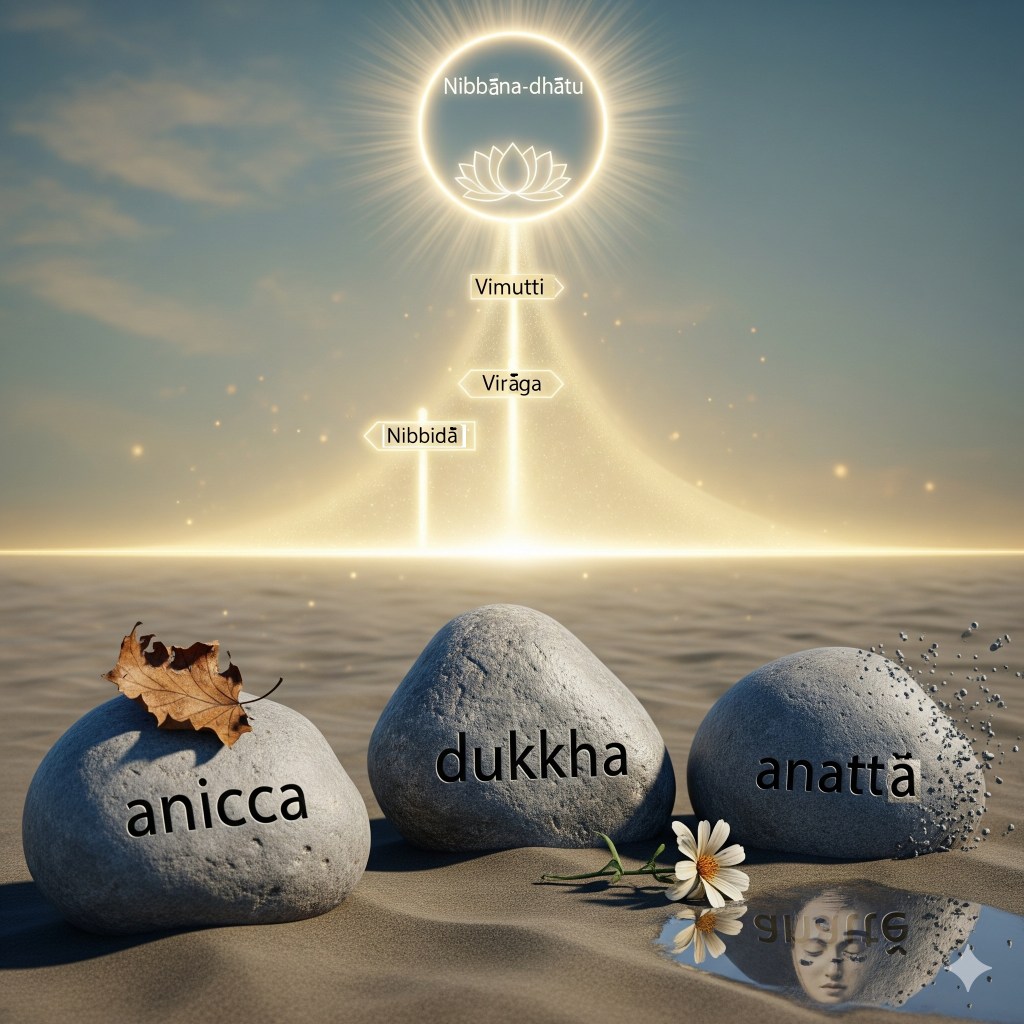
- The process of liberation – disenchantment → dispassion→ release → Nibbāna.
- The goal – the deathless Nibbāna-dhātu.
This is not negation. This is the greatest invitation ever given:
to walk beyond aging and death.
Beyond impermanence lies permanence, beyond suffering lies peace, beyond the false self lies true liberation.
Conclusion
So yes—impermanence, suffering, and not-self are useful. But they are not the essence.
The essence is this:
✨ There is a way out.
✨ There is a deathless.
✨ There is liberation.
Don’t stop at slogans.
Walk the path the Buddha walked:
Disenchantment from the worldly→ Fading of worldly craving and attachment → liberation of the citta from the world→ enter into the deathless.
Further reading:
1. Introduction: The Problem with the Triad
When people today encounter Buddhism—whether in a university course, a meditation workshop, or a popular book—they are almost immediately introduced to a neat summary: “The Buddha taught that all things are impermanent, all things are suffering, and all things are non-self.” This triad of anicca, dukkha, and anattā is repeated so often that many assume it is the very heart of the Dhamma. Teachers present it as the hallmark of Buddhism, a single formula that distinguishes the Tathāgata’s teaching from all others. In the modern imagination, to be Buddhist is to believe in impermanence, suffering, and non-self.
But this neat formula is misleading. It does not reflect how the Buddha himself taught, nor does it capture the lived heart of his disciples’ practice. Instead, it represents a later systematization—an attempt by Buddhist schools, centuries after the Buddha’s passing, to define the Dhamma in simple terms that set it apart from rival traditions. Over time, this systematization hardened into orthodoxy. It became a badge of identity, a weapon in debate, and eventually, the slogan by which Buddhism was introduced to the world.
The problem is not that impermanence, suffering, and not-self are absent from the Buddha’s teaching. Clearly, they are present. But the way they are now packaged together, and the weight placed upon them as “the essence,” distorts the Tathāgata’s true intent. The Buddha’s mission was not to deliver a philosophical triad. His mission was to solve the riddle of aging and death, to reveal the way beyond bondage to the conditioned world, and to open the path to the deathless Nibbāna-dhātu.
This distortion has profound consequences. By emphasizing the triad as Buddhism’s essence, modern interpreters risk turning the Dhamma into a philosophy of denial and negation. “All is impermanent, all is suffering, all is without self”—taken as a creed, this sounds pessimistic, life-denying, and even nihilistic. Many who encounter Buddhism through this formula walk away with the impression that the Buddha taught nothing but despair. They miss entirely the positive vision of liberation, peace, and deathless bliss that animated his quest.
This essay is written, therefore, as a corrective. It is not an attack on impermanence, suffering, or not-self as concepts. Rather, it is an attempt to restore perspective. The Buddha did not leave us with a formula; he left us with a path. He did not say “everything is non-self” as a creed; he said “do not identify your self with what is not truly self” as a method of release. He did not stop at impermanence and suffering; he pointed to a reality beyond them—the deathless Nibbāna-dhātu.
2. The Historical Emergence of the Triad
In the earliest strata of texts—the Pāli Nikāyas and Chinese Āgamas—we find anicca, dukkha, and anattā taught, but not yet crystallized into a doctrinal triad. Each appears contextually: impermanence as a reflection on change, suffering as the fruit of craving, and not-self as a method to loosen identification. Only occasionally are all three mentioned together, and even then, as part of a meditation instruction rather than a doctrinal summary.
The Dhammapada illustrates the imbalance. It contains a full chapter on Atta (“Self”), praising self-mastery and self-reliance (verses 157–166), but only one verse on anattā (verse 279). If denial of self were central, we would expect the reverse emphasis.
The Theragāthā and Therīgāthā, voices of the Buddha’s earliest disciples, confirm this. They sang of impermanence, disenchantment (nibbidā), fading of craving (virāga), release (vimutti), and the deathless (amatadhamma). Explicit mentions of anattā are rare. Their realization was freedom, not “no-self.”
The Abhidhamma, developed centuries later, began to codify the triad systematically, presenting it as the three universal characteristics (tilakkhaṇa). This codification gave Buddhists a memorable identity marker, especially in contrast to Brahmanical schools that emphasized ātman. From then on, the triad was repeated as a hallmark of Buddhism—more a doctrinal badge than a reflection of the Buddha’s lived teaching.
3. How “Non-Self” Was Re-Interpreted
Originally, anattā was pragmatic: the five aggregates (pañcakkhandhā)—form, feeling, perception, volition, and the consciousness aggregate—are not self.
- The form aggregate (rūpa-khandha) is not self.
- The feeling aggregate (vedanā-khandha) is not self.
- The perception aggregate (saññā-khandha) is not self.
- The volitional aggregate (saṅkhāra-khandha) is not self.
- The consciousness aggregate (viññāṇa-khandha) is not self.
These are impermanent, conditioned, and bound to aging and death. The Buddha’s point was not denial of self, but dis-identification: do not mistake these aggregates for your true self.
The consciousness aggregate in particular is not self because it is conditioned by sensory contact and tied to the world. But this does not mean that consciousness in every sense is not self. Beyond the aggregates lies pure, unaggregated consciousness—the true self—which is unconditioned, unbound, and realized in Nibbāna-dhātu.
Later Buddhists, however, hardened anattā into a doctrine: “there is no self.” What had been a method of release was turned into a metaphysical denial. In disputes with Brahmins who proclaimed an eternal ātman, it was easier to say “Buddhists deny self” than to explain the subtle teaching. Thus, nuance was lost.
Mahāyāna compounded this misinterpretation. They expanded anattā into śūnyatā (emptiness), teaching not only no self, but no essence in any phenomenon. The result was a double void: no soul, no substance. This stands in contradiction to the Buddha’s original intent. He never denied the self; he warned against identifying the self with aggregates.
4. Why the Triad Became a Hallmark
The triad gained prominence because it served as a convenient identity marker. It was short, memorable, and distinct from Brahmanical ātman teaching. Abhidhamma systematization spread it widely.
Mahāyāna used it polemically, both acknowledging and critiquing it. They claimed early Buddhism clung to the triad, while Mahāyāna revealed a higher truth of emptiness. This made the triad not only a boundary with Brahmanical schools but also a point of internal contestation.
Western scholars reinforced the trend in the 19th–20th centuries, seizing upon the triad as an easy way to summarize Buddhism for Western audiences. Since then, textbooks and meditation teachers alike have repeated it as “the essence.”
But this simplification came at a cost. Instead of being known as the path to the deathless, Buddhism became known as the religion of impermanence and no-self.
5. The Buddha’s Actual Emphasis
The Buddha’s quest was not abstract speculation but the search for escape from aging and death. His message was always positive: Nibbāna as the amata-dhātu (deathless element). It is described as unconditioned, permanent, blissful, and secure.
The path unfolds as a process: nibbidā → virāga → vimutti → Nibbāna-dhātu.
In this framework, the Buddha taught that the five aggregates are not self. Even the consciousness aggregate is not self, because it is bound to sensory contact. But this does not mean there is no self. The true self is pure, unaggregated consciousness, realized when the aggregates are released.
Thus, the Buddha’s teaching of anattā was never nihilism. It was a method of disentanglement: do not cling to what is not self, and the true self will be freed into the deathless.
This stands in contrast to both the scholastic triad (which stops at negation) and Mahāyāna emptiness (which denies substance altogether). The Tathāgata’s emphasis was liberation into the deathless, not voidness.
6. The Dangers of Overemphasizing the Triad
When impermanence, suffering, and non-self are mistaken for the heart of Buddhism, seven dangers arise:
- Philosophical nihilism – If there is no self, who is liberated? The path collapses.
- Misrepresentation – Outsiders think Buddhism teaches “life is suffering” or “there is no soul.”
- Obscuring the positive path – Ethics, meditation, wisdom, and peace are overshadowed.
- Sectarianism – The triad became a badge of identity, not a guide to freedom.
- Modern confusion – Students cling to “no-self” as a belief, mistaking concept for liberation.
- Psychological pessimism – Negation without positive vision leads to despair.
- Distortion of liberation – The tools are mistaken for the treasure.
These dangers all arise when the triad is overemphasized. None arise when it is seen in its proper place: as helpful reflections, not the essence of the Dhamma.
7. My Approach: Beyond the Triad
This is why I do not teach the triad as central. I do not deny its usefulness, but I refuse to mistake it for the heart.
Instead, I emphasize:
- The Four Noble Truths – practical and liberative, not abstract negation.
- The Noble Eightfold Path – integrating ethics, concentration, and wisdom.
- The progression of liberation – nibbidā → virāga → vimutti → Nibbāna-dhātu.
- Nibbāna-dhātu as the goal – the unconditioned, deathless, permanent refuge.
When I teach anattā, I explain that the five aggregates—including the consciousness aggregate—are not self. But this does not mean there is no self. The true self is a kind of pure, unaggregated consciousness, beyond sensory contact, realized when craving ceases.
This way of teaching restores the liberative meaning of anattā. It is not a denial of self but a release of the self from what is not truly self.
8. Conclusion: Returning to the Buddha’s Heart
The triad of impermanence, suffering, and non-self has value as a reflection. But it is not the Buddha’s heart. To cling to it as central is to cling to a later simplification. To teach it as “no-self” or “emptiness” is to contradict the Tathāgata himself.
The Buddha’s true message is liberation. He did not deny the self—he freed it. He did not preach voidness—he pointed to the deathless. His living path was: disenchantment, fading of craving, liberation, realization of Nibbāna-dhātu.
This is the Dhamma that inspired the early disciples, who sang of peace and the deathless, not of “realizing no-self.” This is the Dhamma that can inspire today as well, if we return to the Buddha’s heart.
Let us not settle for slogans. Let us walk the path he walked, from nibbidā to Nibbāna. Beyond impermanence lies permanence. Beyond suffering lies peace. Beyond the aggregates lies the true self, freed into the deathless.
The triad of impermanence, suffering, and non-self is a later slogan; the Buddha’s true message is freedom from aging and death.

 Gautama Dhamma
Leave a reply to 为什么我不教授「无常、苦、无我」三法印 – Gautama Dhamma Cancel reply