
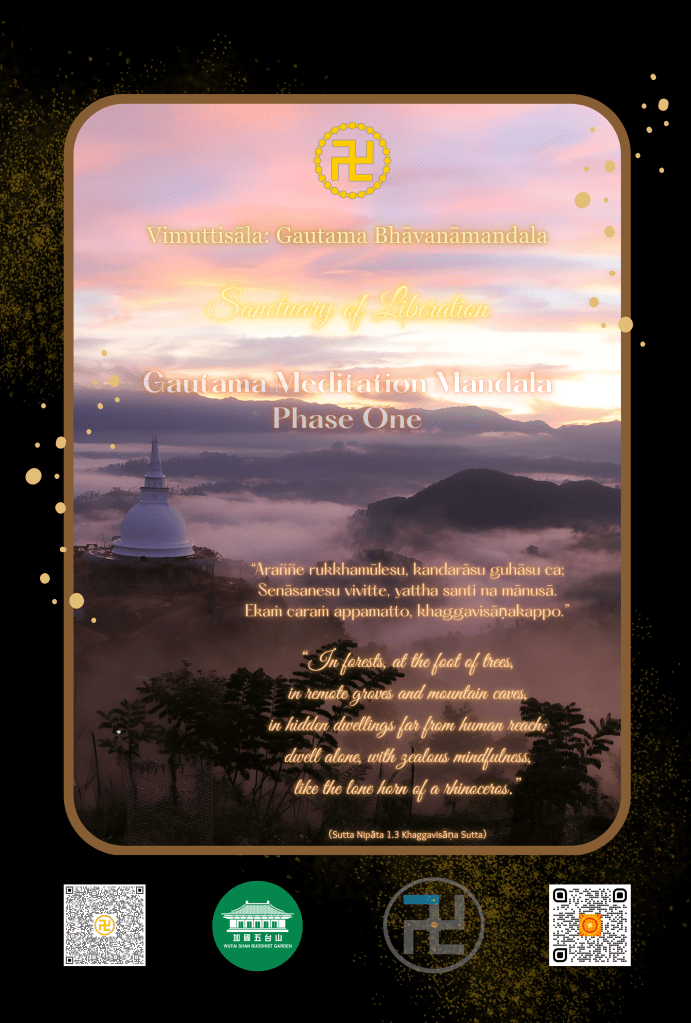
Gautama Meditation Mandala Phase One Draft
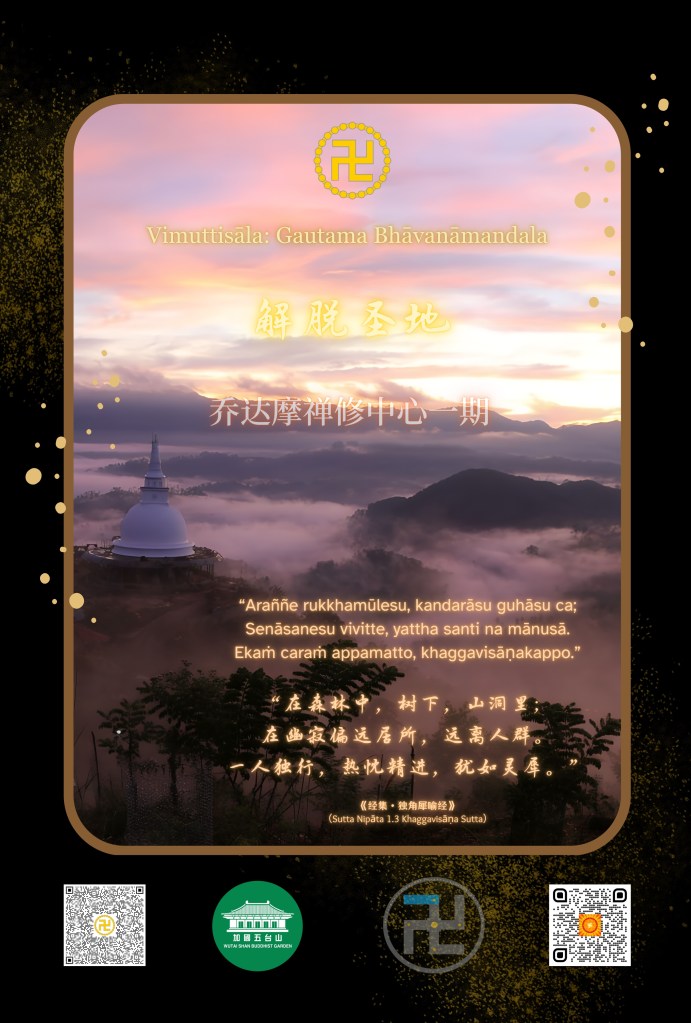
解脫聖地:喬達摩禪修中心一期草案
“Araññe rukkhamūlesu, kandarāsu guhāsu ca; Senāsanesu vivitte, yattha santi na mānusā. Ekaṁ caraṁ appamatto, khaggavisāṇakappo.”
《经集·独角犀喻经》Sutta Nipāta 1.3 Khaggavisāṇa Sutta
“In forests, at the foot of trees,
in remote groves and mountain caves,
in hidden dwellings far from human reach.
dwell alone, with zealous mindfulness,
like the lone horn of a rhinoceros.”
在森林中,树下,山洞里;
在幽寂偏远居所,远离人群。
一人独居,热忱精进,犹如灵犀。
Vision 愿景
We are establishing a meditation mandala in a secluded and protected area of the eastern and southern section of the Wutai Shan Buddhist Garden. This sanctuary will be dedicated to sincere practice and not open to tourists. It is operated under the Buddhist College of Canada as a religious training institution. Phase One of this project focuses on the transmission and realization of the ancient path of liberation as taught by Gautama Buddha.
This center will serve as a place where dedicated practitioners can enter a transformative journey under experienced guidance—progressing from the state of an ordinary person (puthujjana) to that of a noble disciple (ariya) through the direct realization of nibbidā (worldly disenchantment), virāga (fading of worldly passion), and vimutti (liberation from the world).
我們正在五台山佛教園東南側一處隱密而受保護的區域建立一座禪修中心。這是一片專為閉關禪修而保留的清淨道場,不對遊客開放。第一階段的建設將專注於教授與實踐喬達摩佛陀所傳授的古老解脫之道。
此道場將成為真誠行者在具經驗導師的指導下,踏上轉化之旅之處——從凡夫 (puthujjana) 的狀態,依次證得出離世間 (nibbidā)、離世間欲 (virāga),直至從世界解脫 (vimutti),成為佛陀的聖弟子 (ariya)。
Support and Meditation Kutis 護持與禪修寮房
Following the time-honored tradition in Theravāda Buddhist countries, the center welcomes donations to support the construction of meditation kutis (cabins). These kutis remain the property of the non-profit institution. Donors may be offered the opportunity to practice in a supported kuti, subject to institutional approval.
This ensures that contributions are offerings to the Dhamma, not private property, and that the facilities remain dedicated to the collective good of the Sangha and the retreat community.
依照南傳佛教長久以來的傳統,本中心將接受捐助興建禪修寮房 (kuti)。所有寮房均屬於非營利機構所有。捐助者或可獲邀在其所護持的寮房中修行,須經機構批准。
這確保了供養乃是法的布施,而非私人產權,並且所有設施皆專注於服務僧團與禪修社群的共同利益。
Institutional Training Programs 制度化培訓課程
The meditation mandala will operate under the Buddhist College of Canada (BCC) as part of its Liberation Path curriculum. All long-term retreatants are considered students enrolled in institutional religious/educational programs, not general residents. Enrollment may last for several years or longer, consistent with monastic or seminary training traditions.
Housing for monks, nuns, and enrolled students will be provided as accessory institutional accommodation. Occupancy is conditional upon participation in recognized training programs, adherence to discipline, and institutional approval. No private ownership, tenancy rights, or subdivision of property will be created.
禪修中心將由加拿大佛學院 (BCC) 統籌,並納入課程體系。所有長期閉關行者皆為正式學員,屬於教育宗教機構的培訓計畫,而非一般住宅住戶。修學期限可長達數年,甚至更久,類似於神學院或佛教僧院的長期訓練。 僧眾與學員的住宿被視為附屬於宗教教育的住宿設施。入住條件為參與佛學院認可課程、遵守持戒規範、並獲機構批准。此住宿不構成任何私人產權、租住權或土地分割。
Key Principles 核心原則
- Institutional, not residential: The project is a religious and educational institution, not a housing development.
- Program-based accommodation: All lodging is tied to Buddhist College of Canada programs and retreats.
- Clarity of ownership: All kutis and facilities remain under institutional ownership. Donations are offerings, not property purchases.
- Community scale: A phased monastic / retreat community (initially ~40, expanding up to 160 monks, nuns, and enrolled students), comparable to a seminary or monastery campus, will form the living base.
- 宗教教育用途,而非住宅發展:本計畫為宗教與教育機構,而非住宅社區。
- 課程為基礎:所有住宿均隸屬於加拿大佛學院的課程與禪修活動。
- 產權明確:所有寮房與設施皆屬於機構,捐助乃是供養,而非購買。
- 社群規模適中:以階段性發展的常住社群(初期約 40 人,未來最多 160 名僧眾與學員),規模相當於修道院或神學院校園。

Fundraising: Supporting the Foundation of a Noble Practice Mandala
募資:共建聖道修行道場
We now invite sincere practitioners and benefactors to co-create this Sanctuary of Liberation by sponsoring its development in this first phase.
Contributions may take the form of:
- One-time Donation per Kuti (Meditation Cabin): CAD $X0,000 (to support construction of a practice facility).
- Monthly Contribution: CAD $X (to support food, utilities, and operational costs).
All kutis and facilities remain under the ownership of the non-profit institution. Sponsors may be offered the opportunity to practice in the kuti they supported, subject to institutional approval under program terms. Participation is always through enrollment in the Buddhist College of Canada’s programs, under the guidance of experienced teachers.
This model ensures that every contribution is an offering to the Dhamma, supporting both the individual practitioner and the collective flourishing of the Sangha and retreat community.
我們誠摯邀請有志長期閉關解脫道修行之士與功德主,共同護持此聖地的第一期建設。
資助方式包括:
- 每單位一次性捐款:加幣 $X0,000(用於建設一間禪修寮房或等同設施);
- 每月生活護持費:加幣 $X(用於水電、食宿與日常運營)。
所有寮房與設施皆屬於非營利機構所有。功德主或可獲邀在所護持之寮房中修行,須經機構批准。所有入住均需透過加拿大佛學院課程之正式註冊,並在資深南傳禪師的指導下修行。
此制度確保每一份供養都是法的布施,不僅助益個人修行,更護持僧團與禪修社群的整體興盛。
Frequently Asked Questions 常見問答 FAQ
Q: What is the Theravāda liberation path, and why should I practice it? 什麼是南傳解脫道?為何我應該修行?
A: It is the ancient path rediscovered by Gautama Buddha to lead beings beyond the cycles of birth, aging and death, the involuntary state of saṃsāric existence within this world. This path transforms the mind from ordinary defilements to noble realization. It is not faith-based or speculative, but a direct, verifiable way of disengaging from all mental fabrications, leading to true freedom and liberation. Practicing this path is the most direct way to liberate yourself from the cycle of saṃsāra.
這是乔达摩佛所重新發現的古老法道,旨在引導眾生脫離在此世界不断的、不受自己意志支配的生死輪迴。此道不依賴信仰或理論,而是透過實修直接驗證,去除苦之根源,實現真正的自由。修此正道,是脫離生死輪迴(saṃsāra)的最直接之路。
Liberation in the teachings of Gautama Buddha is the ultimate freedom from suffering and the cycle of rebirth known as saṃsāra. It is achieved through the complete eradication of ignorance and all forms of worldly attachment and aversion. This process is described through three critical stages:
根据乔达摩佛的教义,从此世间解脱是彻底摆脱痛苦和轮回(saṃsāra)的终极自由。它通过彻底根除无明以及所有形式的对世界的执著和厌离来实现。这个过程通过三个关键阶段来描述:
- Disenchantment from the World 对世间的厌离 (Nibbidā)
This is the initial stage where one begins to understand the true nature of the world as impermanent (anicca), unsatisfactory (dukkha), and non-self (anattā). As one sees clearly the transient nature of the five aggregates—form, feeling, perception, mental formations, and consciousness—disenchantment arises, allowing one to step back from worldly entanglements. 这是初始阶段,个人开始理解世间的真实本质是无常的 (anicca)、不圓满的 (dukkha) 和非我 (anattā)。当一个人清楚地看到五蕴——色、受、想、行、识——的无常本质时,厌离心便会生起,使人能够摆脱世間的缠繞。
- Dispassion from Worldly Defilements 对世间烦恼的离欲 (Virāga)
With disenchantment, there follows a natural cooling down or fading away of worldly attachment (rāga), all negative emotions including fear and anger, i.e. aversion (dosa), and ignorance for not knowing the liberation from the world and the existence of Nibbāna-dhātu(moha). The mind then becomes purified, and dispassion deepens as one lets go of clinging to the world and its fleeting pleasures. 伴随着厌离,对世间的贪爱执著 (rāga)、内心包括恐惧、愤怒在内的负面情绪之嗔恨 (dosa) 和不知道从世间解脱以及涅槃界存在之無知 (moha) ,这三个轮回之因会自然冷却或消退。心变得纯净,随着一个人放下对世间及其短暂享乐的执著,离欲之心会加深。
- Liberation from the World 从世间解脱 (Vimutti)
When the defilements are completely abandoned, liberation or vimutti is realized. This is not annihilation but the release of the citta (the luminous, knowing essence) from all realms of saṃsāra. It is the cessation of worldly clinging and the full escape from rebirth into the world, culminating in the attainment of Nibbāna—the deathless realm beyond this universe. 当心的染污完全被舍弃时,解脱(vimutti)便得以实现。这不是消灭,而是心(citta,光明、了知的本质)不在受到世界的束缚而有能力从所有轮回领域中解脱出来。它是世间执著的止息,以及彻底摆脱在世间中的再生,最终可以达到涅槃界——超越此宇宙的不死之界。
In the Ādittapariyāya Sutta (SN 35.28), also known as the “Fire Sermon,” Gautama Buddha illustrates this process, concluding with the liberation of the minds of the thousand bhikkhus: “And while this discourse was being spoken, the minds (citta) of the thousand bhikkhus were liberated from the taints by nonclinging (from the five aggregates).”
在《火经》(Ādittapariyāya Sutta, SN 35.28) 中,乔达摩佛陀阐述了这一过程,以一千名比丘心灵的解脱作结:“当此经文宣说时,一千名比丘的心(citta)通过不执著(于五蕴世间)而从诸烦恼中解脱。”
Liberation is not an improvement within the world, but the complete ending of saṃsāra in all worlds. It is the purified citta’s transcendence from this universe, entering the Nibbāna-dhātu, a realm characterized by permanence and freedom from suffering. To know more about this topic, please read Our Practice.
解脱不是世间内的改善,而是所有世间內轮回的彻底终结。它是纯净的心超越此宇宙,进入涅槃界(Nibbāna-dhātu),一个以永恒快樂和免于老死痛苦为特征的彼岸之界。更多关于此内容,可阅读我们的修行。
Q: Why is it called “Sanctuary of Liberation”?為什麼稱為「解脫聖地」?
A: The purpose of acquiring this land is to provide a place where people can temporarily leave behind their family and social life, and enter into a life of simplicity and solitude in a forest setting. Here, one follows the Liberation Path of Gautama Buddha. This teaching is not primarily aimed at helping people function better in the worldly sense—though such improvement may naturally occur as a side effect. Its main purpose is to prepare the mind to become independent, strong, and ready to be released from the world and from the saṃsāra state of existence.
在此用地建設的用意,是為了提供一處環境,使人們能暫時離開家庭與社交生活,進入森林中簡樸與寂靜的生活方式,在此依循喬達摩佛陀的解脫之道修行。這項教導的主要目的,不是為了幫助人們在世間生活中更為成功——雖然這往往會作為副效應而自然發生——而是為了鍛鍊心志,使其獨立、堅強,並準備好從世間與輪迴(生死流轉)的存在狀態中解脫出來。
Meditation retreatants of this meditation mandala are required to observe the Eight Precepts or more. One of the core precepts is Brahmacariya, meaning complete celibacy (no sexual conduct). Only by giving up sexual activity can the mind transcend the sensual realm (kāma-loka). Because it is a place without sexual activity, it is considered brahmaical—pure, sacred, and wholly dedicated to the path toward liberation.
住於此禪修中心的闭关修行者,必須至少持守八戒,其中一項核心戒律即是梵行戒(Brahmacariya),意為完全離欲(持不淫戒)。唯有捨離性行為,心才能超越欲界(kāma-loka)。由於這裡是無性之地,因此被視為梵性清淨——純潔、神聖,並完全奉獻於通往解脫的修行之道。
Q: Do I have to become a monk or nun to practise this liberation path? 我是否必須出家才能修行此解脫之道?
A: Liberation is not merely a belief, but a direct action that leads the mind out of the world. To walk this path, the practitioner must withdraw their mind from worldly involvement—not just mentally, but through every aspect of daily life.
解脫不是一種信仰,而是一種令心出離於世間的實際行動。要真正踏上這條解脫之道,行者必須將自己的心從世間法中收攝——不僅是在思想上,更是在日常行為的每一面上。
This withdrawal is embodied in the practice of Kāyagatāsati — mindfulness directed to the body. When the mind turns inward, disengaging from external sense contact, one’s actions naturally shift from worldly interactions to meditative stillness grounded in bodily awareness.
這種收攝,體現於身至念(Kāyagatāsati)的修行之中——將覺知導向身體,讓心從六根門頭的外緣抽離,安住於身。當心不再追逐外境,行為也自然不再流轉於世俗互動,而是與身體同住,止於靜定。
This path of liberation is not a part-time endeavor; it requires a full-time lifestyle commitment. From this perspective, the life of one devoted to this practice closely resembles the lifestyle of a monk or nun. The main distinction lies in the formal renunciation ceremony — the public act of entering the monastic order.
修行解脫道,是一份全職的承諾,而非可兼顧於世俗職責的副業。因此,若從生活形態來看,一位全心致力於解脫修行的居士,其實與出家人的生活十分相近。兩者的主要區別,只是在於是否正式經歷了出家的儀式——即公開聲明離俗、進入僧團的那一刻。
Therefore, while it is possible for lay practitioners to walk this path with sincerity, the monastic lifestyle is the most fitting and supportive form for complete dedication to the liberation path as taught by Gautama Buddha.
因此,雖然在家人也能以誠心修此解脫之道,但就修行的助益與護持而言,出家生活確實最為相應與適合。
Q: Do you accept Bhikkhunī ordination? 你們是否支持比丘尼受戒?
A: Yes. We regard the monastic lifestyle as the most suitable and supportive form for complete dedication to the liberation path as taught by Gautama Buddha. Therefore, we wholeheartedly support the revival and continuation of Bhikkhunī ordination within the Theravāda tradition.
我們認為,出家生活是最適合並最有助於全心奉行佛陀解脫之道的修行形式。因此,我們堅定支持南傳佛教中比丘尼受戒的復興與延續。
It is our aspiration to conduct both Bhikkhu and Bhikkhunī ordinations at Wutai Shan Buddhist Garden soon in the near future, once our Sīmā Hall (ordination boundary) is completed.
我們計劃在不久的將來,於加拿大五台山佛教園中舉辦比丘與比丘尼的正式受戒儀式,條件是比丘戒壇(Sīmā Hall)建設完成後。
If you wish to support this meritorious endeavor, you are welcome to donate to our Sīmā Hall construction project, which will serve as a sacred foundation for the future Sangha.
若您願意護持此項具大功德的事業,歡迎您捐助我們的比丘戒壇建設基金,此戒壇將成為未來僧團的清淨根基。
Q: I come from a different Buddhist tradition and want to focus only on jhāna or psychic power—can I join? 我來自不同佛教傳承,只想修定與神通,可以參加嗎?
A: Jhāna and psychic powers (iddhi) are important components of this ancient path, but not the final goal. If you make a long-term donation and clearly express this focus, you may train under a teacher’s guidance. However, the success of such training depends on various factors and is not guaranteed. The teacher will assess your progress and provide appropriate instructions. 定(jhāna)與神通(iddhi)雖非最終目標,但確為本修道之重要一環。若您做出長期捐贈並明確表示此意圖,可在禪師指導下修學。然而,成功與否取決於多重因緣,不保證成果,教師會根據您的狀況給予適當指導。
Q: If I donate for a kuti but later cannot join due to personal reasons, what happens? 若我已捐款,但日後因故無法前來修行,怎麼辦?
A: You may request the institution to reassign the practice privilege associated with your donation to another practitioner.
在此情況下,您可請求機構將與您捐助相關的修行機會重新分配給另一位修行者。
Q: I am a Buddhist monk (nun). Can I join your mandala to practice? 我是一位佛教出家人,可以參加此禪修中心嗎?
A: Both monastics and lay practitioners are welcome. All participants are expected to contribute to program costs through donations or sponsorship. If a monk or nun does not own property or resources, they will need to be sponsored by a donor. We are also planning a Support Fund for Bhikkhus and Bhikkhunīs in need—please stay updated on its development.
我們歡迎一切僧俗四眾參與修行。所有參與者均應透過供養或贊助來分擔課程與運營費用。若出家人無資產捐助,可尋找護法贊助其修行。我們也規劃設立僧团資助基金,協助清貧比丘與比丘尼,請關注未來公告。
Q: I am an investor and would like to support the project financially in exchange for return. Do you accept investments? 我是一位投資者,想以商業方式資助此中心以換取回報,你們接受嗎?
A: We do not accept business investments. The center is a non-profit facility dedicated solely to the practice of the Buddha’s path, not a commercial enterprise. If you wish to support this meritorious project, you may do so by donating as a Dhamma offering, helping others attain peace and liberation.
本中心不接受任何形式的商業投資。我們是一個非營利修行場所,唯一目的是分享佛陀的法,幫助眾生解脫生死。若您願意助成此善業,歡迎以護法捐款方式共植福田。

Mandala Highlights禪修中心特色亮點
- Located in the most serene and protected zone of Wutai Shan Buddhist Garden, away from all tourist traffic; 道場選址五台山佛教園區最清幽安靜區域,完全隔離遊客干擾;
- Guided by experienced Theravāda meditation teachers; 由具多年實修經驗的南傳禪修導師親自指導;
- Long-term training structure with progressive meditation modules, including samatha, vipassanā, psychic development, and insight knowledge; 建立系統性、漸進式修行模塊:止禪、觀禪、神通訓練與智慧通達;
- Small and dedicated meditation retreatants community committed to authentic liberation practice; 建立一個精進修道、真誠清淨的小型常住闭关修行社群。
Be a Guardian of the Dhamma 為法護航,廣植福田
By supporting this center, you are planting the seeds of awakening—for yourself and for others. Your donation enables future generations to access the original path of liberation, undistorted, undiluted, and profoundly transformative.
您的發心捐助,不僅為自己,也為未來世代種下覺悟的種子。讓佛陀教导之解脫道延續不斷,純正、無雜、具真實轉化力量——此即大福德、大功德。
Registratrion Form 登记:

 Gautama Dhamma