
A Response to Citrini and Alap Shah’s THE 2028 GLOBAL INTELLIGENCE CRISIS (2028 GIC)
III. Background Part 2 — Policy Countermeasures: Necessary but Insufficient
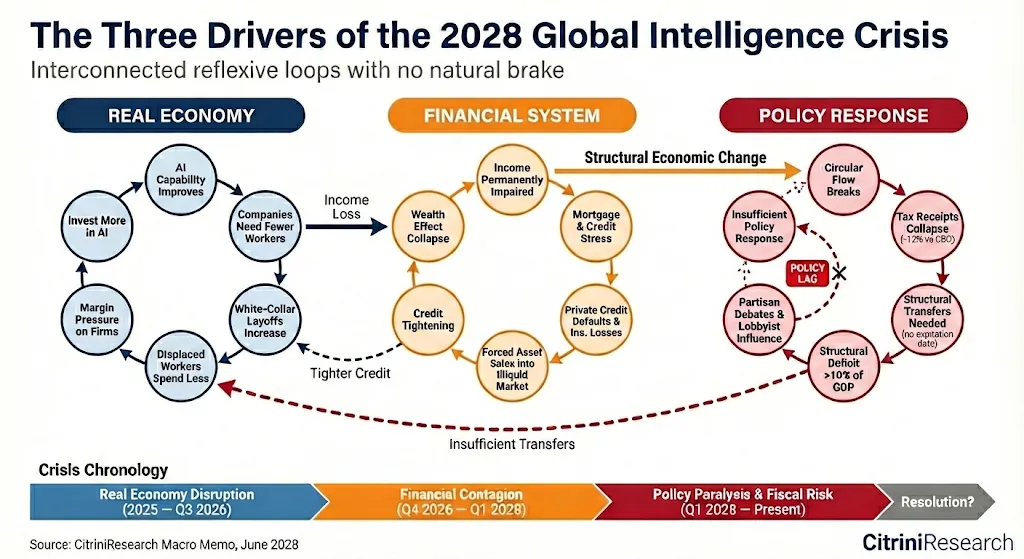
The 2028 Global Intelligence Crisis presents itself not as prophecy but as a “pre-mortem” — an attempt to imagine how a preventable crisis might unfold if societies fail to install effective brakes on the intelligence displacement spiral. By the later stages of the scenario, policymakers recognize the danger and begin deploying increasingly ambitious countermeasures. These responses share a common objective: restoring the broken circulation between technological productivity and human livelihood.
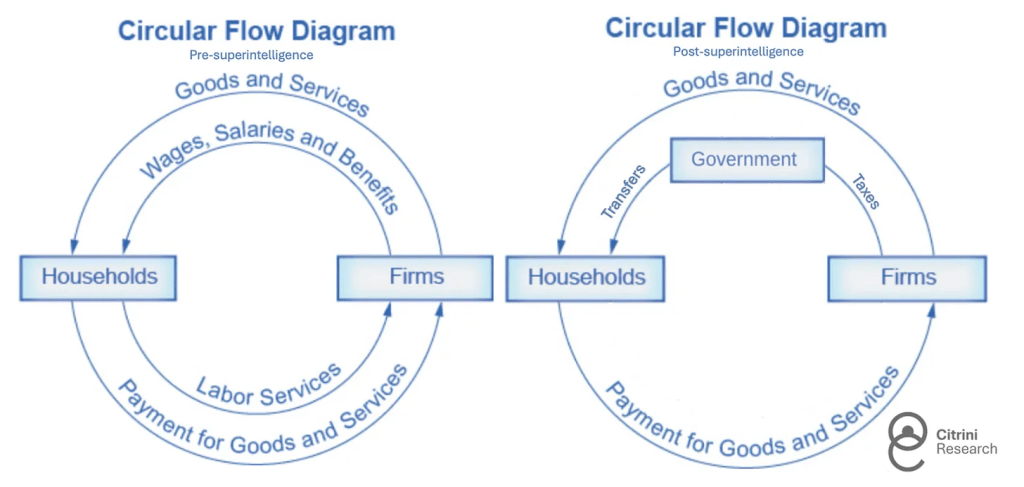
At the heart of the problem lies Ghost GDP. Artificial intelligence generates immense economic output, yet the gains concentrate almost entirely among owners of computation, energy infrastructure, and AI platforms. The traditional economic loop — wages leading to consumption, consumption sustaining businesses, businesses creating employment — weakens as human labor becomes economically unnecessary. Policy responses therefore attempt one essential task: recirculating value from machines back into households.
Early Counter-Moves: Stabilizing the Symptoms
Initial interventions resemble familiar crisis responses. Governments expand unemployment insurance, deploy emergency stimulus payments, and increase deficit spending to support displaced professionals. These measures temporarily stabilize consumption and prevent immediate collapse.
However, within the scenario’s logic, such policies function only as short-term patches. They address declining income but leave untouched the structural transformation underway: intelligence production has detached from human participation. As automation accelerates, each intervention arrives slightly too late, buying time without altering trajectory.
Attention then shifts toward taxation-based redistribution. Policymakers propose levies on AI inference usage, GPU compute hours, or extraordinary profits earned by AI firms. The intention is straightforward — capture a fraction of machine-generated value and redirect it toward citizens through transfers or public services.
Yet implementation proves difficult. Powerful technology firms resist aggressively, regulatory frameworks lag behind technological change, and revenue flows too slowly to counteract rapid labor displacement. Ghost GDP persists because intelligence remains abundant while human earning power continues to erode.
The Transition Economy Act — Bridging a Vanishing Labor Market
By mid-crisis, governments introduce more coordinated responses, exemplified in the scenario by the Transition Economy Act. This framework combines deficit-financed transfers with a dedicated tax on AI computation, effectively attempting to slow runaway automation while supporting displaced workers.
The Act resembles an expanded form of unemployment insurance scaled to an entire professional class. Software engineers, analysts, sales professionals, and consultants receive income support and retraining subsidies designed to ease adaptation to a new economic landscape.
Its purpose is transitional: preserve social stability while new forms of economic participation emerge.
Yet the scenario highlights a critical limitation. The policy arrives after large portions of the labor market have already dissolved. Transfers alleviate individual hardship but struggle to restore broad-based consumer confidence. Entire intermediary sectors — travel, insurance, real estate, and professional services — have already contracted beyond recovery. Economic confidence, once lost, proves difficult to rebuild through income replacement alone.
The Shared AI Prosperity Act — Treating Intelligence as a Public Resource
As conditions worsen, a more radical proposal gains attention: the Shared AI Prosperity Act. Rather than merely redistributing income after the fact, this approach reframes artificial intelligence itself as a shared societal resource.
Proposals include sovereign AI wealth funds, public ownership stakes in critical infrastructure, or mandatory royalties on AI-generated economic output. Citizens would receive regular dividends derived directly from machine productivity — an AI-era analogue to resource dividends in energy economies.
The logic is transformative. If intelligence has become a foundational economic resource, comparable to land or natural energy, then its benefits must circulate broadly to maintain social cohesion.
Such proposals challenge long-standing assumptions about private ownership and market distribution. Predictably, they encounter intense resistance, legal battles, and fears of capital flight. Within the scenario’s timeline, these reforms remain debated but largely unimplemented by the crisis peak, leaving uncertainty about whether they could stabilize the system in time.
Universal Basic or High Income — The Logical Endpoint
From these debates emerges the practical endpoint: some form of universal or quasi-universal income funded by AI-generated wealth. Regular payments guarantee baseline purchasing power even in a world where employment is no longer the primary mechanism of distribution.
Economically, such systems could interrupt the displacement spiral by preserving demand. Machines produce; humans retain the capacity to consume. Basic security improves, and material deprivation declines despite widespread job loss.
Yet even if successful economically, a deeper question remains unresolved.
Income can sustain living standards, but it cannot automatically provide meaning. Work has historically supplied identity, status, structure, and purpose. When employment ceases to organize life, redistribution prevents poverty but does not answer the existential vacuum created by technological abundance.
The Structural Limitation of Policy
The countermeasures envisioned in the GIC scenario are rational, necessary, and potentially stabilizing. They may prevent economic collapse and buy societies time to adapt. In this sense, they function as external brakes on a runaway technological system.
But they operate primarily at the level of material conditions.
The deeper drivers of instability lie within the human mind itself: attachment to identity through occupation, craving for status and comparison, fear triggered by loss of familiar roles, and anger arising from perceived displacement. Even under perfect redistribution, these psychological forces persist.
A society freed from economic necessity yet unprepared for inner freedom risks new forms of suffering — boredom without direction, anxiety without scarcity, and competition shifting from survival to symbolic status. Abundance removes external pressure while exposing internal restlessness.
Thus, policy solutions address the economic manifestation of the crisis but not its existential root. They can stabilize civilization, but they cannot by themselves teach humanity how to live meaningfully in a world no longer defined by survival labor.
The question therefore moves beyond economics:
If technology grants humanity freedom from necessity, what inner discipline prevents freedom from becoming suffering?
The answer to that question lies outside policy — and leads directly to the domain addressed by the Buddha’s Dhamma.
 Gautama Dhamma
Leave a comment