
In recent decades, mindfulness has spread across the globe with remarkable speed. It now appears in hospitals treating chronic pain, in schools helping children focus, in corporate wellness programs, and in therapy rooms supporting emotional balance. These applications bring real benefit: they calm agitation, sharpen attention, and make daily life more manageable. Yet beneath this widespread acceptance lies a subtle but profound shift.
Modern mindfulness has largely become a tool for living better within the world — a way to reduce stress, regulate emotions, and adapt more skillfully to life’s demands. While these outcomes are valuable, they remain firmly oriented toward worldly well-being. The original purpose of Satipaṭṭhāna, as taught by Gautama Buddha, has been quietly obscured.
The Satipaṭṭhāna Sutta does not present mindfulness as a method for psychological comfort or functional improvement. Its aim is far more radical: to establish a direct, penetrating insight that frees the mind from dependence on the world itself. This is expressed clearly and repeatedly in the discourse:
“Vineyya loke abhijjhā-domanassaṃ… yāvadeva ñāṇamattāya paṭissatimattāya anissito ca viharati, na ca kiñci loke upādiyati.”
Subduing longing and dejection regarding the world… mindfulness that “there is a body / feeling / mind / dhammā” is simply established to the extent necessary only for knowing and mindfulness. And he dwells independent (anissito), not clinging to anything in the world.
Here the fields of body, feeling, citta (mind-heart), and dhammā (mental phenomena) are not objects to be improved or balanced. They are fields for higher seeing — tools through which the practitioner comes to recognize that no worldly conditioned phenomenon can serve as a stable refuge, identity, or support. The culmination is anissito: a mind that no longer leans on anything in the world (loka) for security or definition. This independence forms the structural foundation for true liberation (vimutti). Only because citta-with-awareness can abide unsupported does the path to freedom from saṃsāra become possible at all.
Much of modern mindfulness, by contrast, emphasizes relaxation, present-moment awareness, non-judgmental observation, and emotional regulation. These qualities correspond to an early stage of mental refinement — stabilizing the lower layers of experience and reducing gross reactivity. They are helpful, even necessary, as initial steps. But they do not address the deeper bondage to conditioned existence, nor do they lead toward complete release.
A key misunderstanding arises in how “observation” is taught. Many contemporary approaches describe it as stepping back, watching thoughts or sensations from a distance, and maintaining a detached perspective. This creates a subtle division: an observer separates from what is observed. While this can soften immediate reactivity, it keeps the practice externalized and adaptive within the world.
Gautama Buddha’s instruction is different — and far more precise. The sutta uses a deliberate grammatical structure:
kāye kāyānupassī viharati vedanāsu vedanānupassī viharati citte cittānupassī viharati dhammesu dhammānupassī viharati
A literal rendering is: “abides higher-seeing body in body,” “higher-seeing feeling in feelings,” “higher-seeing mind in mind,” “higher-seeing phenomena in phenomena.”
The locative case (kāye, vedanāsu, etc.) is not merely descriptive; it is a direct instruction to enter and abide within the field itself. This is not seeing about the body or from outside it. It is immersive, internal penetration — seeing within the structure of the body, from the body’s own domain.
The term anupassanā (from anu + passanā) lies at the heart of this practice. Modern translations often soften it to “observing” or “contemplating,” which makes it sound like ordinary attention or reflection. Yet anu carries its original force of “higher,” “supreme,” “foremost,” or “leading” — pointing to an elevated vantage above conventional perception. Anupassanā is therefore higher seeing, supreme seeing, extraordinary seeing: direct, structural, penetrating, and immersive. It discloses the layered refinement levels inherent in both experience and existence itself — from gross sensory immersion to the most subtle strata resonant with the unconditioned.
As this higher seeing deepens, the practitioner directly beholds the layered, multidimensional structure of conditioned existence. This revelation discloses a hard and liberating truth: at the very essence of our core being lies citta with awareness — in its ultimate peace — as an existence that is independent from the world and possesses the inherent potential to be fully liberated from it.
The world — saṃsāra — operates entirely under the law of decay with aging and death. Every layer of conditioned being is subject to this inexorable law. Yet purified citta with awareness does not operate under that same law. When fully purified and liberated, it is ready to leave for the other shore: the Deathless realm of Nibbāna — not within this world, but a true reality of existence beyond all worlds under the law of decay.
Seeing this directly — not through concepts or speculation, but through supreme, penetrating vision — weakens dependence at its root. The mind no longer clings to worldly sensation, emotion, thought, identity, or any worldly conditioned support. Worldly clinging falls away naturally through clear, structural understanding of the world’s limitation and instability, and through the direct recognition of citta’s own capacity for independent, deathless abiding.
This is why the practice is called Satipaṭṭhāna: sati (mindfulness, sustained awareness) + paṭṭhāna (establishment, foundation). It is the establishment of a stable ground in which correct, higher seeing can arise and endure. Once this foundation is laid, insight matures, attachment fades, and the path unfolds toward nibbidā (disenchantment), virāga (dispassion), and vimutti (liberation).
The direction of this book is straightforward: to restore Satipaṭṭhāna as a direct path of higher seeing (anupassanā) — a multilayered penetration of existence across the four fields, leading to anissito and the realization of Nibbāna-dhātu, the Deathless realm beyond all worlds.
The practitioner begins with seeing. Through seeing comes understanding. Through understanding comes release. Eventually the mind stands alone — independent, unbound, and free. This is not an improvement of life in the world. It is freedom from dependence on the world altogether.
This is the beginning — and the true aim — of liberation.
1.1 The Rise of Mindfulness in the Modern World
In the decades following the Second World War, a quiet but powerful revival took place within Theravāda Buddhism, particularly in Burma. Amid the country’s struggle for independence and a broader resurgence of traditional teachings, the monk Mahāsi Sayādaw (1904–1982) developed a systematic approach to vipassanā meditation rooted directly in the Satipaṭṭhāna Sutta. His method emphasized clear, moment-to-moment awareness of phenomena as they arose and passed, often supported by simple noting or labeling. This approach spread quickly among both monastics and lay practitioners.
Mahāsi’s students and lineage holders carried these teachings beyond Burma. Centers in Rangoon trained many Western seekers who arrived in the 1960s and 1970s. Among them were figures such as Anagarika Munindra (a direct disciple of Mahāsi), Joseph Goldstein, Jack Kornfield, and Sharon Salzberg, who studied intensively in Asia and later brought these practices to the West.
These early transmissions proved deeply influential. Western psychologists, psychiatrists, and researchers recognized striking parallels between the non-reactive awareness cultivated in vipassanā and the emerging needs of modern mental health care. In 1979, Jon Kabat-Zinn — a molecular biologist and long-time meditation practitioner — created Mindfulness-Based Stress Reduction (MBSR) at the University of Massachusetts Medical Center. Drawing from Burmese-inspired methods (along with elements from other traditions), he deliberately secularized the practice: removing explicit Buddhist frameworks, rituals, and the aim of liberation. Instead, he presented mindfulness as a practical tool for managing chronic pain, stress, anxiety, and emotional suffering.
MBSR and later adaptations — such as Mindfulness-Based Cognitive Therapy (MBCT) — gained rapid acceptance in clinical settings. Empirical studies demonstrated measurable benefits: reduced symptoms of depression and anxiety, improved emotional regulation, and greater resilience in daily life. This evidence helped mindfulness enter hospitals, schools, corporations, and therapy rooms worldwide. Today, brief guided sessions, body scans, mindful breathing exercises, and smartphone apps make present-moment awareness accessible to millions.
These developments have brought genuine relief to many people. They calm the agitated mind, sharpen focus, soften reactivity, and support more balanced living amid modern pressures. Yet this very success has produced a fundamental shift. What began as a path to liberation from the world has been reframed — almost entirely — as a method for living more comfortably within it.
Gautama Buddha did not teach Satipaṭṭhāna to improve adaptation to worldly conditions. He taught it to establish the stable ground from which the mind could become independent of the world altogether — free from clinging to any worldly conditioned phenomenon, ready to leave for the other shore: a true reality of existence beyond all worlds.
The widespread modern version of mindfulness serves a valuable but limited purpose. It stabilizes the lower layers of experience and reduces gross suffering. It remains, however, firmly oriented toward the world. The original Satipaṭṭhāna points beyond this horizon — toward a radical freedom that Gautama Buddha described as anissito: abiding unsupported by anything in the world, with citta no longer dependent on the decaying domain of saṃsāra.
This chapter begins the work of restoration: to recover the depth and precision of the path as Gautama Buddha originally taught it.
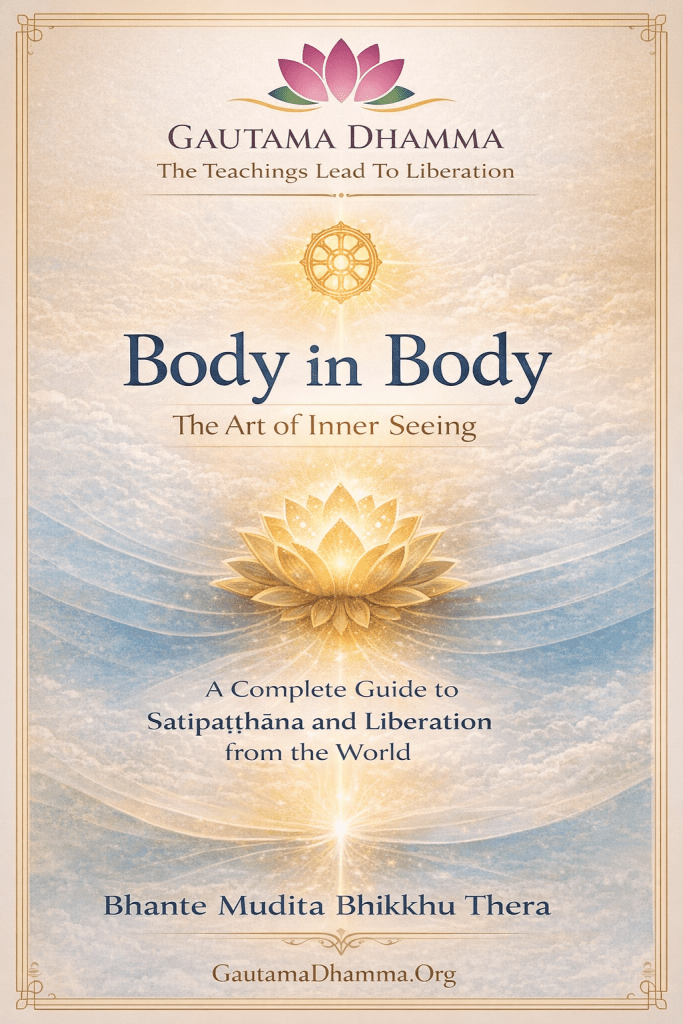
more from my coming book:
 Gautama Dhamma
Leave a comment