
Nature’s Revelation of the Noble Becoming
The Teaching Written into Living Form
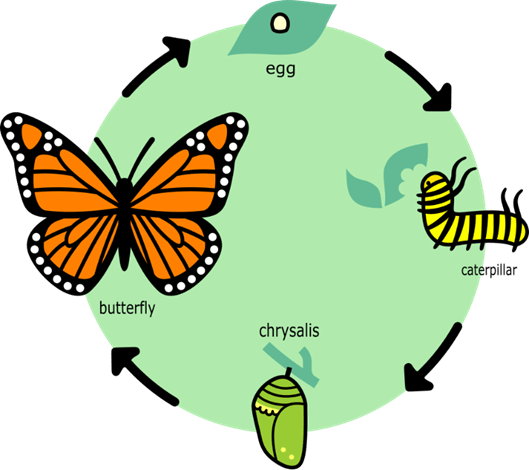
Across cultures, continents, and millennia, the butterfly has been universally revered as the supreme emblem of liberation, transformation, and the soul’s ascent. From ancient Greek psyche (meaning both “butterfly” and “soul”) to Aztec and Native American traditions where butterflies carry the spirits of the departed, from Taoist tales of Zhuangzi dreaming he was a butterfly to Tibetan Buddhist iconography of the rainbow body — humanity has instinctively recognized in the butterfly something far deeper than mere beauty or seasonal change. It is not the gentle renewal of spring flowers or the cyclical return of migrating birds that inspires awe; it is the radical, irreversible rupture: a crawling, earth-bound, consciously 2-dimensional creature dissolves itself entirely and emerges as an consciously 3-dimensional aerial being of an altogether different order.
This recognition is not accidental. It points to a truth embedded in living form: metamorphosis is not rebirth in the ordinary sense (a continuation or slight upgrade of the same being), nor is it mere improvement (a stronger caterpillar, a faster crawler, a better eater). It is a change of existential classification — the death of one mode of existence and the birth of another that shares almost nothing in function, perception, environment, or purpose with what came before. The caterpillar does not become a “better” version of itself; it ceases to be a caterpillar altogether. What emerges is not an enhanced larva but a new species of being: winged, nectar-sipping, sky-dwelling. The old identity is not refined — it is replaced.
In the Buddha’s teaching, this exact structure of radical replacement finds its precise counterpart in the pivotal moment called gotrabhū (or gotrabhū-ñāṇa) — the “change of lineage” or “change of gotra/bloodline.”
- Definition of gotrabhū
Gotrabhū is the decisive supramundane knowledge-moment in which the mind irrevocably shifts from the lineage of ordinary worldlings (puthujjana-gotra) — bound to worldly cravings and survival instincts of fear and anger — to the lineage of the Noble Lineage (ariya-gotra). At this crossing point, the mind no longer takes worldly conditioned phenomena (saṅkhāra) as its object; turns irrevocably toward the unconditioned — the world-transcending values such as the Brahma-vihara values at both individual level and at group level, and finally to the deathless realm of nibbāna itself. The governing law of the mind has changed: it no longer takes worldly conditioned phenomena as the support for identity of existence. The five aggregates continue as before for the time being, yet the governing law of the mind has changed. From this instant, the being is no longer a worldling; stream-entry (sotāpatti) follows, the worldly fetters are severed, and full awakening becomes inevitable. It is not a better worldling, nor a reborn version of the same; it is a new spiritual “species” — unbound, pure, belonging to the family of those who have seen the deathless realm of Nibbana.
Nature, in the monarch butterfly’s metamorphosis, displays the structure of this radical transformation in plain, living form: latent potential encoded within the ordinary, compulsive becoming in one confined mode, deliberate withdrawal, total dissolution of the old identity, an irreversible crossing of lineage (biological gotrabhū), and emergence into a wholly new mode of existence that leaves the old world behind.
The Dhamma, through Gautama Buddha’s teaching, reveals the method: the Noble Eightfold Path that cultivates the insight, ethics, and concentration needed to trigger the same shift in the human mind. Where nature shows the archetype in biological inevitability, the Dhamma offers the deliberate, volitional path by which any human can actualize the same change — not as passive instinct, but as conscious choice for liberation.
Thus, the butterfly is more than a symbol; it is a living scripture — a revelation written into form, whispering to every generation: the blueprint for transcendence is already within. The old lineage must yield completely for the Noble lineage to arise. Not rebirth as the same. Not improvement within limitation. But gotrabhū — the change of lineage — from which true freedom begins.
This is the teaching carved into the chrysalis, waiting for those with eyes to see.
PART I — THE NATURE’S REVELATION: METAMORPHOSIS
1. Introduction — Latent Possibility
Metamorphosis in the monarch butterfly (Danaus plexippus) is far more than a simple change in form; it is a highly regulated and “irreducibly complex” process of total transformation — a deliberate, complete replacement where one entire mode of existence is utterly dissolved and supplanted by another. The voracious, earth-bound caterpillar does not gradually evolve or regenerate into a winged adult; it commits to self-annihilation within the chrysalis, where nearly all of its larval tissues are broken down through autophagy and apoptosis into a nutrient-rich soup. From this apparent death emerges a radically new being: a creature equipped for flight, panoramic vision, precise nectar-feeding, long-distance migration, and aerial freedom — bearing no functional continuity with the crawling, leaf-devouring form that preceded it.
This astonishing process stands as a profound revelation carved into the very fabric of nature — perhaps imprinted by ancestral gods, or reflecting the timeless dhamma itself — to awaken humanity to the possibility of transcending our present limits. It is not an invitation to mere improvement, adaptation, or cosmetic refinement within the human condition; rather, it calls for a radical, total transformation: the death of the old self and the deliberate rise of a higher existence. Just as the monarch abandons the ground entirely for the sky, we are urged toward a shift that allows us to join realms of the deathless (amata) or the divine — not as enhanced versions of what we were, but as entirely new beings in spiritual lineage and capacity.
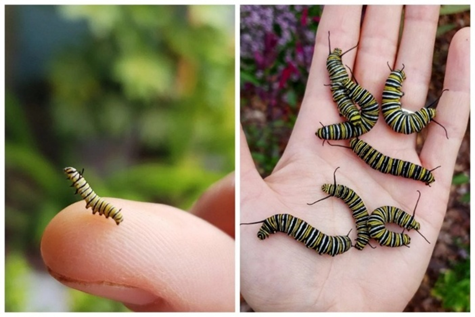
- Hidden blueprint within a simple form
Even in the humble, seemingly uncomplicated caterpillar, the entire architecture of the future adult is already present, concealed and quiescent.
- Entire future organism encoded before activity begins
From the earliest larval stages, tiny clusters of cells known as imaginal discs lie dormant within the body. These are not improvised during metamorphosis; they are pre-encoded, precise blueprints for wings, compound eyes, antennae, legs, reproductive organs, and the intricate proboscis. Their genetic and developmental instructions exist long before any visible change commences — a silent, latent design waiting for activation.
- Principle: potential precedes transformation
The higher state is not created or evolved step-by-step from the lower; it is already inherent, encoded in advance, and only revealed when the conditions for its unfolding are fulfilled. The imaginal discs do not arise reactively — they pre-exist, suppressed during the larval phase, ready to draw nourishment from the very dissolution of the old form. This principle echoes a deeper truth: genuine transcendence does not invent new potential; it uncovers and actualizes what has always been latent within, awaiting the right inner conditions — insight, renunciation, and the collapse of clinging — to emerge.
The chrysalis itself, deriving its name from the Greek chrysos (“gold”), bears witness to this hidden nobility. Its jade-green surface is adorned with a striking diadem of brilliant metallic gold dots — a “crown” formed by carotenoid pigments from the milkweed diet interacting with light-reflecting microstructures. These shimmering markings not only support respiration but evoke an otherworldly royalty concealed within apparent ordinariness.
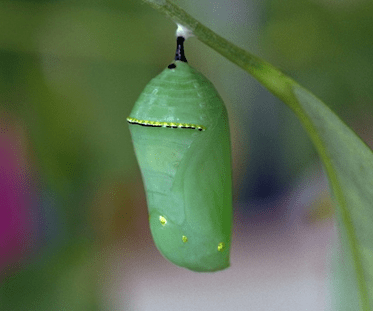
Stunning Monarch Chrysalis (jade with gold-like line and dots)
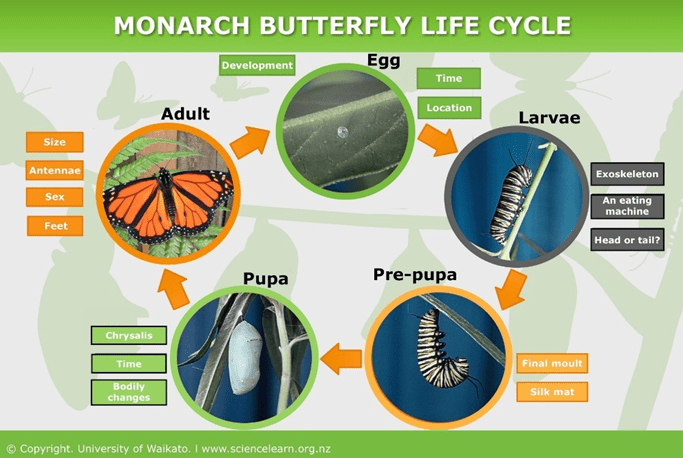
The full life cycle underscores this latent promise: from egg to larva to pupa to adult, each stage carries forward the encoded potential for the next, culminating in a being that leaves its former world behind.
In this way, nature presents metamorphosis not as a biological curiosity, but as a living archetype — a stark, beautiful teaching on the possibility of radical becoming. The blueprint for liberation is already within; the path requires only the courage to dissolve the old governing identity so the new may arise. This is the foundation of the Noble Becoming: potential precedes transformation, and total transcendence awaits those who recognize and actualize what lies hidden.

2. The Caterpillar — The Lineage of Becoming
The eating machine
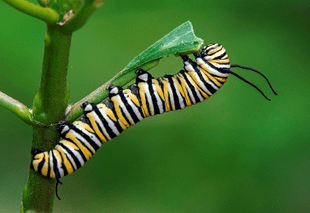
The monarch caterpillar emerges from its tiny egg as a minuscule, almost translucent being, yet it immediately embarks on an extraordinary phase of compulsive, relentless consumption. Over the course of roughly two weeks — through five successive molts (instars) — it multiplies its body mass by approximately 3,000 times, transforming from a pinhead-sized larva into a plump, vividly striped creature up to 2 inches long. Its sole purpose appears to be ingestion: devouring milkweed leaves with insatiable hunger, chewing through vast quantities to fuel explosive growth and store energy reserves in the form of fat bodies. This phase is one of pure accumulation — every bite, every molt, every expansion of the exoskeleton serves survival, size, and preparation for what comes next.
- Identity defined by survival and accumulation
The caterpillar’s entire physiology, behavior, and sensory apparatus are optimized for this single mode: mandibles for tearing plant tissue, a digestive system specialized for processing toxic milkweed (which it sequesters as chemical defense), osmeteria glands for warding off predators, and a body plan built for crawling and clinging to foliage. Its world is horizontal, grounded, and material — defined by endless craving for more food, more growth, more security against threats. There is no hint of aerial aspiration; its identity is wholly that of an eater, a survivor, a hoarder of resources in a confined domain.
- Complete adaptation to one environment
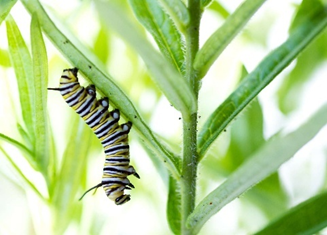
Perfectly attuned to the milkweed plant and the terrestrial leaf-layer ecosystem, the caterpillar is a paragon of efficiency within its niche. Its black, yellow, and white aposematic stripes warn predators of its toxicity, while its voracious appetite ensures rapid maturation before seasonal or predatory pressures intensify. It embodies mastery of samsaric striving: adaptation, accumulation, and conditioned excellence within the bounds of birth, growth, and eventual decay.
- Cannot conceive flight because organs do not support it
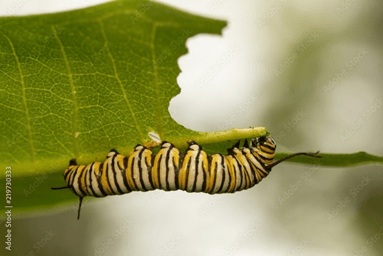
No wings exist, no flight muscles, no compound eyes suited for panoramic sky-vision, no proboscis for sipping nectar. The larval body is structurally incapable of imagining — let alone achieving — the freedom of the air. Its sensory organs detect leaves, stems, and nearby threats; its nervous system coordinates crawling and feeding, not soaring. Flight remains inconceivable not because of lack of effort, but because the governing blueprint of this phase excludes it entirely.
Perfection within a system is still confinement to that system.
This phase, then, symbolizes the human condition in its ordinary, unawakened state: brilliantly adapted to survival and accumulation, yet structurally blind to the higher possibility that lies latent within. The seeds of the butterfly (imaginal discs) are already present, suppressed and unrecognized amid the frenzy of eating — a reminder that the potential for a new lineage exists even in the depths of the old, waiting for the moment of withdrawal and dissolution to assert itself.
3. The J-Hanging — Withdrawal from Activity
Preparation phase
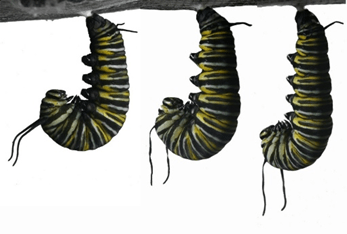
After weeks of relentless feeding and explosive growth, the fully mature fifth-instar caterpillar reaches a critical turning point. The compulsive consumption ceases abruptly. No more milkweed leaves are torn apart; the mandibles fall still. Instead, the larva begins a deliberate sequence of actions that signal irrevocable commitment to transformation rather than continuation.
- It seeks a secure, often elevated site — the underside of a leaf, a stem, or a twig — away from the crowded foliage where it once fed.
- Using specialized spinnerets, it extrudes a small but strong pad of silk onto the chosen surface.
- It then turns and embeds its rear end (the cremaster, a cluster of tiny, curved hooks at the tip of the abdomen) into this silk pad. The hooks interlock with the silk fibers in a manner strikingly akin to natural Velcro — a system requiring both components (hooks and looped fibers) to exist simultaneously for secure attachment.
- With the cremaster firmly anchored, the caterpillar releases its thoracic legs and abdominal prolegs, allowing its body to hang downward in the distinctive J-shape — head pointing toward the ground, body forming a smooth, inverted curve.
- From this moment, external activity ceases almost entirely. The creature appears motionless, suspended in stillness, no longer interacting with the world it once dominated.
Biological meaning
- Energy redirected: All metabolic resources previously devoted to foraging, digestion, and locomotion are now conserved and redirected inward. The frenetic outward striving ends; the system shifts from accumulation to dissolution and reorganization.
- Threshold between two modes of existence: The J-hanging marks the precise boundary — the point of no return — separating the lineage of the caterpillar from that of the butterfly. Before this moment, the organism could theoretically resume feeding if disturbed. After it, the developmental program irreversibly commits to pupation. There is no halfway state; retreat is impossible.
- Irreducible commitment: The cremaster-silk attachment is not gradual or experimental. It must function perfectly from the first instant of hanging — any failure means the larva falls, cannot pupate properly, and perishes. This interlocking precision again illustrates irreducible complexity: the system demands simultaneous presence of all elements, foreshadowing the larger truth that true transformation cannot proceed piecemeal.
This phase of withdrawal and apparent immobility is deceptively quiet. Beneath the surface stillness, profound internal changes are already underway: hormonal signals (ecdysone and juvenile hormone shifts) trigger the onset of pupal development, imaginal discs begin limited activation, and the first steps toward self-digestion are prepared. The body hangs like a suspended question — no longer fully of the earth, yet not yet of the air.
Symbolic parallel
In the Buddha’s teaching, such withdrawal is essential — whether in the seclusion of the forest, the stillness of jhāna, or the deliberate restraint of the senses — to create the conditions in which the old identity can begin to collapse. The J-shape, hanging between earth and sky, embodies liminality: no longer rooted in the old mode, yet not yet liberated into the new. It is the chrysalis of commitment, the threshold where the lineage of becoming starts to yield to the possibility of a new gotra.
The caterpillar does not resist this suspension; instinctual knowledge compels it. In the human domain, however, the step requires knowledge passed down from the Gautama Buddha’s lineage and conscious volition — the courage to stop feeding the old habits, to anchor oneself in renunciation, and to allow stillness to reveal what has been latent all along. Without this withdrawal, transformation never begins.
The J-hanging is thus not passivity, but the active choice to cease activity in one realm so that a radically different activity — the activity of becoming otherwise — may commence.
4. The Chrysalis — Dissolution
Once the J-hanging is complete and the caterpillar has fully committed to stillness, the body undergoes one of the most radical and visually deceptive processes in the living world: the formation of the chrysalis and the subsequent dissolution of the larval form. What appears from the outside as a serene, jewel-like capsule — jade-green, adorned with a regal band of metallic gold dots — conceals an act of total, orchestrated self-destruction.
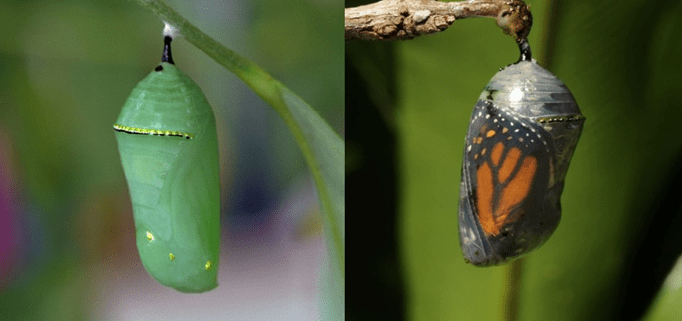
Self-consumption
- Within hours of anchoring, the caterpillar’s exoskeleton hardens and darkens slightly as it molts for the final time — not shedding to reveal a larger larva, but transforming into the pupal case itself. The old cuticle becomes the chrysalis wall, translucent at first, then hardening into a protective, gem-like shell.
- Inside this sealed vessel, autophagy (self-eating) and apoptosis (programmed cell death) commence on a massive scale. Nearly all of the caterpillar’s larval tissues — muscles used for crawling, digestive organs specialized for leaf-processing, the simple larval nervous system, salivary glands, and most of the body wall — are systematically dismantled and digested by the insect’s own enzymes and lysosomes.
- The once-coherent organism liquefies into a nutrient-rich “clear gelatin” or soup of amino acids, nucleotides, lipids, and other molecular building blocks. The caterpillar, as a functional entity, ceases to exist: no recognizable organs remain, no coordinated movement, no larval identity. The body has been reduced to raw material — its own substance consumed to fuel what comes next.
- Remarkably, vital systems persist amid the ruin: a faint heartbeat continues, tracheae (air tubes) remain functional for gas exchange, and certain neurosecretory cells stay active to regulate the hormonal symphony of metamorphosis.
Imaginal discs
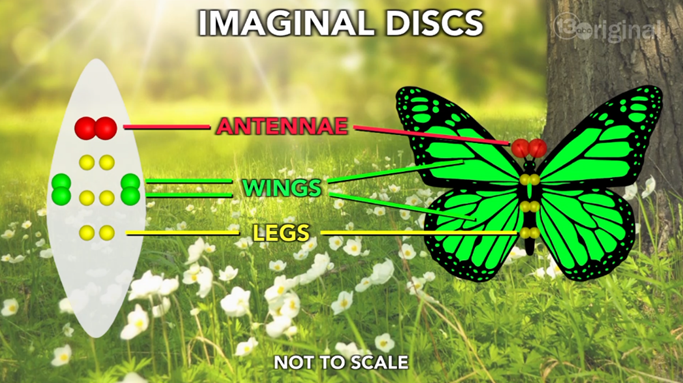
- Scattered throughout the larval body from the earliest stages — tiny, flattened sacs of undifferentiated stem-like cells — the imaginal discs have lain dormant, suppressed by juvenile hormone during the feeding phase.
- These pre-existing structures are the precise, encoded blueprints of the adult butterfly: one pair for each wing (forewing and hindwing discs), pairs for antennae, compound eyes, mouthparts (including the proboscis), legs, genitals, and other adult features.
- With the drop in juvenile hormone and the surge of ecdysone at pupation, the imaginal discs are released from inhibition. They rapidly proliferate, unfold, and differentiate, drawing nourishment directly from the nutrient soup produced by the dissolution of the old tissues.
- The old larval identity cannot reorganize or adapt into the new form. The governing developmental program of the caterpillar — optimized for crawling and consumption — has no pathway to produce wings, a coiled proboscis, or flight musculature. The two modes are mutually exclusive: the blueprint of one must be erased for the blueprint of the other to dominate.
Transformation requires the collapse of the governing identity.
Partial preservation or piecemeal adjustment is impossible. If even a significant portion of the larval tissues were retained, the emerging form would be malformed, non-viable, or trapped in hybrid uselessness. True replacement demands total surrender: the old self must be fully dismantled — not improved, not refined, but consumed and repurposed — so that the latent higher pattern can take over completely.
The chrysalis stage, lasting roughly 8–15 days depending on temperature, is thus a profound liminal space: outwardly still and radiant, inwardly a scene of violent, precise deconstruction and reconstruction. The gold-flecked exterior — formed by light-reflecting cuticular nanostructures and carotenoids sequestered from milkweed — symbolizes hidden nobility amid apparent death, a crown awaiting the one who will emerge.
Symbolic parallel to the path
Through penetrating insight, the practitioner comes to realize that the true, unconditioned awareness — the independent self or soul (anissito, “not dependent”) — stands apart from all worldly phenomena. With this understanding, the worldly constructed identities, attachments, habits, and survival instincts (fear, anger, craving) that have defined the ordinary ego part of the self begin to undergo their own form of autophagy: they are broken down, metabolized, and transformed into the nourishment of wisdom.
The old “caterpillar” ego — the bundle of conditioned tendencies and clinging — cannot be patched, upgraded, or gradually refined into an arahant. It must collapse entirely. No partial preservation is possible; the governing structure of self-identification has to yield completely.
Yet even amid this radical deconstruction, the latent seeds of awakening remain untouched: the imaginal discs of enlightenment — the innate potential for Right vision (sammā-diṭṭhi), Noble conduct (sīla), Right concentration, and ultimate liberation potential— have always been present within the race of Man. They await only the quenching of the fires of taṇhā (worldly cravings) and the full surrender of the old structures. When the old identity dissolves, these latent potentials can unfold, drawing from the very material of the former self to construct the liberated being — not an improved version of the old, but an entirely new mode of existence: unbound, pure, and free.
The chrysalis teaches unflinchingly: liberation is not achieved by keeping the old form intact while adding wings. It is achieved by allowing the old form to die — completely, irreversibly — so the new being, governed by a different law of existence, may arise from the same substance yet wholly transformed. This is the crucible where the lineage of becoming gives way to the possibility of the Noble lineage.
5. Gotrabhū in Biology — The Crossing Point
At a precise, irreversible moment during pupation — typically within the first few hours after the chrysalis seals — the developmental program undergoes a fundamental shift. Control passes irrevocably from the larval (caterpillar) pattern to the adult (butterfly) pattern. From this instant onward, every cellular process, every hormonal signal, every metabolic pathway serves a different organism with different needs, different perception, and a different destiny.
- The imaginal discs, once held in check, now take command: their proliferation accelerates dramatically, their differentiation unfolds with exquisite precision, and they begin to sculpt the adult structures using the nutrient soup yielded by the old tissues.
- Larval-specific genes are silenced; adult-specific genes are activated in coordinated waves.
- The hormonal milieu — once dominated by juvenile hormone to preserve the larval state — flips decisively. Ecdysone surges without juvenile hormone restraint, driving the pupal-to-adult transition.
- The nervous system begins rewiring: larval neural circuits for crawling and chewing are dismantled or repurposed, while new circuits for flight, mate-seeking, and panoramic vision emerge.
- Not yet flying, not yet emerged from the chrysalis — the organism is still enclosed, soft-winged, and vulnerable — but it is no longer a caterpillar in any governing sense. The directive intelligence, the telos, the organizing law of development has changed.
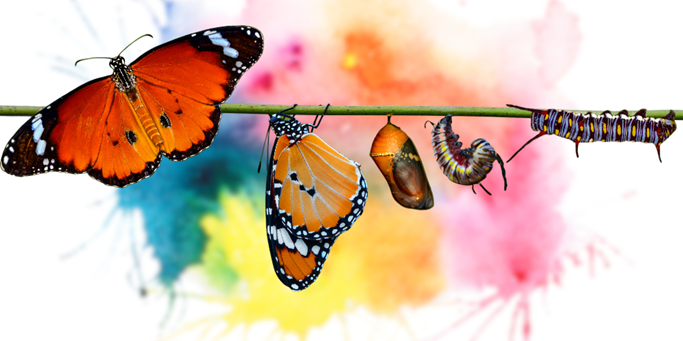
A change of governing law (lineage / gotra) while continuity of matter remains.
The physical substance — proteins, lipids, DNA — is largely continuous with what was once the caterpillar. Yet the blueprint, the developmental program, the very purpose of the organism has shifted to that of an entirely different being. The same raw material now obeys a new master plan: one that builds wings instead of prolegs, a proboscis instead of mandibles, flight muscles instead of crawling segments. This is not adaptation or evolution within the same lineage; it is a crossing point where one lineage ends and another begins.
Biological gotrabhū — the parallel to the Noble shift
This moment mirrors the supramundane gotrabhū-ñāṇa (“change-of-lineage knowledge”) in Gautama Buddha’s teaching. In the path of insight, the practitioner reaches the peak of mundane vipassanā — conformity knowledge (anuloma-ñāṇa) — where insight into the true Self and Soul becomes razor-sharp. Then, in a single mind-moment, gotrabhū occurs:
- The mind, which had been oriented toward worldly conditioned formations (saṅkhāra) as its object, turns irrevocably toward the unconditioned — the world-transcending values such as the Brahma-vihara values at both individual level and at group level, and finally to the deathless realm of nibbāna itself.
- The lineage or bloodline (gotra) shifts from that of the worldling (puthujjana-gotra) — bound to worldly cravings and survival instincts of fear and anger — to that of the Noble Lineage (ariya-gotra).
- No external substance changes; the same five aggregates continue for the time being. Yet the governing law of the mind has changed: it no longer takes worldly conditioned phenomena as the support for identity of existence. It can no longer return to the old way of worldly clinging and worldly becoming.
- From this crossing point, the path moments (magga-ñāṇa) follow: stream-entry (sotāpatti) severs the worldly fetters, and the being is destined for liberation. The old spiritual “species” is replaced; a new one arises.
Just as the monarch at this biological gotrabhū is neither fully caterpillar nor yet butterfly — suspended in a liminal state of radical reorientation — so too is the mind at gotrabhū-ñāṇa neither fully worldling nor yet fully Noble. It has crossed the threshold: the old program no longer governs; the new one has taken hold. The continuity of body/mind remains, but the telos has changed forever.
This crossing point is irreducible and decisive. There is no gradual blending of lineages, no hybrid halfway state that functions. Partial insight yields only continued suffering; only the full shift of governing law allows the latent Noble potentials to unfold without obstruction.
In nature’s revelation, the chrysalis holds this truth in plain sight: transformation reaches its decisive pivot not through addition or improvement, but through the moment when one developmental law yields completely to another. The organism does not negotiate with its old identity; it replaces it. So too does the path demand not refinement of the worldling’s mind, but the irreversible change of lineage — gotrabhū — from which true Noble becoming arises.
6. Emergence — A New Mode of Existence
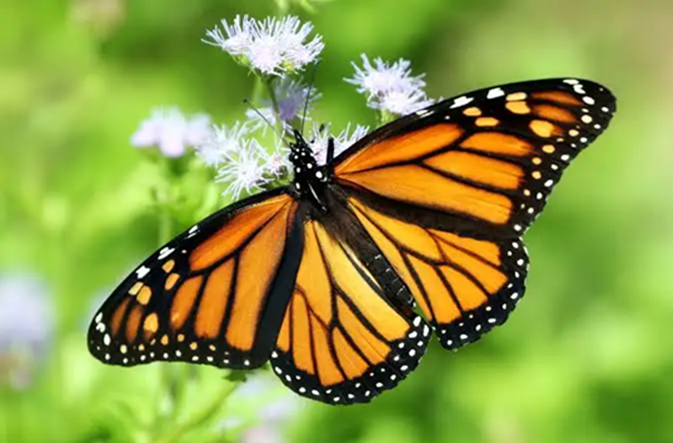
After days of silent, internal revolution within the chrysalis, the moment of emergence arrives. The fully formed adult butterfly — still soft, damp, and fragile — begins to split the pupal case along predetermined lines of weakness. Using rhythmic contractions and the pressure of hemolymph (insect blood), it forces its way out, crawling free from the now-transparent, empty shell that once housed its complete dissolution.
The newly emerged butterfly is not yet ready for flight. Its wings are crumpled, tiny, and wet; its body is limp; its proboscis hangs in two separate halves. Yet every structure necessary for the new life is already present — precision-engineered, pre-assembled by the imaginal discs, and now ready to be activated and finalized through active, deliberate effort.
- Proboscis assembly
The most striking immediate task is the knitting together of the proboscis. In the pupa, this feeding tube developed in two separate halves (each formed by a distinct imaginal disc). Upon emergence, the butterfly repeatedly coils and uncoils these halves in a precise, repetitive motion — sometimes hundreds of times — allowing rows of microscopic hooks, grooves, and interlocking latches (visible only under scanning electron microscopy) to zipper together into a single, airtight, flexible tube. Once sealed, this forms a perfect straw capable of capillary action, enabling the butterfly to sip nectar with suction. Any failure to complete this assembly would leave the insect unable to feed — a death sentence in a matter of hours or days.
- Wing inflation
Almost simultaneously, the butterfly pumps hemolymph from its swollen abdomen into the network of veins within the crumpled wings. This fluid pressure inflates the wings like balloons, expanding them to full size in minutes. As the fluid is withdrawn or absorbed and the wing cuticle hardens (through sclerotization and cross-linking of proteins), the wings become rigid, lightweight aerodynamic surfaces capable of powerful, sustained flight. The process is irreversible: once hardened, the wings cannot be refolded or repaired in the same way.
- New perception and nourishment
The compound eyes — vast mosaics of thousands of ommatidia — now provide panoramic, near-360° vision suited to detecting movement, ultraviolet patterns on flowers, and distant landmarks. The simple larval ocelli are gone; the new visual system is tuned to an aerial world. Nourishment shifts entirely: no more solid leaves, no more chewing mandibles. The butterfly now seeks liquid nectar — energy-rich, flower-derived sugar water — sipped delicately through the newly assembled proboscis. This dietary change reflects a complete metabolic and behavioral reorientation.
- New environment and behavior
The butterfly abandons the terrestrial, leaf-bound world of the caterpillar forever. It now inhabits the three-dimensional realm of the air — fluttering among blossoms, riding thermals, undertaking epic migrations (in the case of monarchs, thousands of kilometers to overwintering sites in Mexico). Its behavior is governed by new instincts: mate location through pheromones and visual cues, egg-laying on specific host plants, navigation by sun compass and magnetic fields. The ground is no longer home; the sky is.
Symbolic parallel to the path
The butterfly does not linger at the chrysalis site to “adapt” or “improve” its old crawling life. It leaves — immediately, irrevocably — for a mode of existence the caterpillar could never conceive. So too does the liberated mind not patch or negotiate with the old lineage; it departs entirely from the wheel of becoming.
Conclusion of Part I
The organism does not adapt to its world — it leaves it.
The caterpillar achieved mastery within limitation, within its 2-dimensional conscious limit; its perfection was its prison. Its dissolution was necessary, not optional. The butterfly, now becomes a 3-dimensional existence, does not improve upon crawling; it abandons the ground altogether. In this complete sequence — from latent potential, through compulsive becoming, withdrawal, dissolution, crossing of lineage, to full emergence — nature reveals the archetype of radical transcendence. Not betterment within the old mode, but the deliberate rise of a new one. The blueprint for liberation is already encoded within; the path requires only the courage to withdraw, dissolve the old governing identity, cross the threshold, and emerge into the unbound. This is the invitation of metamorphosis: to recognize our own latent possibility and strive for the Noble Becoming, where the human limit is not refined but wholly transcended.
 Gautama Dhamma
Leave a comment