
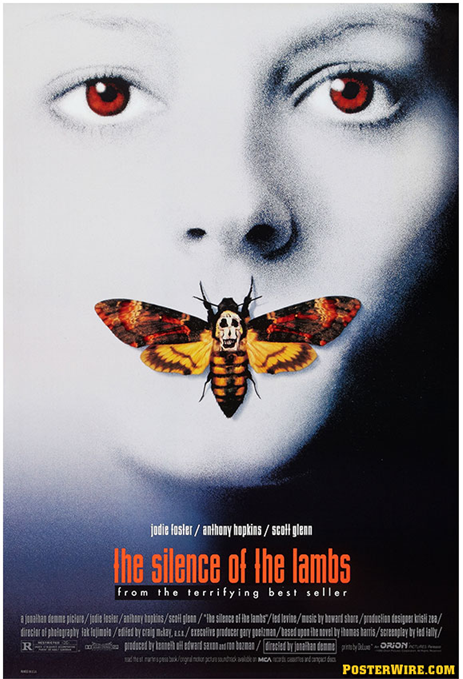
The poster functions as a mirror to the film’s core inquiry: evil as a distortion of human nature, rooted in trauma, unsatisfied desire, and the rejection of empathy. It reveals the shadow self through layered symbols, particularly illuminating the darkness embodied by the two central antagonists—Hannibal Lecter and Buffalo Bill (Jame Gumb)—while echoing Clarice Starling’s confrontation with her own repressed trauma.
The pale, asymmetrical face dominates the composition, rendered unnaturally pallid and corpse-like, with subtle distortions that evoke Freud’s unheimlich (the uncanny): the familiar (female beauty, vulnerability) made strange and threatening. This stylization—often tied to Clarice or a composite of victims—mirrors the silenced women whose innocence is erased, reduced to objectified bodies. It visually enacts the “silence of the lambs,” symbolizing muffled cries of purity and sacrifice (lambs as innocent victims), tied to Clarice’s childhood memory of helpless lambs screaming before slaughter. The lifeless quality underscores repressed suffering under evil’s weight, a Freudian/Jungian descent into the unconscious where trauma festers unheard.
The vampiric red eyes pierce through this pallor, transforming the face from victim to predator—or possessed. These eyes evoke Hannibal Lecter, whose maroon, red-tinged gaze (as described in Thomas Harris’s novel) consumes psyches as he devours flesh. Psychoanalytically, this aligns with Lacan’s gaze: the terrifying look of the Other that objectifies and threatens the self. Lecter represents misaligned coherence—childhood trauma transmuted into predatory mastery, where intellect and culture mask primal hunger. Spiritually, he enthrones animal drives (predation, incorporation) while rejecting divine virtues like compassion (karuna) and loving-kindness (metta), achieving a counterfeit integrity that perfects darkness. The red eyes suggest infection: Clarice risks absorbing this influence in her quest, confronting how virtue brushes against evil without succumbing.
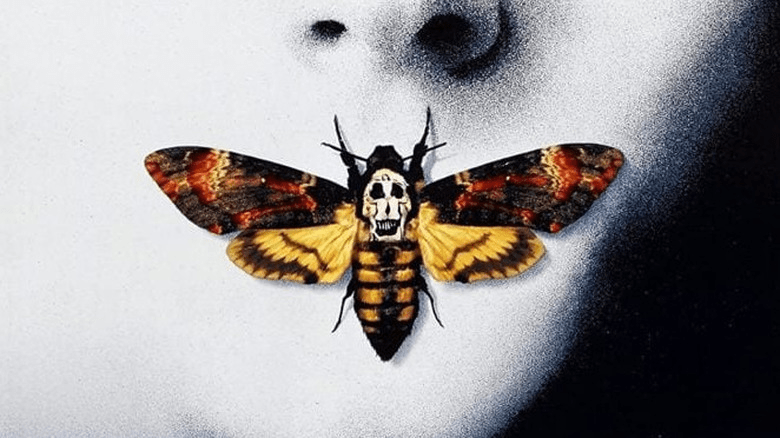
At the center, the Death’s-Head Hawkmoth seals the lips, enforcing silence while dominating the frame. Its skull-like thorax (a natural pattern amplified here) symbolizes death-in-transformation. In the film, Buffalo Bill breeds these moths, inserting pupae into victims’ throats—a grotesque perversion of voice and metamorphosis. Bill embodies the fragmented self: shattered by abuse, rejection, and institutionalization, he projects self-loathing outward, harvesting women’s skin for a “woman suit” in desperate rebirth. This literalizes pathological transformation—gender dysphoria twisted into destruction—where desire for wholeness becomes violent incorporation. Spiritually, his soul is eclipsed by trauma, blocking access to divine alignment; creativity (moth-rearing, sewing) and vulnerability (attachment to his dog) mark him as human at the edge of the abyss, yet trapped in animal drives without transcendence.
Hidden within the moth’s “skull” lies an optical illusion: seven nude female bodies arranged into a death’s head, directly referencing Salvador Dalí and Philippe Halsman’s 1951 photograph In Voluptas Mors (“Voluptuous Death”). This layers eroticism with mortality—beauty fused with death—echoing Bill’s crimes (women as raw material for fantasy) and Lecter’s refined cannibalism (aesthetic horror). It psychoanalyzes human darkness as eroticized violence: desire and destruction intertwined, where female vulnerability becomes subsumed into monstrous form. The “hive mind” illusion (collective bodies into one skull) aligns with silenced victims’ unheard suffering.
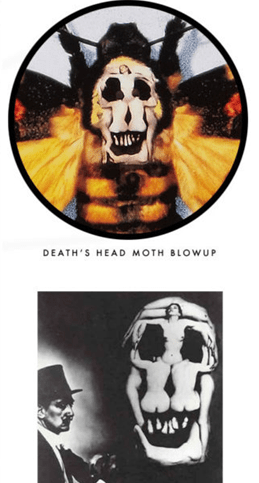
Together, these elements unveil the psyche’s shadow: evil perverts human drives—longing for change (moth), identity (Bill), intellect (Lecter)—silencing trauma and vulnerability. The lambs’ cries demand awakening to this abyss without compromise.
Artistic Mastery: Composition, Symbolism, and Visual Impact
Beyond psychology, the poster excels as iconic graphic design—minimalist, dense with meaning, and award-influencing in its era.
The close-up face creates intimacy and claustrophobia, filling the frame to draw viewers inescapably into the psyche’s depths. The color palette contrasts pale blue-gray skin with the moth’s vibrant oranges, reds, and blacks—evoking blood, fire, warning, and danger—while unifying the red eyes and title text. Chiaroscuro-like shading heightens dread, mirroring Jonathan Demme’s film direction: subjective shots into darkness, muffled sounds, and calm voices aestheticizing horror.
Surrealist influences elevate it: the Dalí homage infuses erotic horror and illusion, aligning with the film’s blend of high culture (Lecter’s drawings, opera) and brutality. Restraint amplifies power—no gore, only implication. The moth over the mouth visually silences; the hidden skull rewards scrutiny, turning viewers into detectives like Clarice. This mirrors the film’s structure: surface beauty conceals darkness, pulsing with transformation and the beautiful-terrible.
In essence, this poster transcends marketing to become standalone art—a psychoanalytic and spiritual confrontation with humanity’s hybrid nature: animal predation versus divine potential. It forces us to read the darkness not as aberration but as perversion of our deepest drives, urging choice toward light amid the abyss.
 Gautama Dhamma
Leave a comment