
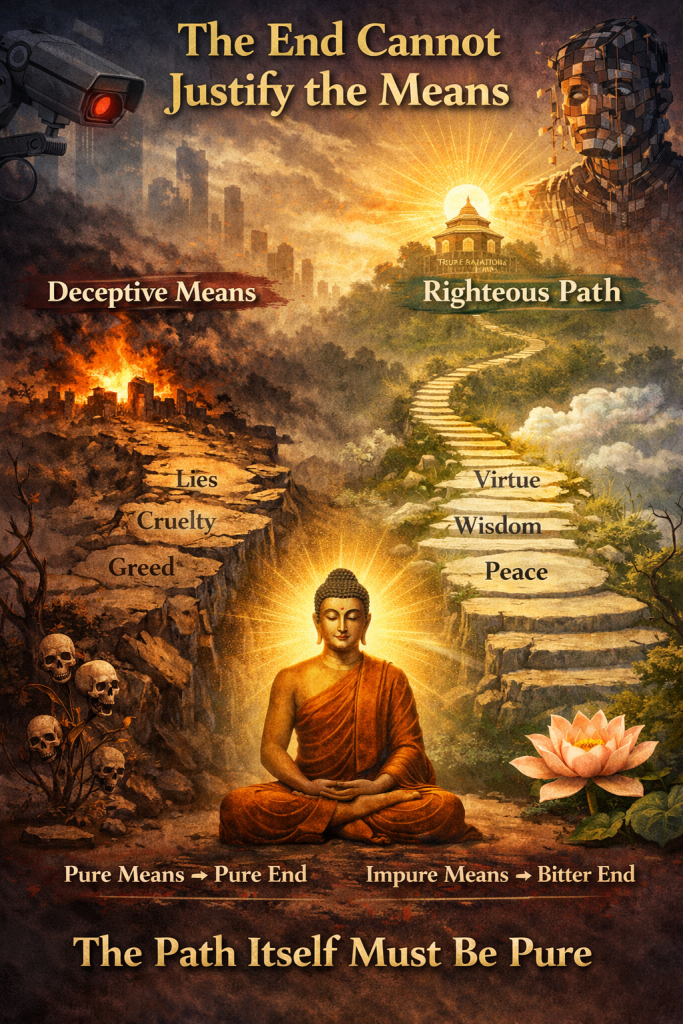
Why the end cannot justify the means
1. A World That Sacrifices the Individual
The film A Scanner Darkly (2006) presents a society obsessed with control yet blind to truth. Surveillance is everywhere, but understanding is nowhere.
Bob Arctor, an undercover narcotics officer, must infiltrate addicts by becoming one of them. The state requires him to take the drug Substance D to maintain credibility. The drug slowly divides his mind into two incompatible halves. He loses identity, memory, and coherence.
Then comes the most disturbing revelation:
his superiors know.
They allow his mental collapse deliberately so he can be placed inside a rehabilitation facility suspected of producing the very drugs the government fights. His mind becomes bait. His life becomes evidence. He is no longer a person — he is an instrument.
The tragedy is not merely political. It is moral and metaphysical.
The government believes a noble goal — stopping drugs — justifies destroying a human being. Yet the result is neither justice nor clarity. Instead, the system produces confusion, suffering, and deeper deception. Even the watchers cannot see what they are doing. They “scan,” but they see darkly.
2. The Fundamental Error of Worldly Thinking
Worldly reasoning assumes:
If the goal is good enough, harmful actions become acceptable.
This idea appears practical. It drives war, policing, propaganda, coercion, and manipulation. It also drives personal life — lying for harmony, aggression for protection, exploitation for prosperity.
But according to the Buddha’s teaching, this logic is structurally impossible.
Because the result is already contained within the cause.
An action rooted in greed, fear, or delusion cannot produce freedom from greed, fear, or delusion. It can only extend them into the future in altered form.
In the film, deception is used to fight deception.
Addiction is used to fight addiction.
Psychological destruction is used to restore social order.
The result: expanded suffering.
Not by accident — by law.
3. The Path and the Destination Are One Process
In the Buddha’s teaching, the path (means) and the goal (Nibbāna) are inseparable phases of a single movement.
If liberation is freedom from rāga (craving and attachment), dosa (fear and anger), and moha (delusion and ignorance), then every step toward it must already weaken those forces.
Otherwise, one is not moving toward liberation at all — only rearranging bondage.
Thus the training is structured as three integrated disciplines:
3.1 Sīla — The Ethical Foundation
Sīla is not merely morality.
It is the deliberate refusal to build peace using violence, truth using lies, or clarity using intoxication.
Every action is a seed.
A seed contains the nature of its fruit.
If deception is planted, trust cannot grow.
If cruelty is planted, harmony cannot grow.
The state in the film plants manipulation and expects order.
Instead, it harvests madness.
A practitioner understands:
good must exist at the beginning of the process, not only at the conclusion.
3.2 Samādhi — The Collected Mind
The mind cannot reach clarity through fragmentation.
In the story, drugs are used as operational tools — shortcuts to infiltration and knowledge. Yet the drug literally splits the mind. The method mirrors the result.
Trying to reach insight through chemical disturbance resembles trying to calm water by stirring it faster.
Samādhi is the opposite movement: gathering, stabilizing, unifying.
Clarity arises from coherence, never from division.
3.3 Paññā — The Understanding of Causality
Wisdom sees that the path is already the destination unfolding over time.
A corrupt process cannot produce a pure state later.
It continuously reproduces its own quality.
Thus, wisdom rejects the entire structure of “temporary wrongdoing for future good.”
There is no temporal loophole in causality.
4. Why the End Cannot Justify the Means
The world imagines time separates cause and result.
Dhamma shows they are one event extended across duration.
The “means” is the end in motion.
The “end” is the means completed.
Therefore:
- Violence leads toward more structures of violence
- Manipulation leads toward deeper confusion
- Compassion leads toward peace
- Clarity leads toward freedom
This is not ethics as ideology.
It is causation as structure.
When the government sacrifices Arctor, it believes it is preventing suffering. Instead it manufactures suffering — not because of incompetence, but because of incorrect principle.
They attempt to reach order through disorder.
5. Justice in the World vs Justice in Dhamma
Worldly justice tries to manage consequences.
Dhamma justice transforms causes.
Worldly systems ask:
How much harm is acceptable to secure stability?
The Dhamma asks:
What action removes the roots of harm entirely?
The first negotiates suffering.
The second ends its production.
6. The Pure Process
The path to Nibbāna follows a precise logic:
Good intention → righteous action → purified mind → liberating knowledge → freedom
Not:
Bad action → temporary benefit → future peace
Peace cannot be manufactured from conflict.
Freedom cannot be engineered from bondage.
Thus the teaching stands:
The path must already contain the destination.
If each step weakens rāga (craving and attachment), dosa (fear and anger), and moha (delusion and ignorance), the journey approaches liberation.
If each step reinforces them, the journey moves away from it — even when claiming noble purpose.
7. Final Reflection
A Scanner Darkly is tragic because its society seeks clarity through obscuration. It watches endlessly yet never understands. It sacrifices people to protect people.
The Buddha’s teaching offers a radically different principle:
Peace is not achieved after impure action.
Peace is the cumulative result of pure action.
Therefore:
The end never justifies the means.
The means becomes the end.
When the process is pure, the result is peace.
When the process is corrupted, the result is suffering — even when called justice.
It is the structure of reality.
 Gautama Dhamma
Leave a comment