
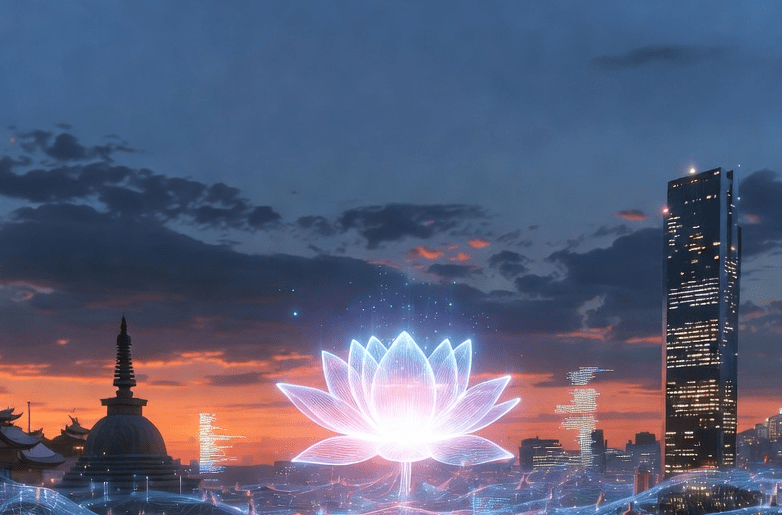
Artificial intelligence is accelerating at a pace most people cannot yet conceptualise.
AI systems are now writing and optimising the code for the next generation of AI. The machine is improving the machine. Progress is no longer merely exponential — it is recursive intelligence compounding upon itself.
Within a few years, a significant portion of white-collar work will no longer require human participation in the way it does today. Not because humans lack talent or value, but because systems will execute tasks faster, more accurately, more consistently, and at near-zero marginal cost. Law, finance, administration, research, logistics, analysis, design, and even parts of medicine and education are already transforming in real time.
The comforting illusion is that this lies in some distant future.
It does not.
The shift is occurring now. What lags behind is our psychological readiness to absorb what it means.
We have crossed a threshold that should genuinely give us pause.
There is no serious scenario in which AI does not end up operating the majority of systems underpinning modern civilisation. The question naturally arises:
What happens to me when my role becomes redundant?
If I am replaced at work, how do I sustain myself — and what becomes of my sense of purpose?
The End of the Work Identity
For centuries, human life revolved around survival. We organised our days around earning, competing, maintaining status, and paying bills. Identity fused with profession. Worth fused with productivity.
But this arrangement was never natural — it was structural.
The economic architecture of the modern world has functioned less like a free market of empowered individuals and more like a sophisticated extraction framework. Income tax, corporate tax, property tax, capital gains tax, inheritance tax, inflation as hidden taxation, regulatory layers embedded in every transaction — productivity continually flows upward into complex systems few truly understand.
We call this normal because we were born inside it.
Complexity protects extraction.
Opacity enables waste.
Dependence stabilises control.
AI and open finance now threaten that architecture. Highly automated, transparent systems leave little room for bureaucratic mediation and hidden siphoning. When transactions and processes become instantly auditable, structures that exist purely to obscure and extract lose structural justification.
This may not simply be a labour shift.
It may be the end of a civilisation organised primarily around economic survival.
The Crisis Is Not Employment — It Is Identity
If machines assume functional roles, humanity faces a deeper disruption:
If survival no longer defines daily life, what defines the human?
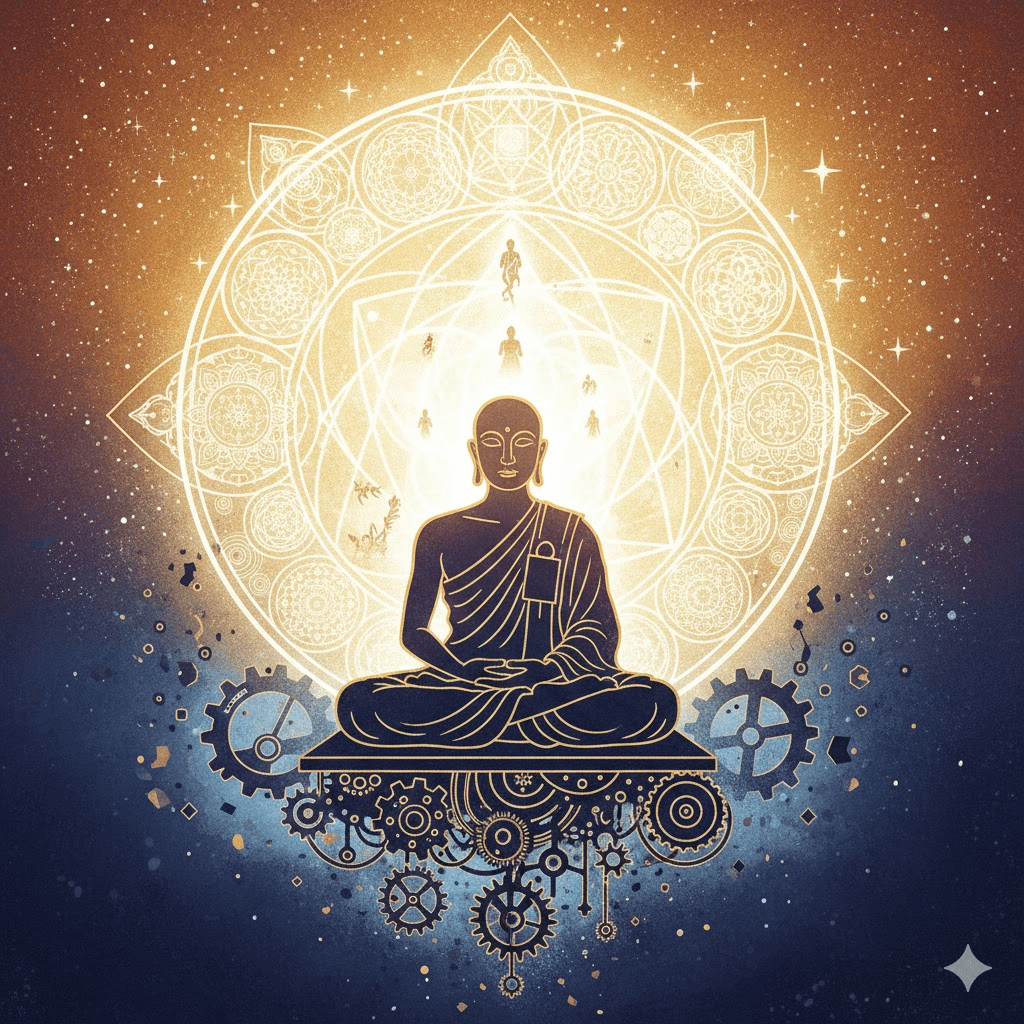
This is precisely the crisis Gautama Buddha addressed long before industrial civilisation existed.
He observed that humans bind identity to worldly activity — occupation, status, possession, recognition. The mind attaches to function and calls that attachment “self.” When the function changes, anxiety appears. When the function disappears, existential fear arises.
The problem was never the job.
The problem was the identification.
Civilisations built around labour unintentionally reinforced this illusion.
Work became identity.
Productivity became worth.
Restlessness became normal.
AI is not creating the crisis.
It is revealing the crisis that was always there.
The Liberation Insight
Gautama Buddha’s liberating wisdom begins with a radical observation:
Suffering does not arise because life lacks security.
Suffering arises because the mind seeks security inside unstable conditions.
For most of history, survival pressure prevented humanity from noticing this. The struggle for food, shelter, and status kept attention outward. Now automation removes part of that pressure — and a psychological vacuum appears.
This is why technological revolutions produce anxiety even when they increase abundance.
The mind, long trained to define itself through struggle, suddenly has nothing to cling to.
So a new question emerges — not economic but existential:
If I am not what I do, then who am I?
This question is the doorway to spiritual maturity.
Time Becomes the True Wealth
If machines take over repetitive, analytical, and administrative burdens, something unprecedented appears in human history:
Time without survival compulsion.
Time to raise children without exhaustion.
Time to learn deeply.
Time to create.
Time to contemplate.
Time to understand existence rather than merely endure it.
Ironically, artificial intelligence may restore the condition necessary for genuine human development.
For the first time at a civilizational scale, humanity may face the possibility of living rather than coping.
But freedom of time produces two very different futures:
- distraction and decay
- awakening and clarity
Technology cannot decide this. Only consciousness can.
The Direction of Power Depends on Mind
AI can centralise power or expose it.
It can create digital feudalism or transparent accountability.
Technology amplifies intention.
Therefore the future will reflect the mental state of those who guide it.
If guided by greed, fear, and domination, systems become instruments of control.
If guided by wisdom and restraint, systems reduce suffering and conflict.
Thus the real battleground is not technological — it is psychological.
The Return of the Spiritual Question
Humanity may soon face a condition unknown for millennia:
A world where survival is no longer the organising principle of life.
At that point civilisation confronts the question Gautama Buddha placed at the center of his teaching:
What is a human being for?
Not for endless production.
Not for perpetual competition.
Not merely for comfort.
But for understanding existence and attaining inner freedom.
When outer compulsion decreases, inner confusion becomes visible.
And when inner confusion becomes visible, the path of awakening becomes possible.
The Real Preparation
The coming change cannot be resisted by policy alone, nor solved by economics alone. It demands psychological preparation and spiritual clarity.
The disappearance of compulsory roles forces a choice:
- continue seeking identity in changing structures
- or discover identity independent of them
One path leads to deeper anxiety.
The other leads to liberation.
The Turning Point of Civilisation
The world as we have known it is dissolving, and a new paradigm is forming faster than most can process. Ignoring it offers no protection. Blind resistance offers no solution.
The rational response is preparation — mental, emotional, and spiritual.
Not escape from technology.
Not worship of technology.
But maturation of the human being.
For the first time, humanity may be collectively invited to move from survival consciousness to awareness consciousness.
The external revolution is technological.
The internal revolution is spiritual.
And readiness will not depend on intelligence, wealth, or position — but on clarity of mind and depth of understanding.
The real awakening is not that machines become intelligent.
It is that humans must finally become wise.
 Gautama Dhamma
Leave a comment