
And Recollection on Nibbāna-dhātu as the Ultimate Peace and Final Destination (Upasamānussati)
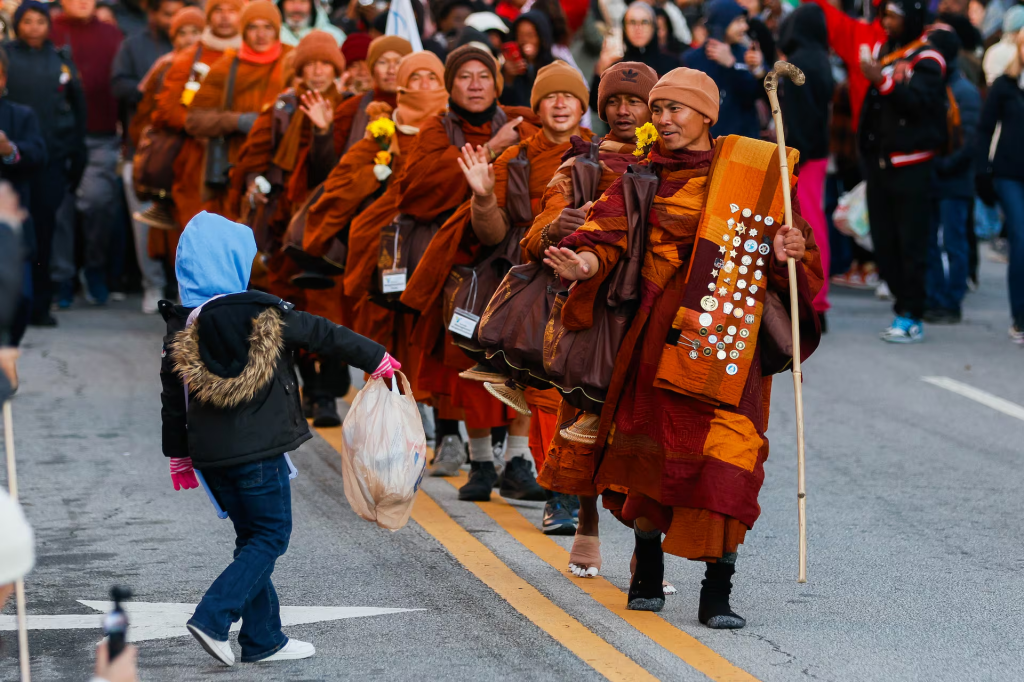
In a world often defined by division, conflict, and fleeting calls for “world peace,” a group of Buddhist monks has embarked on a profound journey that redefines what peace truly means. Beginning on October 26, 2025, from the Huong Dao Vipassana Bhavana Center in Fort Worth, Texas, approximately 19 Theravada Buddhist bhikkhus (monks), led by Venerable Bhikkhu Pannakara, set out on a 2,300-mile pilgrimage to Washington, D.C. Their expected arrival is February 10, 2026, after traversing 10 states through challenging weather, physical hardships, and moments of deep human connection.
This is a living practice of Dhutanga—ancient monastic disciplines emphasizing simplicity, endurance, and mindfulness. The monks walk barefoot in many sections, sleep outdoors, and maintain a rigorous daily routine of meditation, chanting, and peaceful presence. Their path is not a protest against any specific issue but a gentle invitation to awaken the peace that already resides within each person.
The Heart of the Journey: Awakening Inner Peace
At its core, the Walk for Peace is about inner peace—the eradication of rāga (greed/lust), dosa (hatred/anger), and moha (delusion/ignorance) from the mind (citta). As Bhikkhu Pannakara teaches, true peace begins and ends in the individual heart. “We walk not to protest, but to awaken the peace that already lives within each of us,” he has stated. Without inner calm, external harmony remains superficial and temporary.
The walk itself serves as a moving meditation: every step cultivates concentration and resilience. Facing freezing snow, aggressive traffic, blisters, and sore feet, the monks demonstrate non-reaction—pausing before responding, choosing forgiveness over anger. A striking example occurred early in Texas when a vehicle struck members of the group; rather than resentment or legal action, they responded with compassion and healing.
This inner transformation radiates outward. The monks share mettā (loving-kindness) universally, visiting churches, mosques, community centers, and state capitols. They tie “peace bracelets” on supporters as symbols of shared humanity, reminding all that divisions based on politics, race, or identity are worldly illusions (loka)—transient and bound to change.
Petitioning for Vesak: A Day of Universal Reflection
A key goal upon reaching Washington, D.C., is petitioning Congress to recognize Vesak—the full-moon day commemorating the Buddha’s birth, enlightenment, and passing—as a federal holiday. This is not about conversion but about offering a national day for reflection, compassion, and unity open to all faiths. In a divided nation, Vesak could serve as a shared moment to cultivate mindfulness and kindness.
The Three Layers of True Peace
The monks present peace not as a distant political ideal but as a sequential transformation starting within the citta:
- Inner Peace (The Root) — Purifying the mind through Vipassana meditation, observing breath and sensations to stay present amid dukkha (suffering). “If we are peaceful on the inside, we will be peaceful on the outside.”
- Peace Between Beings — Extending mettā to all, recognizing shared vulnerability to impermanence and values. This counters division by affirming our common humanity.
- Peace with the World (Disenchantment) — Accepting the world’s instability without attachment. By embracing simplicity and non-clinging to the worldly, the monks prepare the mind to transcend worldly cycles, pointing toward the ultimate peace: Nibbāna, the deathless realm of existence.
Worldly “peace” through treaties or absence of war is illusory while greed, hatred, and fear persist in hearts. As the Buddha taught, lasting harmony arises only when individuals achieve inner peace; collective peace follows naturally from that foundation.
A Path, Not a Destination
“Peace is not a trophy we find at the end of 2,300 miles; it is the path we cultivate under our feet with every breath and every step,” Bhikkhu Pannakara has said.
The Walk for Peace demonstrates that true peace is active, internal, and accessible now—through mindfulness, forgiveness, and non-attachment. In a chaotic world, the monks show that while we cannot still the ocean’s waves, we can calm the mind that observes them. Their journey invites everyone: pause, breathe, choose peace within—and let it ripple outward.
As they near Washington, D.C., the message endures: the deepest peace is not imposed on the world but realized in the heart, one mindful step at a time. May all beings be well, happy, and at peace. 🙏
Closing Reflection — Upasamānussati: Nibbāna-dhātu as the Ultimate Peace and Final Destination
At the end of a long journey, peace reveals its deeper meaning. Not merely the quieting of conflict, not the temporary calm that follows exhaustion, and not the emotional comfort found in favorable conditions — but a true peace that stands beyond the changing world itself. This is Upasamānussati, the recollection of the True Peace, the stilling of all worldly agitation through contemplation of Nibbāna-dhātu, the Deathless realm of Nibbāna.
When the mind turns toward Nibbāna-dhātu, it reflects on its intrinsic qualities:
Amata — deathless, a realm without the law of aging and death.
Ajara — ageless, beyond the passage of time.
Dhuva — stable and permanent, not shaken by events.
Sukha — blissful, intrinsic joy and happiness.
Suddha — pure, free from negativities.
Santi — peaceful, the absence of external noise and disturbances.
This realm of existence stands outside the jurisdiction of the world system. The universal law governing birth, change, and death holds power only within the world; it finds no reach there. Thus suffering (dukkha) has no footing in the realm of Nibbāna. The pilgrim’s true path therefore leads to the “other shore” — not another place within the world, but freedom from the world’s entire field of instability.
Entry to this shore unfolds through a precise inner transformation:
first nibbidā, disenchantment toward worldly existence;
then virāga, fading of worldly attachment to its attractions and fears;
and finally vimutti, release from the world’s domain.
The training supporting this realization is clear and practical.
Sīla (brahmacariya) withdraws participation from the worldly economy of craving and reaction, especially sexual attachment — the hallmark of kāma-loka, the realm of sensual desire.
Samādhi gathers the mind into unified strength, lifting it beyond the sensory field into higher realities.
Paññā cuts through the roots of bondage to the world — rāga (worldly cravings and attachments), dosa (fear and anger inherited from animal instincts), and moha (not knowing this liberation path revealed by Gautama Buddha).
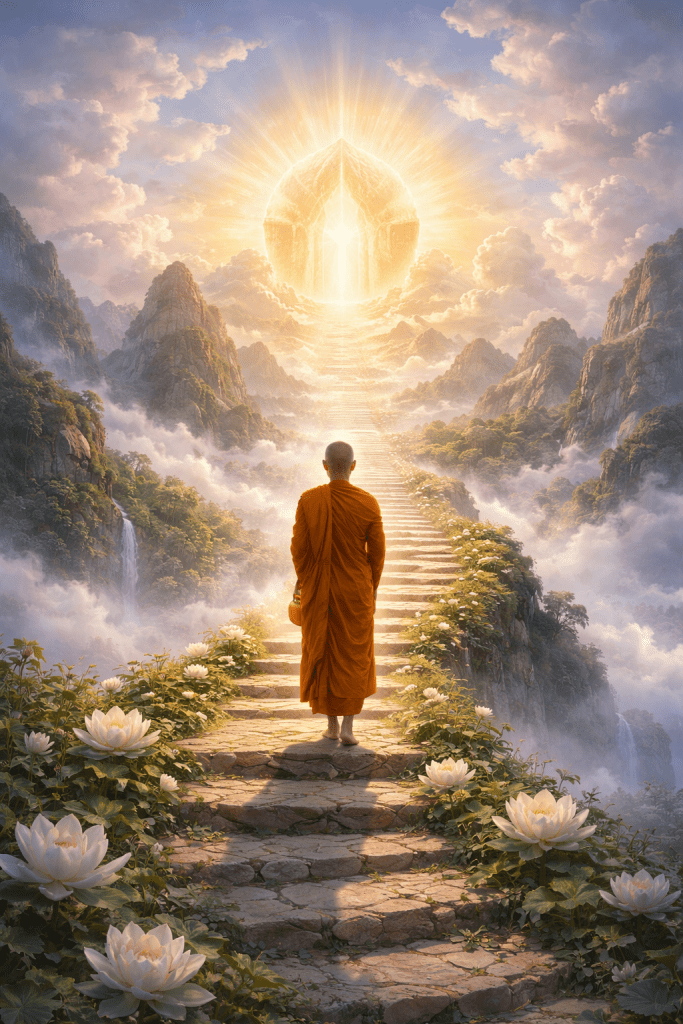
Thus the Walk for Peace ultimately points inward and beyond. The monks’ footsteps across the land symbolize a deeper crossing: from restless worldly becoming to unshakable peace in Nibbāna-dhātu. True harmony among beings rests upon this realization — that the highest peace is not negotiated in the world but realized beyond it.
To recollect Nibbāna-dhatu is therefore to remember the final destination of the path:
the Peace that cannot be lost,
the Freedom that does not depend on conditions,
the Deathless refuge where all journeys end.

 Gautama Dhamma
Leave a comment