
How Internal Identity and Freedom from Social Performance Mature into Pātimokkha Discipline
Introduction
Modern psychology increasingly recognizes that much human suffering does not arise from hardship alone, but from dependence on external validation and the exhaustion of living for others. Two well-established psychological insights illuminate this clearly:
- An internal locus of identity, in which a person’s sense of worth no longer depends on social rituals, recognition, or approval.
- Freedom from people-pleasing, where one ceases to organize life around others’ expectations and reclaims authenticity through firm boundaries.
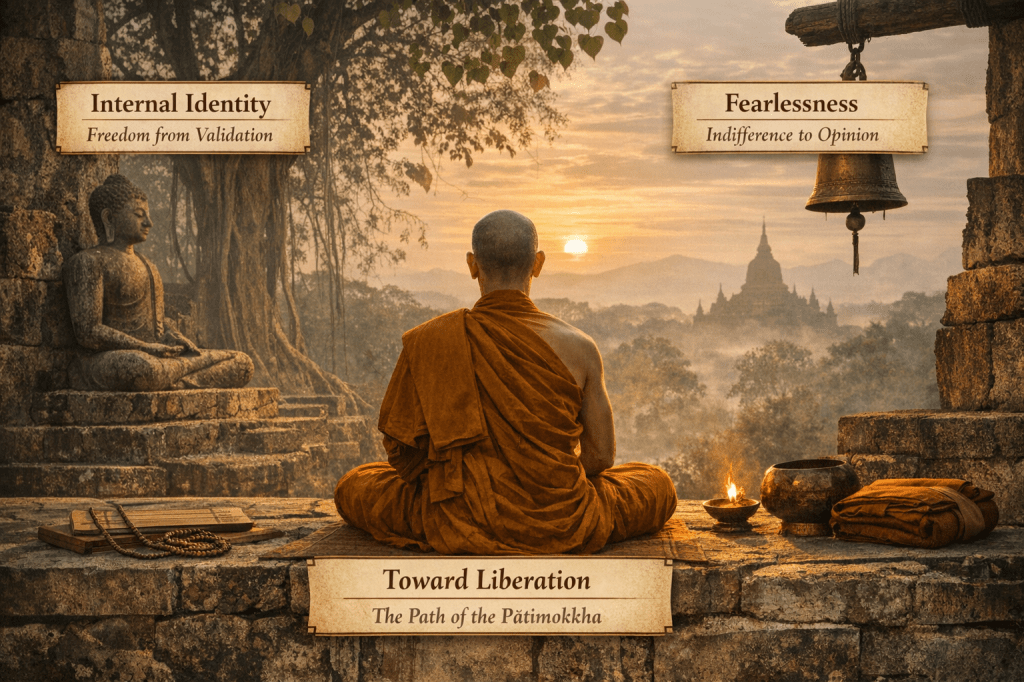
While these insights are often discussed as markers of emotional maturity in lay life, they take on a far deeper significance when viewed through the Theravāda path of renunciation. For a bhikkhu, these same qualities are not optional traits or coping strategies; they are necessary conditions for liberation. They are formalized, stabilized, and protected by the Pātimokkha, whose literal meaning—“toward moksha / liberation”—reveals its true purpose.
I. Internal Locus of Identity and the End of External Validation
Psychology observes that some individuals do not require symbolic affirmations—such as praise, celebrations, or recognition—to feel complete. Their sense of identity is internally anchored rather than socially constructed.
In worldly life
External validation functions as a mirror. One learns who one is by how others respond. This creates dependency, fluctuation, and anxiety, as identity rises and falls with attention and approval.
In the bhikkhu’s life
The Pātimokkha systematically removes identity supports supplied by the world:
- No cultivation of special occasions
- No reinforcement of personal narratives
- No performance for recognition or affection
The bhikkhu’s dignity is grounded in alignment with Vinaya, not in being seen, remembered, or affirmed. This inward anchoring stabilizes the citta, making it less reactive and more capable of sustained samādhi.
Thus, what psychology calls internal locus of identity, the Theravāda path establishes as non-dependence on the world.
II. Continuous Time and the Dissolution of Milestone-Based Identity
Another psychological insight concerns how people relate to time. Those less attached to symbolic milestones experience time as continuous rather than segmented into checkpoints of personal significance.
In worldly life
Milestones—birthdays, anniversaries, achievements—serve as narrative anchors. They reinforce the sense of becoming someone over time and strengthen attachment to identity.
In monastic discipline
The bhikkhu lives without narrative time.
- Growth unfolds through daily restraint and mindfulness
- Purification proceeds gradually, without symbolic markers
- Progress is measured by the weakening of rāga, dosa, and moha
The Pātimokkha dissolves milestone-based identity by redirecting attention to continuous present-moment discipline. This weakens the illusion of self evolving through time and supports disengagement from worldly becoming.
III. Boundary Setting and the End of Emotional Labor
Psychology recognizes that excessive social engagement often involves emotional labor—managing others’ expectations, performing gratitude, and maintaining relational harmony at the expense of inner clarity.
In lay psychology
Choosing fewer, more authentic interactions is a form of healthy boundary setting rather than social withdrawal.
In the bhikkhu’s life
Boundary setting is no longer informal or negotiable. It becomes structural.
- Clear limits on speech, intimacy, and social exchange
- No obligation to entertain, reassure, or reciprocate emotionally
- Relationships governed by Dhamma rather than affective exchange
The Pātimokkha protects the citta from unnecessary depletion. This is not rejection of human connection but withdrawal from emotional economies that bind the mind to the world.
IV. Freedom from People-Pleasing and the Courage to Be Alone
Psychology observes that much human behavior is organized around maintaining connection. People often shape speech, decisions, and even values to preserve belonging. The deepest anxiety is not criticism itself, but isolation. Thus, people-pleasing becomes a strategy to avoid aloneness.
In the world
One seeks agreement, reassurance, and constant interaction. Approval functions as emotional shelter. When interaction decreases, insecurity arises, and one rushes to restore contact through compliance or performance. Identity becomes relationally maintained rather than internally stable.
In the bhikkhu’s training
The training reverses this orientation. The bhikkhu does not cultivate opposition to others; he cultivates independence from the need for psychological company.
The Vinaya gradually removes supports that sustain dependency:
- unnecessary conversation
- habitual companionship
- reassurance through shared emotion
- identity maintained by social feedback
As these fade, solitude is no longer interpreted as deprivation. It becomes clarity.
The citta learns to stand without leaning on interaction. Silence ceases to feel empty; it becomes spacious and steady. One no longer organizes behavior to secure emotional presence from others. This is not indifference to beings, but release from dependence on them.
Thus the training develops fearlessness toward solitude. The bhikkhu can dwell alone without agitation, without the urge to fill space with activity or affirmation. From this stability, concentration deepens naturally, because the mind no longer searches outward for grounding.
What psychology calls freedom from people-pleasing matures, in the monastic life, into contentment in seclusion—a condition necessary for liberation.
V. Disappointment as a Tool of Detachment
Psychology suggests that gradually disappointing others can break people-pleasing patterns and restore authenticity.
In monastic life
This process is formalized.
Every Pātimokkha rule quietly disappoints the world:
- Family expectations
- Cultural norms
- Social reciprocity
The bhikkhu does not confront these expectations aggressively. He simply does not participate. Over time, worldly bonds loosen naturally, without conflict or negotiation. The Vinaya filters relationships automatically, leaving only those grounded in genuine respect for the path.
Conclusion: From Psychological Maturity to Liberation
The psychological tendencies described earlier point toward increasing inner stability. Yet within the bhikkhu’s training they are no longer merely signs of maturity; they become instruments of release.
- Internal identity becomes independence from validation
- Continuous time perception becomes disengagement from personal becoming
- Boundary setting becomes Vinaya restraint
- Freedom from people-pleasing becomes fearlessness toward solitude
The Pātimokkha therefore functions as more than ethical regulation. It reorganizes the relationship between the citta and the world. Social approval loses its governing role, narrative identity weakens, and relational dependence settles into quiet sufficiency.
The bhikkhu does not withdraw out of aversion. He dwells without leaning.
In this non-reliance, solitude is steady rather than empty, silence supportive rather than isolating, and conduct guided by Dhamma rather than reaction.
Psychological autonomy thus matures into renunciation, and renunciation opens the ground for liberation.
For this reason the Pātimokkha truly fulfills its meaning: a discipline oriented toward moksha — freedom from the world’s hold.
 Gautama Dhamma
Leave a comment