
Introduction: Dreams at the Edge of Life
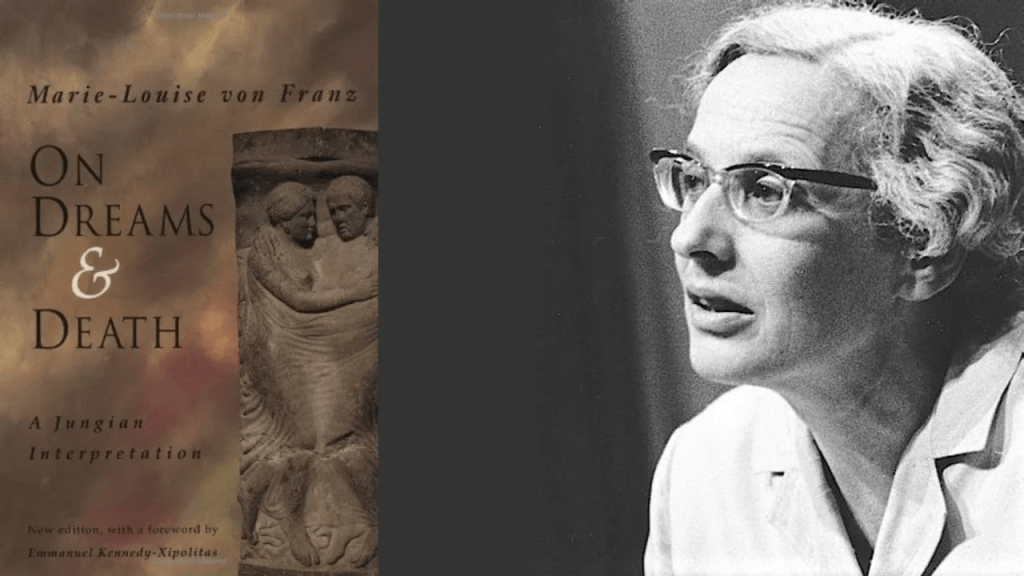
Drawing from the insights of Carl Jung and the work of his closest collaborator Marie-Louise von Franz, particularly her studies collected in On Dreams and Death, dreams arising near the end of life reveal a profound psychological truth:
the subconscious does not approach death as finality.
Where the conscious mind—anchored in the body, social identity, and survival—tends to interpret death as loss or extinction, the subconscious views it as part of a larger psychic process. In dreams, death is rarely represented as annihilation. Instead, it appears as transition, journey, or continuation in another mode of existence.
For Jung and von Franz, this was not speculative philosophy but an empirical conclusion drawn from decades of clinical observation. Thousands of dream reports from elderly, terminally ill, or near-death individuals showed a consistent and remarkable pattern: as physical life wanes, the psyche reorients itself toward timeless, archetypal meaning.
Shifts in Dreaming as Death Approaches
From Personal to Archetypal
As one slowly nears life’s end—through aging, chronic illness, or gradual decline—dreams undergo a clear transformation. Early-life dreams are typically personal and situational, processing relationships, conflicts, ambitions, and fears. Near death, this changes.
Dreams become:
- less autobiographical,
- less emotionally reactive,
- more symbolic and universal.
Jung observed that the psyche withdraws psychic energy (libido) from outer life and invests it in inner reality. This withdrawal is not pathological. It is preparatory. As worldly attachments loosen, dreams increasingly draw material from the collective subconscious—the shared reservoir of universal human symbols and patterns.
Orientation Toward the Collective Conscious
In this phase, dream imagery becomes strikingly similar across cultures, religions, and historical periods. Common motifs appear regardless of personal belief system:
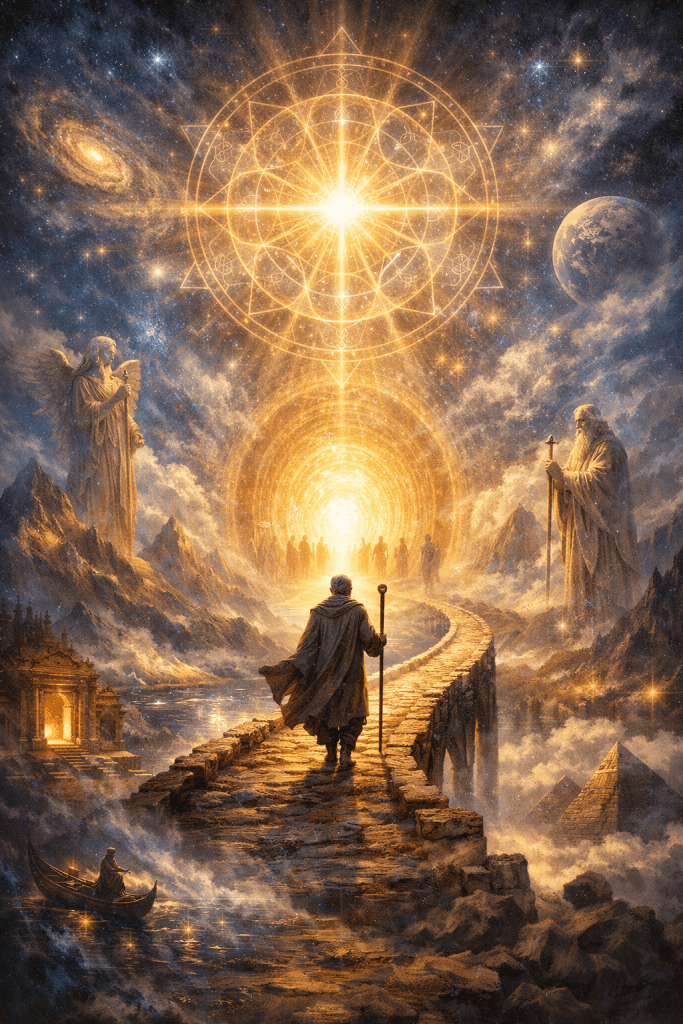
- paths, bridges, rivers, and crossings
- gates, doors, tunnels, and thresholds
- guides, luminous figures, or ancestors
- vast landscapes, stars, or cosmic space
These images are not learned concepts. They arise spontaneously, suggesting that the psyche is orienting itself toward a transpersonal field of meaning that transcends individual biography.
The Subconscious Perspective on Death
Conscious Fear vs. Subconscious Wisdom
The conscious mind is bound to the body. Its reference points are time, continuity, possession, and identity. From this perspective, death appears as rupture and loss.
The subconscious operates differently. It is not limited by linear time or bodily survival. Jung repeatedly emphasized that the subconscious behaves as though continuity, not extinction, is the default condition.
This difference becomes especially visible in near-death dreams.
Rather than depicting:
- emptiness,
- cessation, or
- oblivion,
dreams portray movement, preparation, and passage.
Common Motifs in Near-Death Dreams
Von Franz noted that dreams of the dying are “not about death” in the literal sense. They are about what comes next. Recurring symbols include:
- Preparing for a long journey
Packing, buying tickets, waiting for transport, or saying calm goodbyes. - Crossing thresholds
Entering tunnels, caves, or dark corridors that open into light. - Passage from darkness to light
A symbolic movement from limitation into expanded awareness. - Rebirth or renewal
Images of children, new homes, gardens, or clean water. - Reunion with a beloved
Often deceased relatives or symbolic figures representing wholeness and completion. - Encounters with archetypal figures
Wise elders, guides, luminous beings, or guardians at a boundary.
These symbols consistently express transition rather than termination.
Preparation for Detachment
Withdrawal of Psychic Energy
As death approaches, energy that once animated ambition, social role, and sensory engagement is gradually withdrawn. Jung described this as a natural reversal of libido—from outward expansion to inward consolidation.
Dreams reflect this shift. The psyche rehearses letting go:
- of possessions,
- of status,
- of the body itself.
This inner rehearsal reduces fear and fosters acceptance. Von Franz emphasized that such dreams often bring deep emotional peace, even when the waking condition is physically difficult.
Separation of Mind and Body
At this stage, the mind is no longer tightly confined by bodily perception. Many individuals report:
- heightened intuition,
- panoramic memory,
- symbolic or non-local perception,
- spontaneous psychic sensitivity.
Jung regarded these phenomena as signs that the psyche is no longer fully bound to sensory limitation. The mind begins to function in a more autonomous mode, perceiving subtler layers of reality.
Light, Sacred Geometry, and Cosmic Perspective
A striking feature of near-death dreams is the frequent appearance of light—not merely brightness, but radiant, meaningful luminosity. Jung associated light with expanded consciousness and liberation from spatial constraint.
Equally significant is the appearance of sacred geometry:
- circles, spheres, mandalas,
- symmetrical patterns,
- interwoven forms suggesting unity.
For Jung, the mandala symbolized the Self or Soul—the organizing center of the psyche beyond the ego. Its spontaneous emergence near death indicates psychic integration and completion.
Dreams may also present:
- cosmic vistas,
- planetary perspectives,
- a sense of unity with the universe or omniverse.
These images suggest that the psyche is aligning with larger structures of existence, no longer defined by individual embodiment alone.
Encountering Spirit Source of Mankind
Many near-death dreams include encounters with what dreamers describe as:
- God,
- a divine presence,
- the spirit source of mankind,
- or a universal origin.
Jung approached these experiences carefully. He did not interpret them as hallucinations nor as literal theology. Instead, he understood them as encounters with archetypes of ultimate meaning, arising from the deepest layers of the psyche.
At this threshold, the psyche may perceive both:
- a Manussa (race of man) Source Spirit — the enduring, value-bearing core of human consciousness, and
- a Universal Source Essence — the vast cosmic ground from which forms and realities arise.
Dreams at this stage often reflect humanity’s hybrid nature:
personal yet universal, individual yet rooted in a transpersonal field.
Dreams as Psychological Guidance Toward Continuation
For Jung and von Franz, near-death dreams serve a clear psychological function. They:
- orient the psyche away from bodily fear,
- prepare the mind for detachment,
- and establish continuity beyond physical form.
They do not argue for annihilation. They do not dramatize extinction. Instead, they educate the soul in symbolic language, guiding it gently toward its next mode of being.
The Psyche’s Final Teaching
In the Jungian view, death is not a breakdown of meaning but its culmination. As life draws to a close, dreams become fewer, clearer, and more archetypal—maps drawn from the collective subconscious to guide the departing mind.
They speak of journeys, thresholds, light, unity, and source.
They reflect a psyche that knows—at a level deeper than conscious belief—that existence continues in another form.
Near-death dreams are therefore not merely symptoms of decline.
They are the psyche’s final act of wisdom:
a symbolic preparation for transformation, transition, and continuation beyond the limits of the body.
A Bhikkhu’s Reflection at the End of Life
1). Renunciation as an Early Turning Toward Deathless Clarity
What appears at the end of life for most beings arises much earlier in the life of a bhikkhu.
The gradual withdrawal of energy from ambition, identity, and sensory engagement from the world—so often observed in the dying—is undertaken consciously through renunciation. This withdrawal is not loss. It is clarification.
By stepping away from the noise of the world, the bhikkhu does not move closer to death, but closer to the mind unburdened by fear of death.
2). The World Fades, the Mind Grows Luminous
As worldly engagement loosens, the mind becomes lighter, quieter, and more spacious.
This is the same inward consolidation described in near-death dreams: a turning away from multiplicity toward unity, from effort toward stillness.
In monastic life, this shift is not imposed by illness or decline.
It unfolds through discipline, restraint, and sustained attention to the mind itself.
What the dying encounter briefly, the bhikkhu learns to abide in steadily.
3). Dreams, Samādhi, and the Same Inner Landscape
The archetypal imagery reported by the dying—light, passage, guidance, vastness—belongs to an inner landscape long known to contemplatives.
Through collectedness and absorption, the bhikkhu discovers:
- that the mind is not confined to the body,
- that awareness is not limited by sensory input,
- that peace does not depend on continuity of form.
These are not fantasies of escape.
They are confirmations of inner freedom.
4). Preparing for Death by Living Beyond Fear
Most beings are prepared for death only when the body forces surrender.
The bhikkhu prepares by removing what binds the mind to fear while life is still strong.
This preparation is gentle, gradual, and dignified.
It replaces anxiety with familiarity, resistance with understanding.
When death finally arrives, it does not come as an unknown territory, but as a recognized direction.
5). The End of the Path Is Not an End
Near-death dreams show that the subconscious does not imagine extinction.
The bhikkhu’s life confirms this through practice.
As attachment falls away, what remains is not emptiness, but clarity without grasping, awareness without urgency, and peace not dependent on conditions.
From this perspective, death is neither enemy nor escape.
It is simply the final loosening of what has already been released in the heart.
 Gautama Dhamma
Leave a comment