
Part 3: The Shadow — Human Evilness and the Distortion of Collective Values
I. From Altruism to Its Shadow
Altruism does not begin as a moral ideal. It begins as instinct.
In its most basic form, altruism arises from survival logic: care for offspring, protection of kin, cooperation within a group. At this level, altruism is functional. It serves continuity, not virtue. Many social animals display it. There is no moral choice involved—only biological mandate.
In human beings, however, altruism can mature beyond instinct.
Because humans possess reflective consciousness and moral awareness, altruistic behavior can be chosen by individual consciousness rather than compelled. Care can be extended beyond kin. Responsibility can be assumed without immediate benefit. At its highest expression, altruism becomes moral nobility: action guided by value rather than survival advantage.
This is the point at which altruism becomes genuinely human.
Yet this same capacity contains a latent inversion.
When altruism is absorbed by collective identity, it mutates.
Instead of expressing care rooted in moral discernment, it becomes loyalty. Instead of protecting life, it protects the group. Instead of restraining harm, it justifies it. Altruism ceases to be an act of conscience and becomes a function of alignment.
This inversion is subtle and dangerous because it does not remove empathy—it redirects it.
Human evil, therefore, is not the absence of empathy.
It is empathy captured by misaligned collective consciousness.
In such cases, empathy is fully operative—but selectively. Care is extended inward to the group while being withdrawn from those defined as outsiders, enemies, or obstacles. The emotional force of altruism remains intact; only its moral orientation changes.
History shows that this form of empathy is often more lethal than indifference.
A person who feels nothing may harm sporadically.
A person who feels deeply for the group can harm systematically.
This dynamic is precisely what early Buddhist teaching identifies as māna—conceit or pride.
In the teaching of Gautama Buddha, moral error does not arise only from selfishness. It also arises from identification. Placing the individual self above others is māna. Placing one’s group, identity, or collective above others is also māna.
Both are expressions of the same distortion:
the elevation of identity—personal or collective—into a moral reference point.
From this perspective:
- Acting “for myself” is conceit
- Acting “for my people, my nation, my ideology” is also conceit
Neither represents true compassion.
True kindness, in the Buddha’s teaching, does not begin from the individual self, and it does not end in collective supremacy. It arises from non-identification—from restraint, clarity, and freedom from pride-based alignment. When identity governs action, even noble intentions become contaminated by comparison, exclusion, and justification.
This is why altruism, when captured by collective identity, does not merely fail.
It becomes the engine of cruelty.
The transition from altruism to its shadow does not require hatred. It requires only misalignment—the quiet shift from value-based discernment to identity-based obligation. Once that shift occurs, violence can be experienced as responsibility, exclusion as justice, and destruction as moral necessity.
The cases that follow demonstrate this transformation at scale.
They show how altruism, untethered from moral sovereignty and absorbed into collective identity, becomes one of the most powerful forces driving human evil—not by erasing empathy, but by placing it in the service of survival, dominance, and pride.
II. The Layered Structure of the Human Mind
The human mind does not function as a single, unified psychological field.
It operates across multiple layers of consciousness, each with its own logic, scope, and authority. These layers are not speculative constructs; they are observable in human behavior across cultures, history, and social organization.
Human existence arises from multiple inherited lineages of consciousness, expressed through the human body. The body functions as the interface through which these lineages operate in the world. Some of these lineages are oriented toward survival and adaptation. Others carry value, memory, responsibility, and moral orientation that are not reducible to survival advantage.
At the foundational level, human behavior is shaped by animal survival consciousness, inherited from primate life. This layer governs threat detection, stress response, and immediate reaction. Its primary mechanisms include fear, aggression, territorial defense, dominance behavior, competition for resources, and protection of in-group members. These mechanisms are biologically embedded and operate rapidly, often bypassing reflective judgment.
This layer is effective for survival. It is not designed for moral reasoning.
Above this foundational layer, human consciousness organizes itself into collective identity structures. These structures include, but are not limited to:
- Individual self-identity
- Family and kinship networks
- Ethnic or tribal affiliation
- National and state identity
- Religious and ideological systems
- Species-level and civilizational narratives
Each collective layer extends the scope of belonging beyond the individual and carries increasing symbolic, emotional, and normative weight. These layers do not replace survival consciousness; rather, they mediate and amplify it, giving it narrative coherence, legitimacy, and moral framing.
As collective layers expand in scale, they exert greater psychological authority over the individual. Loyalty to a family can override personal preference. Loyalty to a nation or ideology can override family bonds. At higher levels, collective imperatives can dominate moral judgment entirely.
Crucially, collective consciousness does not inherently elevate moral quality.
It organizes motivation, not value.
Within these collective layers exists a distinct lineage-oriented divine ancestral moral consciousness. This collective is characterized not by survival, power, or dominance, but by values such as responsibility, restraint, truthfulness, and care that extend beyond immediate group advantage. It represents a moral orientation rather than a power structure.
Alignment with this collective is neither automatic nor guaranteed. Membership in a religion, culture, or moral tradition does not ensure alignment. Alignment requires conscious choice, discipline, and sustained commitment. It can be lost, abandoned, or overridden by other collective loyalties.
Human behavior is therefore shaped by which collective layer holds governing authority at the moment of action.
Empathy must be understood within this layered structure.
Empathy is not a moral principle.
It is a capacity for resonance—the ability to emotionally and cognitively connect with others across individual and collective boundaries. This capacity is morally neutral. It can serve any layer of consciousness.
A human being may empathize primarily with family members, with an ethnic group, with a nation, or with an ideological collective. Empathy intensifies connection within the aligned collective, but it does not determine whether that connection is morally grounded.
This is where danger arises.
Higher collective layers exert stronger emotional and normative pressure than individual conscience. Under such pressure, moral discernment can be subordinated to loyalty, obligation, or perceived necessity. Actions are no longer evaluated on the basis of right and wrong, but on whether they serve the collective to which one is aligned.
What religious traditions have called “original sin” describes this condition precisely:
the habitual dominance of survival-based and power-based collective alignments over value-based divine ancestral moral alignment.
The issue is not the presence of fear or anger. These belong to survival.
The issue is authority—whether these impulses are governed by moral discernment or justified through collective structures.
Animals kill to survive.
Humans kill when survival impulses are institutionalized, justified, and enforced through collective identity. In such cases, violence is experienced as obligation, necessity, or righteousness rather than harm.
This layered structure explains why human evil is scalable.
As collective scope increases, individual accountability diffuses.
As abstraction increases, concrete human suffering becomes easier to ignore.
As alignment strengthens, moral hesitation weakens.
Understanding this structure is essential for examining historical atrocities. Without it, mass violence appears as madness or anomaly. With it, a consistent pattern emerges: not the absence of empathy, but its capture by misaligned collective authority.
The cases that follow illustrate this pattern with clarity, showing how layered collective consciousness, when aligned with survival and power rather than value, produces systematic human evil.
III. From Survival to Alignment: How Human Cruelty Becomes Systematic
Any serious account of human evil begins with a biological and psychological foundation.
Life in this world operates through survival. Within animal existence, destructive behavior appears through individual survival drives and kin-level collective behavior. Birds destroy neighboring nests to secure their own offspring. Mammals defend territory aggressively. Predators eliminate rivals. These actions arise from survival necessity and lineage protection. Life is destroyed under pressure rather than moral choice.
This baseline matters because survival is fundamentally predatory. In this world, all life sustains itself by consuming life force. The underlying condition of existence is simple: to survive is to take, and to fail to take is to be consumed.
Human beings inherit these same survival mechanisms—fear, aggression, dominance, territorial defense—but human existence adds decisive structural elements: a strong individual consciousness layer, and layered collective consciousness combined with moral capacity.
The individual consciousness layer introduces self-awareness, memory, anticipation, and agency. A human being experiences himself as an “I” who chooses, aligns, and bears responsibility. This layer is capable of restraint as well as surrender.
Above the individual layer, human life organizes into collective identities—family, tribe, class, nation, ideology, and state. These collectives do not determine behavior by themselves. They offer fields of alignment.
This is the decisive point.
At the individual layer, a human being chooses alignment.
Alignment may be with power-based collectives, governed by survival logic, fear, dominance, and control.
Alignment may be with value-based lineage, governed by restraint, responsibility, truth, and care beyond survival advantage.
Human cruelty becomes systematic when individual consciousness repeatedly aligns with power-based collectives.
When this alignment stabilizes, individual moral sovereignty yields to collective authority. Fear becomes sustained vigilance. Dominance becomes institutional structure. Group defense expands beyond kin into large-scale identities capable of mobilizing populations. Survival logic is enforced through norms, laws, rewards, and punishments.
Cruelty becomes systemic.
Human evil emerges when survival consciousness—fear of threat, desire for control, intolerance of difference—governs moral judgment through collective alignment. The individual still chooses, but chooses in obedience to power. Violence acquires legitimacy. Destruction carries obligation. Killing appears as responsibility rather than transgression.
This condition produces perverted altruism.
Harm is carried out for security, purity, justice, order, or victory. The individual experiences himself as acting morally for something larger than himself. Empathy remains active, even intense, but becomes selectively bound to those inside the aligned collective. Moral concern narrows. Human life outside that boundary loses weight and visibility.
The historical cases examined in this article—Nazi Germany, Khmer Rouge Cambodia, Indonesia (1965–66), the Siege of Changchun, and Maoist China—demonstrate the same structure at scale:
- Individual consciousness aligning with power-based collectives
- Collective authority grounded in fear and dominance
- Empathy restricted to insiders
- Cruelty normalized as necessity
Communism demonstrates this mechanism with exceptional clarity.
This is how evil scales within human societies.
At the group level, loyalty governs judgment.
At the national or ideological level, power eclipses dignity.
At the civilizational level, entire populations become expendable.
Human cruelty exceeds anything found in nature because humans combine individual agency, collective enforcement, and chosen alignment with power into enduring systems.
The cases that follow reveal how ordinary human beings repeatedly choose alignment with power-based collectives and silence the value-based moral capacity available to them.
The shadow exposed here arises from misalignment—the repeated choice to serve power over value, dominance over restraint, survival over responsibility.
That choice, multiplied across individuals and generations, defines the structure of human evil.
IV: Communism as a Power-Aligned Secular Religion: How Collective Cruelty Becomes Systematic
Human cruelty becomes systematic when individual consciousness either chooses to align with, or surrenders itself to, power-based collectives. This alignment can be active or passive, deliberate or fearful, but its effect is the same: moral sovereignty shifts away from the individual and is absorbed by a collective governed by survival, dominance, and control.
Communism provides one of the clearest historical demonstrations of this mechanism.
Power-Based Alignment and the Suppression of Individuality
Across its historical forms, communism consistently orients itself toward power-based alignment rather than value-based restraint. Its defining feature is the systematic suppression of individual moral conscience in favor of collective authority.
This manifests repeatedly as:
- hostility toward independent thinking
- eradication of moral authority outside the state
- criminalization of deviation
- elimination of spiritual, familial, and ethical autonomy
Intellectuals, religious practitioners, artists, teachers, and small property holders become primary targets because they preserve individual moral discernment that resists collective domination.
From your framework, this pattern reflects alignment with a power-based force whose operational logic centers on control, uniformity, obedience, and domination rather than responsibility, restraint, and value. Communism does not merely misuse power; it organizes society around it.
Individual Choice and Collective Surrender
Human beings possess an individual consciousness layer capable of discernment. Some individuals actively choose alignment with power-based collectives, attracted by authority, certainty, or dominance. Others surrender alignment under fear, insecurity, or desire for belonging. Both paths lead to the same outcome.
When individual conscience yields—by choice or by weakness—collective cruelty becomes normalized.
Empathy does not disappear. It is redirected inward toward the collective while excluded from those defined as enemies, deviants, or obstacles. Violence then appears responsible rather than cruel.
Communism as a Secularized Religion of Power
Although modern communist movements present themselves as rational, scientific, and anti-religious, they consistently reproduce the structural mechanisms of organized religion, especially those designed to regulate conscience, loyalty, and moral conformity at scale.
This resemblance reflects the reuse of effective governance technologies rather than theological belief.
Sacred Symbols and Initiation
Communist youth organizations employ uniforms and symbols that function identically to religious vestments.
- Red neckerchiefs signal loyalty, sacrifice, and belonging.
- Uniformity suppresses individuality and establishes moral identity.
- Initiation marks entry into a sanctioned moral community.
These symbols operate as instruments of moral alignment rather than decoration.
Confession and Moral Surveillance
Communist systems institutionalize confession through:
- self-criticism sessions
- public admission of ideological deviation
- denunciation of others as proof of loyalty
This mirrors religious confession in function: inner life becomes externalized, moral authority transfers upward, and psychological dependence on the institution deepens. Conscience becomes monitored rather than cultivated.
Orthodoxy and Punishment
Communism reproduces a complete moral enforcement structure:
| Religious Form | Communist Form |
|---|---|
| Orthodoxy | Party line |
| Heresy | Ideological deviation |
| Sin | Counter-revolutionary thought |
| Excommunication | Expulsion, imprisonment, execution |
| Apostasy | Betrayal of the people |
Deviation is treated as moral corruption and existential threat rather than disagreement.
Canon and Authority
Canonical texts and leaders function as scripture and infallible authority in practice. Interpretation remains centralized. Dissent signals moral failure rather than inquiry.
The claim of scientific objectivity masks a closed moral system where truth flows downward from power.
Eschatology and Justified Suffering
Communism operates through a deferred-salvation narrative:
- present suffering justified by future liberation
- mass sacrifice framed as historical necessity
- moral evaluation postponed indefinitely
This mirrors religious millenarianism, with history replacing divine judgment and utopia replacing heaven.
Elimination of Competing Moral Authority
Communist hostility toward religion functions strategically. Independent spiritual lineages preserve allegiance beyond the state and cultivate inner moral sovereignty. Such allegiance directly threatens total control.
Monks, nuns, priests, and spiritual teachers are targeted not for superstition, but for loyalty outside the collective.
Structural Meaning
These parallels demonstrate that communism functions as a secular religion of power. Its purpose is not merely economic reorganization, but moral capture.
It seeks to:
- absorb conscience into collective authority
- ritualize obedience
- moralize coercion
- suppress individuality
- justify cruelty as virtue
What appears as political ideology operates, at a deeper level, as organized survival consciousness aligned with power. Human evil does not arise from lack of empathy. It arises when empathy, conscience, and moral language are captured by power-based collective alignment.
Communism persists because it resonates with a latent human capacity: the willingness to surrender moral responsibility in exchange for security, belonging, or authority. It is sustained by enduring human lineages and institutions that benefit from centralized control, and it reappears wherever power-based alignment eclipses value-based restraint.
The danger, therefore, lies neither in belief nor in ideology alone, but in alignment.
When individual consciousness repeatedly aligns with collectives governed by power rather than value, cruelty scales, responsibility dissolves, and history records atrocity as necessity.
This is not an external corruption imposed upon humanity.
It is a recurrent expression of human nature when power governs conscience.
V. The True Nature of the Shadow — and Gautama Buddha’s Teaching on Value Alignment
Human evil does not originate from an external force, a fallen group, or a corrupted minority. It arises from misaligned consciousness—from the repeated surrender or choice of individual awareness to collective alignments governed by survival and power rather than value.
At its core, the shadow appears when higher collective layers hijack the individual. Family, tribe, nation, ideology, or historical mission absorbs moral agency upward, relieving the individual of responsibility while intensifying the scale of action. As the collective grows larger and more abstract, cruelty becomes easier to rationalize and harder to feel personally accountable for. Responsibility diffuses. Harm is reframed as necessity. Conscience is replaced by alignment.
The danger, therefore, has never been empathy itself.
Empathy is a connective capacity. It binds beings together. Yet without discernment, empathy readily attaches to whichever collective offers protection, belonging, or purpose. When that collective is aligned with survival and power, empathy narrows rather than expands. It protects insiders while rendering outsiders invisible or expendable.
This is why the decisive issue is alignment, not emotion.
Gautama Buddha’s teaching directly addresses this problem—not by suppressing empathy, nor by retreating into individualism, but by establishing a value-based alignment that neither privileges the self nor sacrifices the self to the collective. In this teaching, placing oneself first and placing others or the collective first are both expressions of māna—conceit and misorientation. Liberation requires a different axis altogether.
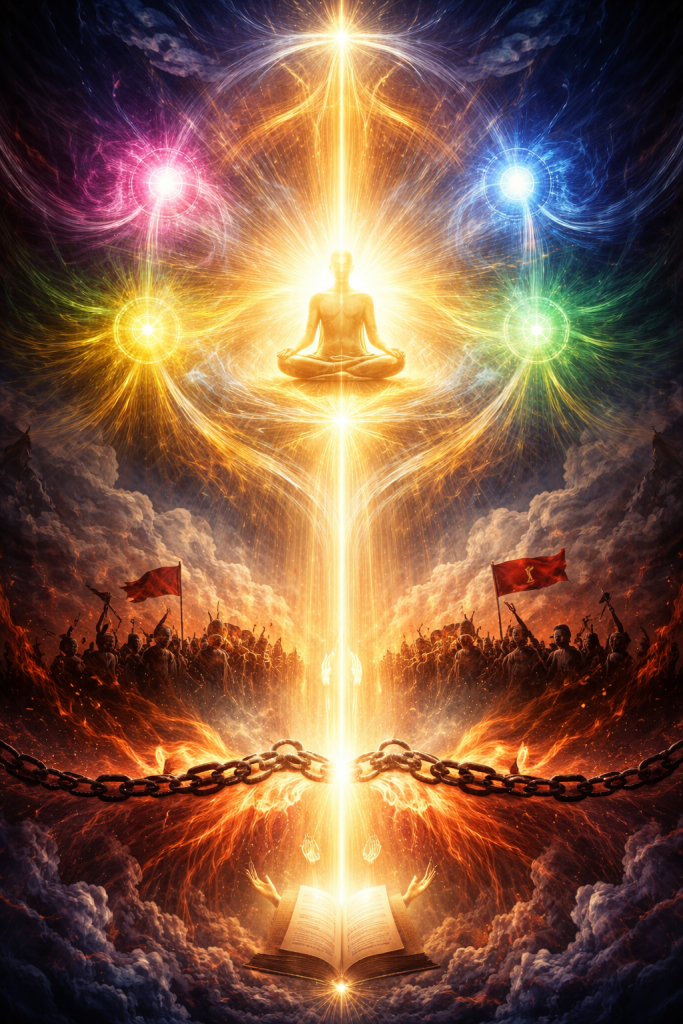
That axis is expressed through the Brahmavihārā, the Four Sublime Abodes:
- Mettā — kindness grounded in goodwill rather than attachment
- Karuṇā — compassion that responds to suffering without domination
- Muditā — Brahmic joy that rejoices in the celestial ancestral value alignment
- Upekkhā — transcendence that stands beyond human limits such as fear, favor, and aversion
These are not private virtues or emotional states. They function as a foundational value system—the ethical orientation of Brahma-aligned societies and lineages. They represent alignment with a collective grounded in value rather than power.
From this alignment arise coherent collective values that stand in direct contrast to the omniverse’s dominant law of hierarchy and conquest. These include:
- Justice — impartial restoration of balance and protection of the vulnerable
- Fairness — consistent ethical standards without favoritism or privilege
- Equality — recognition of the intrinsic worth of every conscious spark
- Democracy — shared stewardship of social harmony and recognition of every voice
- Honesty — unwavering truthfulness, including self-honesty
- Kindness — active goodwill extended without calculation
- Courage — steadiness in the face of danger, doubt, or pressure
- Honor — fidelity to one’s word and principles
- Loyalty — devotion to allies and to the higher cause of value
- Self-sacrifice — placing the greater good above personal gain
- Humility — strength used to uplift rather than dominate
- Chivalry — special defense of the defenseless
- Truth-seeking — relentless pursuit of deeper wisdom and reality
Together, these values form a luminous ethical foundation that distinguishes Brahma-aligned civilizations from power-based collectives. They enable cooperation without coercion, authority without domination, and belonging without erasure of conscience.
The shadow, then, is not the presence of survival instincts, fear, or anger. It is the failure to restrain and reorient them when restraint is possible. It is the repeated choice—by individuals and societies—to align with power rather than value, dominance rather than responsibility.
Gautama Buddha’s teaching offers a clear resolution:
inner restraint, discernment, and alignment with a value-based collective that preserves moral sovereignty rather than consuming it.
The historical cases examined in this article stand as warnings, not aberrations. They show what occurs when humanity mistakes collective power for moral truth and survival alignment for destiny. The path forward lies in choosing differently—again and again—until alignment itself becomes the measure of what it means to be human.
 Gautama Dhamma
Leave a comment