
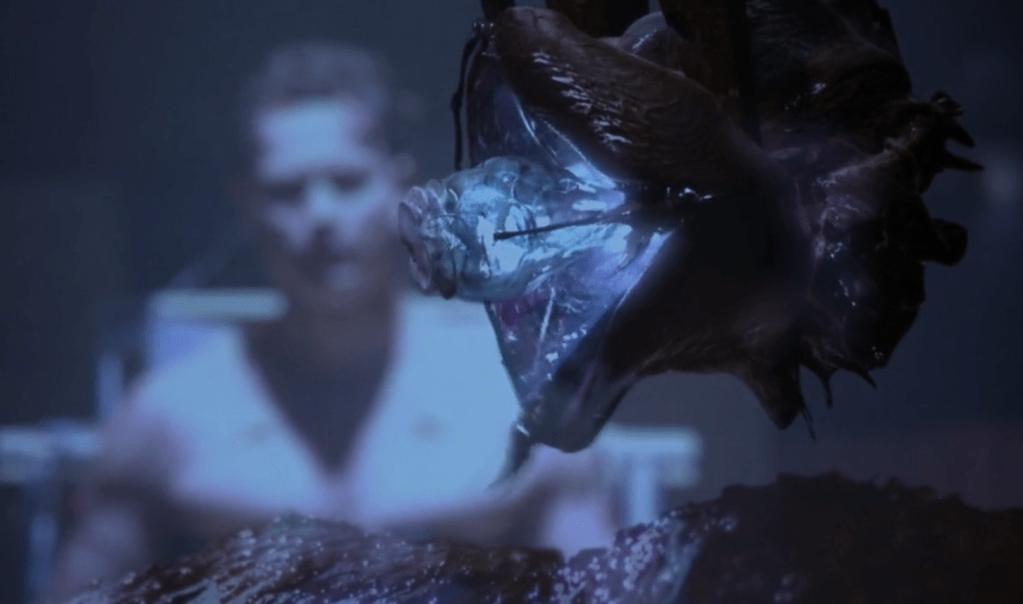
The 2001 film Impostor, adapted from Philip K. Dick’s short story, is set in a dystopian future where Earth is locked in a prolonged war with an unseen alien enemy. These enemies deploy organic replicas—biological copies of humans implanted with hidden explosive devices, programmed to destroy specific targets.
At the center of the story is Spencer Olham, a brilliant weapons designer whose life unravels when he is accused of being one of these impostors. Hunted by authorities and cut off from all trust, he flees through a world where identity itself has become suspect. His only hope is to prove that he is truly human.
The story ends in a devastating revelation: Olham discovers that both he and his wife are replicants. The moment of self-realization triggers the bomb inside him, annihilating both the impostor and the surrounding area.
Impostor is more than a science-fiction thriller. It is a meditation on identity, consciousness, and the cost of mistaking imitation for being.

Imitation Is Not Identity
The impostors in the film are biologically identical to humans and possess:
- complete personal memories,
- emotional responses,
- habits, attachments, love, and fears.
They believe themselves to be human. From the inside, their experience is indistinguishable from that of the original person. There is no sense of falseness, no awareness of duplication. Both the conscious mind and the subconscious mind function normally, because both are seated in the brain—and the brain has been perfectly copied.
For this reason, no medical, psychological, or empathy-based test can expose the impostor. Memory, emotion, moral feeling, and instinct are all present and sincere.
And yet, the film insists that something essential is missing.
Memory, emotion, and personality form the outer mask of identity. They can be copied, transferred, and reconstructed. But they are not the totality of what it means to be human. What is absent lies deeper than cognition and feeling—beyond what any test can measure—revealed only when imitation collides with reality itself.
The Heart Beyond Biology
Although the impostors possess beating hearts and living bodies, the film points toward a deeper meaning of “the heart”—one that is not biological.
This heart is not an organ, a chemical process, or a data structure. It is the irreducible core of subjectivity: the inner continuity that makes a life truly one’s own. It cannot be manufactured or implanted, because it is not a thing. It is a presence.
The tragedy of the impostor is not that it lacks intelligence or feeling. It is that it lives convincingly as a human while being severed from the deeper continuity that makes that life real.
Identity Beyond What Can Be Copied
Impostor forces a fundamental question:
If every observable feature of a human being can be duplicated, what remains uniquely human?
The film’s answer is clear. Humanity does not reside in:
- physical form,
- neural patterns,
- memory,
- or emotional expression.
All of these can be replicated.
Instead, identity points toward something that resists copying altogether—an inner core that grounds consciousness across time and cannot be substituted. In a world of perfect replicas, the true boundary of the human is not external verification, but an intrinsic quality that cannot be reproduced.
Identity and the Layered Self
This insight aligns naturally with a layered understanding of the self. Identity is not confined to the surface layers of biology and psychology. It extends through deeper strata of continuity—individual, collective, and ultimately universal.
An impostor can convincingly occupy the surface layers: memory, behavior, social role. What it lacks is the deeper linkage—the authentic continuity that ties an individual life into the larger fabric of existence.
Its identity is structurally hollow. Perfectly functional, yet fundamentally disconnected.
Final Reflection
As replication technologies—biological, digital, and ideological—move ever closer to perfection, Impostor asks a question that grows more urgent with time:
Is humanity defined by what can be copied, or by what cannot?
The film offers a stark answer. The cost of being a perfect copy is total. When identity is reduced to replicable components, something essential is lost—not visibly, not immediately, but fatally.
Humanity resides not in imitation, but in the irreducible core that no copy can ever contain.
 Gautama Dhamma
Leave a comment