
Part 2: Extending the Meadow to the Sea — Titanic’s Noble Human Altruism
From Instinct to Deliberation
In the natural world, altruism often appears sudden and instinctive. A squirrel’s warning cry erupts without reflection—an archetypal reflex embedded deep in the species’ survival code. It is fast, automatic, and costly, yet largely unchosen.
Human altruism carries another dimension: the individual level of conscious choice, where individual ego, reflection, and free will shape action.
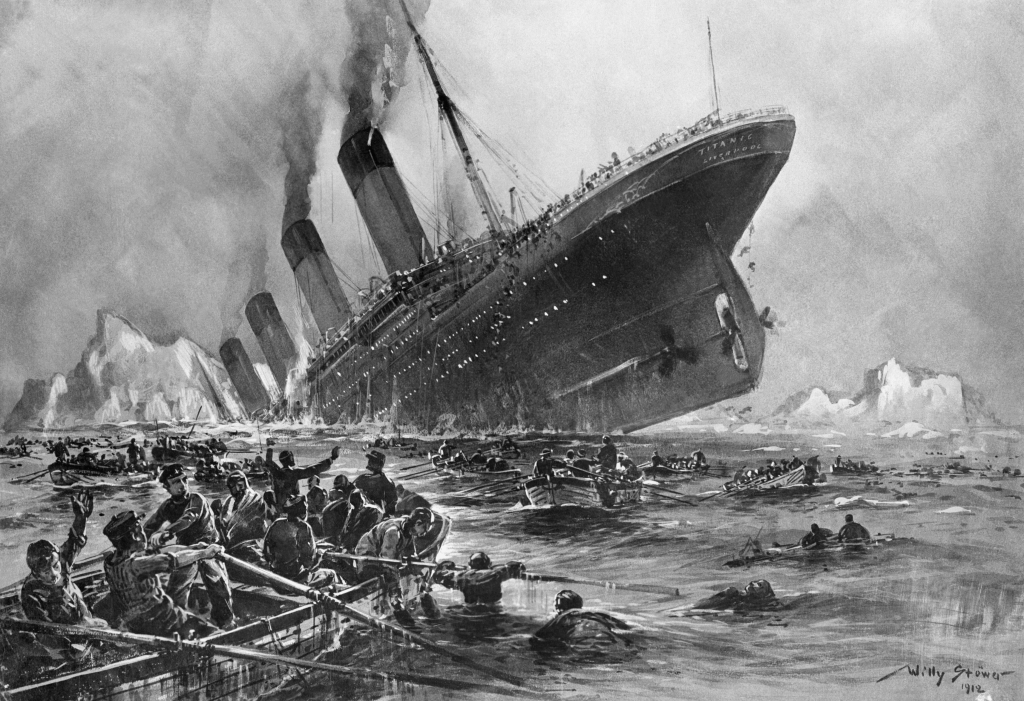
In April 1912, aboard the RMS Titanic, humanity was given time—time enough not merely to react, but to choose. The ship’s slow, two-hour descent created a rare moral laboratory where fear, honor, duty, and meaning stood exposed.
The outcome was striking. Survival rates favored women (roughly 70–74%) and children far more than men (around 20%). This was not enforced solely by officers. Again and again, men stepped aside voluntarily. What unfolded was not blind instinct, but value-driven action.
Chosen Sacrifice: Portraits of Individual Noble Altruism
Indivisible Devotion — Isidor and Ida Straus
Isidor Straus and Ida Straus embodied a form of altruism rooted in love and dignity rather than survival calculus. When Ida was offered a seat in Lifeboat No. 8, she refused:
“I will not be separated from my husband. As we have lived, so will we die, together.”
When Isidor was offered a place because of his age and status, he declined, insisting that no other man be displaced. Ida gave her fur coat to her maid, Ellen Bird, so that another might live. The couple was last seen standing arm-in-arm on deck, choosing shared fate over private escape.
This was altruism extending beyond biology—an assertion of meaning over continuation.
The Engineers — Silent Guardians Below Deck
Deep in the ship’s core, the engineering crew enacted a sacrifice as absolute as any monastic vow. Firemen, greasers, and engineers stayed at their posts, keeping the boilers running as seawater rose.
Their actions ensured that:
- the lights remained on, preventing panic,
- the wireless stayed powered, sending distress calls,
- the pumps continued, slowing the sinking just enough to launch more boats.
None of the 35 engineers survived. Their altruism was unseen, anonymous, and total—service rendered without witness or reward.
The Eight Musicians — Order Against Panic
Led by Wallace Hartley, the Titanic’s eight musicians gathered on deck and began to play. Ragtime first, then hymns. Not for hope of rescue, but to steady trembling minds.
As the deck tilted and the sea crept higher, they continued. All perished.
This was altruism aimed not at bodies, but at the psyche—a deliberate offering of calm in the face of terror.
Father Thomas Byles — Spiritual Presence at the Edge
Thomas Byles, traveling to New York to officiate his brother’s wedding, twice refused a place in a lifeboat. Instead, he remained on deck, hearing confessions, offering absolution, and leading prayers for those trapped on the stern.
As the ship went under, he stood among the doomed, providing spiritual shelter when physical escape was gone.
This was altruism operating on the deepest human layer: meaning at the threshold of death.
Benjamin Guggenheim — Dignity as Moral Gesture
Benjamin Guggenheim and his valet Victor Giglio recognized the truth early: there were not enough boats. Rather than compete, they returned to their cabin, changed into formal evening wear, and re-emerged on deck.
Guggenheim reportedly said:
“We’ve dressed up in our best and are prepared to go down like gentlemen.”
By refusing to struggle for survival, he left space—literally and morally—for others to live.
From Group Consciousness to Individual Choice
In animals, the group consciousness acts through the individual; in humans, the individual can act beyond the group.
In animals, altruistic behavior arises from group survival patterns rather than individual deliberation. The warning call of a squirrel or the self-endangering defense of a herd member is not a personal moral choice; it is the group consciousness acting through the individual body. The individual organism responds automatically, guided by species-level intelligence optimized for collective survival.
Human beings carry this layer as well—but they are not limited to it.
Humans possess an additional level of consciousness: the individual layer, where ego-awareness introduces pause, reflection, and choice. Instinct may arise, but it does not automatically command action. Values—honor, kindness, compassion—can intervene.
On the Titanic, time preserved this individual layer. Group panic did not fully override personal conscience. Men were able to weigh fear against duty, survival against meaning, and act accordingly.
This is the human threshold.
Animal altruism expresses the intelligence of the group. Human altruism, at its highest, expresses the freedom of the individual to align with values that transcend survival. This capacity—to allow consciousness to rise above instinct rather than be driven by it—marks the transition from biological altruism to moral altruism.
The Layered Self: From Individual to Universal
To understand this difference, we must look beyond genes and bodies to the Layered Self—a model of consciousness unfolding across scales.
1. Individual Layer
Genes shape traits—temperament, strength, vulnerability—but consciousness here experiences itself as personal choice. Epigenetics introduces flexibility: lived experience, stress, meditation, and moral resolve modify expression, like updating internal software.
2. Family / Group / Ethnic Layer
Shared ancestry and culture create collective identity. Rituals, language, and inherited memory shape instinctive loyalties. Altruism often concentrates inward—protecting kin, tribe, or nation.
3. Species / Collective Layer
At this scale, humanity carries shared moral archetypes: fairness, care for the weak, reverence for life. These values surface in convergent patterns across cultures, suggesting a deeper ancestral consciousness guiding the species as a whole.
4. Universal / Source Layer
Beyond species lies a unifying consciousness—the field from which individual awareness arises and toward which it gravitates. Altruism at this level no longer serves replication or identity; it serves coherence. The self widens until “other” dissolves.
Karma, Imprint, and Moral Gravity
Each layer accumulates imprints:
- Epigenetic marks in bodies,
- Memetic patterns in cultures,
- Ethical trajectories in civilizations.
A single selfless act ripples upward. The engineers’ sacrifice strengthened collective survival. The musicians’ calm preserved social order. The Strauses’ devotion etched a moral exemplar into human memory.
Altruism, then, acts like gravity—not pulling inward toward self-preservation, but outward toward unity. It reveals what the “human” truly is when fear loosens its grip.
Closing Reflection
The Titanic was not merely a maritime tragedy. It was a mirror that humans can choose instinct—or meaning. They can shrink into survival, or expand into values that outlive the body. In those freezing Atlantic waters, many chose the latter.
In the next episode, we turn to the dark inversion of altruism: how devotion to kings, empires, and ideals can override conscience and magnify cruelty. We will examine why ordinary people commit extraordinary evil—not for personal gain, but in the name of loyalty, duty, or “higher purpose”—and how, when values are no longer held at the individual level, the human capacity for moral choice can be captured, scaled, and weaponized.
 Gautama Dhamma
Leave a comment