
Introduction
Welcome to the inaugural piece in our series, Layers of Self: Rediscovering Human Nature. In this exploration, we delve into the essence of who we are, challenging conventional notions that tie identity to fleeting elements like memory, physical form, or personality traits. Instead, we posit that our true self is forged in the crucible of values—the ancestral-world-transcending principles that guide our actions, connections, and purpose. Values transcend the individual ego, weaving us into broader tapestries of existence, from personal choices to ancestral inheritance and universal harmony.
This first article centers on the profound interplay of selfishness and altruism—two complementary yet asymmetric forces that manifest differently across the layers of consciousness: selfishness anchoring at the individual level as a baseline of self-preservation, altruism ascending through group, species, and universal layers toward connection and harmony. Are these forces mere biological imperatives or psychological constructs? Or do they emerge from different strata of awareness, where the individual self dances with collective forces, and sometimes with darker distortions? We begin in nature’s subtle dramas with Paul Sherman’s study of Belding’s ground squirrels, ascend to human nobility on the sinking Titanic, confront the shadow of deliberate human evilness, and close with reflections on what these patterns reveal about our layered identity. Join me in this reflective journey from thoughtful crossroads, as we uncover how values—not biology alone—define our humanity.
Part 1: Altruism by Group Consciousness – Paul Sherman’s Study on Belding’s Ground Squirrels
Summary: Apparently altruistic or self-sacrificial behaviors in animals are typically instinctual, driven by genetic mechanisms, and often nepotistic—meaning they primarily benefit close kin (relatives sharing genes) rather than the group or species as a whole.
From the perspective of layered consciousness, animal altruism reflects the group or collective layer of awareness overriding the individual layer. In highly social or kin-based species (like Belding’s ground squirrels in matrilineal colonies, social insects, or pack animals), behaviors appear scripted by collective dynamics—pheromones, kin recognition cues, colony needs, or inherited instincts—that prioritize group/kin survival over personal self-preservation. This “collective consciousness” operates as a dominant force because animals generally have limited development of individual consciousness: their awareness is more reflexive and cue-driven, with little room for deliberate, reflective choice or overriding personal ego.
This dynamic is easy to observe in animals due to their constrained individual agency. For instance, a worker bee’s suicidal sting or a ground squirrel’s risky alarm call isn’t an individual conscious moral decision—it’s an instinctive response shaped at the collective level, where the “self” is much more embedded in kin or colony success. In contrast, humans can access higher layers of individual awareness, allowing genuine individual choice (free will) to transcend pure instinct or group scripting, potentially leading to value-based altruism that extends beyond kin or immediate collective benefit. We will examine this in part 2.
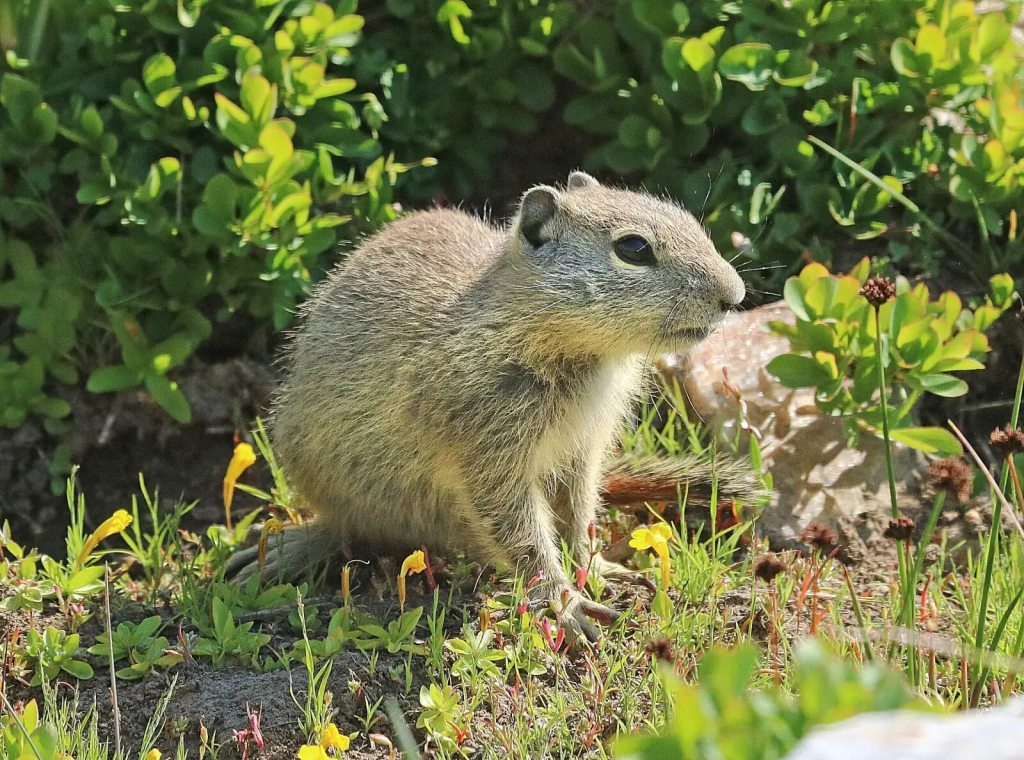
In the high alpine meadows of Tioga Pass, California, amid crisp air and constant predator vigilance, biologist Paul W. Sherman conducted a meticulous nine-year field study (1977–1985) on Belding’s ground squirrels (Urocitellus beldingi, formerly Spermophilus beldingi). These small, social rodents live in matrilineal colonies: females remain near their natal burrows for life, forming dense kin networks of mothers, daughters, sisters, and aunts, while males disperse after weaning and rarely interact with relatives.
Sherman’s core discovery centered on alarm calls—sharp whistles for aerial predators (hawks, eagles) and longer, more complex trills for terrestrial threats (coyotes, bobcats, weasels). Over thousands of hours of observation, marking hundreds of individuals, and analyzing vocal variation, Sherman demonstrated that these calls are not indiscriminate group benevolence but nepotistic altruism: costly behavior that promotes the survival of shared genes. The pattern aligns with kin-selection theory—altruism evolves when the benefit to relatives (weighted by degree of relatedness) exceeds the cost to the actor.
Females called far more frequently than males—up to ten times more in comparable contexts—and they called most intensely when close relatives were present. Using scent-marking experiments, familiarity cues, and playback of recorded calls, Sherman showed that the squirrels discriminated kin from non-kin and directed riskier calls (especially prolonged trills) toward genetic relatives. The personal cost was clear: calling individuals were more likely to be targeted by predators. Yet the net effect was elevated survival for listeners, particularly close kin.
For instance, in predator encounters, adult females called in approximately 58% of cases when kin were present, compared to much lower rates (around 20% or less) when no relatives were nearby.
Juveniles (both males and females) called at roughly equal rates (~50%), often in the presence of siblings (relatedness r=0.5). Adult males, having dispersed from kin groups, called in only about 11% of encounters, with minimal benefits to relatives. Predation risks were quantified: Callers were 2–3 times more likely to be captured than silent individuals (e.g., 28% predation rate for callers vs. 2% for non-callers in observed attacks). Benefits to kin included higher evasion success—listeners to calls escaped predators at rates up to 80–90% higher than those who didn’t hear warnings.
This supports kin selection, as formalized by W.D. Hamilton’s rule: rB > C, where r is genetic relatedness, B is the benefit to the recipient (e.g., increased survival probability), and C is the cost to the actor (e.g., predation risk).
In squirrels, for a female calling to protect an offspring (r=0.5), the gene-level “payoff” is positive if the survival boost to the kin outweighs the caller’s risk. Richard Dawkins, in The Selfish Gene (e.g., pages viii–x in the 30th anniversary introduction), echoes this: Alarm calls exemplify how gene “selfishness” translates to individual altruism, not for species good but for replicating shared genes in kin. Dawkins notes that such behaviors challenge naive group selection, emphasizing the gene as the unit that “chooses” via natural selection.
The following table compares key classes of squirrels, illustrating how calling aligns with kin selection by enhancing shared gene survival:
| Squirrel Class | Calling Rate in Predator Encounters | Relatedness to Nearby (r) | Benefit to Kin (Increased Survival/Evasion) | Cost to Caller (Predation Risk Increase) | Kin Selection Alignment (rB > C) |
|---|---|---|---|---|---|
| Juveniles (M/F) | ~50% (equal for both sexes) | 0.5 (siblings/mother) | High (~80–90% better evasion for listeners) | Moderate (2× higher risk) | Yes: Benefits siblings/offspring outweigh cost |
| Adult Females with Kin | 58% | 0.5 (offspring/siblings) | High (~80–90% better evasion) | High (2–3× higher risk) | Strong Yes: Direct gene propagation via kin |
| Adult Females without Kin | ~20% or less | 0 (non-relatives) | Low (minimal or no kin benefit) | Low (rare calling minimizes risk) | No: Cost not justified without r factor |
| Adult Males | 11% | 0 (dispersed, no kin) | Minimal (group-wide, but no relatives) | Low (infrequent calling) | No: Self-preservation dominates |
This table, derived from Sherman’s aggregated observations, highlights the nepotistic core: Calling peaks where shared genes stand to gain most, underscoring altruism as a gene-level strategy rather than pure selflessness.
A Belding’s ground squirrel stands erect in classic sentinel posture, scanning for danger while the colony forages below.
This behavior appears almost archetypal: an instinctive, collective script programming written deep in the species’ consciousness, triggered by immediate cues (predator silhouette, kin scent, proximity) with little room for individual deliberation. At the group and species layers, the female’s call serves colony persistence; at the universal layer, it echoes an ancient principle of connection-through-sacrifice. Yet the act itself feels reflexive, not chosen. It is altruism shaped predominantly by group consciousness—where the individual’s behavior is tightly bound to the survival needs of the matrilineal collective and the genetic lineage it carries. This sets a baseline against which we can contrast the more reflective, value-guided altruism seen in humans that we will investigate in next part.
Sherman’s squirrels invite us to question: Is altruism a biological reflex, etched into our DNA like a survival script? It seems so. But this pattern holds across species.
Consider black-headed gulls in dense colonies, where adults opportunistically cannibalize neighbors’ defenseless chicks for an easy meal when parents are absent—selfish (of the kin group consciousness) opportunism at its clearest.
Female praying mantises often decapitate and consume males during mating, gaining nutrition for egg production (and possibly enhancing copulation by removing male inhibitions).
Emperor penguins hesitate at ice edges, sometimes pushing others in first to test for leopard seals—rational risk avoidance, not collective heroism.
Yet apparent self-sacrifice abounds too: Worker bees sting intruders, tearing out their organs and dying to protect the hive; small birds risk drawing a hawk’s attention with alarm calls; ground-nesting parents feign injury to lure predators from chicks. These acts save kin or colony members sharing genes, aligning with kin selection rather than vague ‘group good.’
Much of animal life revolves around reproduction, with parental sacrifices (incubation, feeding, protection) dominating observed altruism. Evolution favors genes promoting behaviors that enhance their replication, often via kin benefits.
Thus, applauding animal ‘altruism’ like maternal sacrifice requires caution: Is it mere instinctive script programming driven by collective/group dynamics (colony pheromones, kin cues, or group consciousness underneath the genome), or individual choice? In animals, it’s overwhelmingly the former—reflexive, gene-scripted, lacking individual conscious deliberation. True value-based altruism, guided by reflection and ethics beyond kin or instinct, emerges distinctly in humans, marking our capacity to choose nobility over biological programming.
 Gautama Dhamma
Leave a comment