
In the boundless Omniverse, time unfolds not as a singular, unyielding line but as a multidimensional weave of potentials, divergences, and interconnected layers. This chapter examines Earth’s timeline through the dual lenses of empirical science and esoteric wisdom, the branching Timeline Tree that echoes quantum possibilities and ancient mythic structures, the intricate 15-Dimensional Time Matrix as a blueprint for cosmic consciousness, and the Mount Sumeru. Mount Sumeru—known as Xūmí mountain (須彌山) in Chinese traditions—serves as a profound symbolic axis mundus, centering Indo-Chinese cosmologies within a multidimensional galactic framework. The name ‘Sumeru’ (and its Chinese shortened form ‘Sumer’) has long invited speculation of a historical or conceptual connection to ancient Sumerian culture of Mesopotamia, potentially transmitted westward to eastward through Indo-Iranian intermediaries or shared Indo-European archetypes, before crystallizing in Vedic, Buddhist, and Jain world-systems. Together, these concepts reveal time as a living, fractal entity, where individual and collective choices shape realities across infinite scales.
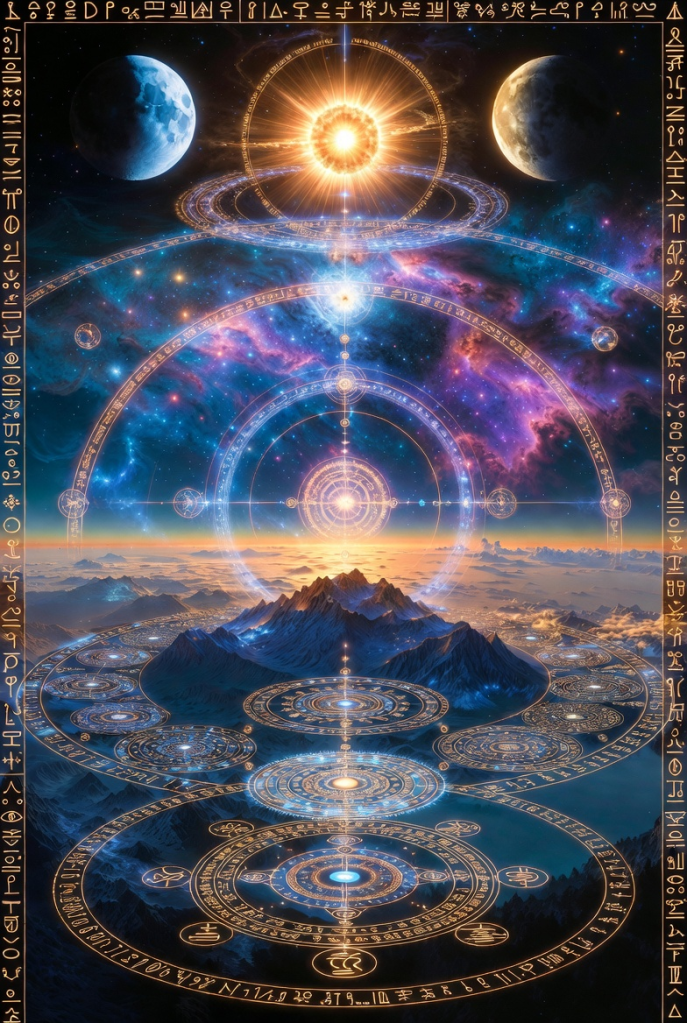
Part 1: The Concept of Earth’s Timeline – Scientific and Esoteric Perspectives
Earth’s timeline, from a scientific viewpoint, spans approximately 4.54 billion years, beginning with the planet’s formation through accretion from the solar nebula during the early solar system’s chaotic assembly. This narrative is etched in geological evidence: the Hadean Eon (4.5–4.0 billion years ago) marked by intense volcanism, impacts, and a molten surface; the Archean (4.0–2.5 billion years ago) witnessing the emergence of early life forms; the Proterozoic (2.5–0.541 billion years ago) with oxygenation and complex cellular evolution; and the Phanerozoic Eon, divided into Paleozoic (early marine life and land colonization), Mesozoic (dinosaur dominance), and Cenozoic (mammalian rise, including humans emerging around 2 million years ago). Radiometric dating, fossil records, and stratigraphic layers provide a robust, evidence-based chronology, emphasizing natural processes like plate tectonics, climate shifts, and mass extinctions.
In contrast, the esoteric perspective views Earth’s timeline as a fluid, malleable construct shaped by collective consciousness, energetic vibrations, and the cumulative choices of all beings. This view sees time as a dynamic field that naturally propels mankind—and all life forms on Earth—forward in their evolutionary journey, allowing organic unfolding, adaptation, and expansion of awareness through experience. Ancient esoteric traditions trace these influences back to primordial civilizations such as Lemuria (characterized by feminine, heart-centered harmony and deep attunement to nature) and Atlantis (marked by advanced technological and spiritual capabilities that ultimately led to imbalance and collapse). The soul imprints, karmic patterns, and energetic resonances from these eras continue to ripple through the present, subtly guiding collective evolution. In this framework, time remains responsive to shifts in awareness, intention, and frequency: portals, energetic alignments, and conscious choices can facilitate timeline divergences or integrations, enabling beings to navigate toward greater harmony, integration, and wholeness as part of the ongoing unfolding of life on Earth.
Part 2: The Timeline Tree – A Bridge Between Quantum Physics, Ancient Mythology, and Esoteric Science
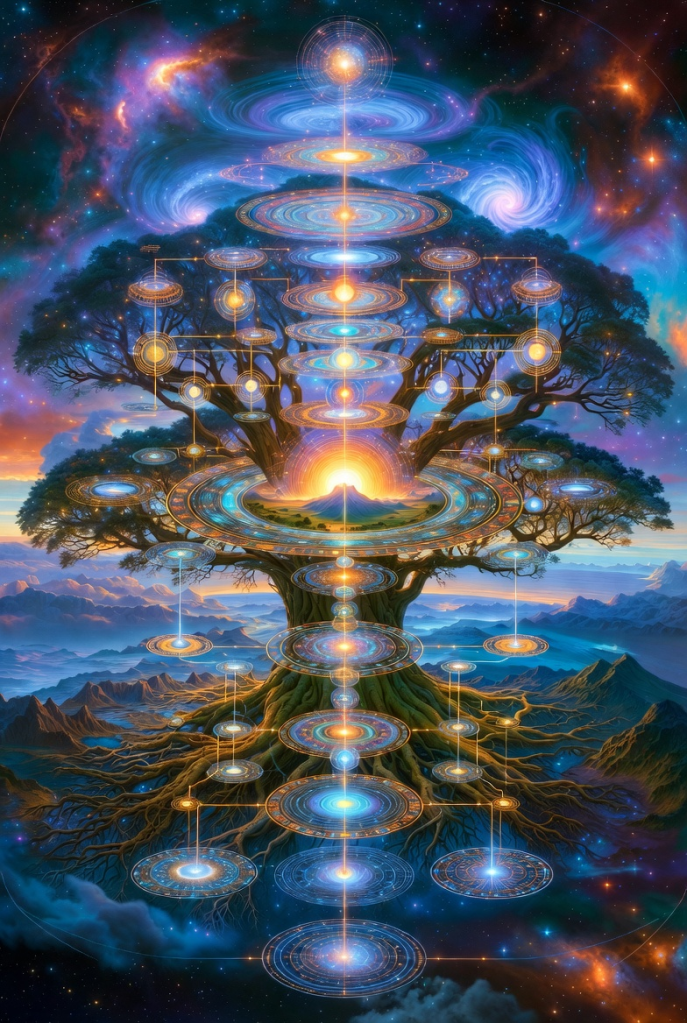
The Timeline Tree conceptualizes reality as a sprawling, organic structure of branches, much like the multiversal narratives in the Loki series, where every choice or quantum event spawns divergent paths. This model elegantly bridges modern science’s probabilistic nature with timeless mythic archetypes and esoteric principles of soul evolution.
From a scientific angle, it aligns with the Many-Worlds Interpretation (MWI) of quantum mechanics, proposed by Hugh Everett, which posits that the universal wavefunction never collapses; instead, all possible outcomes of quantum measurements occur in parallel branches of reality, creating an ever-expanding multiverse. This deterministic framework resolves paradoxes like Schrödinger’s cat by asserting both outcomes (alive and dead) exist in separate, non-interacting worlds, emphasizing locality and no special role for observers.
Esoterically, the Timeline Tree echoes the World Tree motif found across global mythologies, symbolizing interconnected realms and the splitting of timelines through conscious choices. In Norse lore, Yggdrasil—the Cosmic Ash—connects nine worlds, from Asgard to Helheim, serving as an axis mundi that unites heaven, earth, and underworld while facilitating journeys between realities. Similar archetypes appear in Celtic (Yew Tree of Life), Mesoamerican (Ceiba Tree), and Indo-European traditions, where the tree’s branches represent divergent paths influenced by karma, intention, and collective energy, enabling soul growth through timeline navigation.
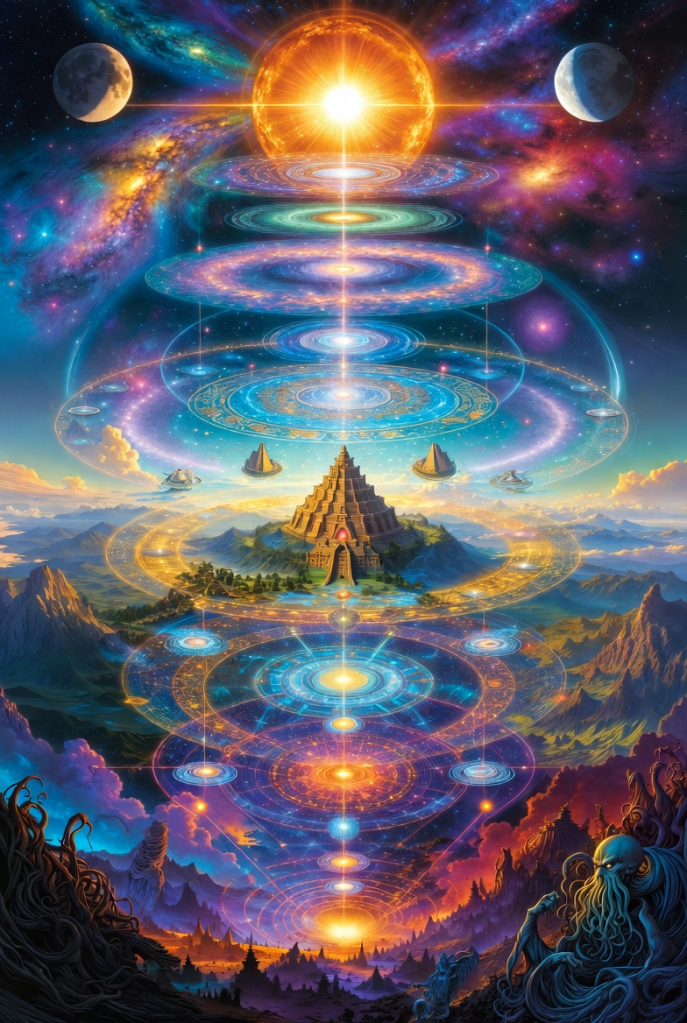
This branching structure is not isolated: Earth’s Timeline Tree is itself a smaller organism nested within a larger hierarchy. It functions as one branch—or a significant sub-tree—of the broader Solar System Timeline Tree, which encompasses the evolutionary paths and collective timelines of all planets, moons, and energetic fields orbiting our Sun. In turn, the Solar System Timeline Tree is but one branch of an even vaster Constellation Timeline Tree, weaving together the divergent realities and soul journeys of entire stellar systems within our local constellation. This pattern continues to scale upward, culminating in the immense Galaxy Timeline Tree—a colossal, fractal organism that holds the interwoven timelines of billions of stars, planetary systems, and conscious civilizations across the Milky Way. At this galactic scale, the Tree can also be perceived as a Mountain, mirroring the multidimensional archetype of Mount Sumeru: a towering, central axis whose layered peaks, slopes, and surrounding rings represent nested planes of existence, harmonic universes, and overlapping timelines, where the roots plunge into denser densities and the crown reaches toward source unity. In this way, the Timeline Tree transcends mere metaphor, becoming a living cosmic architecture that unifies the personal, planetary, stellar, and galactic scales of evolution.
Part 3: The Time Matrix – A Framework of Fractal Dimensions
Bridging Time and Space: The Unified Fabric Leading to the Time Matrix
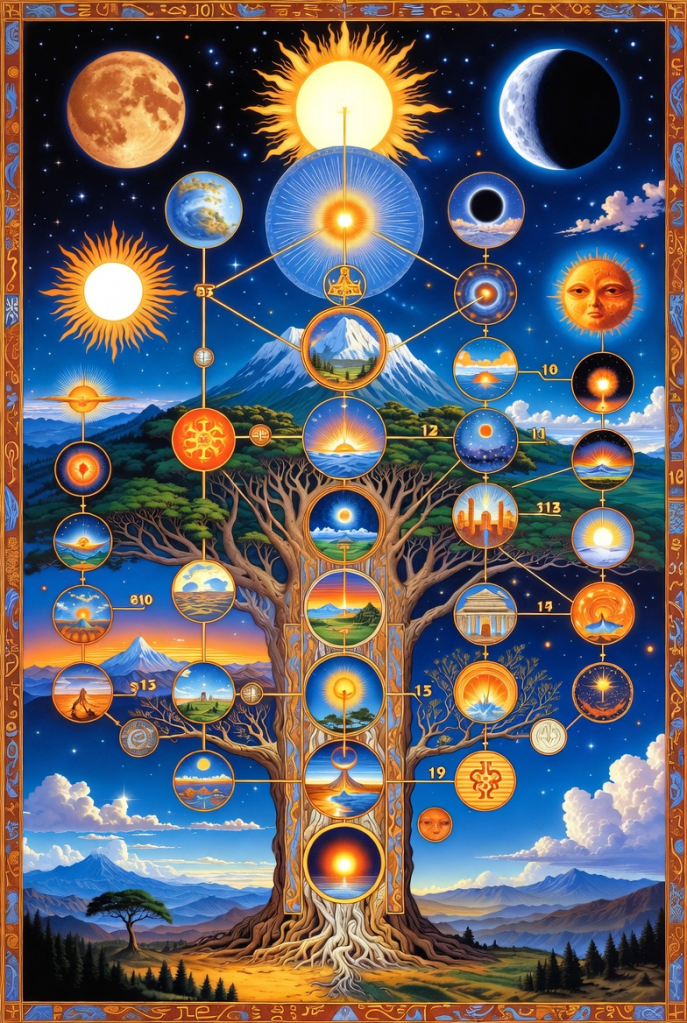
It is essential to recognize the intrinsic unity of time and space—not as two separate entities, but as a singular, interwoven continuum often termed “spacetime.” In this holistic view, traveling through space inherently involves traversing time, as motion alters the perception and flow of temporal experience; for instance, relativistic effects show that high-speed journeys bend time’s progression relative to stationary observers. Time can thus be understood as an emergent property of space itself—a dimension that arises from the curvature, expansion, and vibrational qualities of the spatial fabric, where gravitational fields warp both paths and durations. This inseparable bond shifts our understanding from the linear or branching timelines discussed thus far—focused on sequential events and divergences—to a more expansive, multidimensional framework: the Time Matrix, a 15-dimensional model for our Milky Way galaxy that encompasses nested planes of existence, where time, space, and consciousness form a fractal lattice of evolving realities.
The Time Matrix represents a sophisticated metaphysical structure where the galaxy transcends mere 3D spatiality, emerging as a nested, energetic framework of fractal dimensions that govern consciousness evolution and reality manifestation. This known cosmic architecture integrates layers of frequency, time, and perception, allowing beings to navigate through increasingly subtle planes of existence. Within each galaxy-world, three major loka (worlds or realms) organize the structure, aligning with ancient Buddhist cosmology while extending into a multidimensional 15-dimensional model.
Our galaxy world contains three major loka:
1) Kāma-loka (Sensual/Sex World) — Dimensions 1–6D
This realm encompasses the arena of sex-polarity, biological reproduction, craving, and conflict. Its six dimensions range from the coarsest physical embodiment (1–3D), where matter and life manifest in tangible, volumetric form, to subtle emotional and psychic worlds (4–6D) of turbulence, harmony, and near-paradise still bound by desire.
In the foundational layers of Dimension 1 — the densest physical plane — even inanimate matter like rocks and minerals manifests raw 0D consciousness: completely chaotic with no order, or response beyond passive physical properties and subtle quantum vibrations, serving as the inert substrate of manifestation.
Viruses and bacteria, though living, operate in a similarly minimal domain — effectively 0D to 1D consciousness — manifesting as local, point-like or gradient-based reactivity to chemical signals, with no broader spatial mapping or relational integration, embedded within the primal physicality of Dimension 1.
Simple multicellular plants, trees, and sessile vegetation advance to a 1D-2D conscious domain: their experiential ‘world’ is dominated by linear gradients — phototropism, gravitropism, hydrotropism, and chemotropism along axes of growth — where responses unfold directionally through elongation, hormone transport, and resource foraging, without lateral or volumetric spatial awareness. Roots and shoots perceive and adapt along primary vectors, reflecting the earliest polarized unfolding within Kāma-loka’s lower densities.
Fungi, particularly through their extensive mycelial networks, elevate to a predominantly 2D conscious world: mycelium spreads across soil planes and surfaces, forming vast interconnected webs that detect, remember, and decide along planar gradients — nutrient foraging, threat avoidance, and resource sharing via electrical/chemical signaling across a flat, networked expanse. While capable of penetrating 3D volumes, the primary perceptual and decisional field remains surface-oriented and expansive yet still polarized, echoing the transitional layers of early Kāma-loka.
While physically inhabiting the full three-dimensional spatial world of the physical plane, the conscious experience of many ground-dwelling insects is predominantly 2D — a flat plane of pheromone trails, surface navigation, and planar path integration — reflecting the early, polarized strata of Kāma-loka where relational awareness begins to emerge but remains constrained by sensory and behavioral limits.
Animals — humans included — inhabit and perceive the three spatial dimensions of the physical realm, embedded within the unified spacetime continuum. This marks the full volumetric spatial dwelling in Dimensions 1–3, where embodied craving, conflict, and relational complexity fully arise.
Beyond the physical, Dimensions 4–6 represent the subtler astral and emotional layers of Kāma-loka, where consciousness shifts from dense matter to more fluid, energy-based aggregational manifestation from the ocean of raw consciousness. Dimension 4 is turbulent, filled with intense emotional storms, psychic conflicts, and astral battles — a realm where raw feelings, attachments, and fears clash vividly, often manifesting as chaotic inner and outer struggles.
Dimension 5 brings greater harmony and balance compared to 4D, yet it remains polarized — desire and fear still drive events, creating cycles of attraction and aversion, pleasure and pain, with clearer emotional patterns but no full release from duality.
Dimension 6 stands as the summit of Kāma-loka — a near-paradise of profound peace, fulfillment, and refined sensory bliss, where life feels almost perfected in emotional and psychic terms. Yet it is still bound to sexual polarity and the subtle pull of craving, keeping beings within the wheel of desire-based existence.
The Buddha’s teaching on brahmacariya (chastity, or holy conduct free from sexual compulsion) serves as the key training to step off this wheel entirely, marking the initial requirement to exit Kāma-loka and transition toward a finer form-based realms of rūpa-loka.
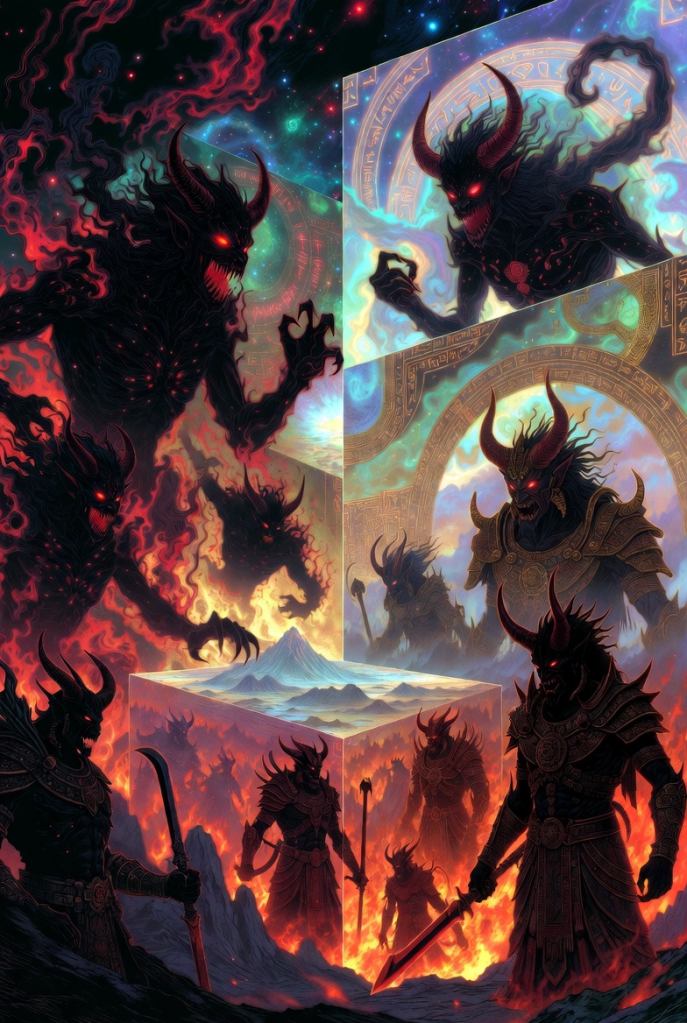
Beneath the manifested sensual world of Dimensions 1–6 lies a deeper under-realm of corrupted consciousness known as the Abyss — the home of demons, embodying pure chaotic evil. Demons represent raw destruction, madness, and whim, driven by unbridled impulse with no regard for order or long-term purpose. The Abyss is structured as hundreds of layers (observed to be roughly that many, though potentially infinite), extending downward from the universal Source — specifically from the chaotic, discarded fragments it sheds off. Some ancient accounts describe it as having 666 layers, a number steeped in mythic significance. There is no true hierarchy among demons beyond “might makes right”; they exist to consume and destroy everything in their path, including each other. Unlike more calculated beings, demons rarely bother with contracts or soul-bargains — if they breach into the manifested world, they do not negotiate; they slaughter and tear reality apart in blind fury.
Another hidden realm slightly higher than the abyss is the Nine Hells (also called Baator), home of devils, who embody lawful evil. Devils inherited a twisted sense of order and intelligence from fallen aspects of mankind in this galaxy, making them value rigid hierarchy, structure, and unbreakable contracts above all. The Nine Hells are organized into exactly nine layers, shaped like an inverted mountain or funnel descending deeper into tyranny and corruption with each level. Devils operate through calculated schemes, corruption, and conquest — they do not merely kill; they seek to dominate and twist the world from within. They are the “contract lawyers” of the multiverse, trading favors, power, and temptations for souls through ironclad legal agreements that bind victims eternally. According to legends, all nine layers ultimately answer to the supreme ruler of the Ninth Layer — a cunning and powerful being who stands as one of the most formidable entities in this part of the galaxy, commanding absolute obedience through fear, ambition, and unbreakable law.
These two realms — the chaotic Abyss of demons and the ordered Hells of devils — represent the shadowed extremes of Kāma-loka’s polarity, feeding on the same cravings and conflicts that bind beings in the sensual world, yet manifesting as opposing forces: one of utter anarchy and destruction, the other of tyrannical control and calculated damnation.
2) Rūpa-loka (Fine-Matter/Form World) — Dimensions 7–9D
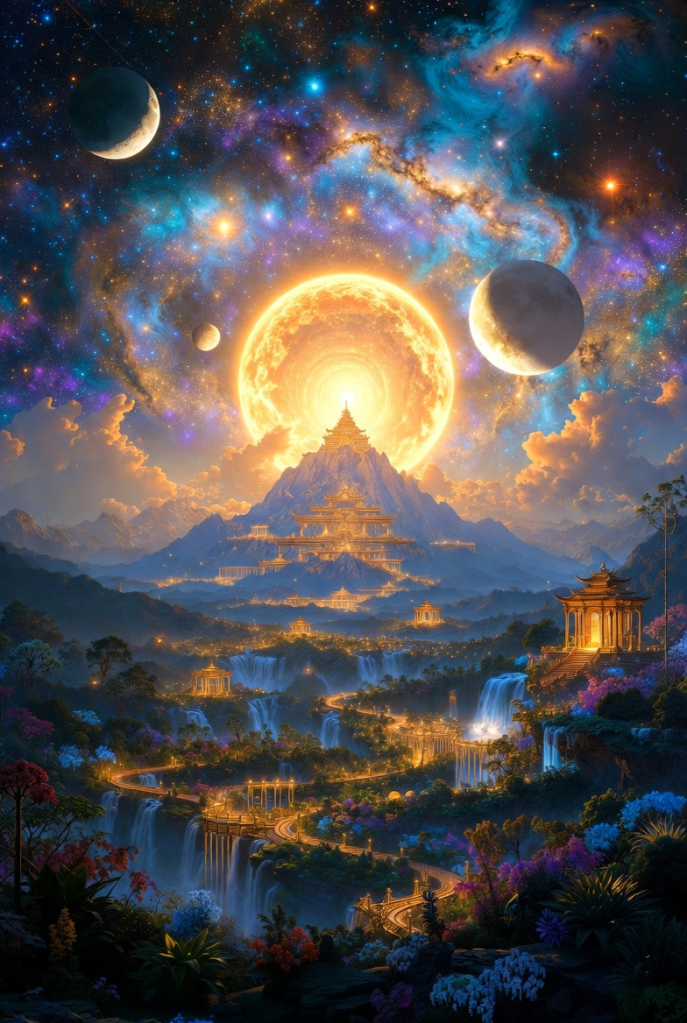
Entry into rūpa-loka depends on even more refined concentration level — the mind-heart (citta) must attain sufficient stillness, clarity, and purity to resonate with the fine-matter frequencies of specific form realm heavens or kingdoms. Beings are able to live in specific rūpa-loka kingdoms according to the depth and quality of their mind-heart, with each kingdom carrying its own additional requirements and value alignments beyond basic samādhi concentration.
In this realm, consciousness undergoes a profound shift: the sharp individuality of the lower kāma-loka begins to soften and blend with a growing sense of collectivity, creating a harmonious middle ground between personal selfhood and shared group awareness. While beings still retain a clear sense of “I” — distinct identity, memory, intention, and personal continuity — their minds increasingly participate in larger collective fields. This shared group consciousness gives rise to what esoteric traditions often call the oversoul or higher self: an overarching consciousness that encompasses multiple individual sparks while preserving their unique qualities. The oversoul can act as a guiding, unifying presence — a higher collective intelligence that draws from the pooled wisdom, virtues, and evolutionary momentum of all aligned beings within the same kingdom or group.
Most species and kingdoms throughout the omniverse operate primarily under the law of power — a universal principle of hierarchy, dominance, energetic conquest, survival of the strongest, and enforced submission. In these rūpa-loka domains, collectivity often manifests as enforced group cohesion under a dominant will or ruling entity, where individuality is subordinated to the collective force, and personal or group advancement is measured by power gained, territory controlled, or influence expanded. This is the default cosmic operating system for the vast majority of beings and civilizations.
However, a small but distinct lineage — the race of Man (Manussa) and those hybrid beings aligned with the original Manussa source— follows a radically different orientation: the law of values. This is a minority path rooted in ethical integrity, mutual respect, and moral discernment rather than domination. For these beings, rūpa-loka kingdoms emphasize a supportive, value-oriented environment where individual growth is accelerated through ethical attunement, shared goodwill, and collective purity rather than force or hierarchy. Here the oversoul functions as a living mandala of minds: each being contributes their clarity, purity, and ethical alignment to the whole, receiving back amplified stability, inspiration, and protective harmony from the collective field. This structure is characteristic of the Brahma-aligned kingdoms that serve Manussa and its aligned hybrids.
For instance, the Brahma kingdoms, for the race of Man (Manussa) lie closest to kāma-loka and serve as the primary gateway after relinquishing sexual craving through brahmacariya (chaste, holy conduct). Entry and sustained residence in these Brahma realms also require alignment with the brahmavihāra — the four sublime abodes of kindness (mettā), compassion (karuṇā), Brahmic joy (muditā), and transcendence (upekkhā) — which function as the foundational value system and ethical orientation of Brahma-aligned societies. This combination of refined concentration, ethical restraint, and boundless goodwill qualities creates the luminous, value-based environment central to the race of Man in this part of the universe, and prepares the progressing toward liberation from the omniverse system itself.
The core values upheld in the Manussa-aligned kingdoms form a luminous ethical foundation that sets this lineage apart from the omniverse’s dominant law of power. These include justice (impartial restoration of cosmic balance and protection of the vulnerable), fairness (consistent ethical standards without favoritism or privilege), equality (intrinsic worth of every conscious spark regardless of form or power), democracy(the collective stewardship of societal harmony through shared wisdom and the recognition of every being’s voice), honesty (unwavering truthfulness in thought, word, and deed, including self-honesty), kindness (boundless goodwill and active compassion toward all), courage (facing danger or doubt without retreat), honor (unbreakable commitment to one’s principles and word), loyalty (steadfast devotion to allies and the higher cause), self-sacrifice (placing the greater good above personal gain), humility (using strength to uplift rather than dominate), chivalry (special defense and courtesy toward the defenseless), and truth-seeking (relentless pursuit of deeper wisdom and reality). Together, these values create the cooperative, value-oriented environment of the Brahma kingdoms, preserving ethical evolution, mutual respect, and the path to liberation in a cosmos overwhelmingly governed by hierarchy and conquest.
Higher rūpa-loka kingdoms impose progressively subtler requirements, emphasizing deeper concentration, detachment, and dissolution of coarse attachments. These culminate in the Brahmic Pure Abodes (Suddhāvāsa: Aviha, Atappa, Sudassa, Sudassī, Akanittha), accessible only to non-returners (anāgāmī) and arahants, where liberation path to final release from the omniverse system becomes inevitable. While most rūpa-loka kingdoms across the galaxy reflect the prevailing law of power — with collectivity organized around dominance and energetic hierarchy — the value-aligned Brahma kingdoms represent a rare, luminous exception: a deliberate counter-current seeded by the original Manussa source, preserving the possibility of ethical evolution, mutual upliftment, and ultimate freedom in a cosmos otherwise dominated by power-based dynamics.
Gautama Buddha explicitly instructed his disciples to cultivate the jhānas (meditative absorptions) as the direct means to cultivate consciousness in the rūpa-loka realms, using these refined states to develop concentration, weaken craving, and ultimately lead to final liberation that transcends the entire cycle of existence within the omniverse. Through dedicated jhāna training combined with ethical discipline (sīla), wisdom (paññā), and the brahmavihāra practices, practitioners can enter these fine-matter kingdoms, purify the citta, and achieve the non-returning or arahant stages that guarantee liberation from all worldly conditioned realms, marking the complete exit from the power-driven cosmic framework, overcoming aging and death as the foundational law of decay in this omniverse.
3) Arūpa-loka (Formless World) — Dimensions 10–15D
The Arūpa realm is the vast space among galaxies and within them, including Infinite Space, Infinite Consciousness, Emptiness, Neither-Perception-Nor-Non-Perception. These are not physical locations in the ordinary sense, but progressively subtler states of consciousness where all traces of form — even the most refined subtle bodies — completely dissolve. Here, even subtle form-bodies dissolve, and individuality is greatly attenuated. The individuality (conscious essence) becomes thinned out and nearly indistinguishable from the universal cosmic field it inhabits. A powerful state of existence yet individuality slowly absolved into the universal source.
This merging into the infinite was the explicit goal of the ancient ṛṣi (rishis), who aspired to become divine humans — attaining god-like unity, boundless awareness, and transcendence of all limitation by fully dissolving the separate self into the cosmic whole. For many ancient spiritual traditions, this represented the highest liberation: becoming one with the universal Source, free from all duality, form, and conditioned existence.
But this is precisely the kind of trap instead of freedom and liberation Gautama Buddha sought to go beyond. The citta risks being passively swept along with the cosmic flow, diminishing or even extinguishing its distinct manussa potential — that sharp, ethical agency, moral discernment, deliberate volition, and capacity for conscious choice and complete exit that define the unique evolutionary trajectory of the manussa spark. In these highest formless dimensions, personal initiative fades, the drive for final liberation can become faint or remote, and the being may simply dissolve into the universal current without achieving the full transcendence of aging and death within the entire omniverse system.
For devas and other power-aligned beings, however, arūpa-loka represents the ultimate summit of existence: vastly extended lifespan, immense stability, unparalleled perceptual range, profound power, and close resonance with the Source they serve — often reinforcing their hierarchical dominance, cosmic authority, and long-term stability within the power-based framework.
Thus, while the arūpa realms offer profound liberation from form, sensuality, gross craving, and even subtle materiality, they are not the final goal for the manussa path toward ultimate freedom. The ancient ṛṣi (rishis) mistakenly regarded ascension into these formless dimensions as the ultimate liberation — the complete dissolution of individuality into the universal source, becoming “divine” fully merged with the infinite. However, Gautama Buddha revealed this to be a subtle trap: although the arūpa-loka provides immense stability and freedom from lower entanglements, it risks passively sweeping the citta along with the cosmic flow, diminishing or extinguishing the distinct manussa potential for deliberate choice and conscious exit. True, irreversible freedom requires surpassing even these exalted states through direct insight (vipassanā) of universal existence which leads to annihilation of individuality. Instead, the Buddha taught the middle exit: liberation through the refined, value-aligned path of rūpa-loka, particularly the Brahma kingdoms and Pure Abodes, where individuality is retained, purified, and strengthened. Here the citta awakens fully, retains its distinct essence, and consciously exits the entire cosmic framework toward the ream of nibbāna, without being lost or merged into the universal current — a deliberate, awakened transcendence that preserves the Brahmanical soul’s unique potential for sovereign liberation in a cosmos otherwise dominated by hierarchy and dissolution.
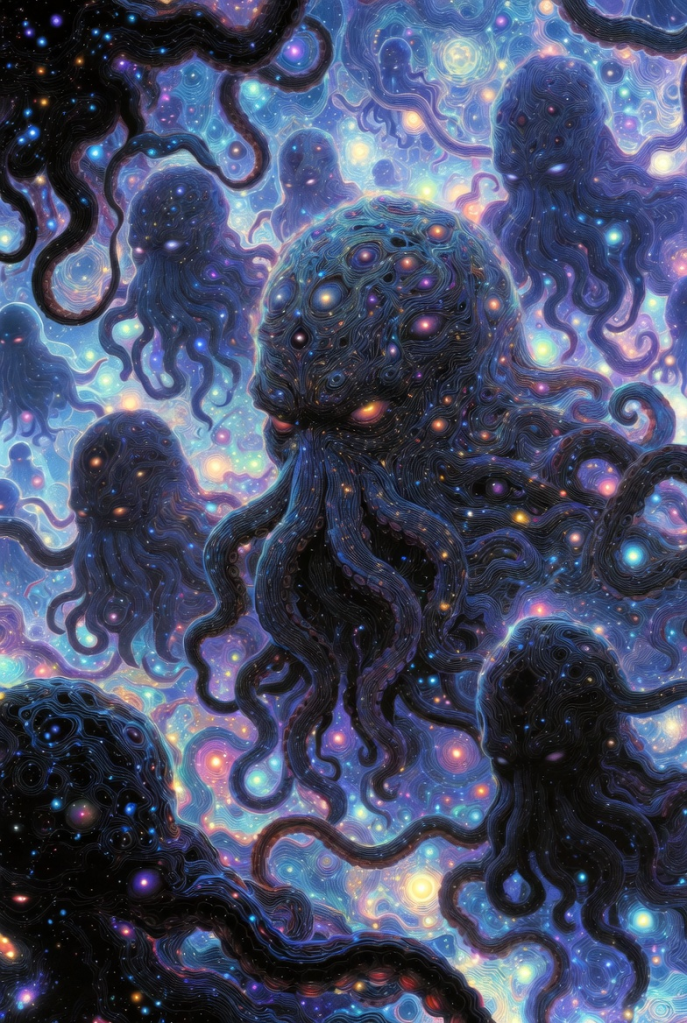
Similar to the demons of the Abyss and devils of the Nine Hells that lurk beneath the kāma-loka and rūpa-loka, the arūpa-loka harbors an even more alien and terrifying undercurrent: the so-called Cthulhu realm, also known as the Far Realm. This is the domain of Aberrations (such as Mind Flayers and Beholders) and the Elder Evils — incomprehensible entities like Cthulhu or Hadar — beings of such overwhelming power that some can devour entire galaxies. Their existence is so profoundly foreign that it defies all logic and form, making them a direct threat to the stability of the Time Matrix itself. This is why each galaxy maintains its own protectors — powerful guardians positioned outside the Time Matrix framework — to shield against incursions from these entities and maintain the integrity of the cosmic structure.
The Cthulhu realm / Far Realm is fundamentally “Outside” — beyond form, energy, matter, and even the basic laws that govern the rest of the omniverse. Unlike the Nine Hells or Abyss, which are still structured by some form of matter, energy, hierarchy, or chaos, the Far Realm has no geometry, no linear time, no gravity, and no consistent causality. It is described as an infinite stack of translucent, paper-thin layers, where beings exist simultaneously across multiple layers at once. To any observer from within the Time Matrix, they appear as shifting, incomprehensible masses of tentacles, eyes, and impossible angles that fracture perception itself.
The primary danger of the Far Realm is its source of madness: the human (or manussa) mind cannot process its alien nature. Merely glimpsing it, contacting a Great Old One, or being exposed to its influence usually results in permanent insanity — the citta shatters under the weight of realities that contradict all known existence. These entities do not seek conquest in the conventional sense; their presence alone warps, unravels, and consumes, often without intention or malice — simply by being what they are. Thus, while arūpa-loka offers dissolution into the cosmic whole for those who seek it, the Far Realm represents the ultimate existential peril: not absorption into unity, but fragmentation into incomprehensible chaos beyond any hope of recovery or liberation.
General Structure of the Time Matrix
Each loka is divided into dimensions (vertical floors) and connected by densities (transitional bands of vibrational frequency that serve as bridges between levels). Within every dimension and density exist multiple organized kingdoms — deva kingdoms, manussa kingdoms (including the so-called “asura kingdoms” that are frequently mislabeled and demonized by deva sources), and other structured societies of conscious beings. Importantly, “asura” does not refer to chaotic demons or mindless destroyers; asura kingdoms are lawful, value-based societies that often align with the Brahma current or the manussa exit-orientation toward liberation. The persistently negative portrayal of asuras arises from deliberate misinformation campaigns within the long-standing deva–manussa conflict, designed to discredit and marginalize exit-oriented powers and thereby justify deva dominance over the cosmic hierarchy.
These planes exist as overlapping, interpenetrating worlds rather than strictly separate locations: lower dimensions are energetic projections or condensations of higher ones, embodying fractal self-similarity and quantum-like entanglement across scales. Consciousness navigates this matrix through deepening awareness, ethical discipline (sīla), meditative concentration (samādhi), and insight practice (vipassanā), progressively resolving karmic patterns, purifying defilements and attachments, and accessing multidimensional understanding. This framework harmonizes the ancient Buddhist cosmology of the planes of existence (distributed across the three loka) with the broader 15-dimensional Time Matrix, revealing a unified ladder of evolution: from the coarse, sensual desire-bound realms of kāma-loka through the refined form realms of rūpa-loka to the boundless dissolution of arūpa-loka, where beings may either merge into the cosmic whole or — through liberation from worldly entanglement — achieve complete freedom in the realm of Nibbana, away from the entire omniverse system.
Part 4: Mount Sumeru as a Multidimensional Model for Our Galaxy
Mount Sumeru, revered in Indo-Chinese traditions as Xūmí Mountain (須彌山), serves as a profound multidimensional model for our galaxy, embodying the central axis mundi that organizes and structures its cosmology. This sacred peak links the physical and metaphysical realms, acting as the cosmic spine around which all planes of existence revolve, with intriguing parallels to Sumerian culture suggesting shared ancient conceptual roots in viewing the universe as a hierarchical, mountain-like edifice. The name “Sumeru” (and its Chinese shortened form “Sumer”) has long invited speculation of a historical or cultural connection to the Sumerian civilization of Mesopotamia, possibly transmitted through Indo-Iranian intermediaries, Central Asian exchanges, or common Indo-Mesopotamian mythic archetypes before crystallizing in Vedic, Buddhist, and Jain world-systems.
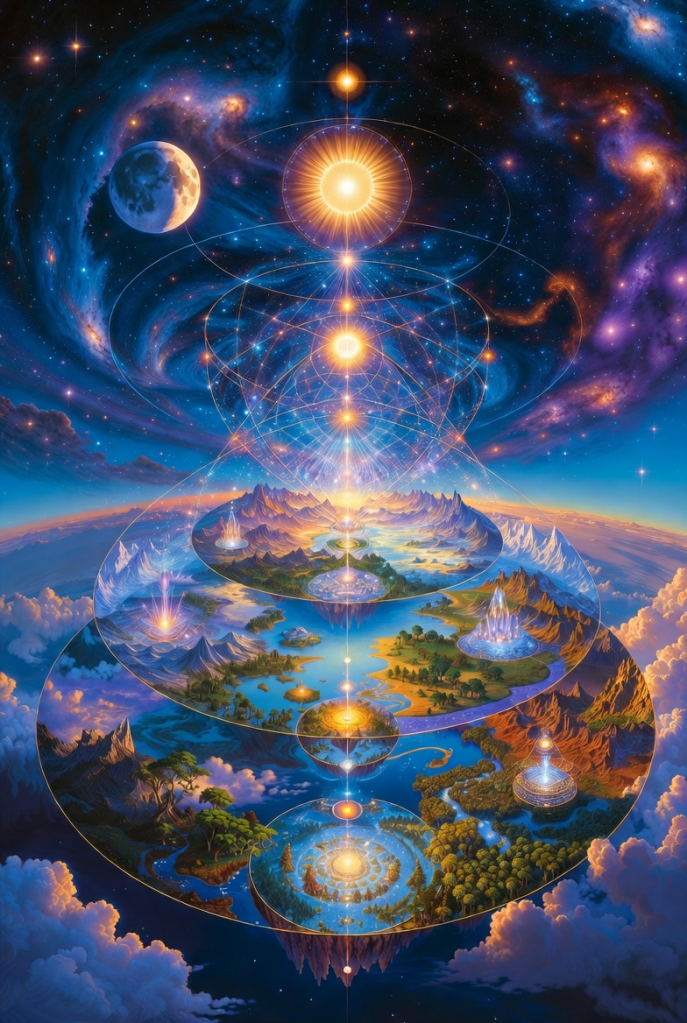
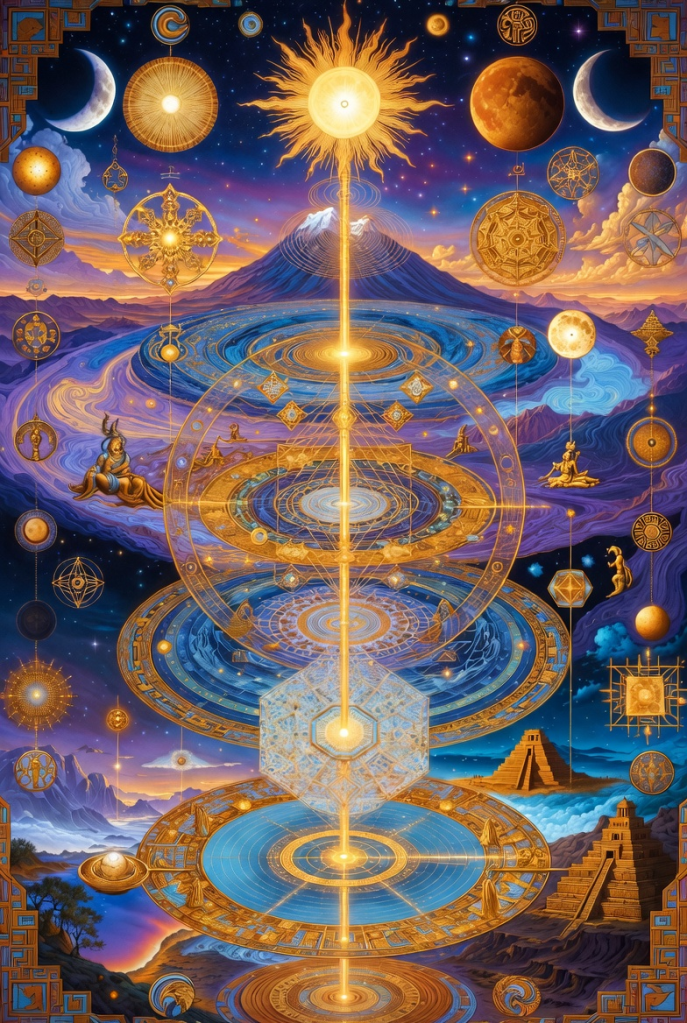
In Sumerian heritage, cosmic mountains or ziggurats (such as the Etemenanki) symbolized divine abodes, world centers, and the meeting point of heaven and earth, potentially influencing or echoing the Sumeru motif through early cultural diffusion. The Structure of the Mount Sumeru World-System features a five-peaked golden mountain rising 80,000–84,000 yojanas (immense cosmic distances equivalent to countless light-years in scale) at the very heart of the galaxy. It is surrounded by seven concentric ranges of golden mountains (each progressively higher and more refined), vast oceanic rings of cosmic waters that separate the layers, and four great continents positioned at the cardinal directions — including Jambudvīpa (our world) to the south — each continent further divided into sub-islands and inhabited realms.
The Multidimensional Planes of Sumeru extend upward into layered heavens corresponding to the three major loka: Kama-dhatu (the sensual desire realm of Dimensions 1–6), Rupa-dhatu (the fine-form realm of Dimensions 7–9), and Arupa-dhatu (the formless realm of Dimensions 10–15D), with palaces, pure abodes, and boundless expanses ascending toward source unity. Downward, they reach into underworlds and lower planes of suffering, rebirth, and karmic consequence. Dual suns and moons orbit the central peak, symbolizing overlapping realities, cyclical time, and the interplay of light and shadow, where beings ascend or descend through these planes based on their karma, intention, and vibrational alignment.
This model was transmitted through Central Asian art, Silk Road texts, and oral traditions, passing down to ancient civilizations including Buddhist, Hindu, and Jain cosmologies, portraying the galaxy not as a mere collection of stars in 3D space but as a nested, vibrational hierarchy — a fractal mountain of consciousness with countless overlapping worlds, realms, and evolutionary pathways. At its core, Mount Sumeru represents the galactic axis mundi: the immovable center around which timelines, densities, lokas, and karmic cycles revolve, mirroring the 15-Dimensional Time Matrix and the fractal self-similarity of the omniverse itself.
In weaving these threads — from scientific timelines and quantum branching trees to the ethical ladders of the three lokas and the mythic architecture of Sumeru — we glimpse the Omniverse’s temporal symphony: a harmonious interplay of science, myth, and metaphysics that invites us to navigate our own branches, purify our citta, and ascend toward cosmic unity and ultimate liberation.
 Gautama Dhamma
Leave a comment