
In the vast expanse of the cosmos—where the laws of physics bend in ways that challenge everyday intuition—quantum mechanics stands as a profound disruption to classical reality.
At the quantum scale, particles do not behave like solid objects moving along predictable paths. Instead, they exist as potentials, unresolved possibilities that only crystallize into definite states when observed. This phenomenon, known as the observer effect, raises a disturbing and fascinating question:
Does reality exist independently—or does it wait to be seen?
In this second installment of Omniverse Cosmology, we explore the observer effect, wave-function collapse, quantum entanglement, and the growing suspicion that the universe behaves less like a machine—and more like a rendered projection.
1. The Observer Effect: When Reality Requires an Audience
At the heart of quantum physics lies the observer effect—the principle that the act of measurement influences the system being measured.
In classical physics, observation is passive. A planet or a ball continues its motion whether anyone watches or not. But in quantum mechanics, this assumption collapses.
Particles such as electrons exist in superposition—a spread of possible states—until an observation forces a choice. Only then does the particle adopt a definite position or momentum.
The Double-Slit Shock
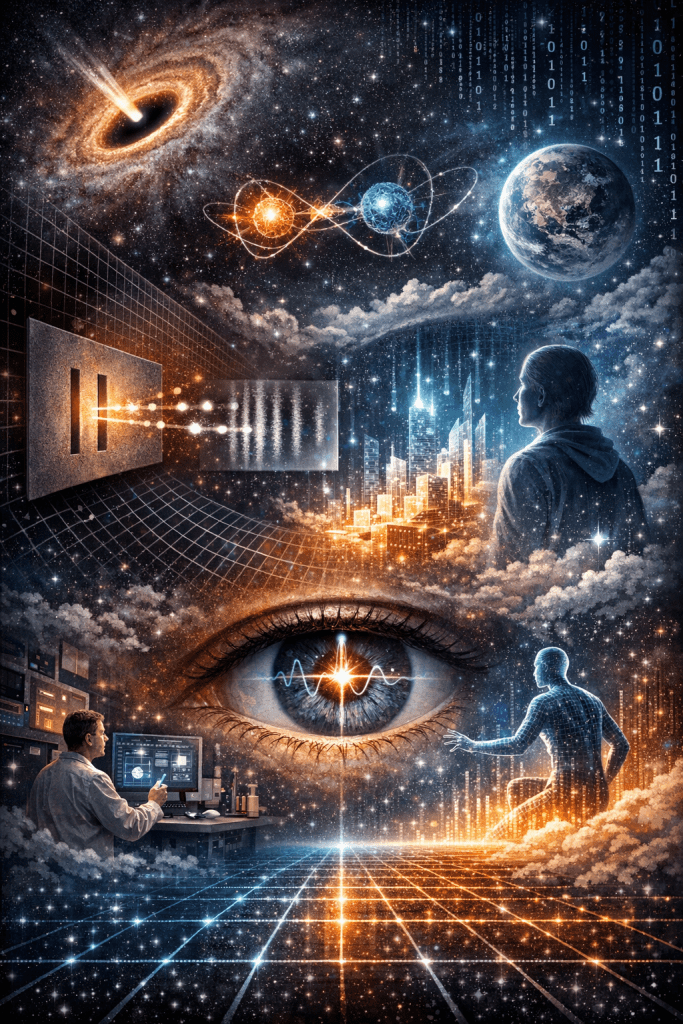
This behavior was dramatically revealed in the famous Double-Slit Experiment:
- When particles pass through two slits unobserved, they behave like waves, forming interference patterns.
- When detectors observe which slit the particle passes through, the wave pattern vanishes—and particles behave like solid objects.
Observation does not merely reveal reality.
It selects it.
This strange dependency has led many to draw parallels with digital rendering.

2. Reality as Rendered Output: The Video Game Analogy
In modern video games, distant environments are not fully rendered until the player looks at them. This conserves computational resources. What is unseen exists only as data, probabilities, or placeholders.
Quantum mechanics appears to operate similarly:
- Unobserved particles exist as probability distributions
- Observed particles “render” into definite outcomes
This resemblance has fueled speculation that the universe may function like a simulation, optimizing reality only when interaction demands it.
But the analogy leads to a deeper question:
If reality is rendered, what—or who—is doing the rendering?
3. Quantum Entanglement: Is Space an Illusion?
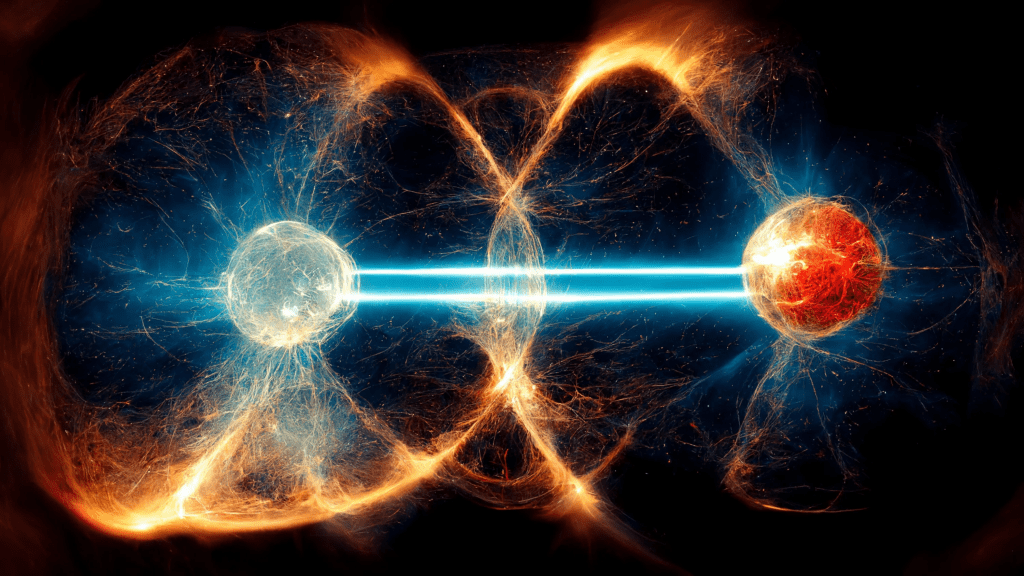
Quantum entanglement intensifies the mystery.
When two particles become entangled, their states remain linked regardless of distance. Measure one, and the other responds instantaneously—even across light-years.
This phenomenon disturbed Albert Einstein, who famously described it as “spooky action at a distance.”
Entanglement suggests:
- Information is not constrained by space
- Spatial separation may be secondary, not fundamental
Modern theories increasingly propose that spacetime itself emerges from quantum entanglement, rather than existing as a primary backdrop.
If space is emergent, then the universe is not a fixed container—but a relational structure, dynamically assembled.
4. Wave Function Collapse: From Possibility to Fact
Quantum objects are not localized things. They are described by a wave function—a mathematical expression of probabilities.
Only when measurement occurs does the wave function “collapse” into a single outcome.
Why?
No consensus exists.
Some interpretations argue that measurement devices cause collapse. Others suggest that conscious awareness plays a decisive role—turning potential into actuality.
This raises a deeply unsettling implication:
Consciousness may not be a by-product of reality—it may be a condition for it.
Recent experiments challenge purely mechanical collapse models, suggesting that objective, observer-independent collapse may not fully explain what we see.
Reality resists being reduced to blind mechanism.
5. The Simulation Hypothesis: A Programmed Universe?
All these features—observer dependence, probabilistic rendering, non-local connections—have converged into what is now called the simulation hypothesis.
The argument is simple:
- Advanced civilizations could simulate entire universes
- Simulated beings would vastly outnumber base-reality beings
- Therefore, statistically, we are more likely to be in a simulation
Quantum mechanics could represent efficiency constraints—probability states acting as computational shortcuts.
Yet serious objections remain:
- Mathematical limits (such as incompleteness theorems) suggest reality cannot be fully algorithmic
- Assuming a “base reality” more real than ours introduces circular reasoning
- Quantum randomness resists deterministic coding
Simulation explains some oddities—but not all.
6. A Deeper Turn: Self-Simulation and Conscious Reality
A more radical idea has emerged: the universe may not be simulated by a computer—but by itself.
In this view:
- Consciousness is primary
- Physical reality is a projection or expression of awareness
- Observation is not an external act—it is reality recognizing itself
The universe becomes a self-actualizing loop, where consciousness and cosmos co-emerge.
Not a machine running code—but a mind rendering experience.
Conclusion: A Universe That Waits
The observer effect, quantum entanglement, and wave-function collapse converge on a startling insight:
Reality is not fully independent of observation.
Whether interpreted as simulation, emergence, or conscious projection, quantum physics forces us to abandon the idea of a passive, objective universe.
The omniverse does not simply exist.
It responds.
And in observing it, we may be doing far more than watching—we may be participating in the act of reality itself.
Is the universe a simulation, a projection of consciousness, or something even stranger?
The question remains open—but the act of asking it may already be shaping the answer.
 Gautama Dhamma
Leave a comment