
Introduction — A Glimpse into Tomorrow’s Consciousness
What if humanity were to undergo a fundamental transformation—not through technology or political reform, but through a collective awakening of consciousness?
Not a gradual cultural shift, but a decisive inner change that reshapes how reality itself is perceived.
This question lies at the heart of Chronicles from the Future, based on the extraordinary diaries of Paul Amadeus Dienach. Whether true consciousness shift or fictional insight, within this enigmatic account, we encounter Nibelvirch: a future state of global enlightenment that brings an end to humanity’s age of conflict and opens an era of deep harmony and clarity.
Nibelvirch is not presented as ideology, religion, or social engineering. It is described as a new mode of perception, a transformation in how human beings experience themselves, others, and existence itself.
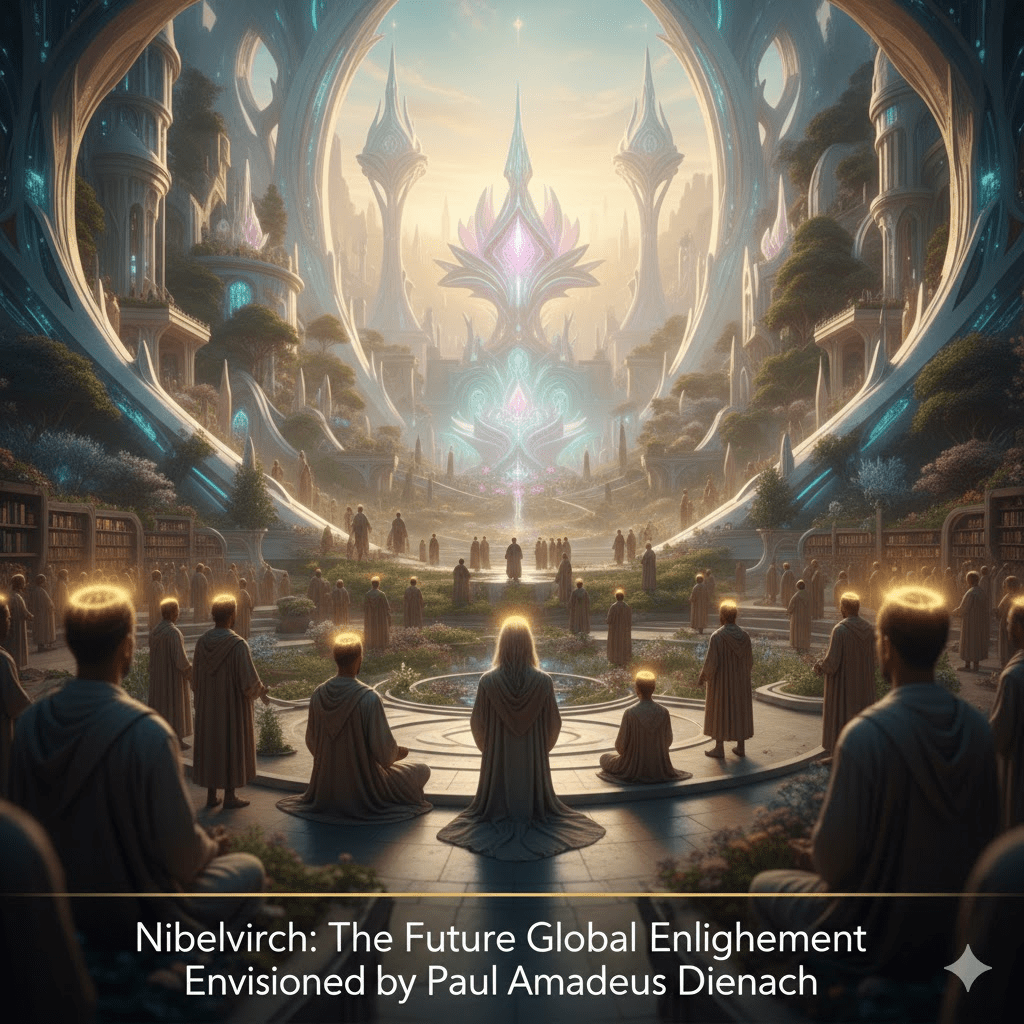
The Genesis of Nibelvirch — A New Human Faculty
According to Dienach’s account—allegedly experienced during a year lived in the distant future around 3906 CE—Nibelvirch emerges around the year 3382 as a spontaneous awakening of a new human faculty.
He describes it as something akin to a spiritual antenna arising in the human brain.
This is not an increase in intelligence, nor an accumulation of knowledge. It is a direct, intuitive mode of knowing, one that bypasses the limitations of analytical thought and sensory fragmentation.
Through Nibelvirch, humans gain immediate insight into what Dienach calls the Samith—the Great Reality underlying all appearances. This knowing does not require belief, debate, or interpretation. It is perceived directly, as self-evident as sight or hearing once were.
In essence, humanity moves from thinking about truth to perceiving truth.
What Nibelvirch Means for Humanity
The consequences of such an awakening are radical and far-reaching.
1. The End of Conflict
With Nibelvirch, the illusion of separation dissolves. Human beings no longer experience themselves as isolated units competing for survival and advantage.
When interconnectedness is directly perceived—not intellectually, but existentially—violence and exploitation lose their foundation. Greed, prejudice, and warfare arise from the belief that “the other” is fundamentally separate. Nibelvirch removes this belief at its root.
Conflict becomes unnecessary, even unthinkable, because harm to another is experienced as harm to oneself.
2. Universal Altruism
Empathy becomes the default condition.
Society shifts from individual accumulation toward collective well-being. Material possessions lose their central importance, not through enforced austerity, but through a natural reorientation of values.
Human energy turns toward:
- inner refinement,
- ethical clarity,
- and the elevation of collective consciousness.
This altruism is not moral obligation. It flows spontaneously from direct perception of unity.
3. A New Social Order — The Nojere
Dienach describes the emergence of a new form of governance known as the Nojere.
In this era, society is no longer led by politicians driven by power dynamics or ideology. Instead, guidance comes from the Lorffe—individuals recognized for their intellectual depth, ethical maturity, and spiritual clarity.
Authority shifts from domination to wisdom. Leadership becomes custodianship of collective consciousness rather than control over resources or people.
4. The Valley of the Roses
One of the most evocative images in Dienach’s vision is the Valley of the Roses.
This is not merely a physical place, but a spiritual heartland—a symbolic center where the art of purity is cultivated. It represents humanity’s collective aspiration to live in harmony with its awakened understanding.
The Valley of the Roses stands as a reminder that enlightenment is not abstraction, but lived alignment.

Nibelvirch and the Path of Transcendence
Despite its utopian appearance, Nibelvirch is not portrayed as the final goal of spiritual evolution.
It represents a mass realization of insights long taught in contemplative traditions, including Buddhism. This recognition liberates the soul from false identification. The worldly self—the constructed interface shaped by craving, fear, and comparison—loses its authority. In its place, the true self, the purified consciousness, or citta, becomes the center of orientation.
At the same time, consciousness expands beyond isolated individuality. Humanity begins to experience itself as a shared inner field, a collective consciousness grounded in world-transcending values rather than worldly power. The Brahmavihāras—loving-kindness, compassion, rejoicing in ancestral nobility, and transcendental knowledge—become not ideals, but structural qualities of awareness.
In this alignment, mankind reconnects with the ancestral heavenly consciousness network—a value-based field for all mankind. Separation among human beings dissolves, and separation between humanity and its higher spiritual lineage fades. Earthly consciousness and the ancestral heavenly kingdoms are no longer experienced as disconnected.
For those committed to deeper paths of renunciation and liberation—such as brahmacariya—Nibelvirch performs a decisive function. It clears the ground globally. It dismantles the psychological machinery that produces suffering: ignorance, craving, rivalry, and domination. What once required heroic resistance becomes increasingly natural.
In this sense, Nibelvirch operates as a collective purification of the human field. It does not replace the path of transcendence beyond the world, nor does it complete liberation for all beings. Rather, it establishes the necessary conditions in which transcendence becomes accessible without obstruction.
The world is not escaped through rejection, but outgrown through understanding. Humanity learns to live by value rather than power, clarity rather than compulsion. From this purified ground, the final step—transcending all conditioned existence—stands open to those who are ready.
Nibelvirch is therefore not the end of the journey.
It is the moment when the path becomes visible to all.
Conclusion — A Vision of Hope and an Invitation to Inner Work
Dienach’s vision of Nibelvirch offers something rare: a future where humanity evolves not by conquering the world, but by understanding itself.
Whether taken as prophecy, metaphor, or speculative philosophy, its message remains deeply relevant today. The roots of conflict, suffering, and division lie not in external systems, but in how consciousness perceives reality.
Nibelvirch reminds us that the most transformative revolution is internal.
While its emergence lies in the distant future within Dienach’s narrative, the seeds of Nibelvirch are available now—in every moment of clarity, compassion, and insight that loosens the grip of ego and reveals our shared ground.
The future it describes may not arrive through time alone, but through the gradual awakening of minds willing to see more deeply—starting here, starting now.
 Gautama Dhamma
Leave a comment