
(Matthew 5:3–12)
3 “Blessed are the poor in spirit, for theirs is the kingdom of heaven.”
4 “Blessed are those who mourn, for they shall be comforted.”
5 “Blessed are the meek, for they shall inherit the earth.”
6 “Blessed are those who hunger and thirst for righteousness, for they shall be satisfied.”
7 “Blessed are the merciful, for they shall receive mercy.”
8 “Blessed are the pure in heart, for they shall see God.”
9 “Blessed are the peacemakers, for they shall be called sons of God.”
10–12 “Blessed are those who are persecuted for righteousness’ sake… Rejoice and be glad, for your reward is great in heaven.”
One Teaching, Two Languages
The Beatitudes spoken by Jesus and the Dhamma rediscovered by Gautama Buddha express the same interior path, articulated through different cultural languages.
In Theravāda understanding, these verses do not function as moral encouragements alone. They describe a precise inner training—a purification of the citta (mind–heart) that lifts a being out of coarse worldly existence and aligns it first with the Brahma-law (Brahma-Cariya), and ultimately beyond all worlds.
Jesus names this higher mode of existence the Kingdom of Heaven.
Theravāda recognizes this first as Brahma-aligned existence, established through the Brahmavihāras, and finally—through wisdom—as the Middle Exit into Nibbāna-dhātu, the Deathless.
Poverty in Spirit — Freedom from Ownership
“Blessed are the poor in spirit, for theirs is the kingdom of heaven.”
In Theravāda terms, this describes a mind free from the illusion of mine. The citta binds itself to the world through ownership—possessions, identity, status—mistaking the aggregates for the true self or soul (attā).
Jesus urges the relinquishment of wealth not because material objects are evil, but because clinging anchors consciousness within the world. This is the same principle as cāga (generosity), the direct antidote to rāga (attachment).
True poverty in spirit is inner renunciation. Even material poverty does not liberate when craving and resentment dominate the heart. Liberation begins when the citta releases worldly ownership altogether.
Mourning, Meekness, and Hunger for Truth — Disenchantment with the World
“Blessed are those who mourn…”
Mourning reflects clear seeing of dukkha. When impermanence of all worldly existence is understood, sorrow naturally arises—not as despair, but as nibbidā, disenchantment with all worldly conditioned existence. This becomes the doorway to virāga, the fading of worldly passion.
“Blessed are the meek…”
Meekness is not weakness. It is humility born from insight. Power loses its grip when the illusion of permanence for worldly existence dissolves. This expresses the Buddha’s wisdom: disciplined sense restraint grounded in wisdom of liberation from the world.
“Blessed are those who hunger and thirst for righteousness…”
This hunger is the drive for dhamma, the teaching on truth, itself. It is fulfilled through paññā, the direct realization of:
- dukkha,
- the origin of dukkha, that is the worldly existence itself,
- the ending of dukkha, that is the purification of mind-heart, or soul, and the liberation of the soul from its worldly trapping,
- and the path that leads beyond the world.
Mercy, Purity, and Peace — The Brahmavihāra Path
“Blessed are the merciful…”
Mercy reflects karuṇā, one of the Brahmavihāras. Actions rooted in non-harm align the citta with Brahma-law—a value-based order characterized by conscience, sense restraint, and inner clarity (mindfulness).
“Blessed are the pure in heart…”
Purity of heart refers to a citta cleansed of defilements from the world. To ‘see God’ refers to the citta’s clear alignment with the Brahma-worlds and Brahma-law—the living connection with our ancestral spiritual lineage of higher values, conscience, and luminous order, perceived when the mind becomes pure, steady, and unobscured.
“Blessed are the peacemakers…”
Peacemakers embody inner peace established through samādhi. They are called “sons of God” because they live according to the Brahma-law, becoming heirs to Brahma-aligned existence rather than worldly power.
Muditā — Joy of Ancestral Recognition
In the Gautama’s Dhamma, muditā is not reduced to polite happiness at another’s success. It is Brahmavihāra-joy—the glad recognition of ancestral nobility.
The Brahma ancestors represent the original lineage of value-based consciousness. The manussa spark within each being is an inheritance from this lineage, eternal in potential yet vulnerable while bound to the cosmic system.
Muditā arises when the citta encounters goodness, sense restraint, or awakening and recognizes:
“The ancestral light is alive here.”
This joy functions as remembrance—re-membering the higher lineage. Practiced as Brahmavihara, it expands the citta toward Brahma-aligned existence and prepares the mind for the Middle Exit.
This is heroic joy: joy that survives suffering of worldly existence and confirms that the path home remains open.
Upekkhā — Transcendence Beyond Worldly Gravity
Upekkhā is the crown of the Brahmavihāras. It is transcendence of worldly existence which is dukkha.
Here the citta rises above taṇhā and dosa, resting in clear, impartial wisdom. It stands beyond the worldly states of existence such as gain and loss, praise and blame, honor and dishonor, pleasure and pain etc..
This worldly transcendence supports the samadhi and jhānic wisdom, where insight fully penetrates worldly conditioned existence. The worldly aggregated form of existence is seen as not our true self or soul.
Persecution and the Final Crossing
“Blessed are those who are persecuted for righteousness’ sake…”
Both Jesus and Gautama Buddha affirmed that the path invites resistance. Renunciation threatens worldly structures. Endurance under trial purifies resolve.
In Theravāda, this maturation culminates in vimutti—liberation. The citta performs the Middle Exit, leaving conditioned existence entirely and entering Nibbāna-dhātu, the Deathless realm beyond worlds, beyond aging and death.
Conclusion — One Path, One Exit
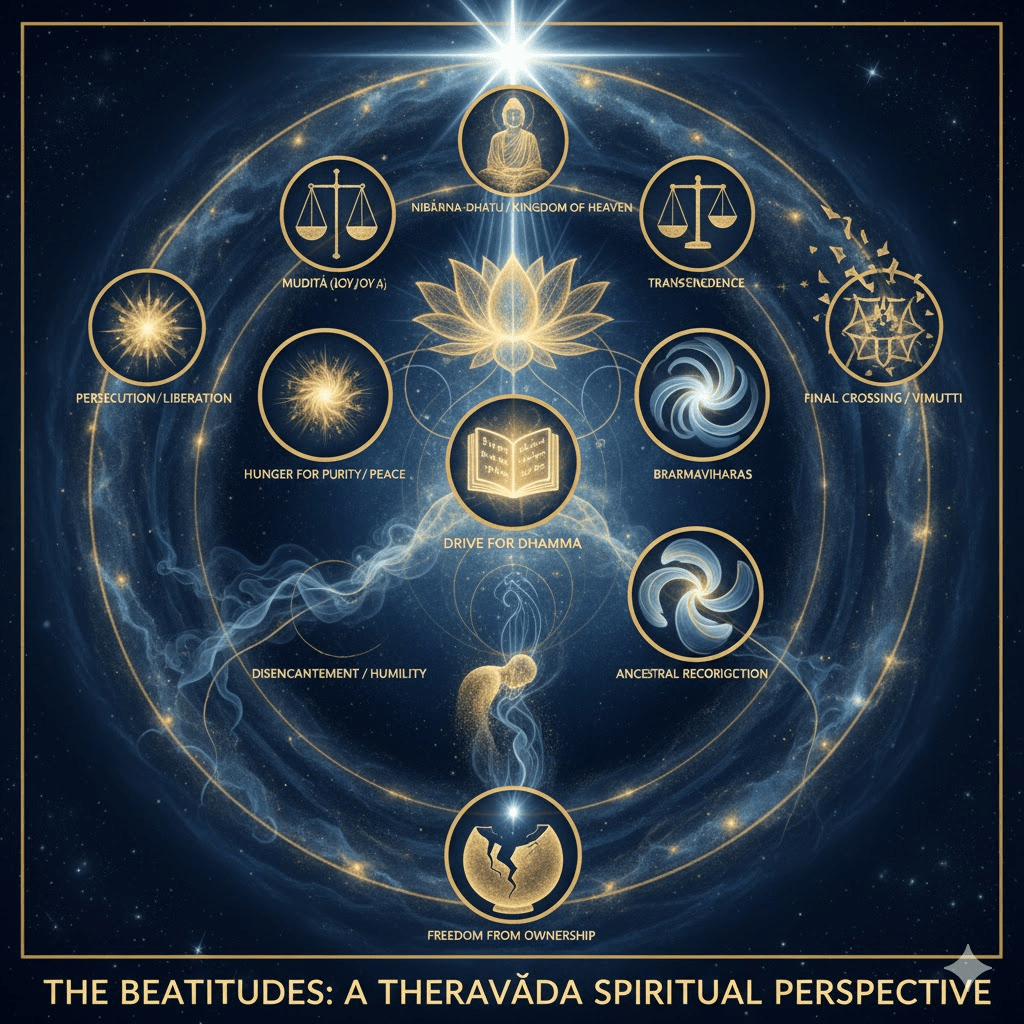
Seen through Theravāda wisdom, the Beatitudes outline a graduated ascent:
- poverty of attachment,
- mourning worldly existence,
- meekness of ego,
- hunger for truth,
- mercy and purity,
- joy in ancestral light,
- transcendence beyond worldly existence,
- endurance under trial which leads to final liberation.
The citta, carrier of the soul, aligns with Brahma-law through the Brahmavihāras.
The Kingdom of Heaven is not a metaphor.
It is the higher order of existence in our ancestral heavens—and beyond it, the Deathless.
Across East and West, the message stands unified:
Withdraw from the world.
Purify the mind.
Join our ancestors and return to the Eternal.
 Gautama Dhamma
Leave a comment