
A Daoist–Esoteric Perspective Preserved in Chinese Civilization
1. Why Chinese Language Preserves Ancient Metaphysics
It is difficult to articulate ancient metaphysical models using modern English alone. One of the great advantages of the Chinese language is its clear separation between spoken language and written characters. While spoken Chinese has evolved greatly over the centuries, written Chinese has remained remarkably stable. As a result, modern Chinese readers can still read texts written over two thousand years ago with relatively little difficulty.
This continuity allows ancient metaphysical concepts to be preserved without being reshaped by phonetic drift, cultural reinterpretation, or later philosophical overlays. Many ideas that appear obscure or symbolic in translation remain structurally precise in their original written form.
2. Two Worlds: Physical and Spiritual
Ancient Chinese cosmology divides existence into two fundamental domains:
- The Physical World (物質界)
- The Spiritual World (靈界)
These are not separate universes but interpenetrating domains connected through interface layers. The physical world is understood to be constructed upon the spiritual world, not independent from it.
Between these two domains lie four intermediary realms, traditionally called the Great Elements:
- Earth (地) – closest to the physical world
- Water (水)
- Fire (火)
- Wind (風) – closest to the spiritual world
These are not merely symbolic elements but states of condensation and vibration, marking the transition from formless spirit to tangible matter.
From a modern scientific perspective, light may be understood as a comparable interface: it exhibits both wave and particle properties, bridging immaterial energy and material form. In this analogy:
- The Wind realm corresponds to high-frequency, high-energy particulate states
- These condense into atoms and molecules
- Eventually forming solid matter — the Earth realm we perceive physically
3. The Daoist Threefold Structure of the Soul
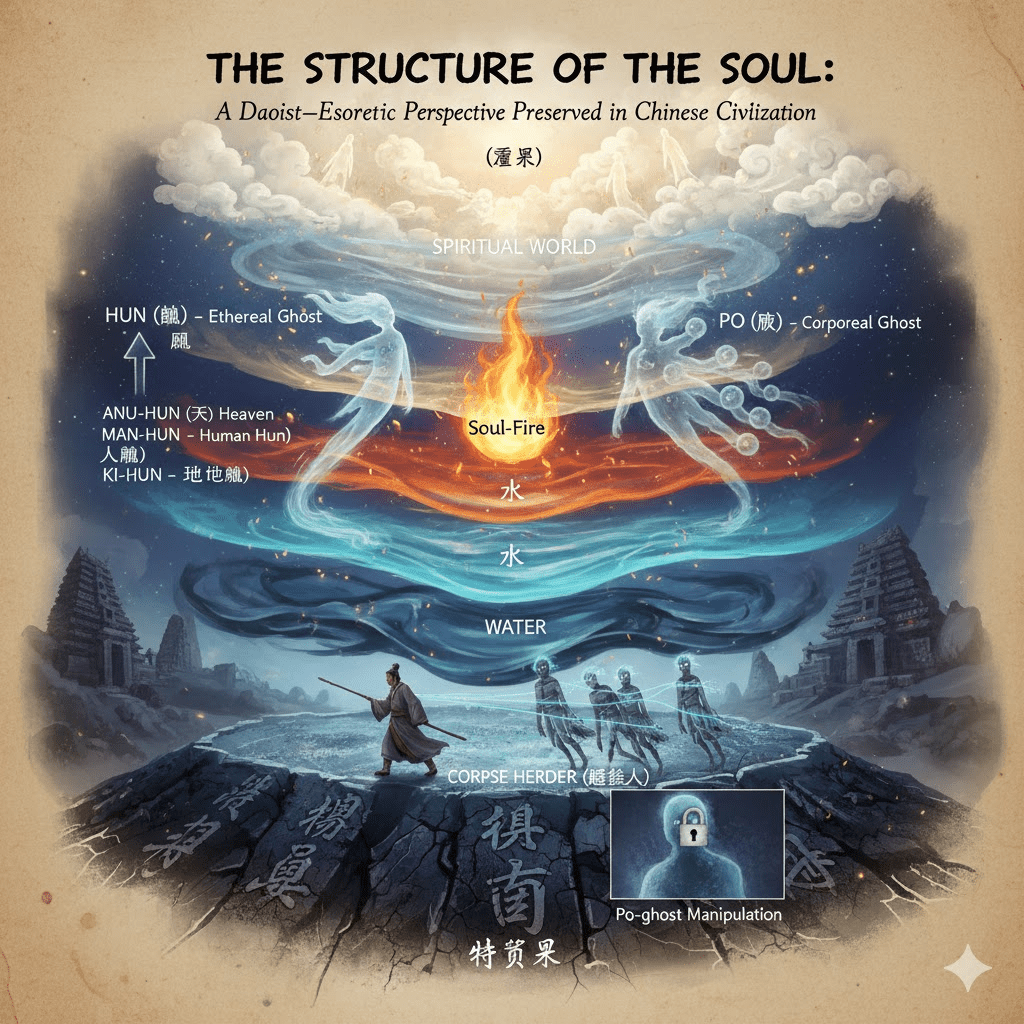
Chinese esoteric science, particularly preserved in Daoist traditions, describes the soul not as a single entity, but as a composite structure consisting of three primary aspects:
- Spirit (靈)
- Hun (魂)
- Po (魄)
Spirit (靈)
The Spirit belongs to higher-dimensional spiritual existence. It is not inherently physical, nor bound to time or matter.
When the Spirit enters the physical world, it passes through the Fire realm, where it becomes ignited as Soul-Fire. This ignition marks the beginning of individual embodied existence.
4. Hun and Po: The Ghost Parts of the Soul-Fire
Once ignited, the Spirit expresses itself through two ghost-like functional parts:
- Hun (魂) — the ethereal ghost
- Po (魄) — the corporeal ghost
Both Hun and Po are described in Daoist texts as ghosts (鬼), not in a moral sense, but as intermediate consciousness forms sustained by Soul-Fire.
5. The Threefold Division of Hun
Daoist esoteric science further divides the Hun-ghost into three components:
- Anu-Hun (天魂) — Heaven Hun
- Man-Hun (人魂) — Human Hun
- Ki-Hun (地魂) — Earth Hun
- Anu (天) means Heaven
- Ki (地) means Earth
Anu-Hun is the highest component and may be called the Soul-Ghost proper, carrying transcendent potential beyond ordinary reincarnation.
Man-Hun and Ki-Hun retain the memories, personality, and karmic imprints of the present life. They are functional consciousness residues rather than eternal principles.
6. The Sevenfold Po
The Po-ghost is associated with body consciousness, instinct, sensation, and biological vitality. Daoist traditions divide the Po into seven parts, each linked to physiological and sensory functions.
Unlike Hun, the Po does not reincarnate.
After death:
- The Hun-ghosts may separate and continue
- The Po-ghost remains bound to the corpse
- Over time, the Po dissipates as the body decays
7. Corpse Practices and Po-Ghost Manipulation
In ancient China, there existed Daoist specialists known as Corpse Herders (趕屍人). These practitioners understood how to preserve and manipulate the Po-ghost, allowing a dead body to move.
This practice had a practical function:
Transporting corpses back to their ancestral hometowns for burial, which was considered essential for ancestral continuity and spiritual harmony.
More extreme esoteric practices involved locking the Po-ghost, or even Man-Hun or Ki-Hun, into the corpse. This gave rise to various forms of animated dead, analogous to what later cultures described as zombies or vampires.
Notably, similar reports exist in modern times, such as in Haiti, where rumors persist of chemical or ritual methods used to suppress consciousness while maintaining bodily animation.
8. A Lost Global Science of Consciousness
The systematic study of soul and consciousness was not unique to China. Evidence suggests that before ancient cataclysms, such knowledge was widespread across civilizations. Traces of this science are carved into stone in certain Hindu temples, indicating a once-global metaphysical tradition.
Some ancient memories and myths suggest that such knowledge became forbidden, and that cataclysmic events — such as great floods — were interpreted as consequences of abusing consciousness-manipulating sciences.
Whether mythic or historical, these narratives reflect a deep human intuition:
consciousness is powerful, dangerous, and not meant to be exploited without consequence.
9. Daoism and Ascension Beyond Human Limits
Daoism may be understood as a systematic attempt to break the limitations of ordinary human existence.
Its ultimate aim is:
- To refine Hun
- To transcend Po
- To allow Anu-Hun to ascend toward spiritual heavens
Practices such as inner alchemy, spirit separation, and ghost-world communication were methods of engaging these structures deliberately.
In this sense, Daoism is part of a much older pan-shamanic human legacy — a lineage of practices concerned with:
- Consciousness beyond the body
- Interaction with non-physical dimensions
- Transcendence of biological destiny
10. Closing Reflection
What modern culture often dismisses as superstition was, in ancient times, treated as technical knowledge — dangerous, sacred, and transformative.
Whether one accepts these models literally or symbolically, they reveal a consistent ancient intuition shared across civilizations:
The soul is structured, layered, and governed by laws as precise as those of physics — and violating those laws carries consequences.
 Gautama Dhamma
Leave a comment