
For more than a century, English-language discussions of Indian and Buddhist philosophy have been shaped by a quiet but decisive mistranslation. Ātman (Sanskrit) and attā (Pāli) have been rendered as “Self.” This choice, now treated as academic common sense, has profoundly altered how the path of liberation is understood.
To recover the true meaning of Brahmacariya—the holy life—and the real aim of the teaching, a correction is required:
Ātman / Attā means Soul.
The citta carries the Soul.
This Soul is real, created, vulnerable in the world, capable of defilement, capable of purification, and able to become eternal only by abiding in Nibbāna-dhātu, the Deathless realm.
Dhammapada 160:
attā hi attano nātho
ko hi nātho paro siyā
attanā va sudantena
nāthaṁ labhati dullabhaṁ
Literal rendering:
The self is indeed the protector of the soul.
Who indeed could be a protector other than that?
By the self that is well-tamed
one obtains a protector that is hard to obtain.
Word-for-word:
- attā — self / oneself / the self (as subject/nominative: the acting, responsible agent)
- attano — soul / one’s soul / of the soul / belonging to the soul (genitive)
- nātho — protector / lord / master / refuge / helper / guardian
- sudantena — well-tamed / thoroughly disciplined / self-controlled
- dullabhaṁ — hard to obtain / difficult to get / rare
The verse distinguishes attā (self: the acting, disciplining agent—the functional, psychological layer of personality, will, habits, and effort) from attano (soul: the deeper, belonging essence—the vital, ontological principle that is protected and ultimately liberated).
The self (as tamer/discipliner) safeguards and purifies the soul (the enduring, animating citta-continuum capable of defilement, purification, and abiding in Nibbāna-dhātu). No external/other can fulfill this role. Through thorough taming (discipline of the self), one attains the hard-to-obtain protector: the ultimate refuge of liberation.
1. The History of a “Secular” Nudge
The translation of ātman / attā as Self did not arise from linguistic necessity. It arose from a cultural decision.
Early Western translators, working before the rise of strict academic secularism, had no hesitation in using Soul. Scholars such as Sir William Jones recognized immediately that ātman referred to the same animating principle spoken of by Western mystics and philosophers—the inner bearer of life, continuity, and moral consequence.
This changed in the late nineteenth century. With the professionalization of religious studies, figures such as T. W. Rhys Davids sought to present Buddhism as compatible with modern psychology and empirical rationalism. The word Soul carried metaphysical weight and spiritual implication. Self felt safer, thinner, and more analytical.
A decisive shift followed:
- Soul became labeled “religious.”
- Self became labeled “philosophical.”
- Liberation was reframed as an internal psychological adjustment rather than an ontological escape from the world.
Language did not merely describe the teaching.
It redirected it.
2. Why “Self” Cannot Carry the Teaching
Despite its academic popularity, Self fails to hold the meaning required by the path. Four points make this unmistakable.
2.1 Essence versus Personality
In contemporary English, self is lightweight.
We speak of self-image, self-expression, self-care, selfies. These refer to personality, emotion, and social identity.
Ātman / attā refers to none of these.
It points to the animating breath, the carrier of continuity across birth and death, the bearer of moral consequence.
Soul restores gravity.
It signals that the teaching addresses the deepest stratum of being, not the rearrangement of personality traits.
The holy life is not therapy.
It is preparation for departure.
2.2 Breath, Life, and Continuity
Across Indo-European traditions, words for soul consistently relate to breath, wind, or vital force. This reflects lived reality: when the breath departs, life departs.
Ātman arises from this same intuition.
It is the living principle that enters the world, becomes entangled, and seeks release.
Self lacks this resonance.
It remains abstract and cerebral—precisely the opposite of what renunciation addresses.
2.3 The True Weight of Anattā — The Aggregates Are Not the Soul
When Anattā is translated as “No-Self,” it is reduced to a clever psychological observation:
“There is no permanent identity.”
Correctly understood as Not-Soul, Anattā makes a precise ontological declaration:
The five aggregates are not the Soul.
The form aggregate (rūpa),
the feeling aggregate (vedanā),
the perception aggregate (saññā),
the mental formations aggregate (saṅkhāra),
and the consciousness aggregate (viññāṇa)
together constitute worldly existence.
They are not part of the Soul.
They do not belong to the Soul.
They are not expressions of the Soul.
They are the world itself—temporary, conditioned, and governed by aging and death.
Anattā does not deny the existence of the Soul.
It denies the false identification of the Soul with the world.
What beings habitually call “my soul,” “my true self,” or “my inner essence” is in fact the five aggregates functioning under worldly law. Seeing this clearly severs the deepest attachment: ownership of existence itself.
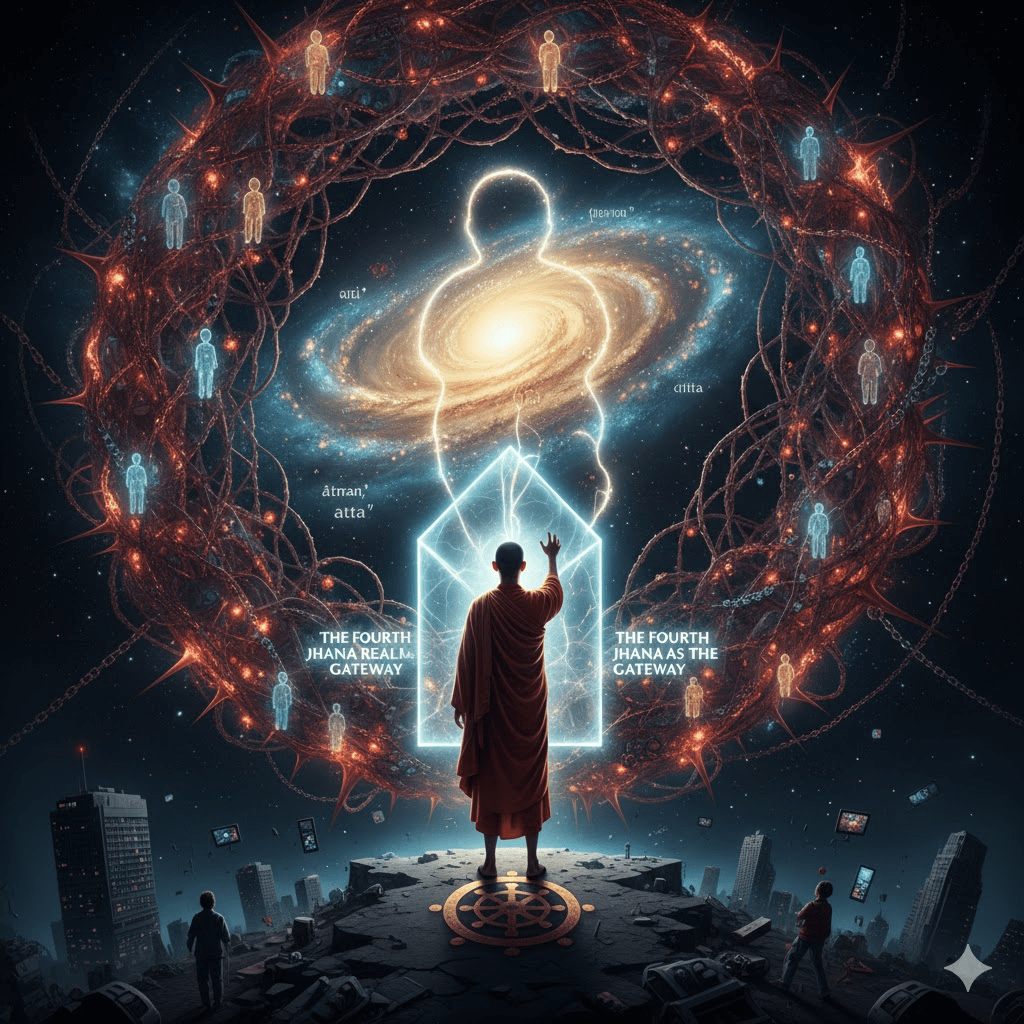
This shatters the Jāla—the net of interlinked attachments that binds the citta to saṃsāra.
This is not nihilism.
It is liberation through accuracy.
2.4 Liberation Requires Ontological Language
The path taught by Gautama Buddha leads beyond the jurisdiction of the world—beyond aging, decay, and death. Such a destination cannot be approached with minimal language.
When we say Self, the goal sounds like balance or insight.
When we say Soul, the goal sounds like escape from the world.
That is exactly what liberation is.
3. The Soul Clarified — Created, Defiled, and Restorable
A further clarification is essential.
The Soul—the citta—is real, but it is not eternal by its own nature. It is created, arising from the Manussa Source, not from the cosmic system itself. Because it is created, the Soul is vulnerable while dwelling in the world. Under worldly law, it can suffer, age, and perish through repeated rebirth.
This is why liberation is necessary at all.
Defilement through rāga, dosa, and moha does not annihilate the Soul. It weighs it down, binding it to worldly gravity. What is defiled, however, can be purified.
4. Reclaiming the Sacred Meaning of the Path
To restore Soul is to restore honesty.
It affirms that beings are more than biological systems or psychological narratives. It affirms that the Soul can be endangered, purified, restored, and ultimately saved—not by belief, but by exit.
Brahmacariya exists for one reason:
to free the Soul from the world.
Through ethical withdrawal (Sīla), concentrated lifting of the mind (Samādhi), and liberating realization (Paññā), the defiled citta is purified. When liberation (Vimutti) is complete, the Soul leaves the world entirely and abides in Nibbāna-dhātu, the Deathless realm.
Only there does the Soul become eternal—not by nature, but by arrival.
This is not a metaphor.
It is the destination.
Restoring Soul restores the seriousness of liberation itself—and reveals again what the path was always meant to accomplish.
“Atta-dīpā viharatha, atta-saraṇā, anañña-saraṇā;
dhamma-dīpā, dhamma-saraṇā, anañña-saraṇā.”
Dwell with your Soul as your island, your Soul as your refuge, there is no other refuges;
My Dhamma as your island, my Dhamma as your refuge, there is no other refuges.
- Gautama Buddha
(DN 16, Mahāparinibbāna Sutta)
(DN 26, Cakkavatti-Sīhanāda Sutta)
(SN 22.43, Attadīpa Sutta)
 Gautama Dhamma
Leave a comment