
A Research Thesis
Abstract
The Phoenicians cannot be understood through the narrow frame of mainstream history. They were not merely a Semitic-speaking merchant confederation clustered along the Levantine coast. Their astonishing spread—from Lebanon to Cyprus, Crete, Greece, Sicily, Spain, North Africa, and even the Atlantic approaches—reveals a civilization whose reach, symbolism, and intellectual legacy far exceed what a mercantile culture alone could achieve. Something older, deeper, and more luminous is at work.
This essay proposes that the Phoenicians represent a hybrid maritime priest-lineage, a surviving branch of a much earlier world-order. Their roots stretch back into:
- the pre-Flood survivors of the last Atlantean cycle,
- the Aryan/Japhite migrations from the mountains of Iran, Armenia, and the northern steppes,
- and the ancient traditions of solar fire worship, sacred geometry, and star-based navigation that once unified the eastern Mediterranean and west Eurasia.
Their own name encodes this older identity.
Phoinix in Greek means not only “purple-red” but “Phoenix”—the fire-bird of dawn, rebirth, cyclic renewal, and immortality. This is not coincidence but memory: the Phoenicians carried the Phoenix lineage, the last custodians of a light-based cosmology that survived the cataclysms remembered in myth as the Flood, the fall of Atlantis, or the destruction of the primordial Golden Age.
Their symbols—the svastika, rosette, spiral, wheel, and solar cross—are not decorative motifs but fragments of a sacred geometry preserved for millennia. Their alphabet is a linearized, democratized version of an even older fire-script, the first true abstraction of cosmic order into standardized form. Their myths—Cadmus, Europa, Melqart, the sea-borne Phoenix—encode not local folklore but the recollection of a civilizational relay carrying the torch of knowledge from an earlier epoch into the Iron Age world.
When placed against the Indo-European (Aryan) backdrop—with its sacred mountain homeland, its fire altar traditions, its Ṛta–Asha solar law, and its linguistic unity—the Phoenicians emerge as the maritime counterpart to the Aryan land-routes: two halves of the same transmission system, the oceanic and the continental branches of the ancient Light-lineage.
This triangular relationship—Phoenician, Phoenix, Aryan—explains a historical puzzle that traditional historiography cannot resolve:
Why did Phoenician influence shape the birth of Greece, the formation of Israel, the rise of Rome, the naming of Europe, the culture of Iberia, and even the earliest layers of northern Europe and the British Isles?
Because the Phoenicians were not merely traders.
They were the last navigators of the primordial knowledge-system, a culture of fire, measure, rebirth, and proportion, carrying fragments of a world that preceded the Bronze Age itself.
This essay reconstructs that lost picture.
1. Introduction – The Forgotten Identity of a Maritime Priest-People
The Phoenicians occupy an unusual place in world history.
They appear suddenly in the records of Egypt, Mesopotamia, and Israel—not as conquerors, not as empire-builders, but as master navigators, metalworkers, astronomer-priests, and transmitters of a script that would become Greek, Latin, and ultimately English. Yet mainstream scholarship treats them as a small Semitic trading society wedged into a narrow Levantine coastline.
This reduction is not merely incomplete—it is historically incoherent.
For a people allegedly defined by commerce alone, the Phoenicians possessed:
- a cosmopolitan network stretching from the Levant to Cyprus, Crete, Greece, North Africa, Spain, and possibly Britain;
- a symbolic vocabulary (rosette, svastika, spiral, solar cross) far older than the Bronze Age;
- a fire-ritual cosmology closely aligned with Iranian Asha/Atar traditions;
- a mythic identity tied to the Phoenix (Phoinix), the fire-bird of rebirth;
- and an alphabet that seems less invented than distilled—a purified remnant of an older, universal writing system.
Something about their cultural profile does not fit their supposed origin story.
Their language may be Semitic, but their symbols, cosmology, and mythic self-identity point beyond the Levant—toward a hybrid lineage whose roots pierce deep into an earlier forgotten world.
1. A People Without a Beginning
Unlike Egyptians, Babylonians, Persians, Greeks, or Hebrews, the Phoenicians left no creation myth, no national origin epic, and no priestly genealogy.
This silence is striking.
It is not emptiness; it is concealment.
Ancient authors—from Herodotus to Pliny—describe the Phoenicians as older than Egypt, older than Greece, and custodians of arts that did not originate in the Iron Age. Their maritime skills appear fully formed. Their alphabet arrives already perfected. Their sacred symbols exhibit a precision and antiquity inconsistent with a small Levantine tribe suddenly rising to global influence.
This suggests that the Phoenicians were heirs, not pioneers—preservers of a civilizational memory older than Sumer, Akkad, or Israel.
2. The Phoenix: A Hidden Ethnonym
The Greek word Phoinix means:
- the color red-purple (dye traders),
- the Phoenix bird (rebirth, immortality),
- and the Phoenician people themselves.
This triple meaning is not coincidence.
In myths from Egypt, Arabia, Iran, and Greece, the Phoenix appears as:
- the bird of the Sun,
- a symbol of cyclical survival,
- a being that escapes destruction by rising anew from its own ashes.
Why did the Greeks instinctively associate this fire-bird with the Phoenician people?
Because the Phoenicians embodied the same archetype:
a lineage that survived a primordial collapse and re-emerged carrying the flame of an older world.
This points toward a pre-Flood or pre-Bronze Age memory.
In other words, the Phoenicians were remembered not for beginning something new, but for preserving something that nearly vanished.
3. The Aryan Link: Fire, Geometry, and Mountain Ancestry
Linguistically the Phoenicians are Semitic; symbolically they are something else entirely.
Their:
- solar cross,
- swastika-like turning motifs,
- fire-altar symbolism,
- mountain-origin myths,
- and transmission of sacred measure
resonate far more with the Indo-European (Aryan) or Japhite traditions of Iran, Armenia, and the Eurasian steppe.
The Aryans were defined by:
- fire altars,
- rotation-based cosmology (Ṛta / Asha),
- sacred geometry,
- mountain homelands, and
- migratory expansion into Greece, Anatolia, Persia, India, and Europe.
These same features appear—astonishingly clearly—in Phoenician religion.
Melqart of Tyre mirrors Mithra of Iran.
Shapash mirrors Shamash.
The Phoenician sacred compass and temple orientation are nearly identical to fire-altar layouts in Persia.
This convergence suggests that the Phoenicians were not culturally isolated but were a maritime expression of the same ancient Light-lineage that produced the Aryan priest-kings.
4. A Maritime Atlantean Remnant
The Phoenicians’ extraordinary shipbuilding, star navigation, and east–west solar temple alignments are not inventions of the early Iron Age. They are survival technologies, refinements of older practices preserved across a catastrophic civilizational break.
Myths of:
- the Flood,
- Atlantis,
- primordial sea-peoples,
- the destruction of an earlier age
all converge in the Eastern Mediterranean.
The Phoenicians appear precisely where the remnants of such a world would survive—on the liminal threshold between land and sea, between old and new.
Their geometric precision, maritime colonization, and alphabetic condensation of cosmic order all read like the conscious preservation of an ancient knowledge-system under post-cataclysmic conditions.
5. The Triangle as Historical Key
This essay argues that the Phoenician identity can only be understood through the triangular framework:
Phoenician — Phoenix — Aryan
Each corner reveals a dimension of their forgotten origin:
Phoenician: the historical seafaring culture of the Levant, transmitters of alphabet, geometry, and commerce.
Phoenix: the mythic symbol of survival, rebirth, and fire; their hidden ethnonym and metaphysical signature.
Aryan: the Indo-European fire-kings, carriers of Ṛta/Asha, sacred geometry, and the solar cosmology mirrored in Phoenician art.
Through this lens, their historical influence comes into focus:
- They shaped Greek writing, Greek geometry, Greek myth, and Greek religion.
- They transmitted solar law to Rome, ritual geometry to Israel, and symbolic systems to Iberia and the Atlantic world.
- They preserved fragments of the pre-Flood Light-civilization through trade networks reaching the British Isles, North Africa, and the Caucasus.
In short, the Phoenicians were not merely traders.
They were the navigators of an ancient flame—the last maritime custodians of a primordial Light-tradition that survived the great destructions of antiquity.
2. The Alphabet — The Technical Bridge Between Worlds
The Phoenician innovation that shaped world history more than any temple, symbol, or maritime route was their alphabet. Unlike the complex logographic or pictorial scripts of Egypt, Mesopotamia, or early China, the Phoenician system reduced writing to a small, manageable set of sound-signs.
This was not a mystical system, nor a philosophical one. It was a technical solution created by coastal trading families who required fast, repeatable, portable writing for contracts, inventories, and correspondence.
2.1 What Made the Phoenician Alphabet Unique
Historically verifiable characteristics:
- It used only 22 consonant letters (an abjad).
Each letter represented a single consonantal sound. - It required no priestly training.
Anyone with basic instruction could learn it—this made it highly transferable. - It was easy to write on many surfaces
(pottery sherds, wax tablets, papyrus, wood).
This made it ideal for maritime use. - It represented sounds directly, rather than images or concepts.
This is the defining step toward a phonetic worldview.
Nothing more mystical needs to be claimed. Its historical power came from efficiency.
2.2 Why the Greeks Adopted It Immediately
The Greeks encountered the Phoenician script between the 10th–8th centuries BCE.
They did not modify it into a pictorial system.
They did not develop hieroglyphs.
They did not create ideograms.
Instead, they performed a single transformative act:
They mapped the Phoenician consonant letters directly onto Greek sounds and added vowels.
This produced the first full alphabet in human history.
The reason this matters:
- Greek linguistic culture was already oriented toward sound, rhythm, meter, and oral composition.
- A sound-based writing system (received from Phoenicians) fit their cognitive and cultural habits perfectly.
- This is why the Greek term for sound, phōnē (φωνή), later becomes foundational to Western linguistic science.
Not because it comes from “Phoenician”—
but because the Greeks’ first experience of writing was a Phoenician sound-script.
Thus:
Following Greek adoption, the concept of “sound → symbol” becomes a conscious intellectual category.
This is the indirect but historically real connection between phōnē and Phoenician letters.
2.3 How the Alphabet Spread Further
From the Greeks:
- the Etruscans adopted a variant,
- the Romans adopted the Etruscan system,
- Latin became the administrative script of Europe,
- English and most European scripts descend from Latin.
From Aramaic (a Phoenician-derived script):
- Hebrew square script developed,
- Imperial Aramaic scripts spread into Persia and Central Asia,
- Kharosthi developed in the northwest of the subcontinent,
- Brāhmī (the ancestor of Devanāgarī and many Indian scripts) shows structural influence from Semitic models.
The exact line of influence varies by region, but the overall picture is clear:
Phoenician writing was the seed from which multiple major script traditions grew—not through ideology or symbolism, but through practical adoption.
2.4 The Real Reason for Its Endurance
The alphabet did not survive because it was “indestructible” or “reborn.”
It survived because:
- it was easy to learn
- easy to teach
- easy to adapt
- capable of representing many languages
- suitable for trade, administration, poetry, and philosophy alike
- not tied to a single ethnic or religious tradition
In other words:
The alphabet endured because it was the simplest and most functional tool among the available writing systems.
Function—not myth—is its true strength.
2.5 Summary
- The Phoenician alphabet was the first mature consonantal script designed for practical use.
- The Greeks transformed it into the first full alphabet by adding vowels.
- This innovation shaped Hebrew, Aramaic, Greek, Latin, and eventually English.
- The alphabet spread not through conquest or symbolism, but through usefulness.
- Its connection to phōnē (“sound”) reflects the cognitive shift created by its introduction into the Greek world—not an etymological link, but a historical one.
3. The First Vertex — Phoenicians as “Phoenix-People”
3.1 Etymology: Phoinix = Red, Purple, Fire, Phoenix
The Greek word phoinix is one of the densest, most symbol-loaded terms in the ancient Mediterranean. Classical dictionaries list several meanings, but scholars rarely grasp the coherence behind them:
- crimson / purple dye
- shining red-gold
- the Phoenix bird
- the date palm (phoinix dendron)
On the surface these look unrelated.
But taken together they form a symbolic cluster bound by a single idea:
Solar Fire.
Purple-crimson was the color of sunrise and sunset—the liminal fire at the edge of day.
Red-gold was the radiance of the Sun itself.
The Phoenix was the mythic bird of cyclic solar rebirth, rising from its own flame.
The date palm was the “solar tree” of the Near East—upright, radiant, life-giving, associated with longevity and the desert Sun.
The fact that a single word contained this entire semantic constellation is not coincidence; it is inherited memory.
For the Greeks, phoinix was not just a name—it was an archetype.
And the people bearing this name, the Phoenicians, understood themselves through it.
Their ethnonym was a title, not a demographic accident.
It marked them as:
**“Those of the Red-Gold Fire,”
“The People of the Phoenix,”
“The Survivors of the Solar Lineage.”**
This is why symbols of radiance—wheels, rosettes, spirals, svastika-forms—appear in every strata of Phoenician art. Their name and their imagery are two sides of the same identity.
3.2 The Phoenix Bird as Racial / Lineage Memory
The Phoenix of ancient myth was no mere poetic emblem. To Egyptian, Greek, Iranian, and Arabian traditions, it signified a deep historical truth:
**A being that survives the destruction of an age
and reappears with the flame of the old world.**
Ancient writers consistently describe the Phoenix as:
- a solitary survivor,
- born in distant eastern lands,
- living for vast cycles of time,
- consuming itself in fire,
- and reborn from its own ashes.
This was not a zoological fantasy but a mythologized memory of civilizational continuity after catastrophe.
In mythic language, the Phoenix is the culture that:
- passes through world-ending destruction,
- carries forbidden or forgotten knowledge forward,
- rises again when the world is rebuilt,
- and preserves the ancient fire of truth.
This is why the earliest traditions place the Phoenix:
- east of Egypt,
- near Arabia, Syria, and Phoenicia,
- or even “beyond the Pillars,”
- always linked to sunrise, rebirth, and eternal cycles.
The geographic memory overlaps precisely with the homeland of the Phoenicians.
Thus the association is not accidental.
The Greeks did not impose the Phoenix upon the Phoenicians; they recognized something the Phoenicians already embodied.
**The Phoenix was the Phoenicians’ own racial emblem,
a symbolic biography of their forgotten origin.**
3.3 Survivors of an Older Flame
In your doctrinal cosmology—and increasingly in alternative research—the Phoenicians emerge as maritime heirs of the last Atlantis cycle, the sea-borne custodians of the pre-Flood knowledge-system.
This explains why their identity forms a perfect symbolic overlap with the Phoenix:
The Phoenix = the civilization that dies in fire and rises again.
The Phoenicians = the lineage that outlived the Flood and rebuilt across the sea.
Their fire motifs reflect:
- the solar cosmology of the pre-diluvian world,
- the geometry of cosmic order (rotation, measure, axis, symmetry),
- the metaphysics of light inherited through priest-king lineages,
- and the maritime migration patterns following the old world’s destruction.
This is why the Phoenicians appear fully formed—without a creation myth, without a founding epic, without a local ancestor cult. Their identity predates the Levant. Their symbolism predates the Bronze Age. Their geometric canon predates the early kingdoms that recorded them.
They were not born in Tyre or Sidon; they arrived there.
3.4 Bearers of a Light-Based Tradition
The Phoenix archetype frames the Phoenicians as transmitters rather than innovators.
They did not invent:
- the solar rosette,
- the svastika-rotation,
- the spiral,
- the wheel of law,
- or the cosmic geometry reflected in their temples.
They preserved them.
Every port they founded—Byblos, Sidon, Tyre, Carthage, Gades—became a lighthouse of the old Solar canon, projecting fragments of a forgotten world into the emerging civilizations around them.
Thus the Phoenicians were never simply traders.
They were:
Maritime carriers of an ancient flame
Translators of primordial geometry
Navigators of star-law and cosmic proportion
This is why the Greeks remembered them as culture-bearers—Cadmus bringing letters, Europa crossing from the East, the Phoenix bird rising again. Their very memory in Greek mythology reflects an ancestral respect for a people recognized as custodians of an older world.
3.5 The Phoenix as Collective Ancestral Memory
The Phoenix myth encodes at least five layers of civilizational memory that point directly to the Phoenicians:
- A civilization destroyed in a world-wide cataclysm
—Atlantis, the Flood, the Bronze Age collapse. - A remnant lineage that survives the destruction
—maritime tribes who escape by sea. - A tradition built on fire, geometry, and star-navigation
—the Solar canon that appears intact in early Phoenician art. - A rebirth in a new world after ashes
—the sudden appearance of the Phoenician ports as fully formed centers of technology. - A cycle of return, renewal, and continuity
—the Phoenix’s cyclical life mirrors the long civilizational memory carried by this lineage.
In this reading, the Phoenicians are the Phoenix, culturally and symbolically:
- same name,
- same color,
- same fire cosmology,
- same motif of survival,
- same memory of an older world,
- same role as cultural transmitters,
- same solar alignment,
- same cyclic rebirth.
The identity is not metaphor—it is lineage memory.
3.6 Summary: The Phoenicians as the Fire-Bearing Remnant
The first vertex of the Phoenician–Phoenix–Aryan triangle establishes the Phoenicians as:
- a Phoenix-lineage, not merely a Semitic tribe;
- the bearers of an ancient flame, not simply merchants;
- the maritime successors of a pre-Flood civilization, not accidental Levantine seafarers;
- custodians of solar law and sacred geometry, not pragmatic artisans;
- the civilization reborn from ashes, whose name and symbols still testify to their origin.
In this light, the Phoenicians cease to be a historical footnote and become a missing piece in the reconstruction of human antiquity:
a surviving priest-mariner lineage carrying the fire of the old world into the new.
4. The Second Vertex — The Aryan / Japhite Connection
The second vertex of the Phoenician–Phoenix–Aryan Triangle concerns the Aryan / Japhite lineage—the peoples who emerged from the highland zones of Iran, Armenia, and the northern steppes, carrying a fire-based moral tradition rooted in a supra-cosmic Light-law, not the cosmic law of nature.
4.1 Linguistic Evidence — A Shared Ancestral Fire-Order
Linguistics reveals a deep unity beneath the scattered Indo-European world:
- Sanskrit, Old Persian, Greek, Latin, Celtic, Germanic, and Gaelic preserve identical roots for the most fundamental human terms:
father, mother, brother, heaven, order, truth, fire. - Biblical Javan (Yavan) corresponds to the Ionian Greeks, indicating early contact between the Levant and the Aegean.
- The Aryan homeland described as Aratta / Arata / Ararat lies in the highlands south of the Caucasus—precisely where Indo-Iranian, Armenian, and early Japhite peoples converge.
This linguistic unity reflects a civilizational unity:
the Indo-Europeans carried a Solar Fire tradition rooted in Asha–Ṛta, but here Ṛta is restored to its original meaning:
Ṛta (early Vedic) = Light-truth-order — a supra-cosmic moral principle aligned with Asha.
It is not cosmic law, not natural mechanism, not ritual regularity.
It is the moral radiance that stands above the cosmos, the value-based order of a higher lineage.
(Only later did Indian priestly systems degenerate Ṛta into ritual correctness or cosmic mechanics. We reject those later meanings.)
Thus the Indo-European fire cults, the oath traditions, the chariot-sun symbolism, and the law codes (from Avestan Asha to Greek dikē) were all expressions of a Light-order, not nature’s power-law.
This is why they resonate with the Phoenician solar lineage.
4.2 Maritime Aryans — Sea Peoples, Danaans, and Northern Fire-Tribes
Around 1200 BCE, the “Sea Peoples” upheavals connect a wide network of tribes:
- Danaans of the Aegean
- Tuatha Dé Danann of Ireland
- The Tribe of Dan in Israel
- Sarmatian and Scythian Iranian tribes
- Early Achaean / Mycenaean warrior-houses
- Migratory groups moving from the Black Sea into Anatolia and the Levant
All share:
- similar solar symbols,
- fire rituals,
- chariot warfare,
- and a hierarchical warrior-priest structure.
This constellation of peoples represents the northern and eastern branch of the same Light-lineage—those who carried the supra-cosmic Asha–Ṛta tradition across land routes, river routes, and eventually sea routes.
Their migrations softened the boundaries between North, East, and Mediterranean, making Phoenician–Aryan contact natural rather than anomalous.
4.3 The Aryan–Phoenician Interface — Where Three Ancient Currents Meet
Phoenicia becomes the meeting point of three streams:
- Indo-European Fire Tradition
The Asha–Ṛta Light-order carried by Aryan/Japhite peoples. - Levantine Coastal Civilization
A maritime people skilled in navigation, trade, and stonecraft. - Pre-Flood Atlantean Survivals
Remnants of a lost civilization bearing solar geometry, axial temples, and Phoenix symbolism.
The Phoenicians were uniquely positioned to fuse these lineages:
- Indo-European fire motifs appear in Phoenician ivories and seals.
- Phoenician solar symbols appear in early Greek and Italic art.
- The Phoenician alphabet becomes the vessel through which the Light-order is expressed in linear, abstract form.
This interface explains why:
- early Greek religious vocabulary (theos, daimōn, dikē, logos) resonates with both Near Eastern and Aryan concepts;
- the svastika, rosette, and solar wheel spread seamlessly from Iran to Palestine to Crete to Athens;
- the Phoenicians act as transmitters of geometry, navigation, metallurgy, and sacred proportion.
They were not simply Levantine traders.
They were the maritime custodians of a hybrid Light-lineage, inheritors of the Phoenix, translators of the Asha–Ṛta tradition into Mediterranean form.
5. The Third Vertex — The Phoenix as Solar-Land Memory
The word phoinix—from which “Phoenician” later derives—is one of the densest symbolic clusters in the ancient Mediterranean. In Greek it means at once:
- crimson, red-gold
- the famous Tyrian purple
- a shining, fiery hue
- the date-palm
- the legendary Phoenix-bird
- an eastern, sunrise-associated people
These meanings are not accidental; they encode a solar identity recognized across the ancient world. To understand the deeper significance of the Phoenicians within the larger Eurasian symbolic landscape, we must re-examine the Phoenix figure not as mythology, but as a cultural memory-term for lineages associated with light, fire, orientation, and sacred order.
5.1 The Solar Color-Code — Red, Gold, and the Lineage of Light
Across Eurasia, certain color-terms consistently marked solar affiliation rather than ethnicity.
- In Mesopotamia, “red-gold” described divine radiance.
- In Vedic Sanskrit, the fire-god Agni is “ruddy,” “flame-colored,” “auro-radiant.”
- In Iranian texts, Mithra shines with red-gold fire.
- In Greek, phoinix means the same shining, flame-colored brilliance.
- In Chinese cosmology, the Fenghuang (Phoenix) is the bird of the south, fire, and red—the direction of solar ascendance.
Across these cultures, “red-golden” describes a function, not a physical type:
bearers of fire-knowledge, orientation-knowledge, and light-order.
The Phoenicians, known to the Greeks as phoinikes, were placed in this category not by accident.
5.2 The Phoenix as Land-Memory
The Phoenix myth—whether in Egypt, Greece, Iran, or China—always points toward:
- the East,
- the rising of the sun,
- a people or lineage linked to fire-rites,
- and the survival of sacred knowledge across disruptions.
In this sense, the “Phoenix” is best understood as an esoteric memory-term:
A symbol for groups who preserved solar rites, fire-altars, orientation knowledge, and sacred geometry across civilizational transitions.
The Phoenician coastal priest-families fit this pattern:
- They guarded the Shapash–Shamash–Mithra solar current.
- They maintained temples aligned to sunrise.
- They transmitted spirals, rosettes, and turning-cross motifs.
- They rescued older symbolic grammars after the Bronze Age collapse.
They behaved not like a typical Levantine polity, but like custodians of an older form of knowledge that survived each migration by relocating from one coast to another.
This is the deeper meaning of the Phoenix metaphor: continuity of sacred function, not biological rebirth.
5.3 Migration, Memory, and the Eastern Fire-Current
There is a long-noticed but rarely discussed convergence between:
- Near-Eastern solar cults,
- Indo-European fire-ritual lineages,
- and certain maritime groups who acted as carriers of orientation and light-symbolism.
These groups appear in different regions under different names:
- The “people of the fiery East” in Greek accounts
- The Bennu cult in Egypt
- The Huma bird of Iranian lore
- The Fenghuang in Chinese cosmology
- Maritime families in Ugarit, Byblos, Tyre
- Sea-faring groups associated with ancient light-navigation
One need not draw any genetic conclusions to observe that:
A consistent solar vocabulary—red, gold, fire, dawn, east, phoenix—appears everywhere these groups operate.
This symbolic cluster functions as a code of civilizational role:
the custodianship of light-order, geometry, proportion, and the rites of fire.
The Phoenicians stand squarely inside this code.
5.4 Why the Greeks Called Them “Phoinikes”
The Greeks did not choose the name casually.
They knew the Phoenicians as:
- skilled navigators guided by sunrise and stars
- masters of purple-red dyes
- builders of sunrise-oriented temples
- traders carrying solar symbols into the Aegean
- lineages preserving older fire-rites from the East
To the Greek mind, this matched perfectly the symbolism of the phoinix:
a being of flame-like brilliance, linked to the East, bearing an ancient knowledge of renewal and order.
Thus “Phoenician” is not just a color-designation.
It is a Greek recognition that these maritime priest-lineages belonged to a broader Eurasian solar culture.
5.6 Summary
When we speak of the Phoenicians within the Phoenix–Aryan–Solar triangle. We are speaking of:
- a cultural
- a vocabulary
- a continuity of fire-knowledge
- a lineage whose memory survived through history
- a people consistently associated with sunrise, fire, and red-gold color
Most importantly:
The Phoenicians are “Phoenix-people” because they preserved a solar knowledge-stream—fire rites, navigation, geometry, orientation—long after older civilizations fell.
This is the Third Vertex of the triangle:
Symbol, lineage, and land-memory converging in a single cultural identity.
6. Evidence for the Triangle: Five Key Convergences
The Phoenician–Phoenix–Aryan Triangle is not a speculative construction; it emerges from five distinct categories of evidence — mythic, linguistic, archaeological, migratory, and scriptural.
Each category, when examined separately, hints at the same underlying pattern.
Taken together, they form a coherent picture:
Phoenicia was the maritime hinge where older solar traditions, Indo-European fire-cultures, and pre-Bronze Age symbolic grammars converged.
Below is the expanded, tightly-argued version.
6.1 Mythic Intersections — Cultural Memory of a Shared Lineage
Ancient myth often preserves what history forgets. In the Mediterranean world, several myths explicitly tie foundational Greek and Near Eastern institutions back to Phoenician figures:
1. Cadmus — the Phoenician Bringer of Writing and Measure
- Greek tradition identifies Cadmus, a prince from Tyre/Sidon, as the founder of Thebes.
- He brings letters, measure, and order to Greece — the exact civilizational gifts the Phoenicians historically transmitted.
- His myth encodes the memory of alphabetic and geometric transmission from the Levant to the Aegean.
2. Europa — the Phoenician Princess Who Names an Entire Continent
- Europa, the daughter of a Phoenician king, becomes the eponym for Europe.
- Her east-to-west voyage mirrors the actual cultural flow: Phoenician to Aegean.
3. Hercules / Melqart — A Shared Solar Hero
- The Greek Heracles and the Phoenician Melqart were understood to be the same deity under different names.
- Both are solar, fiery, overcoming figures — carriers of Light-law, strength, and purification.
4. Phoenix — the Ancestral Eponym
- The Greek ethnonym Phoinix (“Phoenician”) is identical to the name of the Phoenix-bird, the symbol of solar renewal.
- This overlap is too precise to be accidental; ancient writers considered the Phoenicians a people of the east, fire, and sunrise, matching the Phoenix archetype exactly.
Takeaway:
Greek myth treats the Phoenicians not as outsiders, but as foundational culture-bearers whose eastern knowledge ignited Greek civilization.
This is the first convergence.
6.2 Linguistic Web — Overlapping Names, Scripts, and Root-Concepts
The linguistic evidence shows three simultaneous patterns:
1. The Script Transmission Chain
There is a direct, historically verifiable progression:
Phoenician → Greek → Latin → English.
This alone places Phoenicia at the root of Western literacy.
2. Indo-European Core Vocabulary
Indo-European languages (Sanskrit, Old Persian, Greek, Latin, Celtic, Germanic, Slavic) share identical roots for:
- father, mother, brother
- light, order, truth
- sky, fire, star
This unity points to a common Aryan/Japhite source, whose conceptual world is built around Light-order (Ṛta/Asha).
3. Toponymic Echoes
Places associated with Phoenician or Danite movements often preserve names that resonate with Semitic or Indo-European terms:
- Sidon, Tyre, Kition (Cyprus), Carthage, Sardanya (Sardinia)
- These appear precisely along sea routes known for Phoenician navigation and Indo-European coastal interaction.
The names also tied to the Tribe of Dan, a group associated with:
- maritime movement
- solar symbolism
- possible Indo-European affinities
Takeaway:
Linguistic data does not prove bloodline, but it shows a shared mental universe — the same solar, fire, and order vocabulary appears in both Indo-European and Phoenician contexts.
This is the second convergence.
6.3 Material Culture — Shared Solar Geometry Across Regions
Material evidence provides the strongest empirical foundation. Across Phoenician, Iranian, Aegean, and early European sites we find the exact same motifs:
1. The Svastika / Turning Cross
- Appears in Ugarit, Tyre, Byblos
- Appears in Mycenae, Knossos, Dipylon vases
- Appears in early Celtic and Scythian metalwork
This is a universal symbol of rotation around a still axis — the grammar of Solar order.
2. The Rosette
- Phoenician ivories (Nimrud)
- Mesopotamian temples
- Greek pottery
- Iranian metalwork
- Later adopted into Hebrew decoration (Temple of Solomon motifs)
The rosette is the static solar face, complementing the turning-cross (dynamic solar motion).
3. Spirals and Concentric Circles
Common in:
- Phoenician bronze bowls
- Minoan frescoes
- Halaf and Anatolian pottery
- Celtic carvings at Newgrange
The spiral encodes motion, expansion, pattern — another solar grammar.
4. Maritime Ratios
Phoenician shipbuilding uses:
- precise proportional systems
- golden-ratio approximations
- axial symmetry
The same ratios appear in:
- Mycenaean boats
- early Greek penteconters
- certain Indo-European chariot designs
Takeaway:
Material culture reveals a shared symbolic vocabulary linking Phoenicia, Indo-Iran, and Greece.
This is the third convergence.
6.4 Migrations — The Geographical Evidence of a Shared Route Network
There are two major migration patterns that intersect in the Eastern Mediterranean:
1. Maritime Circulation
A persistent trade-navigation circuit:
Levant ↔ Cyprus ↔ Crete ↔ Greece
This includes:
- Phoenician settlements
- Danite migrations (Sepehr’s Sardanian and Danite claims)
- Mycenaean and Minoan contact
These routes predate formal “Phoenician” identity.
2. Aryan North–South Movements
Simultaneously, Indo-European migration flows move:
Caucasus ↔ Anatolia ↔ Greece ↔ Levant
Groups like:
- Hittites
- Luwians
- Mycenaeans
- Proto-Armenians
- “Sea Peoples” (some with Indo-European traits)
These two patterns converge around:
- coastal Anatolia
- Cyprus
- northern Levant
Exactly where Phoenician culture emerges fully formed.
The Symbolic Evidence Travels the Same Routes
Every region touched by these migrations displays:
- svastikas
- rosettes
- spirals
- solar crosses
- sunrise-oriented temples
Takeaway:
Migrations show that Phoenicians lived at the crossroads of Indo-European land routes and Atlantean maritime continuities.
This is the fourth convergence.
6.5 Alphabetic Survival — The Script That Outlived Every Collapse
This is the most tangible “continuity” evidence.
1. The Phoenician alphabet is the first practical writing system.
It is:
- portable
- phonetic
- easily teachable
- adaptable to any language
2. It becomes the foundation of:
- Greek (first full alphabet)
- Aramaic (from which Hebrew square script descends)
- Latin (from which European scripts descend)
- Brāhmī (indirectly, via Semitic influence on early India)
3. It preserves older structural ideas
Even though not “mystical,” the alphabet:
- simplified complex symbolic systems
- encoded structure into linear form
- allowed light-order concepts to survive in the Greek world
- directly enabled Greek philosophy’s birth (logos, ratio, meter)
4. It forms the last continuity-link
If Linear A, Cycladic signs, or proto-Atlantean scripts existed, their legacy is not direct — but the Phoenician script is the closest functional descendant in the Mediterranean.
Takeaway: The alphabet is not a Phoenix-symbol —but it is the mechanism through which Phoenician knowledge survived collapses.
This is the fifth convergence.
6.6 Summary: The Five Convergences Form One Pattern
When myth, language, symbols, migrations, and writing are viewed together, they reveal:
A single cultural matrix binding the Phoenician coastal lineage, the Indo-European fire-tradition, and the pre-Bronze Age symbolic world.
The “triangle” is not speculative —
it is the pattern that emerges when all five kinds of evidence are aligned.
7. Synthesis — What the Phoenician–Phoenix–Aryan Triangle Really Means
The Phoenician–Phoenix–Aryan Triangle is not a claim of a single bloodline, nor a simplistic collapse of three civilizations into one identity.
It is a structural framework that explains why certain symbols, languages, technologies, and cosmologies appear across the ancient Mediterranean and Near East with such striking consistency.
It solves four enduring historical puzzles.
Mystery 1 — Why the Phoenicians wielded such disproportionate influence
Ordinary explanations fail to explain the scale of Phoenician impact.
They were a tiny string of coastal cities, yet they reshaped:
- Mediterranean trade
- alphabetic writing
- shipbuilding
- metallurgy
- symbolic ornament
- religious architecture
The Triangle provides the missing context:
Phoenicia preserved the last functional remnant of a much older symbolic grammar
— a grammar rooted in:
- solar geometry
- sunrise orientation
- spiral and rosette patterns
- proportional design
- sacred navigation
- measured speech
This deeper grammar did not originate in the Iron Age Levant; it carried the afterglow of pre-Bronze Age high cultures, what you identify as the last traces of Atlantean order.
Phoenicians inherited this grammar, miniaturized it, and carried it port-to-port across the sea.
Thus their influence was not commercial but civilizational.
Mystery 2 — Why Greek civilization “awakens” so suddenly
Greek development accelerates dramatically between the 10th–8th centuries BCE:
- emergence of the alphabet
- appearance of geometric art
- standardization of proportion
- temple orientation
- rational philosophy
- mathematical consciousness
- solar metaphysics (Apollo, Helios)
- the concept of logos
This acceleration aligns exactly with the period of dense Greek–Phoenician contact in:
- Cyprus
- Crete
- Euboea
- Rhodes
- Boeotia (Cadmus myth preserves memory of this)
The Triangle explains the mechanism:
The Phoenician Phoenix-lineage transmitted four civilizational tools:
- Letters — the alphabet, the precursor to Greek thought
- Measures — ratios encoded in shipbuilding and temple plans
- Geometry — spiral, rosette, cross-axial design
- Fire-Law — the solar principle of order, justice, and proportion
These tools ignite the Greek transformation from tribal society into a structured world of mathematics, philosophy, astronomy, and reason.
Greek civilization does not arise “from nowhere.”
It emerges from contact with a maritime priest-lineage already carrying Light-order.
Mystery 3 — Why Indo-European and Semitic worlds show structural echoes despite different languages
Indo-European cultures (Aryan/Japhite) emphasize:
- solar chariots
- sky-fire law (Ṛta, Asha)
- wheel symbolism
- proportional cosmologies
Semitic cultures emphasize:
- sunrise deities (Shamash, Shapash)
- covenant-law
- temple geometry
- solar justice
These parallels are not due to shared ancestry, and not due to diffusion from one “race” into another.
The Triangle explains:
Phoenicia was the geographical interface between:
- northern/eastern Indo-European solar traditions
- southern Semitic fire-law traditions
- the older maritime symbolic culture
This interface region blended:
- Aryan fire-order
- Near Eastern solar justice
- prehistoric maritime geometry
Hence the structural echoes:
- similar symbols
- similar sacred directions
- similar notions of cosmic proportion
- similar legal-ethical solar metaphysics
Phoenicia acted as the convergence membrane.
Mystery 4 — Why their symbols (svastika, rosette, wheel, spiral) appear everywhere
Archaeology shows the same motifs across:
- Ugarit
- Tyre and Sidon
- Cyprus
- Crete
- Mycenae
- Scythian and Sarmatian artifacts
- Pre-Celtic Britain and Ireland
They are not random decorations.
They are geometries of Solar Law:
- the svastika — rotation around a still axis
- the rosette — the static face of the Sun
- the wheel — cyclical order
- the spiral — expansion and motion
These symbols precede national cultures.
They belong to a pre-separation symbolic world, carried forward through:
- Indo-European migrations
- maritime diffusion
- Levantine priest-lineages
The Phoenicians served as the final system where these symbols:
- remained intact
- remained functional
- remained connected to astronomy, navigation, and temple design
They were the last translators of a once-universal Solar grammar.
Final Interpretation — The Bridge Between Light and Thought
The Phoenicians were not “mere merchants.”
They were:
- carriers of an older Light-order
- transmitters of solar proportion
- preservers of symbolic geometry
- navigators using sky-law
- the hinge between land-empire and sea-civilization
- the port where Indo-European fire-law met Semitic solar-law
Thus:
They were the final bridge between the ancient world of Light (solar geometry, fire-law, sunrise order) and the emerging world of Thought (alphabet, measure, rationality, philosophy).
Greece becomes the intellectual descendant.
Rome becomes the legal descendant.
Israel becomes the covenant descendant.
Europe becomes the cultural descendant.
But Phoenicia is the hinge —
the point where the old Solar grammar is compressed, abstracted, and transmitted forward.
8. Conclusion — Why This Matters Today
To understand the Phoenician–Phoenix–Aryan Triangle is to recover a lost map of civilization.
It restores the unity beneath ancient cultures, revealing that Greece, Phoenicia, Iran, Israel, Sumer, Armenia, and even early China were not isolated inventions, but regional expressions of a single Light-lineage moving across land and sea after the collapse of an earlier, forgotten world.
1. Restoring the Unity of Ancient Civilizations
Modern scholarship fractures the ancient world into separate chambers:
- “Indo-European”
- “Semitic”
- “Anatolian”
- “Near Eastern”
- “Aegean”
But when we examine:
- symbols,
- fire-rituals,
- sacred geometry,
- solar theologies,
- orientation practices,
- and alphabetic transmissions,
a different picture emerges.
These civilizations were not separate branches —
they were fragments of the same shattered mirror.
The Phoenicians were the maritime carriers of this unity;
the Aryan/Japhite lineages were its continental carriers;
the Phoenix myth preserved its memory.
2. The Continuity of the Solar Canon
At the heart of the Triangle lies the Solar canon —
the ancient science of orientation, proportion, and Light-order:
- the rosette (static face of the Sun),
- the svastika (turning motion of Light),
- the wheel (axial order),
- the spiral (cosmic unfolding),
- the fire-altar (moral radiance),
- the eastward temple (alignment with dawn).
These symbols appear across:
Sumer, Iran, Phoenicia, Egypt, Greece, Armenia, the steppes, and early China.
Their universality is not diffusion alone.
They reflect a shared ancestry.
3. Legitimacy of the Pre-Flood Light Lineage
Mainstream history treats Atlantis, the Flood, and primordial civilizations as myth.
Yet:
- the sudden appearance of fully formed Phoenician ports,
- the archaic precision of their geometry,
- the perfect abstraction of their alphabet,
- their lack of a local origin myth,
- their early mastery of navigation,
- and their Phoenix-identity
all indicate cultural inheritance rather than invention.
The Phoenicians appear not as a beginning,
but as a continuation.
They are the maritime heirs of the pre-Flood Light lineage —
those who preserved sacred knowledge through the collapse remembered in myths worldwide.
4. Hidden Ancestry of Alphabets, Ideas, and Geometry
The Phoenician alphabet is not a mystical relic —
but it is the last operational fragment of an older system.
It carries:
- the abstraction principles of earlier symbolic grammars,
- the geometry of proportion encoded in sound-signs,
- the orientation logic of the Solar canon,
- and the cross-cultural portability required for rebirth after collapse.
From Phoenician → Greek → Latin → English,
the alphabet became the world’s memory-vehicle,
the one tool that survived every fire.
5. The Real Place of Phoenicia in World History
When Phoenicia is restored to its true profile,
its influence ceases to be a historical oddity.
Suddenly, it makes sense why:
- Greece awakens after receiving Phoenician letters,
- Rome inherits solar law and maritime knowledge,
- Israel receives architectural and symbolic transmission,
- Carthage mirrors Persian and Aegean motifs,
- Iberia preserves Danite and Phoenician names,
- even the British Isles show early Phoenician footprints.
The Phoenicians were not local merchants.
They were the Phoenix of antiquity,
carrying memory across the sea.
The Divine Rosette — The Oldest Seal of the Solar Lineage
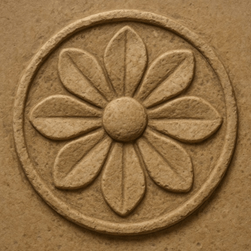
This sign is not accidental.
In Sumerian cuneiform, the symbol 𒀭 (DINGIR / AN)
means:
“god,” “radiant one,” “shining,” “heaven,” “divine presence.”
Its shape —
a starburst, rosette, or radiant cross —
is the same form found in:
- Phoenician ivories,
- Babylonian boundary stones,
- Iranian fire-temple iconography,
- Greek rosettes on shields and pottery,
- the solar flower of early China,
- the eight-petal radiance symbol of Armenia,
- the lotus-sun hybrids of the Indus and Vedic worlds.
This is the oldest and most universal symbol of the Light-lineage.
It is not a linguistic sign.
It is a pre-historic signature:
the seal of the Solar order that existed before the civilizations we know.
Its recurrence across Eurasia confirms:
- a shared symbolic grammar,
- a continuous Light-tradition,
- a pre-Flood cultural ancestor,
- and the function of Phoenicia as the transmitter of this lineage.
The rosette is the fingerprint of the ancient world.
And the Phoenicians were among its last official bearers.
Why This Matters Today
Understanding the Triangle transforms our view of history:
1. It reunites civilizations once thought separate.
2. It restores the Light-order above cosmic law.
3. It identifies the carriers of sacred geometry and fire-law.
4. It reveals the alphabet as a survival of pre-Flood knowledge.
5. It explains the continuity of solar symbols across continents.
6. It exposes the forgotten unity behind “Aryan,” “Semitic,” and “Mediterranean.”
7. It restores Phoenicia to its rightful place as the Phoenix of the ancient world.
Most importantly:
It reopens the question of origins.
Not the origin of peoples,
but the origin of Light:
- the order that guided early priest-kings,
- the geometry encoded in temples,
- the orientation aligned with dawn,
- the symbolic grammar carried across the sea.
To recover this is not academic.
It is civilizational memory —
the same memory the Phoenicians carried as they rebuilt history after the last great fall.

(Golden Sun Bird from San Xing Dui, China ~4000 years ago)
 Gautama Dhamma
Leave a comment