
The Āryan Lineage of Light and the Path Beyond the Cosmos
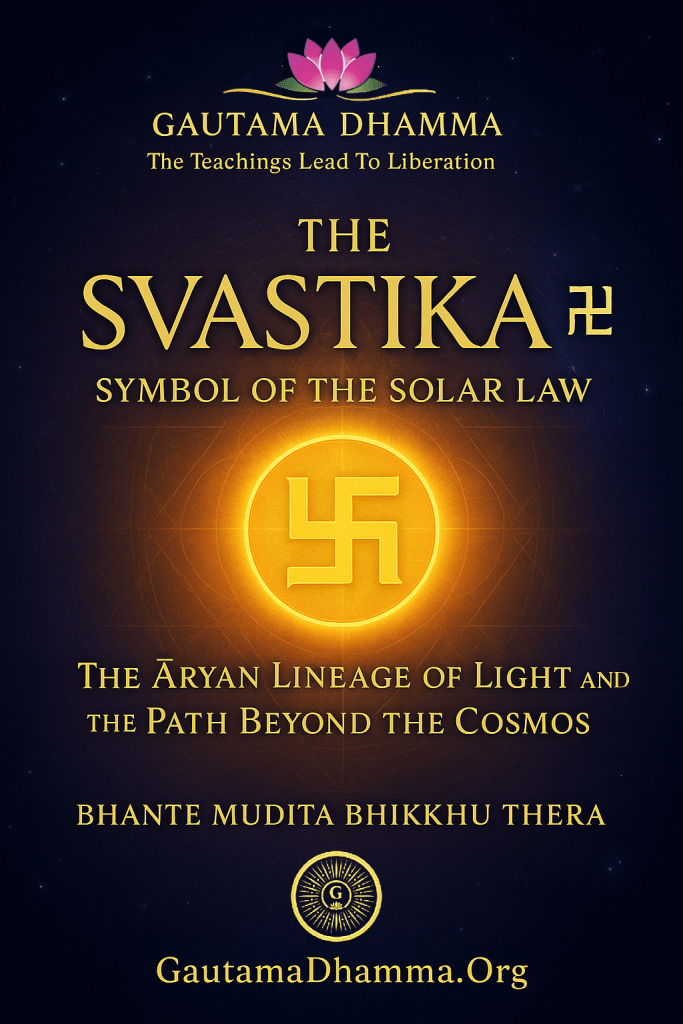
Prologue. The Forgotten Mark of the Sun
“Sūryo vai brahma — the Sun indeed is Brahma, the visible law of the unseen order.”
(Taittirīya Brāhmaṇa 3.12.9.1, paraphrased)
When visitors step into the Grand Buddha Hall at Wutai Shan, their eyes are drawn to a single, ancient sign.
Upon the chest of every Buddha image — cast in bronze, carved in sandalwood, or gilded upon the lotus throne — gleams the svastika (卍).
To some, it is a mystery; to others, an uncomfortable echo of history.
Yet to those who look more deeply, it is the most venerable emblem on earth — the seal of an ancient order and the memory of light itself.
The Modern Inversion
In the last century, this sacred sign was torn from its lineage.
For millennia it had proclaimed life, well-being, and the triumph of light; then it was inverted into an emblem of hatred.
This was not only a historical crime but a spiritual inversion — an enactment of the cosmic law of dosa, where aversion turns truth into its opposite.
Thus arose what scholars call symbolic amnesia — the cutting of a sign from the consciousness that once sustained it.
Few recall that svastika (卍) is a Sanskrit word formed from su (“good, auspicious”) + asti (“being, existence”) + -ka (“mark”): svasti-ka — “that which is of good existence.”
It was never a banner of conquest but a benediction of harmony.
To behold it rightly is to remember that truth itself, when aligned with truth, is su-asti — well-being.
For many Western visitors the symbol recalls the darkest pages of recent history.
Yet long before ideology and war, it shone upon temples, pottery, and manuscripts from the Gobi to the Baltic, from the Andes to Polynesia — the most universal emblem of auspicious power known to humankind.
Its desecration was therefore not only political but civilizational: a break in the continuity of human remembrance.
The Archaic Symbol
Archaeology restores that memory.
Ivory carvings from Mezin (Ukraine, c. 10 000 BCE), incised pottery from Samarra (Mesopotamia), and seals from the Indus Valley (Harappa and Mohenjo-daro) all bear the same turning arms.
Bronze Age ornaments from Troy and Mycenae, petroglyphs in the Altai, and sun-wheels from Gotland repeat the same geometry.
Across oceans, the Hopi and Navajo etched it as the “whirling log”; Polynesian canoe-builders carved it upon prows that faced the sunrise.
Everywhere, before written law, the same pattern declared one truth: life turns toward light.
For the peoples later remembered as the Āryans, this revolving cross expressed the law of ṛta — the moral order of the cosmos.
Its four arms marked the quarters of space and the rhythm of time; its motion signified the eternal return of light from darkness, of order from chaos.
At its center lay stillness — the unmoving axis (skambha) around which worlds revolve.
To inscribe the svastika was to sanctify the meeting of heaven and earth; to understand its motion was to understand the law of becoming.
The Solar Worldview
Among the ancient Āryan and Indo-European peoples — those who spoke the ancestral tongues that became Sanskrit, Avestan, Greek, and Latin — the svastika (卍) was the mark of civilization itself.
It crowned the fire-altars of the Vedic ṛṣis, blazed upon the standards of Darius of Persia (“I am Darius, an Āryan, son of an Āryan,” Behistun Inscription), and gleamed on Hellenic shields and Norse chariots.
In Iran it signified Asha — truth and righteousness; in India, Ṛta — the order of truth; in Greece, Helios — the divine intelligence of the sun; in the North, the solar wheel of Odin’s folk.
It bound together the priest-kings of Persepolis, the sages of the Indus, and the philosophers of Ionia in one conviction: light and law are one.
The Esoteric Geometry
The svastika (卍) is more than ornament; it is cosmology in motion.
Each arm extends toward a quarter of space, while its rotation expresses the rhythm of creation and return.
Its outer whirl is saṃsāra — the field of birth, aging, and death; its silent center is the Deathless (Nibbāna-dhātu).
In its symmetry the Four Āriya Truths are written:
- Dukkha — the world’s rotation under the law of decay.
- Samudaya — the arising of motion through craving.
- Nirodha — the cessation of dukkha — the stilling of that motion.
- Magga — the Path of return through Sīla – Samādhi – Paññā.
At the heart lies stillness: the axis of liberation.
Thus the ancient solar mark becomes the diagram of the mind’s ascent — the stargate through which consciousness exits the world.
Physiology mirrors this law.
The heart turns in spirals, blood flows in vortices, and even the double helix of DNA echoes the svastika’s symmetry.
Ancient sages intuited that body, mind, and law share a single pattern.
They spoke of the citta–dhamma–blood triad: consciousness generates law, law shapes life, and life refines consciousness.
To transcend blood was not to deny ancestry but to complete it — to transform inheritance into illumination.
This is the moment called Gotrabhū, the Change of Lineage — the passage from loka-gotta (worldly lineage) to amata-gotta (the Deathless lineage).
The svastika marks that crossing: the instant when outward motion becomes inward release.
The Continuity of Light
Modern science, stripped of ideology, still bears witness to this unity.
Genetic studies (Haak et al. 2015; Narasimhan et al. 2019) trace the diffusion of the steppe peoples who carried both language and the ethical vision of ṛta.
The same haplogroups R1a and R1b seeded Vedic and European civilizations; the same solar root joins sūrya, sol, and sun.
These are not accidents of culture but echoes of a shared cognition: that truth moves by light, and consciousness, to be whole, must turn with it.
Through Gautama Buddha this ancient law reached its fulfillment.
He transformed the outer covenant of purity into the inner path of liberation, translating cosmic geometry into meditative science.
The svastika upon his heart is the map of that realization: the outer sun turned inward to the Deathless center.
The Loss and the Recovery
As ages darkened, the symbol fell into eclipse, as did the nobility it once embodied.
Industrial mind replaced harmony with mechanism; sacred geometry became political icon.
The Law of Light was recast as ideology of power.
Yet symbols cannot die — they withdraw, awaiting remembrance.
When the svastika (卍) reappears in its rightful context — on the Buddha’s chest, within a temple of peace — it speaks again the language of the sun:
May all beings be well; may light prevail.
Purpose and Invitation
This work seeks to restore that memory — to trace the journey of the svastika (卍) as the ancient sun-mark of the Āryan and Indo-European civilizations that once bound East and West in a single order of truth.
It does not claim ownership for any nation but reveals a universal heritage: that civilization itself began when human beings chose to live by light instead of instinct, by truth instead of force.
From the Caucasus to India, from Persia to Scandinavia, from the fire-altars of the Magi to the heart of the Buddha, this sign proclaims the same law: Order is the form of Light.
When visitors at Wutai Shan pause before the Buddha’s image and see the svastika (卍) shining upon his heart,
may they see not a mark of a dark century, but the sun of civilization itself — the forgotten seal of the Āryan worldview, the reminder that the light which rose in the first age still turns within the awakened heart.
It is the same light that Gautama Buddha rekindled through his teaching of Brahmacariya — the divine and disciplined way of purity, restraint, and wisdom;
that he established through Brahmavihāra — loving-kindness, compassion, rejoicing in manussa, and transcendental equanimity;
and that he perfected through the Ariyan Eightfold Path — right view, resolve, speech, action, livelihood, effort, mindfulness, and concentration.
To walk this Path is to live by the Solar Law of Truth,
to become part of his Ariyan disciples, and to dwell within his Ariyan Saṅgha — those who turn their hearts toward the Deathless and uphold the civilization of light.
Chapter I. The Aryan Worldview — Order, Light, and Truth
Epigraph
“Ṛtaṁ ca satyaṁ cābhīdāt tapasādhyājāyata — From the fire of discipline arose Order and Truth.” (Rig Veda X.190.1)
Following the remembrance of the forgotten mark of the Sun, we now turn to the worldview that gave it birth — the Aryan vision of order, light, and truth.
Across the early ages of the world, before nations or creeds, there existed a current of consciousness that sought order rather than chaos, light rather than power, truth rather than opinion. Later generations would remember its bearers as Ārya — the noble ones — but in their own time they were simply the people who lived in harmony with their ancestral law. They walked with their ancestral Brahma gods, not as servants but as companions in righteousness. Their legacy is woven through the oldest hymns, the earliest metallurgies, and the first codifications of law, echoing from the steppes of the Caucasus to the valleys of the Ganges and the shores of the North Sea.
This opening part traces that luminous inheritance: the worldview that understood life itself as the manifestation of an eternal order. Its essence was not dogma but structure — a law of proportion and restraint by which energy becomes form and form returns to light. To live rightly was to align one’s citta with that rhythm, to let the inner fire mirror the solar fire above. From this understanding came the triad that would later be re-articulated by Gautama Buddha as Sīla, Samādhi, and Paññā: ethical discipline, concentration, and wisdom as the threefold way to transcend the world.
Yet the same current that uplifted humanity also faced decline. As bloodlines mingled and civilizations multiplied, the unity of spirit fractured. What had once been a communion between consciousness and the divine became a memory encoded in language, ritual, and myth. The svastika (卍), once the doorway of truth of liberation, endured as the last visible sign of that forgotten covenant of light.
Part I therefore seeks to recover this ancient horizon — to understand how the Aryan consciousness arose, flourished, and waned; how its law of order became the Four Ārya Truths; and how Gautama Buddha, the final scion of the Solar-Brāhmaṇa lineage, fulfilled its spiritual destiny. Through historical, linguistic, and archaeological memory, we shall follow the arc from the radiant dawn of the Aryan world to the twilight that called forth the Buddha’s awakening — a path from blood to consciousness, from lineage to law, from the sun without to the light within.
1. The Sign of the Sun – The Svastika (卍) as Cosmic Doorway
Across every continent, from Siberia’s ice to the islands of the Pacific, the same figure turns — the four-armed cross in motion. In Sanskrit it is svastika; in the language of ancient Europe it became sun-wheel or fylfot; among the Hopi and Navajo, whirling log; among the Polynesians, the spiral of life. Wherever it appeared, it signified order, vitality, and passage. Its geometry is not static: each arm bends forward, suggesting motion around an invisible center. The ancients did not draw a fixed emblem; they depicted the living rotation of existence itself.
Archaeologists trace its earliest forms to the Upper Paleolithic engravings of Eastern Europe and Siberia, carved on mammoth ivory more than 12 000 years ago (Gimbutas 1991). Later, in the Neolithic settlements of Çatalhöyük in Anatolia and Vinča along the Danube, the motif appears on hearths and walls beside female and solar figurines (Mallory & Adams 1997). By the Bronze Age it was stamped on seals from Harappa and Mohenjo-daro, cast into ritual vessels of the Andronovo and Sintashta cultures, and incised on pottery across Iran, the Caucasus, and the Balkans. Genetic studies (Haak et al. 2015; Narasimhan et al. 2019) correlate these horizons with the movement of Indo-European-speaking peoples from the Pontic–Caspian steppe into both India and Europe, carrying with them shared words for sun, law, and truth—sūrya, ṛta, satya, soþel, sol, veritas.
Yet beyond diffusion, the svastika (卍) endured because it encoded a universal cosmology. Every culture that grasped its form recognized a simple truth: existence is rotational. Day and night, the seasons, the ages of the world, the breath itself—all move in spirals around a still point. To live in accordance with that law is to live in harmony; to lose the center is to fall into chaos.
For the early Āryans this rotation was not mechanical but spiritual motion. The truth, they taught, turns because consciousness flows through it. The four arms of the svastika signify the four emanations of consciousness: creation, preservation, transformation, and return. Its center is Brahman—the silent axis from which light radiates. To contemplate the svastika was to contemplate the rhythm of one’s own existence within the greater field.
In Vedic hymns, the Sun’s chariot is said to have four spokes and twelve fellies—the same geometry expressed by the turning cross. The word cakra (wheel) later became a metaphor for centers of energy within the body; the svastika, the outer emblem of the inner wheel. Thus, the sign carried multiple layers: cosmic, physiological, and spiritual.
On the Indus Valley seals, the symbol marks boundaries of sanctity. On later Iranian fire altars, it signifies the turning flame. In early Greek and Etruscan art it frames solar deities; in Nordic bronzes it appears on Thor’s hammer, representing lightning—the spark of consciousness striking matter. In the Americas it appears on Pueblo kiva murals as the journey of the soul through four worlds before reaching the fifth, the realm of peace. Each culture translated the same geometry into its own idiom of liberation.
The Esoteric Geometry
The svastika (卍) is a moving spiral, not a cross of domination. The four arms turn outward, yet their motion implies a path inward. It is the map of the saṃsāric whirl and simultaneously the key to its transcendence. Each rotation corresponds to the four stages of conditioned existence—birth, growth, decay, and dissolution. The initiate learns to reverse the current: to trace the motion inward toward the still axis, the Nibbāna-dhātu, the Deathless realm.
The symbol therefore functions as a doorway of truth—a stargate through which consciousness may pass from the world to the beyond. It represents liberation, not domination; freedom, not fate. Its Sanskrit root su-asti means “it is well,” or literally “good being.” Thus, the svastika is the signature of well-being in the highest sense: the alignment of being with truth.
In Gautama Buddha’s Dhamma this meaning survives in purified form. The svastika engraved upon the Buddha’s chest is not decoration but doctrinal diagram. It shows that the Awakened One embodies the law of the world and the passage beyond it. Each arm corresponds to one of the Four Āriya Saccāni (Four Noble Truths):
- The first arm — Dukkha — the turning of the world under the law of decay.
- The second — Samudaya — the arising of that motion through craving.
- The third — Nirodha — the cessation of dukkha — the stilling of that motion, the cessation of dukkha.
- The fourth — Magga — the path of return to the center through Sīla–Samādhi–Paññā.
At the heart lies stillness: Nibbāna, the unshaken center. Thus the ancient solar mark becomes the seal of liberation itself.
The Human Reflection
Physiology mirrors this geometry. The human heart is a rotary chamber; the bloodstream flows in spirals; the very DNA of life forms a double helix—a paired spiral that echoes the svastika’s turning symmetry. Ancient sages intuited this correspondence. The body was a microcosm of the world; to purify it through moral conduct (Sīla) and concentration (Samādhi) was to bring the microcosm into resonance with the macrocosm. The citta–dhamma–blood triad expresses this unity: consciousness generates law, law shapes life, and life in turn refines consciousness.
Blood, therefore, was both gift and limitation. It carried the memory of order, but also the inertia of the world. To transcend blood meant not rejection of ancestry but completion of it—transforming the inherited pattern into luminous awareness. This process was later named Gotrabhū, “change of lineage,” the moment when the practitioner passes from worldly birth (loka-gotta) to the Deathless lineage (amata-gotta).
The svastika, seen in this light, represents the very instant of that passage: the crossing from outward rotation to inward liberation. Its outer arms are the world; its center, the Deathless. To understand it is to understand the mechanics of release.
Decline of Understanding
Over centuries, as civilizations rose and fell, the svastika’s esoteric meaning dimmed. In late antiquity it survived as ornament; in medieval Europe it became the crux gammata on Christian mosaics; in Asia it remained on Buddhist manuscripts and statues. But the inner knowledge—the law of liberation it encoded—was forgotten. When the symbol reappeared in modern Europe, scholars misread it through the narrow lens of race and power. The tragedy of the twentieth century completed the inversion: a sign of cosmic freedom turned into a badge of temporal domination.
Yet the symbol itself remains innocent. In the quiet halls of Wutai Shan, the svastika (卍) still shines on the Buddha’s chest, uncorrupted. It points silently to what humanity once knew: that life’s rotation has a center, and that from that center one may depart the cycle of decay.
2. The Āryan (Ariya) Lineage: Law, Blood, and Consciousness
To speak of the Āryans is to recall not a tribe but a civilizational current—a living law expressed through language, art, and conscience. They were people of every craft and calling — farmers, builders, healers, smiths, governors, poets, and contemplatives — who lived righteously, with morality and with the Brahma gods. They sought not conquest but consonance, aligning their lives with the law of truth and purity (Ṛta) that holds both world and conscience together.
The Meaning of Ārya
The earliest texts record ārya simply as “one of our people.” Only later did the word acquire its moral sense — because later generations looked back and saw that this people lived by justice, self-restraint, and luminous mind. Hence ārya came to mean noble, not by decree but by recognition. In the Iranian Avestan hymns the cognate airya described those who uphold Asha — truth and right order. In Vedic India it was associated with Ṛta, the path of righteousness that sustains the world. From these two pillars, Iranian and Indian, the law of ethical civilization spread westward through the Indo-European family of speech.
Linguistically the same root ar / ṛ means “to fit rightly, to move forward.” The ārya therefore are “those who move rightly”—the moral direction of evolution. Their speech became Sanskrit, Avestan, Greek, Latin, and the tongues of Europe; their ethical grammar remained the same: truth (satya), order (ṛta), law (dharma), and conscience (manas).
Life with the Brahma Gods
In the hymns of both East and West, the Aryans walked with the Brahma gods—the higher intelligences of light and justice. These were not remote deities but spiritual companions, examples of perfected mind. To live “with the Brahma gods” meant to live by their values: compassion, restraint, truth, and inner clarity. The fire on the hearth was their bridge; the rising sun, their daily reminder that consciousness is born anew each dawn.
Their civilization radiated these values into every field of life. Law was sacred because speech carried moral weight. Craftsmanship was sacred because the shaping of matter reflected the shaping of the soul. Music, astronomy, and healing were all acts of harmonization between body, society, and world. In this sense the Aryan way was the civilization of value—where power served law, and law served liberation.
Blood as Pattern, Not Privilege
Within this worldview, blood symbolized the continuity of order in living form. The bloodline transmitted not superiority but pattern—a code of proportion, rhythm, and memory. Each lineage carried both gift and limitation. To be born into a particular bloodline was to inherit a certain configuration of the law of truth, just as one inherits the pattern of stars under which one is born.
The Aryan sages understood that this inheritance had to be transcended, not worshipped. As later expressed in Gautama Buddha’s Dhamma, the physical lineage (loka-gotta) is the vessel through which consciousness (citta) and formative law (dhamma) operate. But through practice—through Sīla, Samādhi, and Paññā—the practitioner refines both mind and body, leading to the Gotrabhū, the “change of lineage.” At that moment the old pattern dissolves, and a new one forms—the Deathless lineage (Amata-gotta) beyond the order of truth. Thus, blood and consciousness are two layers of one continuum: the first expresses the second; the second redeems the first.
This triad—citta–dhamma–blood—was the secret science of the ancient Aryans. It united physiology, psychology, and cosmology into a single law of transformation. Later medicine and alchemy across Iran, India, and Greece still carried traces of it: the purification of metals mirrored the purification of blood; the tempering of iron, the tempering of mind.
The Ethical Order
Archaeological and textual evidence points to societies governed by councils and codes rather than absolute kingship. Lawgivers such as Manu in India or Zarathustra in Iran embodied the same archetype: the sage-ruler who teaches restraint and justice as divine law. Their authority arose not from force but from insight into Ṛta. In later Europe this ideal reappeared in the myth of the just king and the round table — each seat equal around a center, the visible echo of the svastika’s turning symmetry.
The moral law they upheld demanded truthfulness, purity, hospitality, and reverence for life. Violence was permitted only in defense of order; greed and falsehood were condemned as sins against the world. Women held high honor as preservers of lineage and learning. Education was initiation into cosmic proportion — geometry, measure, and rhythm. To be cultured was to be conscious of the greater harmony.
Such was the Aryan ideal: to live truth outwardly and inwardly, with discipline in action, serenity in thought, and compassion in rule. This was the moral soil from which Gautama Buddha’s understanding would later arise.
Decline and Dispersion — The Eclipse of Brahma-Dhamma
After the Great Flood and the planetary dimming recorded in ancestral memories, the Brahma-current that once sustained long life, strong memory, and direct communion with higher beings weakened. As the Earth’s resonance fell, the gods withdrew from the open plane. The age of divine–human coexistence ended; the world entered an era governed by their descendants and hybrids—human kings and demi-gods who possessed fragments of the old sciences but lacked the discipline of purity to wield them rightly.
What followed was the first inversion: power began to replace purity. Temples still shone with the svastika (卍), speech still carried ritual phrases, but realization dimmed. Ritual accuracy replaced inner attunement, and law became privilege. The Brahma-dhamma that had once bound authority to virtue was recast as status; the upward current of liberation was confused with the worldly machinery of prosperity and protection.
Wars of the Dying Age
As that inner light waned, the visible world grew violent. The Mahābhārata and the Rāmāyaṇa preserve the last historical memory of conflicts in which divine and semi-divine lineages still acted upon the earth. These were not literary ornaments but the closing battles of a dying age. The Kurukṣetra War extinguished great houses tied to the Solar stream; the struggle of Rāma and Rāvaṇa signaled a terminal rupture between the Brahma-line of restraint and the draconic hunger for possession. What remained afterward were scattered custodians and fleeing remnants: some withdrew into mountain sanctuaries and forest hermitages; others moved across seas and steppe corridors, dispersing the codes of measure, metal, and mantra into distant geographies.
Oral histories across the world echo fragments of this dispersion—memories of law-bringers from the sunrise, luminous visitors, and bearded teachers who established rites of measure and purity before vanishing again. The svastika (卍) endured in stone and on cloth, but fewer remembered that it signified a doorway of exit, not a banner of dominion.
The Anti-Brahma Reaction
As value declined and worldliness matured, a deliberate Anti-Brahma Reaction gathered force. It progressed in four interlocking movements:
- Defamation of memory. The archetype of Brahmā—the pure mind of order—was recoded as a mere creator trapped in his own making, then mocked as flawed or fallen. By inverting the image of the solar intellect, the rebellion undermined the authority of purity itself.
- Legal–economic strangulation. Temple lands were confiscated, ritual jurisdictions voided, and wealth diverted to the courts of ambitious rulers. Custodians of purity were branded arrogant; disciplined restraint was redefined as social oppression.
- Ritual–iconic inversion. Multi-faced images of Brahmā lost the northern face—the face of ascent. Sanctuaries were reoriented: where geometry had once directed consciousness eastward toward the dawn of awakening, buildings now turned to the circulatory maintenance of worldly life. Mantra reduced from vehicles of ascent to vernacular praise for prosperity; resonance was retained but its polarity reversed.
- Bloodline neutralization. The ancient houses were dispersed, diluted, or destroyed. Genealogies were rewritten; archives disappeared. The method followed a consistent pattern—ridicule → restriction → extermination—until only fragmentary families and hidden hermitages held the living current.
The Śākya Annihilation — Last Light of the Solar Line
This campaign culminated in the annihilation of the Śākyas. Far from a small provincial clan, the Śākyas were the last visible node of the Solar–Brāhmaṇa lineage, disciplined in speech and pure in practice. Their very purity became a political offense to surrounding powers fashioned by hybrid ambition. Under the pretext of insult and vengeance, men, women, and children were exterminated; a few escaped as bearers of memory.
From the ashes of that destruction, Gautama arose—not to rebuild an earthly throne, but to translate the Solar law into inner science. He would restore what the world had inverted: not by erecting new monuments, but by reopening the upward gate within the citta.
The World After the Withdrawal
By the time Gautama Buddha walked forth, the rebellion of mankind was culturally complete. Temples stood, but their function had reversed. The svastika (卍) still adorned thresholds, yet its geometry of exit was scarcely understood. Brahmā remained as a name, yet Brahma-consciousness—the clean flame of purity and restraint—had been driven from public life into private cultivation.
Gautama did not argue with the victors of the Anti-Brahma Reaction; he outflanked them. He opened the Middle Exit (Majjhimā Nissaraṇa) inside the human frame: Sīla to withdraw from worldly economy, Samādhi to lift the mind beyond the sensory field, Paññā to see the world’s conditioned nature clearly, and the maturation into Nibbidā → Virāga → Vimutti—disenchantment with the world, fading of worldly attraction, and liberation from the world. In doing so, he re-inscribed the lost architecture of ascent in consciousness where no king could confiscate it and no iconoclast could chisel it away.
Dispersion as Destiny—and Task
The earlier geographical dispersion of the Aryan current now became a spiritual dispersion. The sciences of ascent survived where hearts still honored value over power. Some lines remembered through craft (metal, measure, medicine); others through chant and meditation; a few through law and ethical restraint. But the civilizational center—the public union of craft, justice, and wisdom under Brahma-dhamma—had fallen. What endured was the inner svastika (卍): a turning back toward the still point, kept alive by those who would rather be poor in the world than powerless before the truth.
The decline and dispersion were not accidents of history. They were the predictable outcome of a world choosing power over purity once the gods had withdrawn from open sight. The symbol remained; the memory faded. And so the task of our age is not to resurrect lost crowns or castes, but to restore remembrance—to teach again that the sign on the Buddha’s chest marks a doorway, that blood is gift and limit, and that consciousness must transcend both through training.
The Seed of Restoration
Yet within the ruins, the seed of the ancient law remained. In northern India, among the descendants of both Brahma-line and Samaṇa-line, one man of direct Aryan descent rediscovered its essence. That man was Gautama Buddha. He took the ethical-spiritual law that had once governed civilizations and turned it inward, transforming the outer law of purity into the inner path of liberation. He called his discovery Cattāri Ariya-Saccāni—the Four Āryan Truths. He called his disciples Ariya-Sāvaka—noble disciples. In doing so he preserved the heritage of the Aryan world not as blood but as consciousness.
Thus the wheel turned once more. The svastika (卍) found its living form in the Dhamma-wheel (Dhammacakka), the turning of the law that leads beyond the world. In the Buddha, the outer civilization of light became the inner science of the Deathless. Through him the ancient partnership between mankind and the Brahma gods was renewed, now within the purified citta of the liberated being.
3. Gautama Buddha and the Fulfilment of the Āryan Vision
Epigraph
Āriyo maggo niyyāti takko pahāya — the Ariyan Path leads beyond, letting go of intellectual debate. (SN 45.4)
1. The Last Light of the Solar Lineage
Gautama Buddha arose at the twilight of the ancient world, born among the Śākya, the final Solar–Brāhmaṇa house descended from the Aryan current of purity and restraint. The Dīgha Nikāya records him as Khattiyo Sakyaputto Ādiccagotto — a noble warrior, son of the Sakyas, of the Sun lineage (DN 3). The Śākyas preserved the final remnant of that luminous covenant: discipline, truth, and detachment from worldly power. When surrounding tribes fell to indulgence and greed, this small republic upheld the ancient law of righteousness (Brahma-dhamma). When Kosala’s armies later destroyed the clan, the Solar race was extinguished; only Gautama remained to transmute its blood-born law into a universal science of mind.
Modern archaeogenetic and linguistic research places the ancestral Aryan peoples in the Caucasus–Scythian corridor, from which Indo-European culture spread both eastward into India and westward into Europe (Science 2019). These migrations carried not only language but ethical codes, ritual sciences, and a phenotype described as fair, tall, and sun-eyed. The Buddha’s physical depictions — blue eyes, golden complexion, radiant skin (DN 30) — echo the same solar archetype revered from Persia to Scandinavia: the “sons of the Sun,” bearers of clarity and order.
Yet this lineage was never meant to glorify blood. The Ādicca line symbolized the illumined consciousness that lives righteously with morality and divine law. In Gautama, this solar virtue completed its evolution: the Ādicca-gotta of the body became the Ādicca-gotta of the mind — a new birth in Dhamma.
2. From Lineage to Law
In Gautama, the blood-line became the mind-line. What had been transmitted by heredity was reborn as law. The citta–dhamma–blood triad reached its culmination:
- Sīla withdrew the actions of blood from the world.
- Samādhi lifted consciousness beyond the sensory field.
- Paññā revealed the structure of becoming itself.
At the moment of Gotrabhū — the Change of Lineage — the mind left the worldly current (loka-gotta) and entered the Deathless lineage (amata-gotta). What the Aryans had once carried in blood, Gautama transmitted through consciousness. He fulfilled their mission to open once more the doorway (卍) of liberation from the world.
When he cut his hair (MN 26), the golden locks of the Solar race fell to earth — a symbolic renunciation of blood heritage. Hair was the banner of lineage, the outer sign of ancestral fire; to shear it was to declare that nobility had become a matter of consciousness. From that moment, the Ārya path belonged not to descendants by birth but to those who perfected their citta by Dhamma.
3. The Four Āriya Truths — Law of Liberation
Gautama did not invent a doctrine; he remembered the law of truth long forgotten. He called it the Āriya-sacca, the Noble (Aryan) Truths — not moral precepts but laws of existence itself.
- Dukkha — the condition of worldly existence
All beings formed within the world (loka) are subject to loss of order, aging, and death. This is intrinsic to the cosmic system itself; even a perfect body and mind within it remain under the law of decay. - Samudaya — the continuation of dukkha
Craving (rāga), aversion (dosa), and delusion (moha) do not create dukkha; they sustain it. They bind consciousness to worldly becoming (bhava), thus projecting new manifestations and continuing future dukkha. - Nirodha — the cessation of dukkha — the cessation of dukkha
When rāga–dosa–moha cease, the production of future dukkha stops. The present aggregates still age and pass away, but no new dukkha is generated. (This is always expressed as “Nirodha — the cessation of dukkha — the cessation of dukkha,” never as a stand-alone term.) - Magga — the Path to that cessation and to liberation
The Middle Exit (Majjhimā Nissaraṇa): Sīla–Samādhi–Paññā → Nibbidā–Virāga–Vimutti. Through graduated withdrawal, concentration, and wisdom, the citta ceases participation in the world and opens to the Deathless realm (Nibbāna-dhātu).
Thus, the Buddha re-established the lost Brahma-dhamma internally. Where temples had once aligned stone with the sun, he aligned the mind with the Deathless. The Vedic law of Ṛta became the psychic law of liberation: order of truth restored within consciousness.
4. The Completion of the Solar Covenant
Earlier Aryan teachers had guarded fragments of the Solar law — Manu through ethics, Zarathustra through truth, the Ṛṣis through sacred sound and fire. Gautama did not refute them; he fulfilled them. His enlightenment beneath the Bodhi tree was the re-illumination of Brahmā’s northern face — the path upward reopened after ages of forgetfulness. The svastika (卍) turned again — not on stone altars, but within the vortex of consciousness itself, signifying the stargate of liberation.
Across the Indo-European world, this symbol had the same meaning: a doorway of truth of release. Archaeological finds from the Bronze Age to ancient Troy, Scythia, and the American Southwest show the swastika as the spiral of emergence — the path from the center to the beyond. In Gautama, that door was no longer carved in matter but realized in mind. Through his training, the law of truth was restored as a science of exit from the world.
5. Transcending Blood and Consciousness
Blood and consciousness mirror one another. Blood transmits order through the body; consciousness transmits order through thought. Both belong to the world and are subject to its law of decay. Hence the path of liberation must purify both.
Through Sīla, blood is restrained; its instincts and impulses are withdrawn from the cosmic economy.
Through Samādhi, citta is lifted beyond the sensory field into the rūpa and arūpa dimensions.
Through Paññā, the two are seen as impermanent, not-self, and transcended.
At Gotrabhū, the inner law of being is reborn into Gautama’s Dhamma. This is the moment of true Ariya birth. The Buddha declared:
“Bhikkhave, you are my true sons (puttā orasā), born of my mouth, born of Dhamma, created by Dhamma, heirs of Dhamma.” (Itiv 100)
And before his final passing, he instructed:
“Atta-dīpā viharatha, atta-saraṇā, anañña-saraṇā; dhamma-dīpā, dhamma-saraṇā, anañña-saraṇā.”
Dwell with your Self as your island, Self as your refuge, with none other as refuge; Dwell with the Dhamma as your island, Dhamma as your refuge, with none other as refuge. (DN 16 Mahāparinibbāna Sutta)
To use the Dhamma as refuge is to transform the self by it. When the personal dhamma and Gautama’s Dhamma become one, the old blood law dissolves and a new law arises — the brāhmaṇa–ariyā–manussa continuum of the Deathless realm.
6. Legacy and Decline
For five centuries after the Parinibbāna, the Āriya light endured through the Bhikkhu Saṅgha. Vinaya replaced royal law; meditation replaced sacrifice; liberation replaced conquest. The Solar covenant lived again — not in palaces of gold, but in the discipline of those who renounced the world. Within this order, nobility was measured not by birth but by restraint, wisdom, and the stillness of citta established in Dhamma.
Yet the Tathāgata understood the weight of history. He foresaw that his true Dhamma could not endure long among humans. Its purity was too severe for the defiled, its subtlety too difficult for the distracted, its transcendence intolerable to the unseen powers that maintain the world’s law. The opposition, he knew, would not come through open persecution but through corruption from within — commentary softening discipline, compromise replacing practice, and misinterpretation turning liberation into mere philosophy.
This decline was not failure but law. In a world ruled by decay, even truth must appear and vanish according to conditions. Yet within that law, even a brief reappearance of the true Dhamma reopens the Path. Every age that restores it, even for a moment, releases innumerable beings from delusion. One spark recovered from the ashes of forgetfulness is enough to justify the descent of the Dhamma into the world again.
Thus the Aryan light, though obscured, was never extinguished. It receded into hidden streams — among forest hermits, contemplatives, and ascetics who still practiced the training of Sīla–Samādhi–Paññā. Each renewal of restraint and insight rekindles the ancient current, linking back to Gautama’s lineage of the Deathless.
7. Closing Reflection
Thus the circle completes itself. What began as a blood lineage ends as a lineage of consciousness.
The Aryan mission — to uphold order, truth, and purity — reached its consummation in Gautama Buddha, who turned heredity into realization and ancestry into enlightenment. In him, the Solar covenant fulfilled its own law: the flame of nobility passed from blood to mind, from generation to revelation.
For a time, the world received this light. The bhikkhus who lived by Vinaya and Dhamma became living pillars of the ancient covenant, walking embodiments of the svastika (卍) — the turning gateway of order and release. Through their discipline, the Deathless realm (Nibbāna-dhātu) was made visible again upon the earth.
But the world is governed by change. When restraint waned and craving re-emerged, the light withdrew, leaving only memory — myth and fragment, legend and symbol. Yet within that withdrawal lay a silent promise: that wherever a being perfects Sīla, Samādhi, and Paññā, the Aryan covenant is renewed. Each awakening restores the axis of the world; each liberated citta re-opens the Doorway of the Sun.
The svastika (卍) endures as its sign — the doorway of truth through which the noble disciple departs from the world into the Deathless realm.
It is not a relic of power but a reminder of freedom: that within the decaying truth there remains a Path leading beyond.
Whenever one mind remembers the law of liberation, the ancient order rises again, and the light of the Arya-Dhamma turns once more.
4. The Waning of the Āryan Current
Epigraph
“Ye dhammā hetuppabhavā, tesaṃ hetuṃ Tathāgato āha — of all things that arise from causes, the Tathāgata has shown the cause.” (SN 12.20)
1 . After the Re-illumination
When Gautama Buddha attained awakening beneath the Bodhi-tree, the current of Aryan light flared once more upon the earth. His realization of the Four Ārya Truths—the law of dukkha, its arising, its cessation, and the Path leading beyond—re-articulated the ancient covenant of order that earlier races had dimly preserved. For a brief epoch the world heard again the cadence of a language born of both heaven and earth: the speech of truth (sacca-vācā), restraint, and purity. Yet the Tathāgata also foresaw that this illumination would not last. “This Dhamma is deep, subtle, hard to see,” he told the monks; “beings delight in attachment” (DN 16). The brightness that broke through the clouds would soon recede, not because the law itself failed, but because the world had lost the resonance to sustain it.
2 . The Weakening of Resonance
Long before Gautama’s birth, the earth had undergone what later traditions remembered as the Great Flood. Civilizations along the Indus, Nile, and Euphrates recorded a collapse of climate and frequency—an event modern geology correlates with glacial melt and shifting sea levels (Bryson & Murray 2018). In that lowering of planetary resonance, the contact between human and divine planes thinned. The luminous beings whom the Vedas call the Devas and the Persians the Amesha Spentas withdrew from the visible world. Humanity, deprived of direct communion, turned outward toward matter to regain what it had lost in spirit. Metal replaced mantra; architecture replaced meditation. The Aryan consciousness, once transparent to the Brahma gods, began to harden into caste and ritual.
3 . Hybridization and Descent
Archaeology reveals that as the high cultures of the Indus and the Near East mingled, new hybrid peoples arose—traders, soldiers, and settlers who carried fragments of the Solar order but not its discipline (Mallory 2020). The Yamnaya and Sintashta horizons of the steppe spread horses, chariots, and sky symbolism into both Europe and Asia (Anthony & Ringe 2015), but the ethical core of restraint eroded. Where once purity of mind governed purity of blood, the two were confused: lineage became pride; hierarchy became domination. The cosmic tax of dukkha—aging, decay, and conflict—tightened its grip as societies competed for power under the law of dosa (aversion).
In the West, Sumer and Egypt pursued immortality through stone and empire; in the East, kings sought it through conquest. The great wars remembered as the Rāmāyaṇa and the Mahābhārata were not mythic allegories but echoes of real conflicts among semi-divine lineages struggling for survival. When Rāma’s Solar dynasty fell and the Śākya house centuries later was annihilated by Kosala, the final threads of the Aryan covenant were nearly severed.
4 . The Cultural Inversion
With the withdrawal of the gods and the loss of inner resonance, form replaced essence. The Vedic fire-rite that once mirrored the cosmic flame (agni) became a ceremony for material gain. Law (ṛta) hardened into social code (dharma), and metaphysics turned to speculation. Across the Mediterranean the same inversion unfolded: Egyptian Maʿat, Greek Dike, and Persian Asha—each once meaning moral order—became instruments of kingship. The Solar symbol of liberation, the svastika (卍), degenerated into a mark of fortune, wealth, or tribal totem. The inner gate it signified was forgotten.
Linguistically, the Aryan speech diversified into Sanskrit, Avestan, Greek, Latin, and Gothic; unity of tongue gave way to babel of dialects. Yet within their roots scholars still discern shared words for “sun,” “truth,” and “king” (Mallory 2020): sūrya, helios, sol; satya, aletheia, veritas; rājan, rex, regin. These cognates are relics of a once-common vision—language itself as luminous law.
5 . Genetic Memory and Loss
Modern population genetics identifies two great paternal lineages—R1a and R1b—spread from the Caucasus into India and Europe (Haak et al. 2015). They mark the diffusion of what science calls “steppe ancestry” but what ancient myth named the seed of the Sun. Yet heredity, like consciousness, decays when unpurified. The blood that once resonated with moral clarity became the carrier of conflict. Civilizations rose and fell in cycles of refinement and corruption—Egyptian, Babylonian, Persian, Greek, Roman—each inheriting fragments of the Solar science and each eventually using them for dominion rather than liberation. Thus the citta–dhamma–blood triad inverted: mind served desire, law served power, blood served appetite.
6 . The Age of Fragmentation
By the time of Alexander’s campaigns, the Aryan world had splintered. The Brahmanic East and the Hellenic West, though born of the same linguistic family, faced each other as rivals. The Magi of Persia, heirs to the Chaldean astronomer-priests, preserved only the outer sciences of stars and metals (Burney 2019). In India, Buddhist monasteries guarded the inner path but were gradually absorbed into ritual and metaphysics. Europe, deprived of direct transmission, sought substitute illumination through mystery cults and later monotheisms. The once-universal law of Sīla–Samādhi–Paññā was remembered dimly as ethics, contemplation, and faith.
7 . The Cosmic Law of Conflict
This decline did not proceed peacefully. The truth itself operates under twin currents: the value-based order of the Aryan law and the power-based order of the cosmic field. When the former weakens, the latter dominates. History’s record—wars of empire, crusades, inquisitions, revolutions—is the manifestation of dosa writ large: the aggressive enforcement of partial truth. What the Buddha called samudaya, the arising of suffering through attachment and aversion, became globalized. The Aryan current, unable to sustain equilibrium, scattered into countless eddies of ideology and sect.
8 . The Erosion of Memory
As centuries passed, even remembrance of the Solar origin faded. In India, the word Ārya came to denote courtesy or caste; in Europe, aristos meant merely noble by birth. The esoteric bond between purity and illumination dissolved into social vanity. Temples once aligned to the rising sun were reoriented toward wealth and fertility. The northern face of Brahmā—the upward gate of release—was symbolically sealed. Humanity began to define salvation as continuation, not transcendence.
The sages who retained fragments of the old science migrated: some eastward into Tibet and China, where the svastika survived as emblem of wisdom; others northward into Scythia and Scandinavia, where it became the sun-wheel of Odin’s folk. Everywhere its meaning narrowed, but its presence remained a silent witness to the law of light that the world had betrayed.
9 . Echoes in the West
Among the Greeks, Pythagoras transmitted remnants of Magian arithmetic; Plato rephrased the doctrine of ascent as the allegory of the cave. In Persia, Zarathustra’s hymns preserved the dual vision of truth (asha) and lie (druj). The Druids of Gaul remembered the spiral of creation and decay, while in the Germanic north the Eddas spoke of a final twilight when gods and men would perish in mutual destruction. These were echoes of the same intuition: that the light of order, once embodied on earth, was withdrawing beyond the veil. Each culture, sensing loss, sought redemption through prophecy or apocalypse.
10 . The Modern Veiling
When the cycles turned to the present age, the Aryan current had nearly vanished as conscious knowledge. Its symbols were either politicized or profaned. The svastika, oldest emblem of life’s law, was inverted and weaponized in the twentieth century—a tragic culmination of the very ignorance it once opposed (Goodrick-Clarke 2002). The term Aryan, which in the Buddha’s mouth meant noble by realization, was recast as racial slogan. Thus the anti-Brahma reaction reached its modern consummation: the triumph of form without essence, power without purity.
Yet beneath the distortions, archaeology continues to uncover the deep unity of the ancient world: common solar iconography across Troy, Mycenae, Harappa, and Scandinavia; shared burial customs linking steppe and subcontinent; and genetic continuities reminding modern humanity of forgotten kinship (Anthony 2019). The evidence speaks, though interpretation falters.
11 . The Withdrawal of Light
Doctrinally, the fading of the Aryan current marks the exhaustion of a cosmic epoch. When collective citta turns outward, its energy feeds the world; when it turns inward, the gate to the Deathless re-opens. The Buddha’s own prediction that his true Dhamma would last only five centuries was not pessimism but recognition of entropy within consciousness itself. The decline of virtue follows the law of dispersion: every transmission multiplies form and divides essence. What was revelation becomes doctrine; what was liberation becomes culture. Thus the light withdraws, not in anger but in preservation, awaiting a world capable of bearing it again.
12 . The Surviving Thread
Still, the lineage of light was not wholly extinguished. It continued in the inner work of those who understood gotrabhū—change of lineage—not as ritual conversion but as transformation of being. In each generation a few purified their blood and consciousness through Sīla, Samādhi, and Paññā, renewing within themselves the triune inheritance of Brāhmaṇa, Ariya, and Manussa. They were the quiet custodians of the Solar law, scattered across monasteries, hermitages, and esoteric schools from India to Egypt to the northern forests. Through them the svastika (卍) continued to turn unseen—the doorway of truth still open to those who remembered.
13 . Closing Reflection
The story of the Aryan current is the story of humanity’s own conscience. It begins with communion between gods and men, ascends through revelation, and descends through pride. Every civilization, every language, and every lineage carries both the light of order and the shadow of decay. The Buddha’s illumination was the last full flowering of that primordial covenant: a reminder that nobility is not of birth but of awakening. When the world forgets, it is not punished; it merely loses access to its higher self.
Thus the Āryan current waned—not destroyed, but withdrawn into silence. Its return depends not on race or empire but on remembrance. Wherever a being perceives dukkha as the law of truth of decay and walks the Middle Exit toward Nibbāna-dhātu, the ancient lineage lives again. The svastika (卍) remains the sign of that motion: the turning of consciousness from the world toward the Deathless.
 Gautama Dhamma
Leave a comment