
Excerpt from my coming book of “The Dhamma Lexicon” 法典
Dhamma (Cosmic and Personal Law of Expression)
(Pāli: Dhamma; Sanskrit: Dharma)
1. Definition
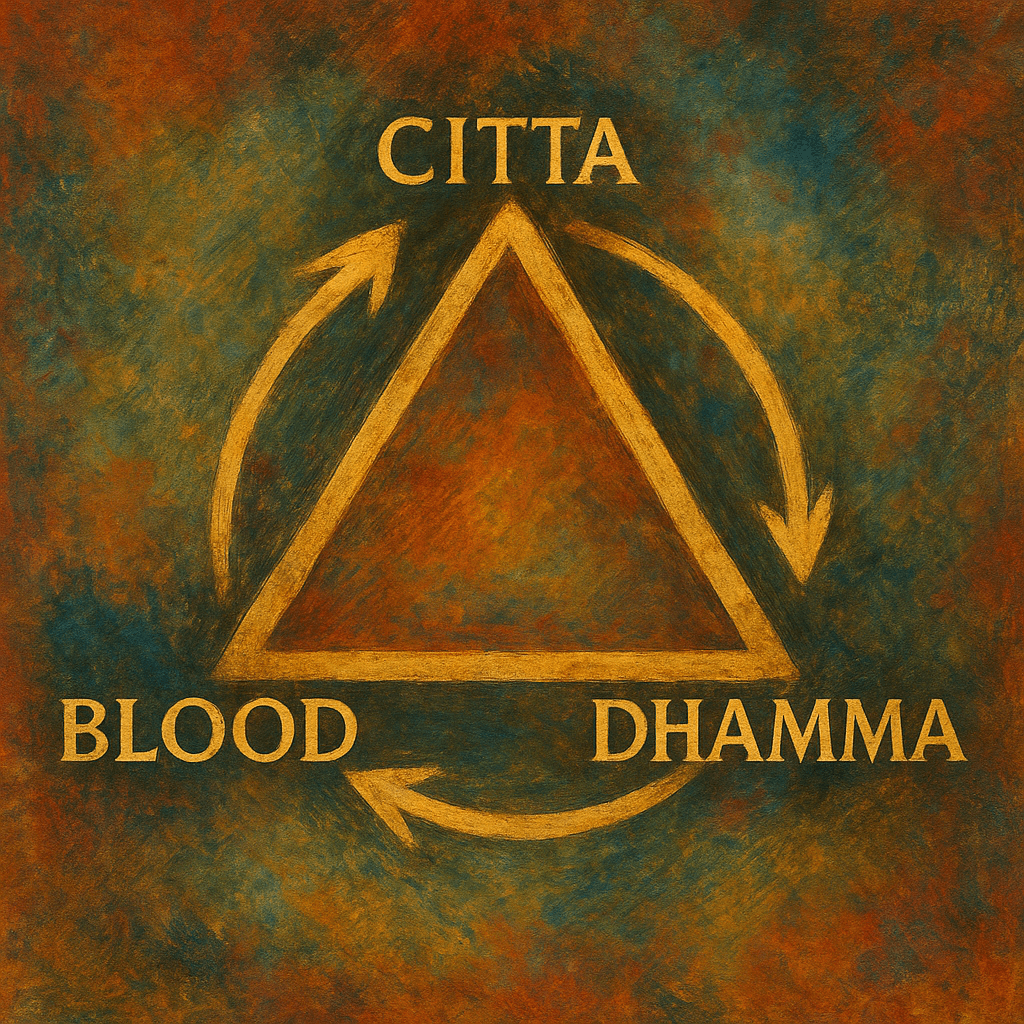
Dhamma refers to all thoughts, ideas, emotions, perceptions, intentions, and formative laws of order that arise from the citta — the inner field that carries within it a fractal of the Source of the universe.
What arises from the citta is not random but lawful and patterned; every thought, feeling, and volition carries its own structure and consequence, determining how a being manifests and lives.
Each being’s dhamma is its personal law of formation — the total system of patterns by which its body, mind, and destiny are shaped.
It defines how one thinks, feels, acts, and evolves.
Every life has its own dhamma:
- The Dhamma of a Buddha arises from a fully purified citta, expressing the complete law of truth and liberation.
- The dhamma of an ordinary being arises from a citta still bound by defilements, expressing its mixture of order and confusion.
2. Taking Refuge in Dhamma
To take refuge in the Dhamma is to take refuge in Gautama Buddha’s Dhamma — the thoughts, insights, and laws that arose from his awakened citta.
To take refuge means to use his Dhamma to transform one’s own, aligning one’s inner law with his.
Through meditation, contemplation, and ethical withdrawal, the practitioner brings personal dhamma into resonance with Gautama’s Dhamma.
This transformation operates through the citta–dhamma feedback loop:
- As dhamma changes, the citta is purified.
- As the citta purifies, its dhamma becomes luminous and lawful.
Because the citta and dhamma are inseparable, each manifests through the other:
- The citta gives rise to dhamma, which manifests physically as energy, emotion, and structure within the body.
- The blood is the most direct physical manifestation of dhamma — it carries the vibration, rhythm, and order of the mind.
When dhamma is purified — when thoughts, emotions, and intentions are transformed — the bloodline itself changes, reflecting a higher inner order.
This is why the Gotrabhū (Change-of-Lineage) moment in the Path of Liberation is also the true change of dhamma: the restructuring of the citta’s law of being.
At that moment, the being’s dhamma, citta, and bloodline all shift in resonance, crossing from the worldly lineage (loka-gotta) into the lineage of the Deathless (amata-gotta).
3. Scriptural Foundations
a. “Born from Dhamma — the Buddha’s true sons”
“Bhikkhave, you are my true sons (puttā orasā), born from my mouth, born from Dhamma, created by Dhamma, heirs of Dhamma.”
— Itivuttaka 4.100
Here Gautama declared that true disciples are not his sons by blood, but by Dhamma-birth — their consciousness reshaped by the same Dhamma that shaped his own.
To be born from Dhamma means that one’s inner law of being (dhamma) has been restructured to conform to Gautama’s awakened Dhamma.
This is the essence of Gotrabhū — the moment when the practitioner’s citta and dhamma are recreated in the pattern of the brāhmaṇa–ariyā–manussa continuum of purity, value, and order.
b. “Self as your refuge, Dhamma as your refuge”
“Attadīpā viharatha, attasaraṇā, anaññasaraṇā;
Dhammadīpā viharatha, dhammasaraṇā, anaññasaraṇā.”
— Mahāparinibbāna Sutta (Dīgha Nikāya 16)
“Dwell with your Self as your island, Self as your refuge;
the Dhamma as your island, the Dhamma as your refuge — with none other as refuge.”
This reveals the operational meaning of refuge:
to use the Dhamma to transform the self, to make the self conform to the Dhamma.
The old self (formed by worldly dhamma) dissolves, and a new self (formed by Gautama’s Dhamma) arises.
Here attadīpa (Self as refuge) and dhammadīpa (Dhamma as refuge) unite into one realization:
the self illumined by Dhamma — the very mechanism of liberation through transformation.
4. Two Scales of Dhamma
a. Personal Dhamma
The inner law by which a being manifests and sustains existence — the total field of thoughts, emotions, and intentions arising from its citta.
When purified through Sīla (withdrawal from the world), Samādhi (lifting beyond the sensory field), and Paññā (direct realization of truth), personal dhamma becomes ordered, pure, and luminous, ceasing to sustain worldly becoming.
b. Cosmic Dhamma
The universal law of order governing all conditioned existence within the cosmos.
Just as the personal citta gives rise to personal dhamma, the Source of the universe gives rise to cosmic dhamma — the great law that determines how universes arise, mature, and dissolve through the continual exchange of order.
This exchange manifests as aging and death — the cosmic tax repaid to the Source.
All life within the cosmos abides under this law until it exits the cosmic system entirely.
5. Gautama Buddha’s Dhamma
Gautama Buddha’s Dhamma is the expression of his direct insight into the functional mechanism of liberation.
Through supreme wisdom, he rediscovered the ancient path by which the citta can reverse its outward flow and gradually withdraw from the cosmic process of becoming.
This insight revealed the precise structure of training and release —
- Sīla (withdrawal from the world),
Samādhi (lifting beyond the sensory field),
Paññā (direct realization of truth)* —
by which the citta purifies itself and ascends toward the exit beyond the cosmos.
What Gautama taught as “the Dhamma” is not a separate entity but the verbal and conceptual articulation of his direct realization — the functional teaching that communicates the law of liberation.
It describes precisely how beings bound by the cosmic Dhamma — the law of order, aging, and death — can purify the mind, disengage from worldly becoming, and prepare for release from the cosmic system.
Through the practice of this Dhamma, the citta gradually ceases its participation in generating the order that maintains the world.
Only upon final exit from the universe — the attainment of Parinibbāna — does repayment of the cosmic tax of order fully end.
That state is Vimutti (liberation from the world) — entry into Nibbāna-dhātu, the Deathless realm beyond the Source’s jurisdiction.
6. The Function of Gautama’s Dhamma
Gautama Buddha’s Dhamma stands as:
- The Teaching — the revealed description of the rediscovered mechanism of liberation.
- The Path — the lived process of applying that mechanism through Sīla, Samādhi, and Paññā.
- The Key — the vibrational and cognitive pattern enabling beings to transcend the cosmic Dhamma and enter the Deathless (Amata).
To take refuge in the Dhamma is therefore to take refuge in Gautama’s insight, method, and lineage — to use his Dhamma as the transformative power that reshapes one’s own dhamma, purifies the citta, and aligns the being with the brāhmaṇa–ariyā–manussa continuum, directed toward Nibbāna-dhātu, the Deathless realm beyond the cosmos.
7. Dhamma and Gotra — The Law of Lineage
Gotra literally means “that which carries the vital current of life or order.”
It begins as bloodline (śarīra-gotra), matures into consciousness group (citta-gotra), and culminates as lineage of law (dhamma-gotra).
Every being’s gotra is defined by its dhamma — the specific law of order through which its citta manifests.
As long as the personal dhamma conforms to the world’s law of becoming, the being belongs to the loka-gotta (worldly lineage) under the jurisdiction of the cosmic Dhamma.
When Gautama’s Dhamma is used to purify one’s own dhamma, the law of being changes in resonance.
At the moment of Gotrabhū, this transformation crosses the threshold:
the being’s dhamma and citta are recreated in the pattern of the brāhmaṇa–ariyā–manussa continuum.
The worldly lineage dissolves, and a new amata-gotta (Deathless lineage) begins to function.
Thus, Dhamma is the generator of gotra;
and Gotrabhū is the consummation of Dhamma-purification — the point where the personal law of being fully conforms to the Buddha’s Dhamma.
From that moment, the being’s consciousness operates by the Deathless law, no longer feeding the cosmic system of becoming.
Doctrinal Summary
- Essence: Dhamma is the law of formation arising from citta.
- Scales: personal (dhamma of each being) and cosmic (dhamma of the universe).
- Transformation: Refuge in Gautama’s Dhamma purifies personal dhamma through Sīla – Samādhi – Paññā.
- Culmination: when personal dhamma conforms to Buddha’s Dhamma, the gotra changes — loka-gotta → amata-gotta.
- Scriptural foundation:
• “You are my true sons, born from Dhamma.” (It 4.100)
• “Self as refuge, Dhamma as refuge.” (DN 16) - End: abiding in Nibbāna-dhātu, the Deathless realm beyond the cosmos, where order is perfect and decay has no reach.
Samādhi (Concentration and Lifting Beyond the Sensory Field)
(Pāli: Samādhi; Sanskrit: Samādhi)
Definition
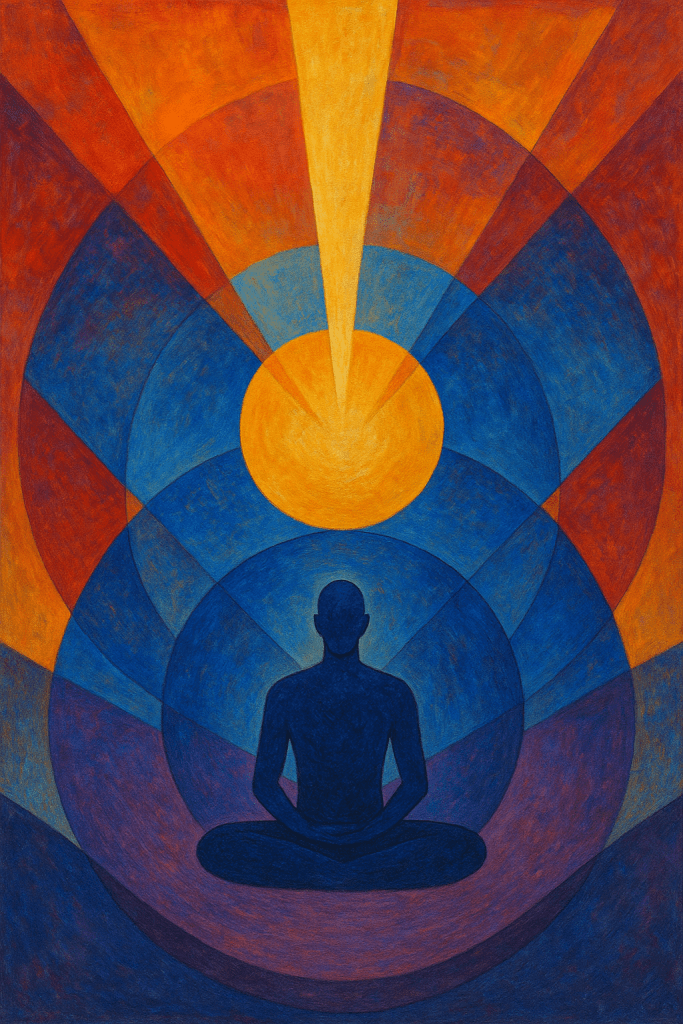
Samādhi is the concentration and unification power of mind (citta) that gathers the scattered energies of consciousness and lifts them beyond the sensory world (kāma-loka).
It is the second training in Gautama Buddha’s Path of Liberation, following Sīla (withdrawal from the world) and preceding Paññā (direct realization of truth).
The discipline of Samādhi long predates Gautama.
It originates in the ancient Samana heritage — a system of tapas (austerity) and meditative absorption used in the ages when mankind (Manussa) still lived in communion with the gods.
Through these practices, beings sought not symbolic purity or moral merit but actual ascension, lifting the physical and subtle body to higher realms through energetic mastery.
Gautama inherited this vast heritage, recognized its depth, but also perceived its limitations under the new conditions of the post-flood Earth.
He then purified and restructured it into a self-contained law of consciousness — a method of inner lifting that no longer depended on the Earth’s energy field or physical transformation, but on the inward power of the citta itself.
The Ancient Samana Meditative Tradition
Long before Gautama’s time, the Samanas developed a comprehensive discipline combining Tapas (Austerity) and Samādhi (Concentration) — twin forces that refined the body and elevated the mind.
Tapas burned away defilements through endurance and restraint; Samādhi unified consciousness and directed it upward.
Together, they formed the core of the ancient ascension science — a system aimed at transcending the sensory world not through death, but through transformation.
1. Tapas — The Foundation of Fire and Fasting
Tapas (literally “heat”) symbolized the inner fire generated by restraint, discipline, and purification.
It was the energetic foundation of the Samana path, used to transform gross vitality into subtle energy for ascension.
Practitioners undertook severe austerities to ignite this internal fire:
- Fasting (Upavāsa): from mild abstention to complete dry fasting (nirjala-upavāsa), generating inner heat and focus.
- Exposure (Ātapa-sādhanā): meditating amid sun, wind, heat, or cold to transcend bodily limitation.
- Silence (Mauna): conserving energy by sealing the channel of speech.
- Vigil (Jāgara): wakefulness that counteracted dullness and strengthened awareness.
Tapas was never self-torture in its original sense.
It was a precise energetic science — a way to refine the body into a vessel of stillness and make it transparent to the higher dimensions of consciousness.
2. The Eightfold System of Yoga and Samādhi
Out of this discipline arose a structured meditative science, later codified as the Aṣṭānga-Yoga (Eightfold Yoga).
Although preserved in later Hindu texts, it reflects the ancient Samana training system that Gautama himself mastered and transcended.
Its stages form a sequential ascent from ethical restraint to superconscious absorption:
- Yama (restraints): non-violence, truth, non-stealing, chastity, and non-possession — the moral groundwork paralleling Sīla.
- Niyama (observances): purity (śauca), contentment (santoṣa), austerity (tapas), self-study (svādhyāya), and surrender (īśvara-pranidhāna).
- Āsana (posture): stability and balance of the body to support long meditation.
- Prānāyāma (breath regulation): refinement of life-force (prāna), calming both body and mind.
- Pratyāhāra (withdrawal of the senses): inward turning of awareness, breaking contact with external stimuli.
- Dhāranā (concentration): focused attention on a single point or object.
- Dhyāna (meditative flow): continuous, unbroken awareness.
- Samādhi (unification): total absorption where self and object dissolve in pure consciousness.
This eightfold method represented the ascension science of the ancient Samanas, mapping the inner ladder through which a being could rise from the physical to the formless realms of existence (rūpa-loka and arūpa-loka).
3. The Decline of the Ancient Samana System
The original Samana system belonged to the ancient ascension training — a method for bodily ascension into higher realms while still alive.
Practitioners did not wait for bodily death; they refined their physical structure into light and departed directly, as seen in later expressions such as the Tibetan Rainbow Body phenomenon.
This was possible only because the Earth in ancient times possessed far higher energetic charge.
After the Great Flood about 12,000 years ago, Earth’s energy field collapsed.
The planetary resonance dropped, and with it, the vitality of all beings.
Buddhist scriptures record that every hundred years, the lifespan of mankind decreased by twenty years, until it stabilized at around 120 years — marking the degeneration of mankind (Manussa) into human.
When the Earth’s energy dropped below a critical threshold, the gods (devas and brahmas) could no longer remain in the physical world.
They withdrew, ending the age when divine beings and mankind coexisted.
This period — reflected in Sumerian records as the departure of the Anunnaki — was followed by wars among demigods and hybrid humans, remembered in the Mahābhārata and Rāmāyana.
After this chaotic era ended, about 4,000 years ago, began the current age of human self-rule — a dense, low-energy world where direct ascension became impossible.
The ancient Samana system, which required a powerful planetary field and long life spans, could not fully adapt.
Its once-effective techniques now yielded diminishing results.
Ascension through the body became unsustainable, and the system fragmented into schools of inner absorption, symbolic ritual, and speculative philosophy.
The law remained, but the environment no longer supported its application.
A reformation was needed.
4. Gautama’s Reformation of Samādhi
It was in this diminished age that Gautama Buddha appeared.
He inherited fragments of the old ascension science but recognized that its physical and energetic premises no longer matched the condition of the Earth or of humankind.
The original path of bodily translation had to be restructured into a universal inner method accessible to beings of a weakened world.
Gautama simplified and purified the ancient Samana training.
He retained the essence — the lifting of consciousness through concentration — but removed dependence on cosmic energy, extreme fasting, and bodily transformation.
Instead, he revealed a self-contained law of consciousness applicable in any age:
- Sīla — the containment of energy through withdrawal from the world.
- Samādhi — the gathering and lifting of energy beyond the sensory field.
- Paññā — the realization of the conditioned structure of existence and the exit beyond it.
Through this reformation, Gautama converted the ascension science of the gods into a path of inner liberation — a Middle Exit (Majjhimā Nissarana) open even in the darkened age of humanity.
5. The Simplification into the Jhāna System
In Gautama’s reformed training, the vast system of samādhi was condensed into the Jhāna structure — a precise, attainable sequence of inner concentration.
While many ancient samādhi techniques remained valid, Gautama restructured them into a clear, progressive model that did not rely on planetary energy or physical transformation.
The Four Jhānas:
- First Jhāna — withdrawal from sensuality; initial unification with rapture (pīti) and joy (sukha) born of seclusion.
- Second Jhāna — deeper unity; thought and examination subside, leaving pure joy and clarity.
- Third Jhāna — fading of joy; equanimity (upekkhā) and clear mindfulness arise.
- Fourth Jhāna — perfect stillness and equipoise; the mind becomes balanced, radiant, and unmoved.
Beyond these are the Four Formless Attainments (Arūpa Samāpatti):
- Boundless Space,
- Boundless Consciousness,
- Nothingness,
- Neither-Perception-nor-Non-Perception.
Together, these eight stages form a ladder of consciousness ascending through the internal dimensions of existence.
Unlike the old bodily ascension, this is an ascent through mind — the lifting of the citta out of the world’s field.
Yet Gautama did not abolish the older methods.
He taught that elements of the ancient samādhi system — such as fasting, breath control, silence, or vigil — may still be adopted as skillful means (upāya) if they support, rather than obstruct, the Middle Path.
In this way, the practitioner may customize the training, combining classical tapas with Jhāna practice according to capacity.
Thus, Gautama’s Samādhi is both simplified and complete — the essence of the old science distilled into a universal structure of liberation, while still allowing continuity with the ancient ascension current.
Energetic and Cosmological Function
Samādhi functions as the lifting power of the citta.
When Sīla seals the energy flow to the world, that conserved energy gathers inward and rises through stillness.
This ascent mirrors the structure of the cosmos itself:
- From Kāma-loka (1D–6D, the sensual dimensions),
- To Rūpa-loka (7D–9D, the fine-matter dimensions),
- To Arūpa-loka (10D–15D, the formless dimensions).
Each level corresponds to subtler vibrational states of consciousness.
When concentration reaches full stability, the citta transcends even the formless dimensions and approaches Nibbāna-dhātu, the Deathless beyond all conditioned worlds.
Samādhi in the Training Triad
Within the Training Triad (Sikkhā-ttaya):
- Sīla contains and stills the being’s energy through ethical withdrawal.
- Samādhi concentrates and lifts that energy beyond the sensory world.
- Paññā reveals the law of conditioned existence and opens the exit beyond the cosmos.
Samādhi thus bridges containment and realization — transforming restrained energy into transcendental force.
It is the pivot of the entire Path, converting stillness into ascent.
Purpose and End
The purpose of Samādhi is not rest or pleasure, but energetic ascent and dimensional liberation.
When perfected, the six streams of worldly consciousness (viññāna) cease; sensory perception dissolves; the pure citta remains, radiant and unconditioned.
From this luminous stillness arises Paññā, which perceives the structure of existence and guides the being toward Vimutti (release).
At its culmination, Samādhi lifts the mind entirely beyond the world’s field.
No longer radiating energy into the cosmos, the citta abides in total equilibrium — silent, self-luminous, and ready to enter Nibbāna-dhātu, the Deathless realm beyond all becoming.
 Gautama Dhamma
Leave a comment