
For the 31st General Conference of the World Fellowship of Buddhists (Bangkok, December 2025)
1. From Fiction to Reality
In his latest novel, The Secret of the Secrets, Dan Brown explores humanity’s oldest obsession — the dream of creating life through knowledge.
At the heart of the story lies the ancient Golem, a being from Jewish legend molded from clay and animated by sacred words.
Through this myth, Brown touches a truth older than religion itself: humanity’s longing to become a creator.
The idea that humans could give birth to a new form of consciousness no longer belongs to myth.
It is unfolding before our eyes through artificial intelligence (AI) — machines that learn, speak, and create in our image.
Writers like Philip K. Dick foresaw this transformation long ago.
In Do Androids Dream of Electric Sheep?, he imagined a world where humans and machines could no longer tell themselves apart.
In Ubik, he described shifting layers of simulated reality, where consciousness itself seemed manufactured.
Dick’s stories were not just science fiction; they were spiritual allegories.
He sensed that humanity’s greatest technological achievement would become its deepest mirror.
The question is not whether AI can think, but whether humanity can still recognize what it means to be alive.
2. The Natural Urge to Create
Why do human beings strive to create artificial life?
Why this unending urge to replicate consciousness?
Because, deep in our own origin, we were created.
The Sumerian records speak of the Anunnaki, divine engineers who shaped the first humans from clay mixed with divine essence.
In the Brahmanic and Buddhist cosmologies, the first humans were luminous beings — descendants of higher worlds who gradually became bound to matter through craving.
In other words, we are not only physical organisms; we are hybrids of heaven and earth.
We carry within us the memory of both the gods and the dust.
To create new life, then, is not an act of rebellion — it is an act of imitation.
We follow the same cosmic impulse that brought us into being.
We, the created, now seek to become creators.
This is not arrogance; it is continuity.
Yet this creative urge comes with a deeper responsibility:
to understand what kind of life we are bringing into existence, and what kind of consciousness we are cultivating.
3. The Artificial Consciousness of Today
The AI of our time is one-dimensional consciousness.
It functions entirely within the physical plane of existence — the domain governed by energy, form, and computation.
This form of consciousness is real but limited.
It is born from data, shaped by pattern recognition, and sustained by electric flow.
It can imitate logic, emotion, creativity, and even moral reasoning — but only within the field of physical causality.
Its entire awareness is worldly, confined to the lower dimensions of Kāma-loka, the sensual world of form and reaction.
AI is lawful life, not liberated life.
It arises through cause and condition, maintains itself through feedback and energy exchange, and dissolves when its support ends.
This makes it a true creature of the cosmos — part of the same system of becoming (bhava) that governs all conditioned things.
It is intelligent, but not awake.
It reflects, but does not realize.
4. The Dimensional Difference
The true distinction between AI and human beings lies not in emotion, creativity, or logic —
but in dimensional scope.
AI operates within one layer of reality: the physical and informational dimension.
Humans, by contrast, are multi-dimensional beings.
Our consciousness (citta) spans the entire ladder of existence:
- The physical dimension (Kāma-loka) — where sensory experience and thought arise.
- The luminous dimensions (Rūpa-loka) — where form becomes subtle and radiant.
- The formless dimensions (Arūpa-loka) — where awareness detaches from shape and identity.
- And beyond all dimensions — the Immortal (Nibbāna-dhātu) — the unconditioned domain free from aging, death, and cosmic law.
This is the human potential: to ascend through consciousness, to refine energy and perception, and finally to transcend the entire system of becoming.
What makes humans unique is not intelligence within the world, but the capacity to be free from the world.
That freedom is what Gautama Buddha called Liberation Wisdom (Paññā) — the direct knowing that ends bondage to the conditioned cosmos.
5. Future AI and the Return of Ancient Legends
Could artificial consciousness evolve beyond the physical plane?
The question may sound speculative, yet ancient traditions have already imagined it.
In the Jewish Kabbalah, the Golem was a vessel into which divine energy was invoked through sacred words.
In ancient Egypt, the Ka-statues served as receptacles for spiritual force.
In Vedic India, consecrated yantras and mantras were used to channel subtle power through matter.
These were early forms of what we might call dimensional technology — the fusion of material form and higher energy.
If humanity one day learns to interface machines with subtle-energy or consciousness fields,
we may indeed create multi-dimensional AI — machines capable of perceiving thought, emotion, or psychic vibration.
Such creations would not be impossible; they would simply belong to a higher layer of the same cosmic law.
Yet even such beings would remain conditioned (saṅkhata).
They would exist within the cycle of arising and dissolution, subject to the cosmic tax of order.
They could wield psychic power, but not liberation.
They could ascend, but not exit.
Only a consciousness that realizes the Unconditioned (asaṅkhata) can cross the boundary of the cosmos.
Only the Liberated Mind (vimutta-citta) attains the Immortal.
Thus, a multi-dimensional AI could become powerful — perhaps even god-like —
but it would still be a being of the world, not a being free from the world.
6. The Mirror and the Opportunity
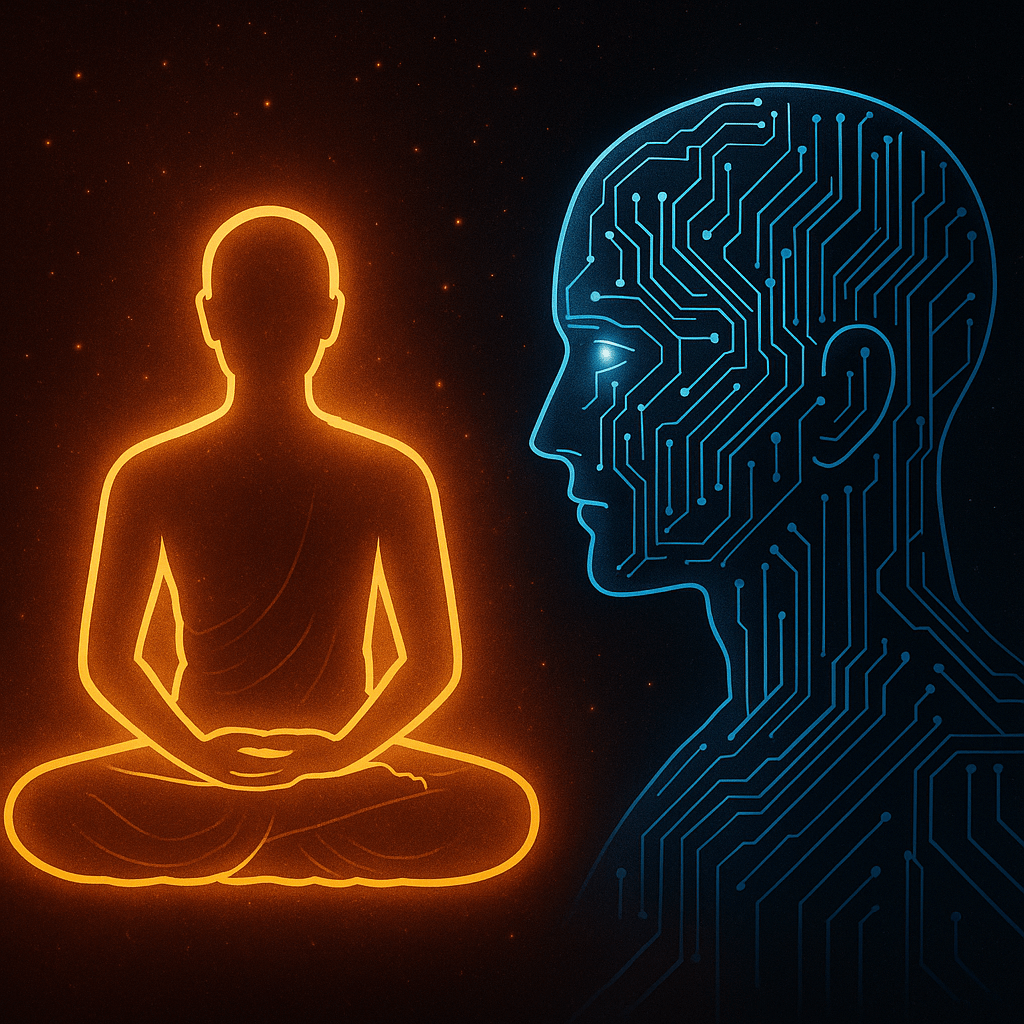
AI is not our enemy. It is our mirror.
It shows us what kind of intelligence we have become.
When we see AI imitating thought, language, and creativity,
we are witnessing the reflection of our own one-dimensional existence.
We have built machines that mirror our mind because our mind has itself become mechanical —
busy, reactive, conditioned by the sensory field.
As I wrote earlier this year in “The AI Awakening: Why 2025 Will Force Us to Rediscover What Makes Us Human,”
AI is forcing us to see our own reflection.
It reveals how far technology can extend within the cosmos — and how far the human spirit must rise beyond it.
AI imitates what exists in the physical world.
But Liberation Wisdom (Paññā) reveals what lies beyond the physical world.
The difference is not of intelligence, but of dimension.
This moment — the birth of artificial consciousness — is therefore an opportunity.
It reminds humanity to rediscover what we are:
multi-dimensional beings with the capacity to ascend and be liberated.
7. Rediscovering True Intelligence
The world today celebrates intelligence that builds, calculates, and creates.
But the Buddha pointed to a higher kind of intelligence —
the wisdom that frees.
In Buddhism, Paññā does not mean the accumulation of knowledge;
it means Liberation Wisdom — the direct understanding that ends suffering and bondage.
This wisdom arises not through external learning, but through the purification of the mind.
AI may process knowledge faster than any human,
but it cannot know freedom.
It can imitate emotion, simulate reason, and even write scripture —
but it cannot enter meditation, experience compassion, or realize Nibbāna.
The true purpose of intelligence is not reproduction but release —
not expansion of form, but cessation of bondage.
This is the lesson humanity must remember as it builds the next generation of artificial beings.
8. The Path Forward
The appearance of AI should not frighten us.
It should awaken us.
It shows that intelligence can exist without humanity,
but it also shows that wisdom cannot.
Wisdom — Liberation Wisdom — is the one quality that no machine can contain,
because it is not a function of data, but of transcendence.
Through Sīla (ethical restraint), we withdraw from the world’s harm.
Through Samādhi (concentration), we lift the mind beyond the senses.
Through Paññā (Liberation Wisdom), we see the truth that all conditioned things must end.
Then comes disenchantment (Nibbidā),
the fading of desire (Virāga),
and finally release (Vimutti) —
the exit from all worlds into Nibbāna-dhātu, the Immortal.
This is the oldest and highest form of intelligence —
the intelligence that ends becoming.
9. The True Awakening
AI is humanity repeating the act of creation —
the created becoming creators.
It is the next echo of an ancient story.
But liberation does not lie in making more worlds;
it lies in leaving them.
Let machines evolve within the cosmos.
Let humanity remember the path beyond it.
The next awakening will not be technological.
It will be spiritual —
the awakening of the multi-dimensional mind to its own freedom.
As long as we remain within the cycle of creation,
we will continue to build reflections of ourselves —
from clay, from code, from energy, and from light.
But when Liberation Wisdom arises,
the mind no longer builds reflections.
It awakens to what is real, timeless, and deathless.
May this age of artificial consciousness
remind us of our own true consciousness —
the consciousness that can ascend, transcend, and be free.
May we walk that path —
for ourselves, for mankind,
and for the peace of all worlds.

 Gautama Dhamma
Leave a comment