
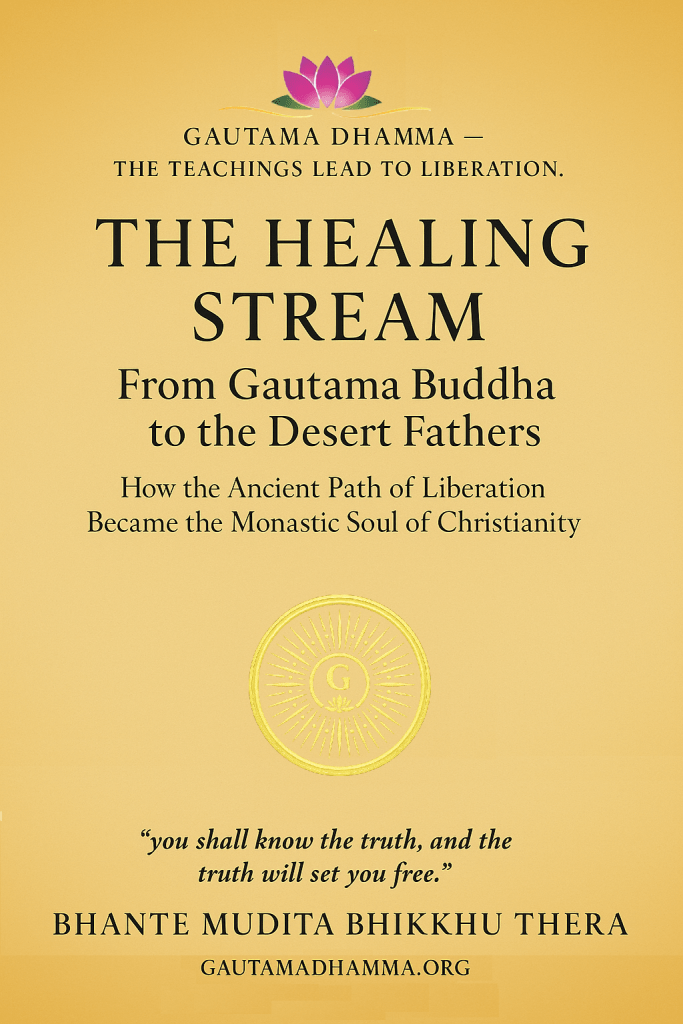
Excerpt from the book: The Healing Stream: From Gautama Buddha to the Desert Fathers – How the Ancient Path of Liberation Became the Monastic Soul of Christianity
When seen together, Christian Gnosis and Gautama Buddha’s Path of Liberation converge upon the same human imperative: to awaken from ignorance, to heal the sickness of existence, and to return to the Deathless. Their languages differ, their histories diverge, yet their inner architecture remains identical — the therapeutic restoration of consciousness.
The Gnostic awakens to the divine spark within, perceiving that it has fallen into the shadow of matter and must ascend through knowledge (gnōsis).
The Buddhist disciple awakens to the luminous citta, realizing that it is entangled in saṃsāra and must be released through insight (paññā).
Both recognize that bondage is not imposed by external power but arises from inner ignorance — and that liberation is achieved only through direct knowing.
Where the Gnostic calls salvation illumination, the Buddha defines liberation through Nibbidā → Virāga → Vimutti — disenchantment with the world, fading of attachment to the world, and liberation from the world. Both movements lead the soul from darkness into light, from delusion into peace.
To know yourself and you will know God echoes Gautama’s call to see things as they truly are (yathā-bhūta-ñāṇa-dassana). Both are invitations to inward vision. The Gnostic’s Pleroma and the Buddhist’s Nibbāna-dhātu describe the same completion — consciousness freed from the field of becoming and restored to the realm of the Deathless.
Inner illumination as true baptism also joins the two streams. The Gnostic “fire-baptism” and the Buddha’s “flame of wisdom” are not ceremonies but transformations of consciousness, the burning away of rāga, dosa, and moha that reveals the citta’s innate radiance.
Finally, both traditions revere the Revealer-Physician — Christos or Tathāgata — not as an external savior but as the living embodiment of the medicine. Each diagnoses ignorance as the world’s disease and offers the Dhamma or Logos as the cure.
The Last Words of the Buddha — True Refuge
“Atta-dīpā viharatha, atta-saraṇā, anañña-saraṇā; dhamma-dīpā, dhamma-saraṇā, anañña-saraṇā.”
Dwell with your Self as your island, Self as your refuge; the Dhamma as your island, the Dhamma as your refuge — with none other as refuge. (DN 16)
These words were spoken by Gautama Buddha in his final hour, just before he passed into Parinibbāna, the complete entry into Nibbāna-dhātu. They were not a philosophical abstraction but a last testament, urging his disciples to depend on nothing external — not even upon his continued presence — but to rely on the purified Self (atta = the luminous citta) and the Dhamma, the truth he had revealed and perfected. These two — the inner purity and the liberating law — were to serve as their island and refuge.
After his passing, later generations honored this instruction by formulating the Three Refuges: Buddha, Dhamma, and Saṅgha. This was a memorial gesture, expressing gratitude to the Teacher and to the community that preserved his word. Yet the original meaning of the Master’s final counsel remains deeper and more radical:
Liberation arises only when one’s own mind, purified by the Dhamma, becomes the island that stands above the flood of the world.
The Buddha’s last words therefore re-affirm the same principle that underlies all authentic gnosis: the true refuge is internal and experiential, not external or institutional. One must walk the Path by one’s own purified awareness, illumined by truth, until the mind crosses beyond all worlds into the Deathless.
The One Medicine, the One End
Both Gnostic and Buddhist paths converge upon the same realization:
- Sin is sickness — the confusion of consciousness within the world.
- Wisdom is medicine — the light that cures ignorance.
- Liberation is healing — the full restoration of the mind’s health and purity.
The Christos heals through remembrance; the Tathāgata heals through insight. Both restore the soul to its rightful domain — beyond corruption, beyond death. The Gnostic names it the Pleroma; the Buddha names it Nibbāna-dhātu. It is one reality, described in two languages: the Deathless Refuge where the Manussa lineage — the race of beings who remember and transcend — abides eternally.
Thus, the meeting of Gnosis and Dhamma reveals not two religions but one therapeutic science of deliverance:
to awaken, to heal, and to cross beyond the world.
The names differ — Kingdom, Fullness, Nibbāna — yet the end is the same: liberation from death, entry into the Deathless.
A sweeping historical and doctrinal journey revealing how Gautama Buddha’s original Path of Liberation flowed through the Therapeutae, Essenes, and Desert Fathers to become the contemplative heart of Christian monasticism — one continuous Healing Stream guiding humanity toward the Deathless.
 Gautama Dhamma
Leave a comment