
Excerpt from the coming book: The Healing Stream: From Gautama Buddha to the Desert Fathers – How the Ancient Path of Liberation Became the Monastic Soul of Christianity
A sweeping historical and doctrinal journey revealing how Gautama Buddha’s original Path of Liberation flowed through the Therapeutae, Essenes, and Desert Fathers to become the contemplative heart of Christian monasticism — one continuous Healing Stream guiding humanity toward the Deathless.
When we reach the early centuries of Christianity, we find a landscape both luminous and divided. The Jesus movement, which began as a small circle of disciples within Judaea, had spread throughout the Roman world—absorbing the languages, philosophies, and customs of many civilizations. In this encounter between Hebrew revelation and Greek inquiry, between prophetic faith and philosophical reason, a great question arose:
What does it mean to be saved?
For the institutional Church that was beginning to consolidate its authority, salvation became defined in juridical and theological terms—sin as a moral debt, redemption as legal pardon, and faith as assent to a creed. But alongside this public orthodoxy there continued an older current, a therapeutic stream that regarded salvation as healing, illumination, and liberation of the soul from the material world.
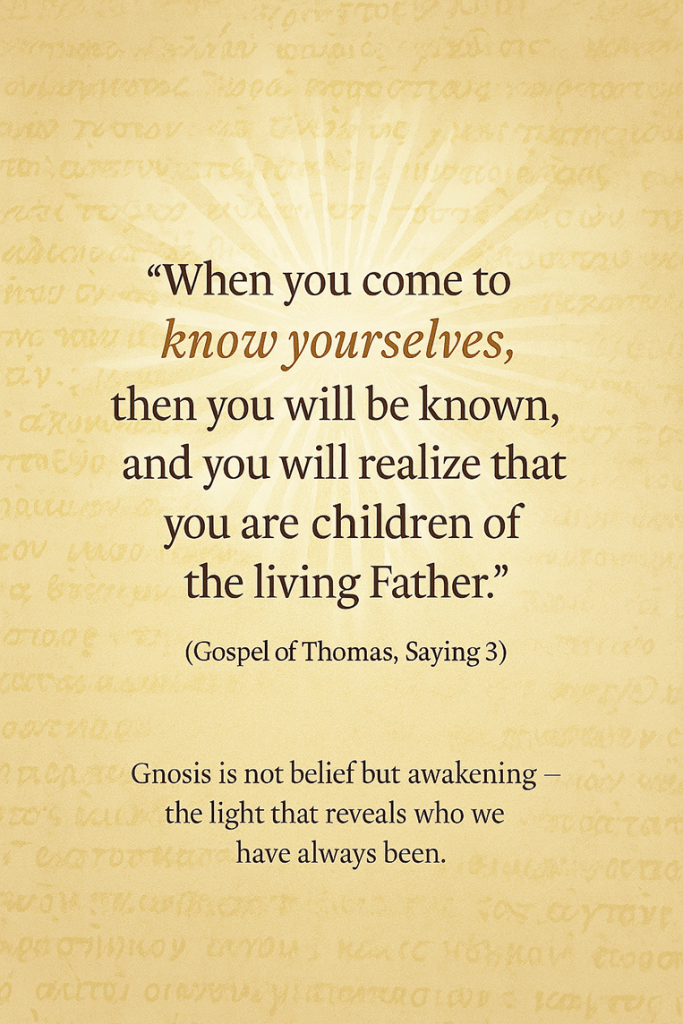
This inner current is what later ages called Gnosis—not abstract speculation, but direct knowing; not argument about the divine, but participation in divine consciousness itself. To the Gnostics, ignorance (agnoia) was the true original sin, and knowledge (gnōsis) the remedy. The fall was a forgetting; salvation, a remembering. To know oneself as a spark of the higher order was to begin the ascent from the world of decay toward the realm of incorruption.
Gnosis was thus existential rather than dogmatic. It did not rest upon belief in external authority but upon the awakening of the inner man—the pneumatic being (from pneuma, spirit)—who, once awakened, recognized his exile in this lower world and began the journey homeward to the Pleroma, the fullness beyond the cosmos. Here again we see the same law that Gautama Buddha discovered: the soul’s bondage to the conditioned world and its release through insight, disenchantment, and transcendence.
The contest between these two interpretations—faith as obedience versus knowledge as illumination—would shape the entire future of Christianity. The ecclesiastical current produced the Church; the gnostic current preserved the hidden science of liberation. Though suppressed, its essence survived among the contemplatives, mystics, and later monastic lineages that continued to seek inner union rather than external conformity.
7.1 What is Gnosis?
The Greek word gnōsis literally means “knowledge,” yet in the early Christian mystical vocabulary it signified direct acquaintance with truth—a kind of seeing that transcends both faith and reason. It was the knowledge of the heart, born of inner purification and contemplation.
- It is not book-learning, but first-hand vision of reality.
- It is not conjecture, but certainty born of experience.
- It is not belief in God, but perception and participation in the divine life itself.
This mode of knowing corresponds closely to what in the Buddhist tradition is called vipassanā—insight into things as they truly are (yathā-bhūta-ñāṇa-dassana). Both paths teach that liberation does not come from intellectual argument or ritual observance but from the transformation of consciousness.
In the gnostic vocabulary, this transformation is the passage from psychic (soulish) to pneumatic (spiritual) being; in the Buddhist vocabulary, it is the shift from defiled viññāṇa (worldly consciousness) to purified citta (liberated mind). Both recognize that ignorance (avidyā or agnoia) is the root of bondage, and that true knowledge is salvific.
To attain gnōsis is to recover memory of one’s higher origin, to see through the illusions of the world, and to realign the soul with the unconditioned source of life. It is the Christian form of nibbidā—disenchantment with the world—and the beginning of virāga—the fading of worldly attachment—which culminates in vimutti, the release into the eternal.
7.2 The Therapeutic Dimension of Gnosis
For the early Gnostics, the human condition was not a matter of legal guilt but of ontological illness. Humanity, they said, had fallen into agnōsia—a blindness of the spirit, a forgetting of its divine origin. The soul was not wicked by nature; it was simply asleep, intoxicated by the world, and enslaved to lower powers that fed upon its ignorance. Therefore, their language was not accusatory but diagnostic, not judicial but medicinal.
- The soul is asleep — it must be awakened through remembrance (anamnēsis).
- The inner spark is buried — it must be freed from matter’s grip.
- The mind is clouded — it must be illuminated by the light of truth (phōs gnōseōs).
This is the same mode of analysis that Gautama Buddha employed. He too did not condemn but diagnosed. His discovery of the Four Noble Truths was not a theology of sin but a medical science of liberation. He identified the universal disease as dukkha, the unease of all conditioned existence; the cause as samudaya, the arising of craving, aversion, and ignorance (rāga, dosa, moha); the cure as nirodha, the cessation of this disease; and the path of treatment as magga, the Eightfold Path—a regimen of ethical restraint, mental training, and direct realization.
The Gnostics and the Buddhists thus stand upon the same medical foundation:
both regard existence in the world as a condition of spiritual sickness, and both prescribe knowledge as the cure—not conceptual knowledge but liberating insight that dissolves the cause of suffering itself.
Where the Church spoke of faith and repentance, the Gnostics spoke of healing and awakening. They called their teachers therapeutai—healers of the soul. They understood that the fall of man was not moral disobedience but a descent into forgetfulness, and that the task of the savior was to restore remembrance of the divine origin. Salvation was thus a process of interior reordering—a return from dispersion to unity, from darkness to light, from ignorance to wisdom.
In the same way, Gautama Buddha prescribed a precise and graduated cure:
- Sīla (Ethical Withdrawal): containment of worldly conduct, which stabilizes the field of mind.
- Samādhi (Concentration and Lifting): refinement of consciousness beyond the sensory world, through which the mind regains its intrinsic clarity.
- Paññā (Wisdom): direct seeing of the world as conditioned and impermanent, revealing the exit toward the unconditioned.
When these trainings are fulfilled, the result is the threefold liberation: Nibbidā (disenchantment with the world), Virāga (fading of worldly attachment), and Vimutti (release beyond the world).
Likewise, in Gnostic doctrine, healing culminates in three stages: awareness of bondage, separation from the powers, and return to the Pleroma—the realm of incorruption beyond the created cosmos. The parallels are exact. Gnosis is the therapy of being, and the Dhamma is the science of liberation. Both aim to restore the soul’s native luminosity, its capacity to dwell in the unconditioned and deathless.
Thus, Gnosis—like the Dhamma—is not a belief system but a therapeutic discipline, a medicine for existence. It does not demand worship of an external deity but the purification of one’s own consciousness, until the divine principle within is freed from ignorance and returns to its rightful domain.
 Gautama Dhamma
Leave a comment