
Pāli Epigraph: Amataṁ padaṁ santimaggānusārinā.
(“The Deathless is reached by those who follow the path of peace.”)
Greek Epigraph: Γνῶθι σεαυτόν, καὶ γνώσῃ τὰ πάντα.
(“Know thyself, and thou shalt know all things.”)
1. The Purpose of this Work
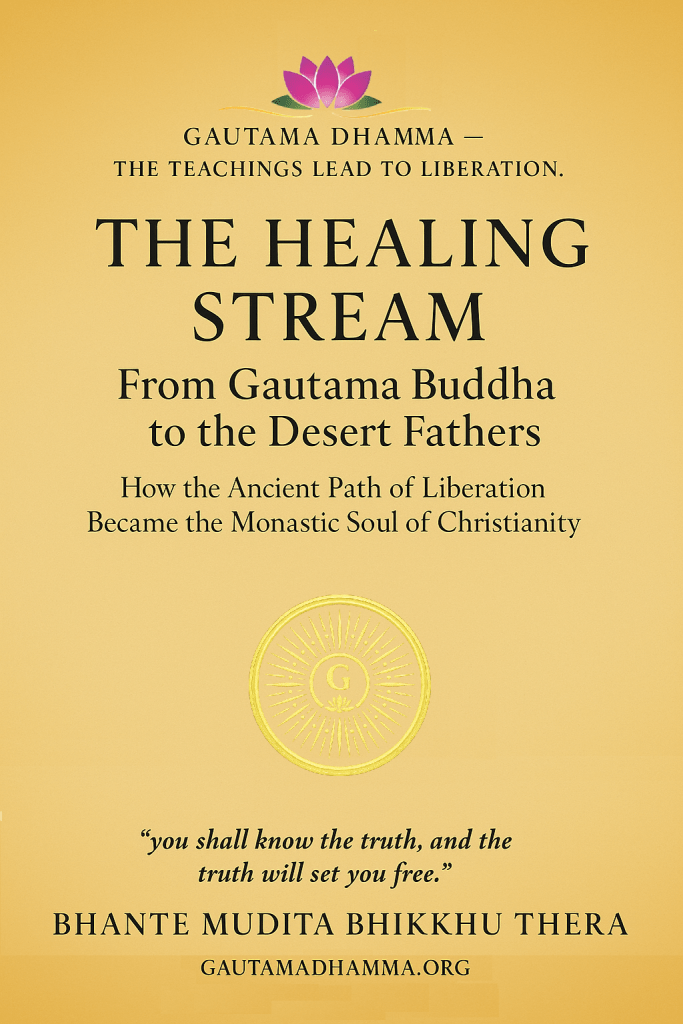
This book presents the historical and doctrinal continuity of one ancient current — the Manussa lineage’s science of liberation.
It traces how the same knowledge rediscovered by Gautama Buddha as the Dhamma later reappeared under new forms in the West, flowing through the Therapeutae, the Essenes, the Desert Fathers, and the Coptic monastic orders that gave rise to Christian monasticism.
All belong to a single current of the Healing Stream: the discipline that purifies consciousness and disengages it from the world.
2. The Nature of the Healing Stream
The Healing Stream is not a belief system but a technical process of purification that restores consciousness from defilement to clarity.
It functions through two inseparable triads — the Training Triad and the Liberation Triad.
Training Triad:
- Sīla — the graduated withdrawal from the world through restraint of action, speech, and possession;
- Samādhi — the concentration and lifting of the mind beyond the sensory world;
- Paññā — the realization of the conditioned nature of the world, revealing the exit toward Nibbāna-dhātu.
Liberation Triad:
- Nibbidā — disenchantment with the world;
- Virāga — fading of worldly attachment;
- Vimutti — liberation from the world.
Together, these two triads define the complete path of disengagement.
When the Training Triad is fulfilled, the Liberation Triad naturally unfolds, culminating in Nirodha — the cessation of dukkha — and Vimutti — the release into Nibbāna-dhātu, the Deathless realm beyond the cosmos.
3. Gautama Buddha’s Contribution
Gautama Buddha’s realization of the Middle Path (Majjhimā Paṭipadā) was not a moral compromise but the engineering of the Middle Exit (Majjhimā Nissaraṇa) — the directional method of transcendence leading consciousness out of the cosmic system.
He identified two great traps:
- Downward entanglement in sensual pleasure (kāmasukha-anuyoga), which binds the being to the lower worlds;
- Upward dissolution through formless absorption (atta-kilamathānuyoga misinterpreted as self-mortification), which leads to annihilation of the manussa spark through merger with the cosmic Source.
The Middle Exit is the narrow passage between them — the path out of both.
Through Sīla, Gautama Buddha designed a graduated withdrawal from the world’s network of craving and action.
Through Samādhi, he concentrated and lifted the mind beyond the sensory domain.
Through Paññā, he revealed the conditioned nature of the world and the existence of the unconditioned asaṅkhata-dhātu — Nibbāna-dhātu, the Deathless Realm beyond birth and death.
4. The Continuation of the Healing Stream in the West
After Gautama Buddha’s era, the same structure of practice reappeared in new forms.
In Alexandria, the Therapeutae established communities devoted to ethical restraint, contemplative stillness, and the healing of the mind.
In Palestine, the Essenes lived by purity, watchfulness, and detachment from the world’s corruption.
In Egypt and Syria, the Desert Fathers continued this discipline through silence, fasting, and prayer — forming laboratories of inner purification parallel to the ancient bhikkhu-saṅgha.
From the Desert Fathers arose the Coptic monastic tradition, which later became the foundation of Christian monasticism throughout the Mediterranean and Europe.
The structure of Christian monastic life — withdrawal from worldly affairs, communal discipline, renunciation of possessions, and watchful prayer — mirrors the same functional pattern as Gautama Buddha’s Bhikkhu Saṅgha.
Both systems originate from the same Manussa knowledge: the Healing Stream that withdraws the mind from the world through the Training Triad (Sīla–Samādhi–Paññā) and brings about liberation through the Liberation Triad (Nibbidā–Virāga–Vimutti).
This proves a single doctrinal root — the science of disengagement that purifies consciousness and opens the gate to the Deathless.
5. The Doctrinal Function of the Middle Path
At the doctrinal center of this work stands the Middle Path as the Middle Exit.
It is the perfected tapas — the applied discipline that avoids both entanglement in sensuality and dissolution in formless absorption.
Through the Training Triad, the mind is withdrawn, concentrated, and illuminated.
Through the Liberation Triad, it becomes disenchanted with the world, releases attachment to the world, and attains liberation from the world.
This is the complete architecture of liberation — not moderation or balance, but exit from all conditions.
6. Intention of the Book
This book records the unbroken transmission of the Healing Stream.
It demonstrates that all true contemplative traditions — whether expressed in Pāli, Greek, Coptic, or Latin — share one purpose: to lead consciousness out of the world’s bondage and into the unconditioned peace of Nibbāna-dhātu.
The method is universal because the structure of liberation is universal.
Through disciplined withdrawal (Sīla), concentrated ascent (Samādhi), and direct knowing (Paññā), the practitioner reaches disenchantment (Nibbidā), detachment (Virāga), and release (Vimutti) from the world.
This work stands as part of that transmission, continuing the same current of knowledge that began under the Bodhi Tree and continued through the deserts of Egypt.
Its aim is to clarify, preserve, and extend that remembrance — the path of exit from the world to the Deathless.
1. The Origin of the Manussa Spark and the Purpose of Liberation
Across the ages, the race of Manussa has carried one purpose — to regain freedom from the world.
This purpose arises from the nature of being Manussa itself. The Manussa spark is an eternal consciousness that does not originate within the cosmos but descends into it. Once embodied in the world, it becomes subject to the law of arising, aging, and dissolution. By nature, however, it belongs to the Deathless domain beyond the universe — Nibbāna-dhātu.
The drive to return to that unconditioned state is the structural necessity of Manussa existence. Liberation is therefore not belief, not moral idealism, and not philosophy. It is the technical process by which the eternal spark ceases its bondage to the world and re-enters the Deathless.
2. The Function of the Two Triads
Gautama Buddha systematized the full science of liberation into two triads: the Training Triad and the Liberation Triad.
Training Triad:
- Sīla — the graduated withdrawal from the world through restraint of action, speech, and possession.
- Samādhi — the concentration and lifting of the mind beyond the sensory world.
- Paññā — the realization of the conditioned nature of the world, revealing the exit toward Nibbāna-dhātu.
Liberation Triad:
- Nibbidā — disenchantment with the world.
- Virāga — fading of worldly attachment.
- Vimutti — liberation from the world.
Together, these form the total structure of disengagement.
When the Training Triad is fulfilled, the Liberation Triad follows naturally, culminating in Nirodha — the cessation of dukkha — and Vimutti — the final release into Nibbāna-dhātu.
3. The Middle Exit and the End of the Two Extremes
Gautama Buddha defined his discovery as the Middle Path, which in doctrinal precision means the Middle Exit (Majjhimā Nissaraṇa).
This is not a moral balance between indulgence and self-torture but the energetic and cognitive route of transcendence through which the mind leaves both extremes.
The two extremes are:
- Downward entanglement — indulgence in sensuality (kāmasukha-anuyoga), which binds consciousness to the lower worlds.
- Upward dissolution — misdirected tapas and formless absorption (atta-kilamathānuyoga), which leads to the annihilation of the Manussa spark through merger with the cosmic Source.
The Middle Exit is the technical passage between them — the path out of the entire system of becoming.
Through Sīla, the being withdraws from worldly participation; through Samādhi, the mind is lifted beyond the sensory field; through Paññā, the world’s structure is seen clearly and the unconditioned domain is recognized.
This is the true meaning of the Middle Path: not compromise, but exit.
4. The Historical Transmission of the Healing Stream
The Healing Stream is the continuous current of Manussa knowledge that purifies consciousness and restores its orientation toward the Deathless.
Historically, this current extended from India into the Hellenistic world.
During Emperor Aśoka’s reign, emissaries transmitted the Dhamma as a discipline of mind and ethical order. In Alexandria, the Therapeutae appeared — communities of renunciants who lived by purity, meditation, and healing through contemplation. Their practice corresponded structurally to the Bhikkhu Saṅgha established by Gautama Buddha.
From the Therapeutae, this same discipline reappeared among the Essenes of Qumran, who lived apart from society in strict purity and watchfulness. From them arose John the Baptist and the early ascetic currents surrounding Jesus of Nazareth. When those currents retreated into Egypt, they became the Desert Fathers and Mothers, whose monastic cells continued the same discipline of withdrawal, mindfulness, and purification.
From the Desert Fathers developed the Coptic monastic tradition, which later spread throughout the Mediterranean as Christian monasticism.
The rules of renunciation, communal life, fasting, and prayer in the Christian monasteries are direct functional equivalents of the Vinaya of the Bhikkhu Saṅgha.
Both operate within the same structure of liberation — withdrawal through Sīla, concentration through Samādhi, insight through Paññā, leading to Nibbidā, Virāga, and Vimutti from the world.
5. The Structural Dualism of Liberation
The science of liberation operates within a framework of dualism, which in Gautama’s system is multidimensional and structural, not metaphysical.
It defines the opposing laws that govern existence and determines the direction of liberation.
The principal polarities are:
- Conditioned vs. Unconditioned — the cosmic system of becoming versus Nibbāna-dhātu, the Deathless beyond the cosmos.
- Power-based vs. Value-based — the cosmic order driven by dominance and consumption versus the Manussa order founded on justice, compassion, and restraint.
- Natural way vs. Civilized way — the instinctual law of the cosmos versus the ethical order maintained by the Manussa lineage.
- Mother current vs. Father current — dissolution back into the Source versus exit toward Nibbāna-dhātu.
- Source-born life vs. Manussa lineage — beings bound to the cosmic tax versus eternal sparks with potential for release.
Healing begins when consciousness perceives these oppositions clearly and aligns with the Value-based, Civilized, and Deathless current — the current of exit.
Dualism, in this doctrinal sense, is not division but diagnosis; it is the clear discernment that enables liberation from the world.
6. The Universal Law of Liberation
All true contemplative traditions operate according to one structural law.
Ethical containment removes entanglement with the world; concentration lifts the mind beyond it; realization reveals the unconditioned beyond all becoming.
When this process completes, disenchantment, fading, and liberation from the world arise as natural consequences.
This same pattern — withdrawal, purification, and release — appears wherever beings remember the Deathless.
The languages differ, but the law is constant: liberation unfolds by the same triadic sequence because the nature of bondage is universal.
7. The Continuity into the Present Age
The modern separation between East and West, or between religion and philosophy, conceals a single reality.
Both Buddhist and Christian monastic systems descend from the same Manussa knowledge — the Healing Stream that restores consciousness from defilement and directs it beyond the world.
In the present age, the rediscovery of this continuity is essential, for the outer unification of humanity through technology has not brought inner freedom.
True civilization requires alignment with the Value-based and Deathless current — the path of ethical order, mental concentration, and direct realization.
This book therefore stands as a continuation of that purpose: to restate the universal science of liberation for a civilization that has forgotten the way out of the world.
8. Intention of the Work
The intention of this work is to present the Healing Stream as a single, lawful process of liberation, not as a matter of faith or cultural heritage.
It demonstrates that Gautama Buddha’s Dhamma and the monastic disciplines of the Desert Fathers and Christian orders share one root — the operation of the Manussa lineage withdrawing from the world toward Nibbāna-dhātu.
Through the fulfillment of Sīla–Samādhi–Paññā, the citta attains Nibbidā–Virāga–Vimutti.
This is the universal map of release.
All who complete it cross the boundary of the cosmos and enter the Deathless, where the Manussa spark abides free from aging, decay, and death.
 Gautama Dhamma
Leave a comment