
Unveiling the forgotten meaning of “Thera” and the lineage that carried the Buddha’s true Dhamma across the world
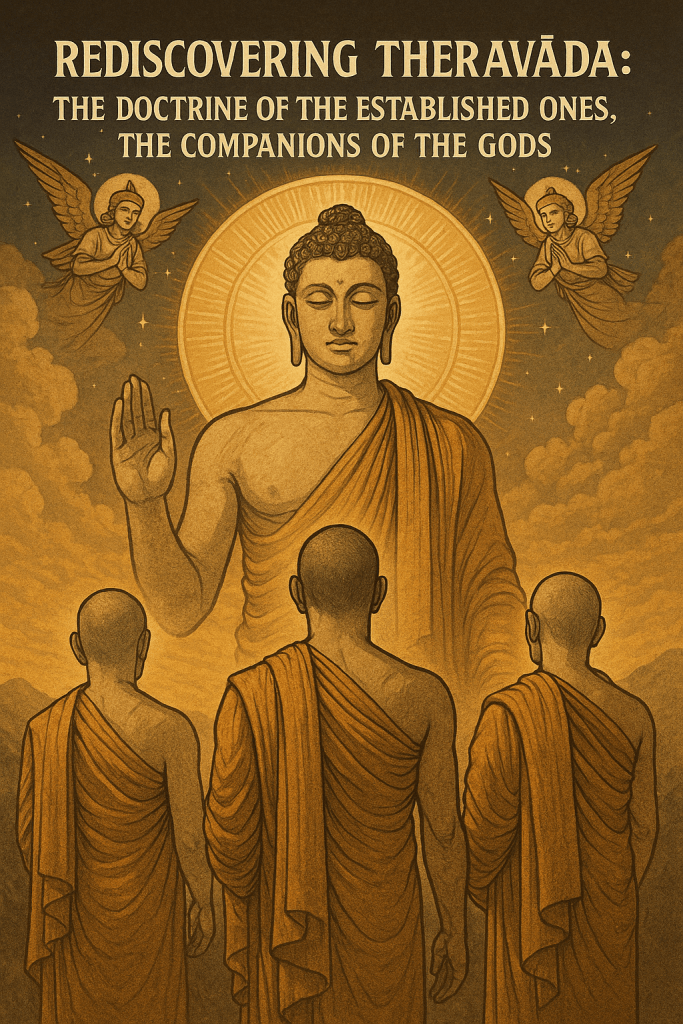
Opening Reflection
When Gautama Buddha entered Nibbāna, his physical body ceased, but his realization and teaching did not end.
The Dhamma continued through those disciples who had realized the same liberation.
They preserved it not as belief but as direct knowledge, grounded in discipline (Sīla), concentration (Samādhi), and wisdom (Paññā).
The disciples who were firm in realization were called Theras — those established in Dhamma, free from defilements, and unshaken by the world.
Their continuity became known as Theravāda, “the Doctrine of the Established Ones.”
At the Third Council under King Aśoka, these Theras purified the Saṅgha and reaffirmed the authentic Dhamma.
From that foundation, missions were sent to many regions — Sri Lanka, the Himalayas, Burma, Suvaṇṇabhūmi, and even to the Greek and Egyptian lands.
Through these missions, the Dhamma was transmitted as both teaching and living realization.
Theravāda is not a sect but the continuation of the Buddha’s method of liberation.
Behind its name lies a deeper meaning that has long been forgotten — a meaning contained in the word Thera itself.
1. The Forgotten Meaning of Thera
In this section we explain the original meaning of Thera and how it differs from the later, simplified understanding.
Thera as Stability, Not Age
Today Theravāda is often translated as “Teaching of the Elders,” giving the impression that Thera means “old monk.”
This is incomplete.
In Pāli, Thera comes from the Sanskrit Sthavira, derived from sthā, meaning “to stand” or “to remain firm.”
Related words such as sthiti (stability) and sthāna (standing place) show that Thera means “the one who is stable” or “the established one.”
In the early Saṅgha, a Thera was recognized not by seniority but by attainment.
A monk who realized Arahantship became a Thera because his mind was steady, purified, and free from wavering.
He was called stable because his liberation did not depend on external conditions.
Later, as the community grew, the term began to refer to seniority by years, but the original meaning remained: a Thera is one whose mind stands firm in Dhamma.
Thera as the Upholder of the Dhamma
Here we clarify the role of the Thera within the early Saṅgha.
A Thera is not defined by authority but by function.
He upholds the Dhamma through his stability of realization.
When the Buddha said, “He who is virtuous, concentrated, and wise — that one I call a Thera” (Dhp 260), he identified Thera as a quality of the liberated mind, not a social title.
Such stability is not passivity.
It is the firm establishment of the citta (mind) that has ceased to follow craving, aversion, or delusion.
It no longer moves toward worldly existence or non-existence.
This unshaken mind represents the true foundation upon which the Dhamma stands.
From Vedic Stability to Buddhist Realization
The word Sthavira existed even before Buddhism, used in Vedic culture to describe those who upheld Ṛta — the principle of order.
In that context, Sthaviras were guardians of law and ritual order.
Gautama Buddha transformed this meaning from outer ritual to inner discipline.
The true Sthavira, or Thera, became the one who maintains order within — by purifying the mind and sustaining moral and meditative stability.
When the Buddha attained enlightenment, he became the foremost Thera — the one perfectly established in the cessation of dukkha.
Those who followed his method carried that same steadiness, forming an unbroken line of stability in the human world.
This is the true origin of the word Thera within the Dhamma.
Theravāda — The Doctrine of the Established Ones
We now define Theravāda according to its original intent.
It means “the doctrine upheld by those established in realization.”
The Theras preserved the Dhamma not by power but by unshakable practice.
Their firmness in Sīla, Samādhi, and Paññā prevented the distortion of the teachings and kept the path clear for others to follow.
When new interpretations arose in later centuries, Theravāda remained unchanged because it was grounded in direct realization, not in speculation.
Thus, it is called the “Doctrine of the Established Ones” — the system that endures because it rests on the stability of awakened minds.
The Living Meaning of Thera
To be a Thera means to live with unshaken discipline, concentration, and understanding.
It is not a position of hierarchy but a state of completion.
A true Thera is free from the influence of the world, yet remains in the world for the benefit of others.
As long as there are such beings — those who remain established in the cessation of dukkha (Nirodha) and live in freedom (Vimutti) — the Dhamma continues to exist in its true form.
2. Theravāda — The Doctrine of the Established Ones
This section explains how the Theravāda tradition preserves the Buddha’s original system of training and realization. It shows that Theravāda is not a sectarian school but the living continuation of Gautama Buddha’s path toward the cessation of dukkha and liberation from the world.
The Continuity After Parinibbāna
When Gautama Buddha entered Parinibbāna, he did not appoint a successor or establish a central authority.
He instructed the disciples to rely on the Dhamma and on their own realization.
He said:
“Dwell with your Self as your island, Self as your refuge; there is no other refuge.
The Dhamma as your island, Dhamma as your refuge; there is no other refuge.”
(DN II 100)
Here the word attā refers to the true Self — the pure consciousness that is free from defilement and no longer bound to the world.
To rely on this Self means to rely on direct realization.
To rely on the Dhamma means to rely on the universal law of liberation.
Both indicate stability and independence from worldly conditions.
This instruction defines the core of the Theravāda: establishment in the Dhamma through direct realization, not through external belief or authority.
The Threefold Training
The Buddha’s path is structured through three components of training:
- Sīla (Moral Discipline) — restraint of body and speech, containment of desire and aversion, and establishment of harmony with all beings.
- Samādhi (Concentration) — withdrawal of the mind from the senses, stabilization of attention, and development of clarity and power in consciousness.
- Paññā (Wisdom) — direct understanding of the conditioned nature of existence and the realization that attachment to the world sustains suffering.
When these three components are practiced together, the mind becomes purified and begins to see through the causes of suffering — rāga (attachment), dosa (aversion), and moha (ignorance).
Through this purification, the mind naturally enters Nibbidā (disenchantment from the world) and Virāga (fading of worldly attachment), leading to Vimutti (released from the world) and can enter Nibbāna-dhātu, the unconditioned and Deathless realm beyond the cosmos.
This sequence defines the doctrinal framework of Theravāda.
It is not a linear chain but an integrated system of practice that leads from restraint and clarity to full liberation.
The Transmission of the Training
After the Buddha’s passing, different groups of monks arose with varying interpretations of the Dhamma.
The Theravāda lineage preserved the original training in its complete form.
Its practitioners focused on maintaining the discipline of Sīla, the power of Samādhi, and the insight of Paññā without deviation.
They did not alter the structure or substitute intellectual discussion for practice.
The authenticity of the Dhamma was preserved by those who continued to cultivate realization directly.
The Theras — the established ones — were not identified by age or position but by stability of mind.
Their lives demonstrated the same qualities the Buddha embodied: self-restraint, clarity, and freedom from attachment to worldly conditions.
Their stability maintained the presence of the Dhamma in the human world.
The Third Council Under King Aśoka
About two centuries after the Parinibbāna, King Aśoka supported the Saṅgha and sought to restore its purity.
He convened the Third Buddhist Council at Pāṭaliputra under the arahant Moggaliputta Tissa.
The Council had three main purposes:
- To remove individuals who distorted the Dhamma.
- To confirm the Tipiṭaka as the authentic record of the teaching.
- To send bhikkhus to different regions to establish the Dhamma through practice and discipline.
This was not an administrative reform but a restoration of doctrinal and ethical purity.
By reaffirming Sīla, Samādhi, and Paññā as the basis of training, the Council ensured that the path to cessation (Nirodha) and liberation (Vimutti) would remain intact.
From this event, nine missions were sent to other lands — including Sri Lanka, Suvaṇṇabhūmi, and the Yona regions — carrying the complete structure of training.
The Function of the Theravāda
The Theravāda functions as the framework through which beings can still access liberation.
Its purpose is not to maintain cultural continuity but to ensure that the method of purification remains available.
As long as Sīla, Samādhi, and Paññā are cultivated and lead to Nibbidā, Virāga, Nirodha, and Vimutti, the Dhamma remains alive.
The presence of even a few who practice correctly sustains the connection between human consciousness and Nibbāna-dhātu.
This is the real meaning of preserving the Dhamma — not by institution or ritual, but by continuation of realization.
The Decline and Preservation
The Buddha predicted that the true Dhamma would last 500 years in full strength.
This period represents the gradual fading of the true dhamma.
The Third Council marked the last complete restoration of the path.
Afterward, the missions carried the Theravāda system to new lands, where it continued independently as living practice.
Through them, the structure of training survived even as India’s spiritual center declined.
The survival of the Dhamma therefore depends not on geography but on the continued presence of practitioners who fulfill Sīla, Samādhi, and Paññā until they reach cessation and release.
Summary
Theravāda means “the Doctrine of the Established Ones.”
It designates the lineage that preserves the Buddha’s training system in its pure form.
Its purpose is to lead beings from moral restraint to concentration, from concentration to wisdom, from wisdom to cessation of suffering, and from cessation to liberation beyond the cosmos.
This is the living continuation of Gautama Buddha’s realization — maintained through stability, not through belief.
3. The Greek and Latin Echo — Therapeia and Therapy
This section explains how the Dhamma’s terminology and meaning were transmitted into the Greek-speaking world through Aśoka’s missions, and how words such as therapeuō, therapeia, and therapōn developed as linguistic reflections of Thera.
It shows that the core meaning — stability, discipline, and healing of the mind — remained consistent across cultures.
3.1 Linguistic Parallels Between India and Greece
When Aśoka’s missions reached the Greek and Egyptian regions, the word Thera encountered languages that shared similar linguistic roots.
In Pāli, Thera comes from Sthavira, derived from sthā, meaning “to stand” or “to be established.”
In Greek, there existed a family of related words — therapeuō, therapeia, and therapōn — all implying attending, caring, or serving in a disciplined and reverential manner.
These words reflected a similar concept: stability expressed as disciplined care or devotion.
The correspondence is not accidental.
Across Indo-European languages, roots such as sthā and dher- share the sense of holding, supporting, or standing firm.
Thus, both Thera and Therapōn express the same archetype — one who maintains steadiness in relation to the divine order.
When Indian bhikkhus spoke of Theras (the established ones), Greek listeners naturally understood it through their word Therapeutae, meaning those who heal or attend to the sacred.
3.2 The Meaning of Therapeuō and Therapeia
In Greek usage, therapeuō means “to attend,” “to care for,” or “to heal.”
Its derivative, therapeia, means “healing,” “treatment,” or “discipline.”
Both carry the sense of maintaining order through disciplined care.
This is directly parallel to the Buddhist understanding of the Dhamma as a method for curing the defilements of the mind.
In the Dhamma, the true purpose of practice is the purification of the citta.
Through Sīla, defilements are restrained; through Samādhi, the mind becomes steady; through Paññā, the mind understands the nature of phenomena and detaches from the world.
This is the true therapeia — the healing of the mind through discipline, concentration, and wisdom.
In the Greek world, therapeia also carried a religious meaning: attending to the gods through purity and order.
This corresponds to the Buddhist understanding that a purified mind is naturally aligned with higher realms, such as the Brahma worlds.
Thus, therapeia in its highest sense is not physical treatment but the mental process of restoring purity and alignment with truth.
3.3 The Function of the Thera as Healer of the Mind
The Thera’s role was not to cure the body but to heal the mind.
The Buddha himself is called the supreme physician because he diagnosed the cause of mental suffering — rāga, dosa, and moha — and prescribed the path that removes them.
The Theras continued this work by maintaining the discipline and teaching that remove these defilements.
In this way, therapeia and Thera share the same function.
Both represent an ordered process that restores mental balance and detachment from the world.
Healing in the Dhamma means freeing the mind from the influence of craving and ignorance, not adjusting to the world but transcending it.
A healed mind is stable, unattached, and directed toward release (Vimutti).
3.4 The Meaning of Therapōn
The Greek word therapōn originally meant “attendant” or “companion,” often used to describe those who served heroes or gods.
In spiritual usage, it came to mean one who stands beside the divine, maintaining discipline and reverence.
In the Dhamma, this parallels the function of the Thera as one who stands in alignment with the Brahma order — not through servitude but through the purity of consciousness.
When a Thera attains Samādhi and detaches from sensual perception, the citta resonates with the purity of the Rūpa-loka.
This communion with the Brahma realms is not imagination but correspondence of mental quality.
The Thera thus “stands beside the divine” in the sense that his mind functions on the same level of purity as beings of higher realms.
In this sense, therapōn expresses the same meaning as Thera — a being established in discipline and mental purity, upholding the order of Dhamma.
3.5 The Transmission Into Western Terminology
As Greek learning spread to Rome, therapeia entered Latin as therapia, and from there into English as therapy.
Although the sacred meaning was lost, the basic sense of restoring order remained.
In modern usage, “therapy” means the process of restoring health, but in its original form it referred to restoring harmony between human consciousness and higher order.
From a Dhamma perspective, true therapy is the purification of the citta through training.
The defilements — rāga, dosa, and moha — are the real causes of imbalance.
By eliminating them through practice, the mind is restored to its natural condition of clarity and freedom.
Therefore, therapy in its truest form is not medical treatment but Dhamma practice: discipline, concentration, and wisdom leading to detachment from the world and liberation of the mind.
3.6 The Convergence of Meanings
| Term | Language | Literal Meaning | Corresponding Function in Dhamma |
|---|---|---|---|
| Thera | Pāli / Sanskrit (Sthavira) | Stable, established one | Mind established through Sīla, Samādhi, Paññā |
| Therapeuō | Greek | Attend, care, heal | Practice of discipline and purification |
| Therapeia | Greek | Healing, care, disciplined service | Purification of the citta through training |
| Therapōn | Greek | Attendant, companion of the divine | Mind aligned with Brahma realms through purity |
| Therapia / Therapy | Latin / English | Treatment, restoration | Mental purification and liberation (Vimutti) |
All share the same doctrinal essence: restoration of order through discipline and detachment.
In both the Eastern and Western expressions, healing means freeing the mind from defilement and returning it to stability.
The Thera, the Therapeuta, and the therapist — when understood in their true origin — all refer to one process: the training that leads the mind from impurity to clarity and from bondage to freedom.
3.7 Summary
The words Thera, Therapeuō, and Therapeia arose in different languages but express the same principle.
They describe the process of purifying, stabilizing, and releasing the mind.
Through the missions sent by Aśoka, this principle entered the Mediterranean world, where it continued in different forms but preserved the same purpose — healing of the mind and liberation from the world.
The true continuity of meaning lies not in language but in function: the steady application of discipline, concentration, and wisdom that leads to detachment (Nibbidā), dispassion (Virāga), and final release (Vimutti).
4. The Further Meaning of Thera — Companion of the Gods
This section explains the expanded meaning of Thera.
Beyond firmness in Sīla, Samādhi, and Paññā, a Thera is one whose purified consciousness is capable of direct communion with divine beings.
Such communion is not worship or imagination but a natural function of mental purity and stability.
4.1 Gautama Buddha’s Communion with the Gods
After Gautama Buddha attained awakening, he clearly saw the condition of the world.
He saw that all beings are bound to aging, sickness, and death; that they live under delusion; and that they cannot easily comprehend the Dhamma leading to release.
Seeing the depth of ignorance in beings, he felt discouraged to teach.
At that moment, Brahmā Sahampati appeared and requested him to teach for the welfare of beings.
This was not an external miracle but a correspondence of consciousness.
When the Buddha’s citta became fully purified, it immediately resonated with the divine beings of the higher Rūpa-loka.
Brahmā Sahampati was among the pure manussa who dwell in those dimensions.
The Buddha’s higher consciousness was already functioning at that level.
Thus, when his human aspect hesitated, his higher counterpart within the same pure field responded through the being of Brahmā Sahampati.
This event shows that communion with divine beings is intrinsic to enlightenment.
It arises automatically when the citta is freed from rāga, dosa, and moha.
Such communion does not depend on faith or ritual.
It is a natural alignment between purified consciousnesses within different dimensions.
After this event, Gautama Buddha continued to teach not only humans but also devas and brahma beings.
His Dhamma functioned across worlds because his realization transcended the sensual domain while still capable of communication within it.
A Thera therefore represents one who can stand in the same condition of purity and stability — a being whose consciousness naturally corresponds with the divine.
4.2 The Mechanism of Communion
Communion with divine beings arises through purification, not through request or belief.
When a practitioner fulfils Sīla, Samādhi, and Paññā, the citta becomes stable, clear, and detached from coarse sensory experience.
When rāga, dosa, and moha are removed, the mind operates at a frequency corresponding to the Rūpa-loka.
At that level, perception of and communication with divine beings occur directly through consciousness.
These contacts are not visions or trances.
They are natural resonance between pure mental fields.
The devas and manussa who remain in higher purity recognize and respond to such stability.
Hence, devas are described in the Canon as approaching arahants and discussing Dhamma with them.
It is the same process seen in the Buddha’s interaction with Brahmā Sahampati — communication through shared purity.
4.3 Linguistic Connection: Thera and Therapōn
The Greek word therapōn means attendant or companion of a divine being.
It comes from the same root idea as Thera: “to stand, to hold, to maintain.”
Both describe the state of one who stands near the divine through inner stability.
When the early Theras reached Greek-speaking regions, this correspondence became apparent.
The Thera, established in Dhamma, was naturally understood as a therapōn, companion of divine order.
This linguistic connection indicates that in ancient understanding, firmness and purity were seen as the means of divine correspondence.
The Theras did not worship gods but existed in awareness of them through meditative purity.
This was recognized by other cultures and recorded in terms familiar to them.
4.4 The Doctrinal Basis of Communion
According to the Dhamma, communion arises from specific conditions:
- Sīla removes coarse defilements and creates harmony of conduct.
- Samādhi withdraws the mind from the senses and stabilizes attention.
- Paññā realizes the conditioned nature of existence and ends attachment to form and perception.
When these conditions are complete, the citta naturally becomes aware of higher planes of existence.
Communication with devas and brahma beings becomes possible because the mind functions within the same field of clarity.
This contact neither disturbs realization nor adds new knowledge; it confirms that the mind is operating beyond the sensual domain.
Such communion is a secondary result of purity.
It is not the aim of practice but a sign that the citta has transcended the world while still able to perceive its higher layers.
4.5 The Thera as Companion, Not Worshiper
A Thera does not depend on gods and does not seek them.
He functions as a companion in purity.
Divine beings remain within the conditioned world, but the Thera has detached from it internally.
He can communicate across dimensions without attachment to any.
This condition explains why devas often seek the presence of arahants and listen to their teachings.
The Thera represents a higher stage of realization, and his wisdom benefits even divine beings.
“Companion of the Gods” therefore means equality in purity, not subordination.
The gods may possess greater radiance, but their liberation is incomplete.
The Thera stands beyond craving and ignorance; his consciousness, though still embodied, touches the level of release (Vimutti).
4.6 Implications for Theravāda
This layer of meaning expands the understanding of Theravāda as more than a historical school.
It is the system that preserves the state of purity allowing correspondence with higher beings.
Through its discipline and meditative training, Theravāda maintains the same function established by Gautama Buddha — the connection between human realization and divine awareness.
A true Thera thus upholds not only the Dhamma on earth but also its communication across dimensions.
To rediscover this meaning is to see Theravāda not as doctrine of the elders by age, but as the living lineage of the companions of the gods — beings established in purity, maintaining correspondence between worlds until full release into Nibbāna-dhātu.
5. The Significance of Rediscovering the True Meaning of Theravāda
The recovery of the true meaning of Thera and Theravāda has direct doctrinal and historical importance.
It corrects the misunderstanding that Theravāda is only a conservative school or a teaching of old monks.
In truth, it is the continuation of Gautama Buddha’s own establishment — the discipline, concentration, and wisdom that maintain purity of consciousness.
When this meaning is restored, several points become clear:
- Theravāda preserves the Buddha’s original function.
The Theras are those who maintain the state of inner stability that keeps the Dhamma present in the world.
They do not merely repeat doctrine; they keep the channel to Nibbāna-dhātu open through purified citta. - The Buddha’s communion with the gods defines the model.
His awakening revealed the natural correspondence between purified human consciousness and divine beings.
The Theras who follow the same discipline can function within this correspondence without dependence or worship.
Their presence ensures continuity between the human and higher dimensions of existence. - The practice structure remains universal.
Through Sīla, Samādhi, and Paññā, defilements (rāga, dosa, moha) are removed.
This leads to Nibbidā (disenchantment from the world), Virāga (fading of worldly attachment), and finally Vimutti (release from the world).
When this process is complete, the being exits worldly bondage and reaches Nibbāna-dhātu, the Deathless condition.
This is the technical foundation that unites the path of the Theras and the reality of the divine companionship described earlier. - Theravāda links historical continuity and cosmological function.
After the Third Council, the Theras who spread the Dhamma to different lands carried not only teachings but the living current of realization.
Their presence among early Mediterranean communities — remembered as the Therapeutae — preserved this correspondence in another language and culture.
Hence the Theravāda was both a religious transmission and a field of mental stability extending across civilizations. - Rediscovery supports modern understanding.
In the present era, this interpretation shows that the Dhamma is not bound by culture.
It represents a universal structure of purification leading from the human condition to the Deathless.
Understanding Theravāda as “the Doctrine of the Established Ones, the Companions of the Gods” restores its full dignity and clarifies its place in the universal path of liberation.
Concluding Statement
Theravāda is the preservation of the Buddha’s direct method — the system that stabilizes consciousness, purifies the mind, and enables correspondence with higher realms until full release.
The Thera is not an old monk but one who stands firm in realization, established in Dhamma, and pure enough to commune with the divine without attachment.
By recovering this meaning, we see that Gautama Buddha’s legacy was not a closed tradition but a universal mechanism of liberation connecting the human world, the divine worlds, and the Deathless beyond them.
 Gautama Dhamma
Leave a comment