
Why Keeping a Stricter Vinaya Protects Not Only Monastics, but the Longevity of Gautama’s Dhamma
At a recent discussion, someone asked: “Why be so strict with Vinaya? Isn’t it enough for monks to keep the basics and focus on meditation?”
It’s a sincere question—but the Buddha himself gave the answer long ago. In the Mahāparinibbāna Sutta (DN 16), he declared:
“So long as the bhikkhus hold the Vinaya as their authority, respect it, revere it, and train in it—then this holy life will not decline, but will remain long.”
The Buddha left no single successor. Instead, he entrusted his Sasana (Teaching) to Dhamma and Vinaya.
Vinaya is not just about restraining individuals. It is about the lifespan of the Sasana:
- It protects the purity and distinctiveness of the Saṅgha.
- It inspires faith among laypeople.
- It preserves a living tradition for future generations.
That is why in Theravāda tradition, the upajjhāya (preceptor)—the Vinaya teacher—is the root teacher for every new monk. Meditation and study may come later, but without Vinaya, there is no foundation.
Every act of restraint, every precept observed, is not just for one’s own safety. It is an act of compassion for the future—so that centuries from now, people may still see the robe, hear the Pātimokkha, and encounter the Saṅgha.
The Elders of the Second Council warned:
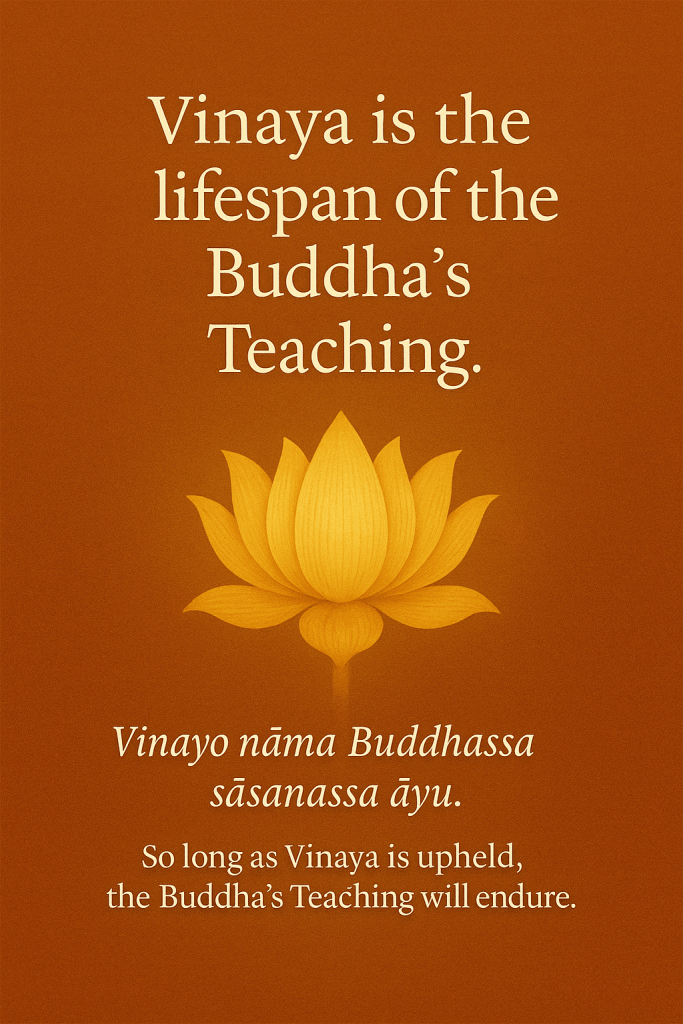
“Vinayo nāma sāsanassa āyu.”
“Vinaya is the lifespan of the Buddha’s Teaching.”
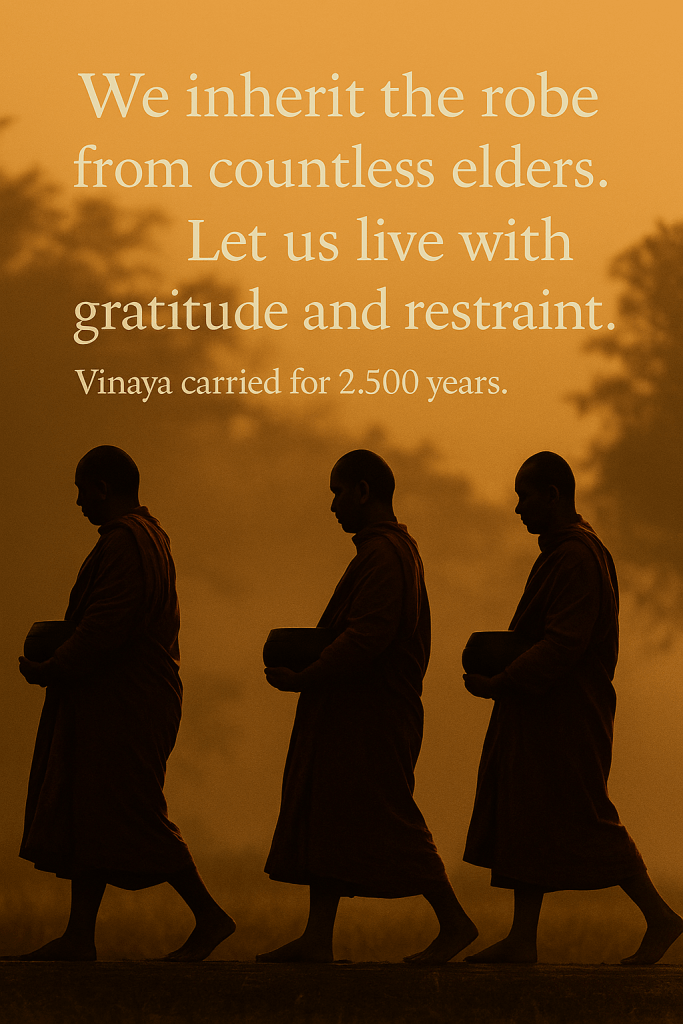
Let us be grateful for the Theravāda tradition that preserved this Vinaya for 2,500 years. Let us honor it, value it, and live it.
Because Vinaya is not only the safeguard of monks and nuns.
Vinaya is the very safeguard of Gautama Buddha’s Dhamma.

1. Introduction: The Foundation of the Sasana
When the Buddha was nearing Parinibbāna, Venerable Ānanda asked who would lead the Saṅgha after the Blessed One’s passing. The Buddha replied:
“Ananda, whatever Dhamma and Vinaya I have taught and made known to you, that will be your teacher after my passing.”
(DN 16, Mahāparinibbāna Sutta)
The Buddha left no single successor. Instead, he entrusted the continuity of his teaching to Dhamma and Vinaya. This is profound: the authority for the Saṅgha is not in a person, but in the discipline and truth itself.
Without Dhamma, there is no liberation. Without Vinaya, there is no Saṅgha. And without Saṅgha, the living Dhamma cannot remain in the world.
2. Vinaya as the Lifeline of the Sasana
In the same sutta, the Buddha declared eight conditions for the Sasana to remain long in the world. The very first is:
“Yāvakīvañca, Ānanda, bhikkhū sammukhībhūtā vinayaṃ āsevissanti, sakkatvā garuṃ karissanti, vattamānā ca vinaye, sikkhissanti vinaye—evañca kho, Ānanda, ayaṃ brahmacariyavāso na parihāyissati, ciraṭṭhitiko ca bhavissati.”
“So long, Ānanda, as the bhikkhus hold the Vinaya as their authority, respect it, revere it, honor it, and train in it—then this holy life will not decline, but will remain long.”
(DN 16)
Thus the Buddha tied the lifespan of his dispensation directly to the preservation of Vinaya.

3. The Role of the Vinaya Teacher (Upajjhāya)
In Theravāda ordination, the upajjhāya (preceptor) is not chosen as a meditation master or scholar, but as the one who confers the ordination and teaches Vinaya. The upajjhāya is called the mūla-ācariya—the “root teacher.”
This shows that Vinaya is the root of monastic life. Without it, a new bhikkhu has no ground to stand upon. As the Mahāvagga (Vinaya Piṭaka) says:
“Yo upajjhāyo, so mūlaṃ, so saraṇaṃ, so paccayagāhako.”
“The upajjhāya is the root, the refuge, the one who provides the requisites.”
A monk may later seek meditation teachers or Dhamma scholars, but the very foundation is Vinaya. Without Vinaya, there is no Saṅgha identity, no refuge, no continuity.
4. Gratitude to the Theravāda Tradition
For 2,500 years, the Theravāda tradition has preserved the full Vinaya intact. In Sri Lanka, Myanmar, Thailand, Laos, and Cambodia, monks still gather twice a month to recite the Pātimokkha, just as prescribed by the Buddha.
“Yāva tiṭṭhati saddhammo, yāva vinayo tiṭṭhati; yāva pātimokkhaṃ tiṭṭhati, tāva tiṭṭhati sāsanaṃ.”
“So long as the True Dhamma stands, so long as the Vinaya stands; so long as the Pātimokkha stands, so long will the Sasana stand.”
(Commentarial tradition, often cited in Vinaya exegesis)
We should reflect with gratitude. Without the diligence of countless generations, we would not today have the opportunity to enter this lineage. Every robe we wear, every Pātimokkha we hear, is the fruit of centuries of careful preservation.
5. Stricter Vinaya: Not for Self, but for the Sasana
Some may dismiss strict Vinaya as mere legalism. But the Buddha himself said in the Aṅguttara Nikāya (AN 7.56):
“Sattime, bhikkhave, dhammā satthari anapavattini na cirasseva saddhammo antaradhāyeyya. Katame satta? Idha, bhikkhave, bhikkhū na sakkaronti, na garuṃ karonti, na mānenti, na pūjenti Tathāgatappaveditāni sikkhāpadāni. Ayaṃ paṭhamo dhammo satthari anapavattini na cirasseva saddhammo antaradhāyeyya.”
“Bhikkhus, there are seven things which, if the Teacher does not continue them, the True Dhamma will soon disappear. What seven? Here, bhikkhus, the bhikkhus do not respect, revere, esteem, and honor the training rules proclaimed by the Tathāgata. This is the first reason why, if not continued, the True Dhamma will soon disappear.”
Thus, keeping Vinaya is not personal rigidity. It is an act of compassion for future generations. Each monk who restrains himself today strengthens the conditions for the Sasana to endure tomorrow.
6. Historical Warnings
The Second Council at Vesālī (Cullavagga, Vinaya Piṭaka, XII) records that one hundred years after the Buddha’s Parinibbāna, some monks relaxed ten rules. The Elders resisted:
“Vinayo nāma sāsanassa āyu.”
“Vinaya is indeed the lifespan of the Buddha’s Teaching.”
From this Council onward, Buddhist history shows the same pattern: whenever Vinaya was loosened, decline followed. Wherever it was upheld strictly, the Sasana flourished.
7. The Call to Honor and Be Grateful
To be a Theravāda monastic is to inherit this great trust. We are not owners of the robe; we are caretakers. We receive it from the hands of the tradition, and we must pass it on intact.
Thus we must:
- Value the tradition: Recognize the treasure of a living Vinaya lineage.
- Honor the tradition: Not water it down for convenience.
- Be grateful to the tradition: Remember the countless elders who preserved it.
Gratitude is shown not in words, but in practice. Every time we observe restraint, we express thanks to the Buddha and to the lineage that preserved his path.
8. Conclusion: Vinaya as the Lifespan of the Sasana
The Buddha foresaw the future. He left no successor but entrusted us to the Dhamma and Vinaya.
The Vinaya teacher is the root teacher. The Vinaya is the root of the Sasana. The Vinaya is the lifespan of the Buddha’s teaching.
Therefore:
- Stricter Vinaya is not narrowness. It is wisdom.
- Stricter Vinaya is not self-protection only. It is protection of the Sasana.
- Stricter Vinaya is gratitude in action.
So long as the Vinaya is honored, the Sasana will live. When the Vinaya declines, the Sasana dies.
Thus we must remember:
Vinaya is not only the safeguard of monks and nuns. Vinaya is the very lifespan of Gautama Buddha’s Dhamma.

 Gautama Dhamma
Leave a comment