
Last weekend during our meditation retreat, a thoughtful question arose:
“Did the Buddha forbid bhikkhus from using mantras, spells, or charms (咒語)?”
This is not just a matter of history. It goes to the heart of what makes Buddhism unique: do we rely on external powers for protection, or do we rely on the inner strength of our own cultivated mind?
The World of Spells in Ancient India
At the Buddha’s time, Brahmins derived their authority from Vedic mantras, especially those of the Atharva Veda, filled with charms for healing, protection, and exorcism.
Ordinary villagers also turned to wandering ascetics, shamans, and healers for amulets, beads, and protective chants. Religious professionals were expected to control unseen forces through sound and ritual.
Against this backdrop, the Buddha took a radical stand. He refused to be a spell-caster, insisting instead that:
“The self is one’s own refuge. Who else could be a refuge? By the well-trained self, one finds a refuge hard to gain.”
(Dhp 160)
Vinaya and Sutta Evidence
The prohibition is clear on mantras, spells, or charms (often tied to tiracchāna-vijjā, “animal/low arts” or “base/superstitious knowledges”), the key canonical references are:
In the Vinaya (bhikkhu discipline), there are rules prohibiting bhikkhus from engaging in such practices, often grouped under Wrong livelihood (micchā-ājīva): engaging in tiracchāna-vijjā (“low/debased arts” or “animal-like/superstitious knowledges”) is classified as a form of improper livelihood for monks.
In the Dīgha Nikāya (e.g., DN 1, Brahmajāla Sutta), the Buddha lists many “base arts” (tiracchāna-vijjā) as wrong livelihood for ascetics/recluses, including fortune-telling, astrology, interpreting dreams/omens, geomancy, spells/incantations (mantā or āthabbaṇa for sorcery/charms), exorcisms, animal charming, poison lore, and more. These are explicitly critiqued as low, unworthy practices that ascetics should avoid.
Similar lists appear in other suttas (e.g., DN 11 Kevaṭṭa Sutta critiques miracles/spells indirectly, favoring the “miracle of instruction” via Dhamma teaching).
The Buddha clearly forbade bhikkhus from using mantras as magical formulas or selling protective rituals.
What About Paritta Chants?
Some might ask: “But don’t Theravāda monks chant the Ratana Sutta or Mettā Sutta?”
The distinction is crucial:
- A spell is thought to have inherent power regardless of meaning.
- A paritta works because it conveys truth (sacca-kiriyā), arousing faith, calming fear, and guiding the mind to wholesome states.
The Ratana Sutta was recited during plague in Vesālī not as a charm, but as a proclamation of truth about the Triple Gem. Protection arises from Dhamma itself, not from magical formulas.
The Source of Power in Mantras
Anthropologically, mantras and charms draw power from collective archetypes—ancestral spirits, protective deities, subconscious cultural forces. They “work” because the group invests energy into them.
But the Buddha saw the danger:
- Relying on such powers breeds dependence.
- It keeps one bound to the worldly matrix of archetypal forces.
- It distracts from the higher freedom of self-reliance and liberation.
Instead, he urged:
- Develop the armor of Dhamma—sīla (ethics), samādhi (concentration), paññā (wisdom).
- Find protection in the power of your own purified mind.
- Use the Dhamma as your true refuge.
The Buddha’s Radical Message
By forbidding spells, the Buddha was not “taking away” a resource. He was freeing us from subtle bondage to external forces. He redirected the Saṅgha away from being seen as sorcerers-for-hire, and toward its true role: guides to liberation.
His message remains powerful today. Many still seek safety in astrology, rituals, or magical words. But the Buddha’s voice calls across centuries:
“Dwell with yourselves as an island, with yourselves as a refuge, with no other refuge; with the Dhamma as your refuge, with no other refuge.”
(SN 22.43, Attadīpa Sutta)
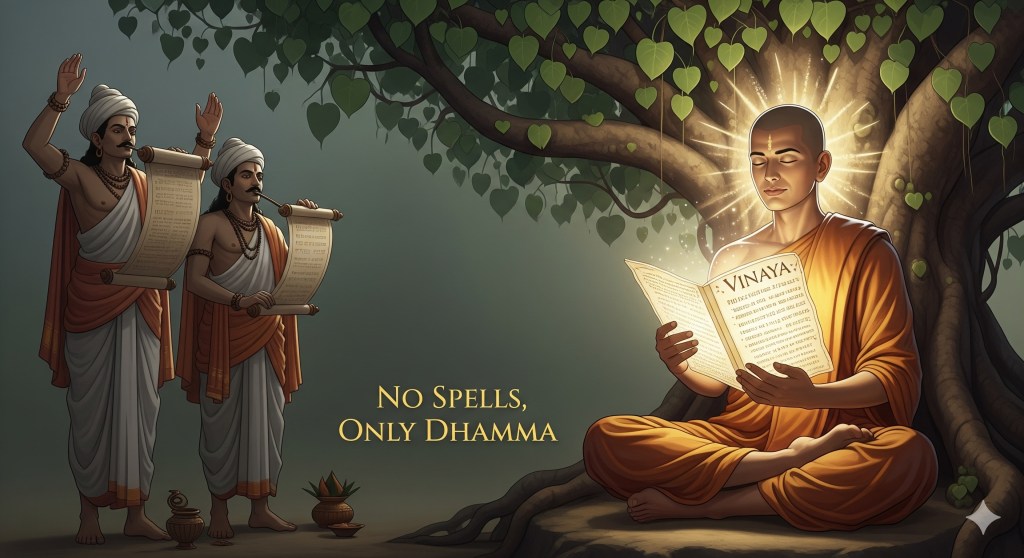
The Vinaya Prohibition
Did the Buddha forbid monks from using mantras, spells, or charms (咒語)?
Yes. In the Vinaya, Pācittiya 60 states:
“If any bhikkhu should make use of a protection spell (rakkhā), a jewel-charm (māṇi), a release-spell (mutti), or a mantra (manta), it is a pācittiya offence.”The Buddha wanted the Saṅgha to be teachers of liberation, not spell-casters or sorcerers for hire. His vision was clear: monks should live by Dhamma, not by magic.
Conclusion
Yes, the Buddha forbade bhikkhus from using mantras, spells, or charms. But he also gave us something greater: the path to true independence.
Protection does not come from borrowed words of power, but from a well-trained mind. Freedom is not in clinging to archetypes, but in letting go of dependence. Liberation is not found in the world, but in transcending it altogether—into Nibbāna-dhātu, the deathless refuge beyond all bondage.
👉 Read the full article here:
1. Context: Why This Question Arises
During our most recent meditation retreat, a thoughtful question emerged in group discussion:
“Did the Buddha forbid bhikkhus from using mantras, spells, or charms (咒語)?”
It is a timely question. In many parts of Asia, Buddhism is often identified with chanting—whether in the form of Theravāda paritta recitations, Mahāyāna dhāraṇīs, or Vajrayāna mantras. Laypeople sometimes expect that a monk can chant a formula for protection, healing, or blessings. Some practitioners are puzzled when Theravāda teachers decline to use “spells,” while others insist that chanting is essential.
Behind this lies a deeper question: Where does true protection come from?
Is it from invoking archetypal forces through sound, or from cultivating the inner strength of our own awakened mind?
This article clarifies the Buddha’s position according to the Theravāda Vinaya and Pāli Canon, situates it in its historical background, and explores its deeper meaning: the Buddha’s radical reorientation of spiritual power from external dependence to internal liberation.
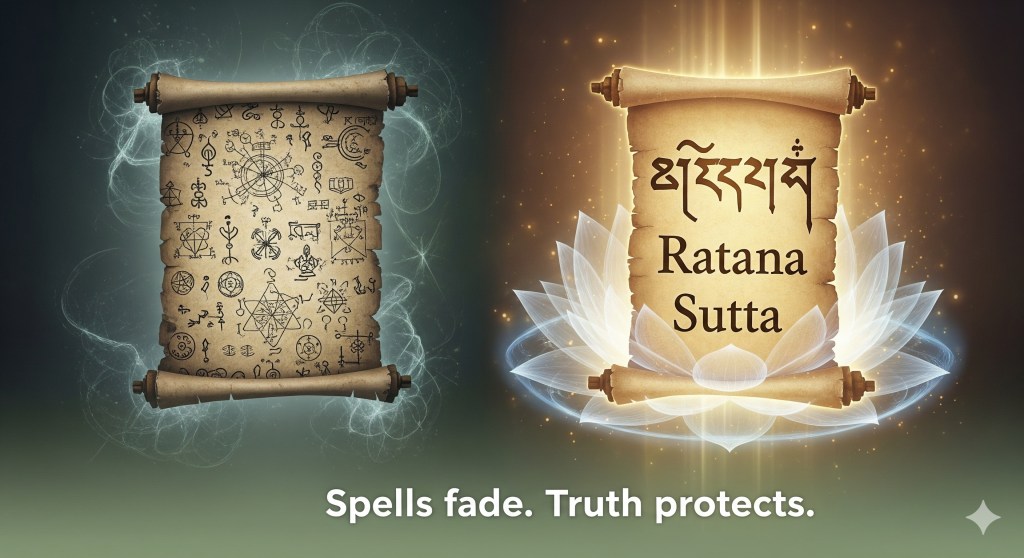
pells vs. Paritta
Buddhism is not a religion of spells.
- A spell is believed to have inherent magical power, regardless of meaning.
- A paritta is effective because it expresses truth (sacca-kiriyā) and arouses wholesome states of mind.
When monks chant the Ratana Sutta or Mettā Sutta, they are not “casting spells.” They are proclaiming Dhamma truths that calm fear, inspire confidence, and guide us toward inner peace.
2. Historical Background: India and the World of Charms
2.1 The Brahmins and Vedic Mantras
In the Buddha’s day, Brahmins derived their authority from the Vedas, especially from their mastery of mantra. The hymns of the Ṛg Veda were cosmic invocations; the Yajur Veda supplied sacrificial formulas; the Sāma Veda gave ritual chants. Most relevant here is the Atharva Veda, which contained spells for healing, protection, prosperity, and exorcism.
For the Brahmins, power resided in sound itself. Correct recitation of a mantra was thought to compel gods, ward off misfortune, or produce rain. To pay a Brahmin to chant for protection was normal for a household.
2.2 Samaṇas, Shamans, and Village Healers
Beyond the Brahminical sphere, the religious landscape of India was populated by wandering ascetics (samaṇas) and by local shamans, healers, and sorcerers. They offered:
- Charms against snakebite.
- Amulets for childbirth.
- Spells to appease spirits (yakkhas, bhūtas).
- Protective knots and beads.
For villagers, these figures were indispensable. In a world without modern medicine, the line between religion, magic, and healing was blurry. A spiritual professional was expected to provide supernatural protection.
2.3 The Buddha’s Radical Redefinition
Against this backdrop, the Buddha charted a new path. He refused to be a spell-caster or miracle-monger. Instead, he insisted that the true refuge is not found in magical formulas, but in one’s own disciplined mind and realization of Dhamma.
He declared:
“Attā hi attano nātho,
Ko hi nātho paro siyā?
Attanā hi sudantena,
Nāthaṃ labhati dullabhaṃ.”
(Dhammapada 160)
Literal translation:
“The self is one’s own refuge;
For who else could be a refuge?
By the well-trained self, indeed,
One finds a refuge hard to gain.”
This was revolutionary. Instead of offering charms, he redefined the monk’s role: to teach the Dhamma that liberates.
Where Do Mantras Get Their Power?
Mantras and charms often work by tapping into collective archetypes—ancestral spirits, cultural forces, or shared subconscious imagery.
But the Buddha warned: reliance on these external powers breeds dependence and keeps us bound to the worldly matrix.
Instead, he urged us to develop the power of our own mind—through ethics, concentration, and wisdom. This is the true armor of Dhamma.

3. Vinaya Evidence: Clear Prohibitions
The clearest statement is found in the Bhikkhu Pātimokkha, the core Vinaya code recited fortnightly.
3.1 Pācittiya 60
“Yo pana bhikkhu rakkhaṃ vā māṇiṃ vā muttiṃ vā mantaṃ vā paribhuñjeyya, pācittiyaṃ.”
Literal translation:
“If any bhikkhu should make use of a protection spell (rakkhā), a jewel-charm (māṇi), a release-spell (mutti), or a mantra (manta), it is a pācittiya offence (requiring confession).”
- Rakkhā: protective charm, often against spirits.
- Māṇi: jewel or bead thought to have power.
- Mutti: release spell, e.g. against poison or possession.
- Manta: incantation, mantra, or spell.
This prohibition made it unambiguous: monks are not to use or provide such spells.
3.2 Commentary Explanation
The Vinaya commentaries explain that some monks began imitating Brahmins and shamans to win lay support. The Buddha forbade this to prevent monks from being seen as sorcerers-for-hire. The Saṅgha’s purpose was liberation, not magical livelihood.
4. Sutta Evidence: Discourses Against Charms
4.1 Wrong Livelihood (AN 5.192)
In the Aṅguttara Nikāya, the Buddha lists inappropriate livelihoods for monks:
- Divination by signs.
- Fortune-telling and dream interpretation.
- Astrology and casting omens.
- Use of spells, exorcisms, and charms.
- Promising protection through rituals.
He groups these under tiracchāna-vijjā (“lowly arts,” literally “animal sciences”), unworthy of noble disciples.
4.2 The Kevaṭṭa Sutta (DN 11)
A layman named Kevaṭṭa asks the Buddha to have monks display supernatural powers in public, to inspire faith. The Buddha refuses, saying that miracles of psychic power or recitation are not the highest miracle. The true miracle is the miracle of instruction—teaching people to end greed, hatred, and delusion.
This shows that the Buddha did not reject supernaturalism out of ignorance; he deliberately replaced it with instruction and liberation.
True Protection
The Buddha’s message was radical:
“The self is one’s own refuge. Who else could be a refuge? By the well-trained self, one finds a refuge hard to gain.” (Dhp 160)
Protection is not in charms or rituals, but in a mind trained in sīla, samādhi, and paññā. The greatest blessing is freedom from greed, hatred, and delusion.

5. Paritta: Reciting Dhamma as Protection
Some may object: “But don’t Theravāda monks recite protective chants like the Ratana Sutta or Mettā Sutta? Isn’t that the same as a spell?”
The difference is crucial:
- Spell (manta): Believed to have inherent magical power, often invoking spirits or cosmic forces.
- Paritta: Recitation of truths of Dhamma (sacca-kiriyā), effective because they remind, calm, and arouse wholesome qualities.
Examples:
- Ratana Sutta (Snp 2.1): Chanted in Vesālī during plague, affirming the truth of the Triple Gem.
- Karaṇīya Mettā Sutta: Radiating loving-kindness that naturally dissolves fear and hostility.
- Dhajagga Sutta (SN 11.3): Encouraging recollection of the Buddha in times of fear.
Thus paritta is not superstition, but Dhamma in verbal form—truth that protects by transforming the mind.
6. The Source of Power in Mantras and Charms
6.1 Archetypal Collective Forces
Anthropologically, mantras and charms derive power from collective archetypes. When a shaman recites a spell, the words activate deep-seated images in the group’s subconscious: guardian spirits, ancestral protectors, or cosmic beings. These forces are real as psychological-energetic structures, shaping collective experience.
6.2 The Buddha’s Critique
But the Buddha saw the limitation:
- Depending on external archetypes creates habitual dependence.
- The mind becomes bound by the forces it invokes.
- Such practices cannot free one from saṃsāra; they only reinforce bondage.
Instead, the Buddha taught:
- Develop the inner power of samādhi.
- Use wisdom (paññā) to cut through delusion.
- Let the mind itself become unshakable, luminous, and self-reliant.
Thus, he redirected attention from external archetypal forces to the power of the liberated citta.
7. The Buddha’s Alternative: True Refuge in the Mind
Instead of spells, the Buddha offered a threefold training:
- Sīla (Ethical conduct): Protection from harmful consequences of misconduct.
- Samādhi (Concentration): Protection from fear, agitation, and external influence.
- Paññā (Wisdom): Protection from ignorance and bondage.
This is the armor of Dhamma, arising from one’s own practice, not borrowed from external forces.
He urged his disciples:
“Attadīpā viharatha, attasaraṇā, anaññasaraṇā;
Dhammadīpā, dhammasaraṇā, anaññasaraṇā.”
(SN 22.43, Attadīpa Sutta)
Literal translation:
“Dwell with yourselves as an island, with yourselves as a refuge, with no other refuge; with the Dhamma as your island, with the Dhamma as your refuge, with no other refuge.”
Liberation, Not Dependence
By forbidding spells, the Buddha was not depriving us—he was freeing us.
- Spells = dependence on external powers.
- Dhamma = self-reliance, freedom, and liberation.
He taught us to rely on our own mind as refuge, and to take the Dhamma as our true protection. Beyond dependence, beyond bondage—there lies Nibbāna-dhātu, the deathless realm.

8. Reflection: Why the Buddha Forbade Spells
From our retreat discussion, the deeper reason is clear:
- Dependency: Spells cultivate reliance on external powers.
- Limitation: Archetypal forces are still part of the worldly matrix, binding us to saṃsāra.
- Distraction: They divert energy from the path of liberation.
- True Protection: Only a well-trained mind offers unshakable safety, leading beyond aging and death.
Thus the prohibition was not merely disciplinary; it was liberative in intent. By forbidding spells, the Buddha freed his disciples from subtle bondage and pointed them to the deathless refuge of Nibbāna-dhātu.
9. Conclusion
So—did the Buddha forbid bhikkhus from using mantras, spells, or charms (咒語)?
✅ Yes. He explicitly prohibited them in the Vinaya (Pācittiya 60) and denounced them as wrong livelihood in the suttas.
✅ He distinguished between superstition and Dhamma recitation: paritta chants are allowed because they embody truth, not because they invoke hidden forces.
✅ The deeper reason is that true protection is internal: in the power of our own cultivated mind, not in borrowed powers of the collective unconscious.
The Buddha’s teaching remains radical even today. Many still seek safety in rituals, astrology, or external powers. But the Buddha’s voice continues to call:
“Be a refuge unto yourselves. Take the Dhamma as your refuge. Do not seek refuge elsewhere.”
This is the path of true independence: to rely on our own well-trained mind, to be freed from all bonds of dependence, and to find the ultimate refuge in the unconditioned Nibbāna-dhātu.

 Gautama Dhamma
Leave a comment