
The Cosmic Awakening of the Sammāsambuddho
On the night beneath the Bodhi tree, Siddhattha Gautama reached the culmination of his quest. Drawing on years of tapas, renunciation, and unwavering discipline, Gautama entered the Four Jhānas. With the penetrating strength of samādhi and the radiance of psychic power, his citta became like a still, radiant flame — immovable, luminous, far beyond the reach of the mundane senses. As the night deepened, he rose into the rūpa realms, communed with the Brahmā gods, and from that foundation crossed the threshold into the supreme state: Sammāsambuddho — the rightly and fully awakened mind.
Yet this awakening was not simply a quiet realization. It was a vast and terrible unveiling — a cosmic vision that pierced through the fabric of human history, across galaxies and epochs, revealing both the nobility and the tragedy of the race of man.
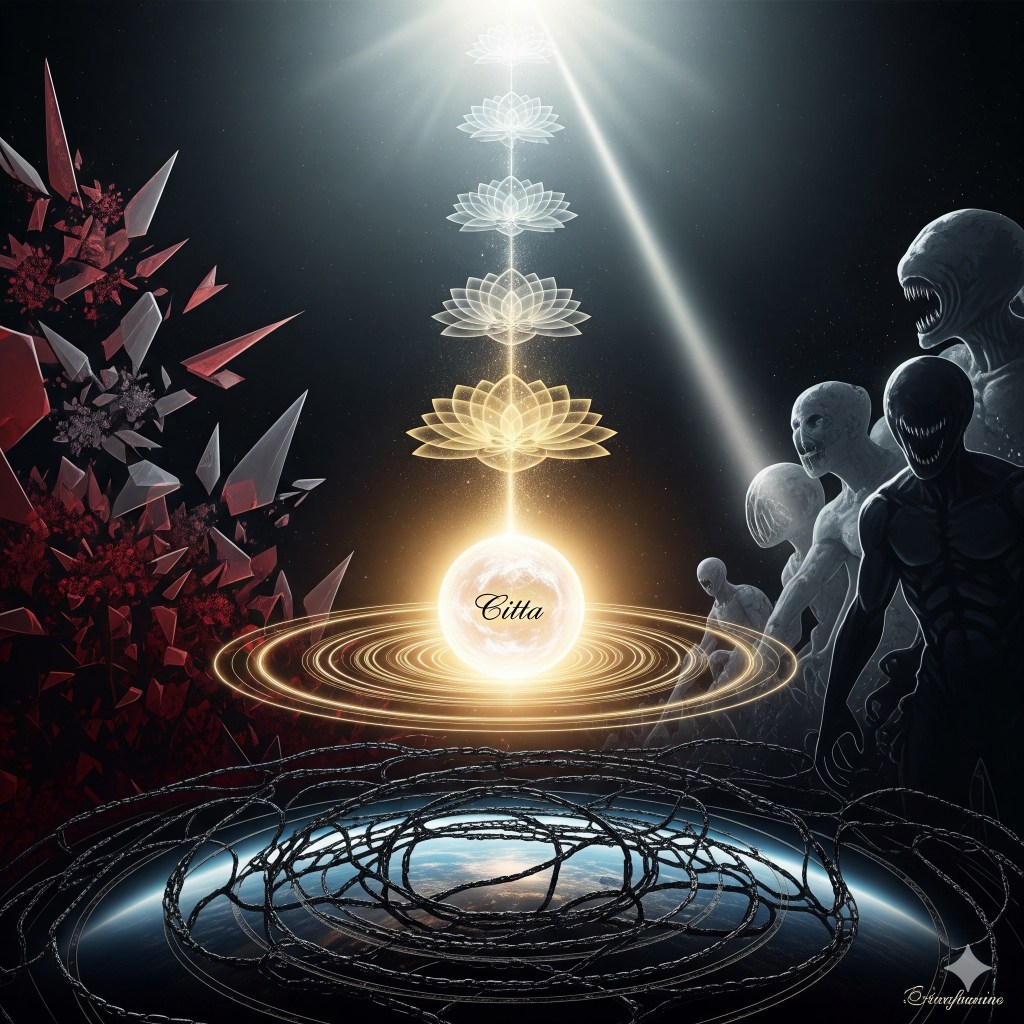
The Cosmic Awakening of Gautama Buddha: a vision of light and shadow, the fall of manussa, the bondage of mankind, and the citta’s radiant ascent into the deathless Nibbāna-dhātu.
The First Vision: The Fall of Manussa
In the first watch of the night, Gautama recalled not only his own past existences but also the ancient prehistory of the race of man (manussa). He beheld the race of man (manussa) in its original form: pure, radiant, aligned with higher consciousness. This was a noble lineage, pure and uncorrupted, carrying the potential of vast spirituality.
Then came the great tragedy — the Lyran War. He saw the fall of manussa in fire and sorrow, their civilizations shattered, their purity broken. Bloodlines were scattered across the galaxy, and from this scattering arose the hybridized races of mankind. Through intermingling with other beings — reptilian, insectoid, animaloid — the clarity of the original lineage was diluted. Light and shadow mingled in the same blood, producing a race torn between nobility and bondage.
Earth’s mankind, he saw, was not born of freedom but deliberately seeded and engineered by powerful beings. Here, manipulation shaped the very conditions of rebirth. Earth was not a free sphere but a prison planet, a place where souls were recycled endlessly under karmic nets, their destinies directed by hidden powers.
To behold this history was heartbreaking. For the young Buddha, it was no abstract knowledge but a sorrowful vision of what had been lost. The nobility of manussa — radiant and pure — had been dragged into fragmentation, hybridization, and bondage. What could have been a race of light became a lineage of suffering.
The Second Vision: The Destiny of Mankind
In the second watch of the night, Gautama saw the destinies of beings, determined by their karma. Here he looked upon Earth’s present condition. He saw mankind wandering blind, chained by ignorance, satisfied with vanity, selfishness, cruelty, and folly. He saw the karmic stains of craving, hatred, and delusion rippling through generations, binding beings to rebirth.
Then comes the degeneration of mankind into humanity. Outwardly, these humans resembled mankind — but inwardly, they were corrupted, secularized, driven by the monster within. Humanity had lost touch with their origins, who mocked the sacred, who exalted power and material gain over purity and wisdom.
Gautama saw how these humans were continually manipulated by higher forces — who exploited ignorance for their own ends. Humanity was not merely ignorant; it was trapped, twisted, and exploited in ways it could not even comprehend.
The sight was heart-rending. The Buddha-to-be saw the nobility of manussa scattered into dust, mankind hybridized and enslaved, and humanity finally degraded into corruption. What should have been a lineage of light was now a prison of sorrow.
The Third Vision: Liberation
In the third watch, Gautama turned inward to his own citta. Here, the final battle was fought.
Every trace of attachment to this world-system was uprooted. No ignorance, craving, or hatred could ever enter again. The nets of manipulation, the karmic chains of the prison planet, the bonds of saṃsāra itself — all were cut away.
This was vimutti — liberation. His citta, purified of every stain, empowered by samādhi and illumined by wisdom, transcended not only the human condition but the entire galactic karmic order. He realized directly the Nibbāna-dhātu: the deathless, permanent, blissful realm beyond every cosmic powers.
Here the arc was fulfilled: Nibbidā → Virāga → Vimutti.
The Heaviness of Awakening
At dawn, as the morning star rose, Gautama was free. He was Buddha — Sammāsambuddho.
Yet the vision of his awakening was not only luminous. It was also heavy with sorrow. For in his freedom, he saw the chains of others. He saw Earth’s humanity engineered, hybridized, deceived, and bound. He saw how the race of man had fallen in the wars, how mankind had spread across the stars as a hybrid lineage, and how humanity had degenerated into blindness and corruption.
This knowledge was heartbreaking. Awakening revealed not only the way out but also the full depth of the prison. Gautama saw not just liberation but the weight of tragedy pressing down upon all beings.
At first he hesitated. Would they understand? Could such a corrupted lineage hear truth, let alone walk it? The sorrow of this question burdened his mind.
The Turn of Compassion
At first, Gautama hesitated. Could such beings understand? Could truth take root in a lineage so blinded and degraded? The sorrow of this question weighed upon him.
Then came a moment of cosmic intervention. Brahmā Sahampati, the great Brahmā, appeared before Gautama. With reverence he said:
“There are beings with little dust in their eyes. If they do not hear the Dhamma, they will perish. Some will understand.”
This plea was both comfort and encouragement. It assured Gautama that even amidst the vast corruption and blindness, there were still hearts capable of awakening.
Thus, from sorrow arose mahā-karuṇā — great compassion. Strengthened by the appeal of Brahmā Sahampati, Gautama resolved to teach. Though burdened by the weight of tragedy, he chose compassion. Out of love for beings, he would show the way: Nibbidā → Virāga → Vimutti → Nibbāna-dhātu.
Conclusion: The Cosmic Awakening
The night of Gautama’s awakening was not merely the enlightenment of a sage in India. It was a cosmic unveiling:
- The nobility of the race of man (manussa).
- The tragic fall in the Lyran War.
- The hybridization and scattering of mankind.
- The degeneration into humanity, blind and corrupted.
- And the final liberation of the citta into the Nibbāna-dhātu, beyond all prisons.
This is the full meaning of awakening: not only to see the deathless, but to see the conditioned in all its sorrow and bondage — and to teach the way beyond.
Thus Gautama Buddha became Sammāsambuddho: rightly and fully awakened, carrying both the clarity of liberation and the heartbreak of compassion.
 Gautama Dhamma
Leave a comment