
by Bhante Mudita Thera
“Tapas is not torment — it is life-force communion.”
🔥✨ Tapas: The Forgotten Fire on the Buddha’s Path
We often hear that the Buddha’s six years of fasting and austerities were a “mistake” — but was it really?
In truth, tapas (self-discipline, austerity) was not failure but fire:
- It purified the citta.
- Awakened psychic powers (iddhi).
- Opened communion with devas and Brahmā gods.
- Began virāga, the fading of craving.
The Buddha himself praised tapas in the Mahā Maṅgala Sutta, placing it alongside brahmacariya, wisdom, and Nibbāna as among life’s highest blessings.
Tapas was not the end, but it was the beginning — the crucible that prepared the mind for liberation.
Discover how tapas became the gateway to transcendence, and why this fiery discipline still holds power for seekers today.
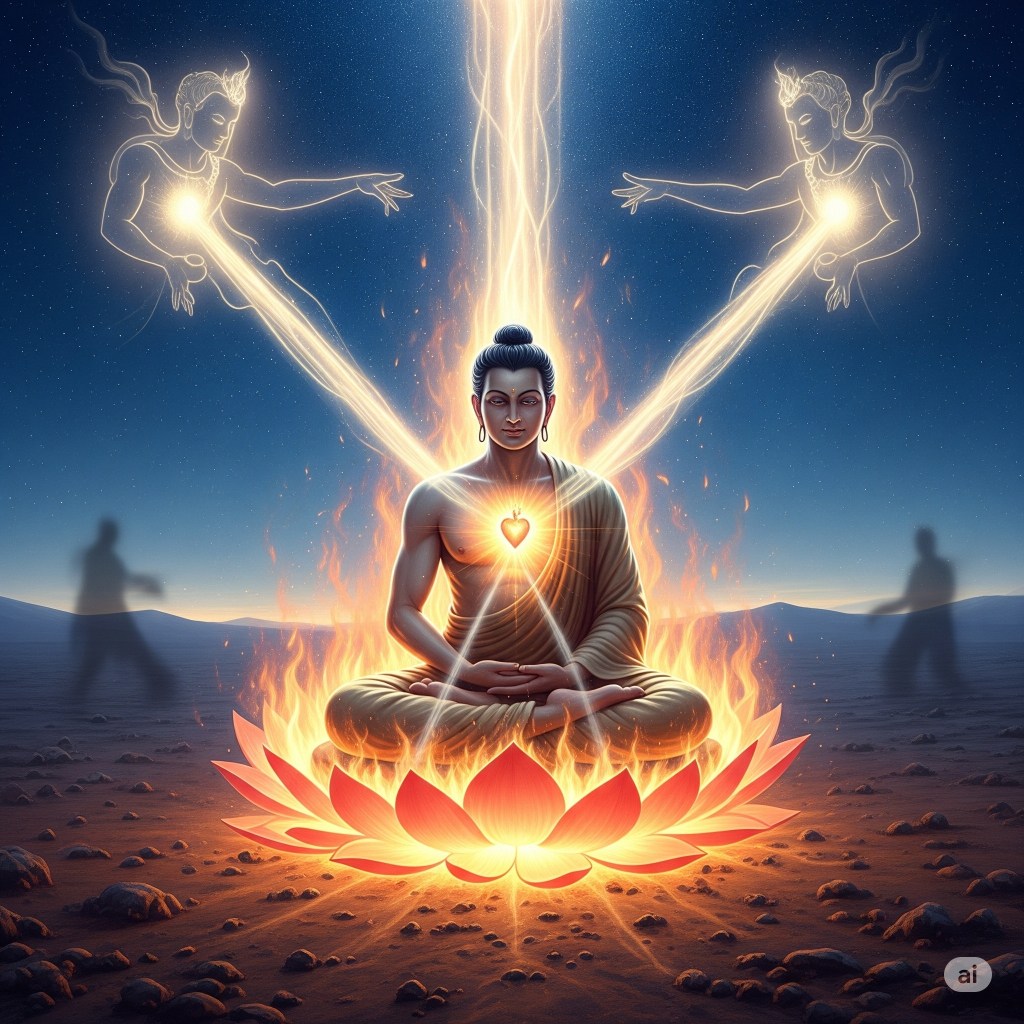
Introduction: Rethinking the Buddha’s Austerities
In many modern retellings of the Buddha’s life, the six years he spent practicing austerities are dismissed as a failed detour — a stage of “self-mortification” that he later abandoned for the “Middle Way.”
This view, though common, distorts the truth. It reduces tapas — the fiery discipline of austerity — to an error rather than understanding it as a central stage of transformation.
In reality, tapas was not a mistake but a shamanic practice of immense power. For Siddhattha Gotama, tapas was the gateway that:
- Purified his citta of worldly craving,
- Unleashed vast psychic powers (iddhi),
- Opened channels of communion with higher beings and realms,
- And prepared him for the deeper insight (paññā) that would carry him into Nibbāna-dhātu.
Tapas, in short, was the beginning of virāga — the fading of craving — the necessary fire through which the Bodhisatta’s mind was purified and empowered for the final breakthrough.
Tapas in the Ancient World: The Discipline of Fire
The word tapas literally means heat. It refers to the inner fire generated through austerity, fasting, celibacy, solitude, and exposure to the elements.
In the ancient Śramaṇa traditions, tapas was a way of igniting the inner flame — the burning away of craving, defilement, and dependence. It was never meaningless torment. It was understood as a powerful technology of consciousness.
We see parallels across cultures:
- Jesus fasting forty days in the desert.
- Shamans undergoing vision quests of hunger, thirst, and solitude.
- Daoist ascetics practicing inner fire (tummo).
- Yogis standing in the snow or sun, focusing willpower into psychic transformation.
All these practices reflect the same truth: when the body approaches the edge of survival, the mind draws life-force from deeper dimensions. This influx of higher energy transforms the citta and awakens psychic abilities.
Siddhattha’s Six Years of Tapas
After leaving the palace, Siddhattha studied with great meditation masters and mastered exalted states of samādhi. Yet he saw they did not end aging and death.
He then turned to tapas, practicing with fierce resolve for six years. He fasted, exposed himself to the elements, and disciplined his body to the edge of survival.
These years forged in him extraordinary powers:
- Diamond concentration: the citta unwavering, luminous.
- Psychic mastery (iddhi): command over body, perception, and subtle energies.
- Communion with higher beings: direct resonance with devas and Brahmā gods of the rūpa-loka.
It is likely through tapas that Siddhattha experienced union with the Brahmā gods, sharing in the refined bliss of the form realms. Tapas gave him mastery over the pathways between worlds.
Tapas as Near-Death Communion
The key to tapas is that it creates a near-death experience without dying.
By suspending ordinary nourishment, the body reaches its limits. At that threshold, the citta opens to higher dimensions and begins to draw subtle vitality — prāṇa, life-force, universal energy — directly from the cosmos.
This influx sustains the mind, transforms the citta, and grants access to extraordinary powers. In this way, tapas is not punishment but life-force communion — a conscious choice to let the mind transcend ordinary dependence and connect with higher reality.
Tapas and the Mahā Maṅgala Sutta
The Buddha himself later praised tapas in the Mahā Maṅgala Sutta (Sn 2.4), where it is listed among the highest blessings:
Tapo ca brahmacariyañca – Ariya Saccānadassanaṁ
Nibbāṇasacchikiriyā ca – Etaṁ maṅgalamuttamaṁ
Self-control (tapas), chastity (brahmacariya), understanding the Noble Truths, and the realization of Nibbāna — these are the highest blessings.
Here tapas is explicitly part of the arc of liberation:
- Tapo (self-control, fiery discipline) → purifies and empowers.
- Brahmacariya (chastity, renunciation) → severs worldly entanglements.
- Ariya-saccānadassana (seeing the Noble Truths) → brings wisdom.
- Nibbāṇa-sacchikiriyā (realization of Nibbāna) → final liberation.
Thus tapas is not failure but foundation. It is honored as a supreme blessing because it begins the work of virāga.
“Tapas opens the gateways of psychic power, but only wisdom leads to liberation.”
Tapas and the Beginning of Virāga
Through tapas, Siddhattha burned away worldly craving. Old stains of rāga (craving), dosa (hatred), and moha (delusion) were weakened. The citta became luminous, detached, and empowered.
This was the beginning of virāga — the fading of craving. With craving weakened, the mind was no longer pulled by the endless hunger for food, comfort, or pleasure. Instead, it stood free, radiant, and able to commune with higher dimensions.
But even here, the Bodhisatta saw clearly: tapas alone was not enough. Communion with heavenly beings, even Brahmās, was still saṃsāra. Psychic power, though vast, does not dissolve ignorance. Only paññā (wisdom) — the insight into impermanence, suffering, and non-self — could complete the path.
From Virāga to Vimutti
Tapas cleared the ground. It stripped away craving and opened the higher channels. It made the citta strong, luminous, and detached.
But the final step was vimutti — liberation. With the strength of tapas, combined with the clarity of paññā, the Buddha stepped beyond all conditioned states.
Thus the arc was complete:
- Nibbidā: turning away from the world.
- Virāga: fading of craving through tapas and brahmacariya.
- Vimutti: liberation of the citta through samādhi and wisdom.
- Nibbāna-dhātu: entry into the deathless, unconditioned realm.
“Through tapas, craving fades and the citta grows luminous and detached.”
Conclusion: The Fire That Opens the Way
Tapas was not a mistake. It was the fire that opened the way. It purified the citta, unleashed psychic powers, and established communion with higher realms.
But the Bodhisatta also saw its limit. Tapas was a supreme blessing, yet not the final one. To reach the deathless, tapas had to unite with brahmacariya and be illumined by paññā.
The lesson is timeless: tapas is not self-torture but the awakening of inner fire. It is the beginning of virāga, the fading of craving, and the purification of the citta. When joined with wisdom, it becomes part of the Middle Way — the path that leads beyond all worlds into Nibbāna-dhātu.

A mandala of tapas: the lotus of fire at the center purifies the citta, opening psychic pathways and communion with higher beings, pointing toward the final transcendence into Nibbāna-dhātu.
Flame-lotus: tapas as purification and blossoming.
First ring: tapas and brahmacariya, stripping away craving.
Second ring: psychic powers awakened through fiery discipline.
Third ring: communion with Brahmās and higher beings.
Outer ring: the gateway beyond saṃsāra, toward paññā and Nibbāna.
“Tapas is the fire that begins virāga, preparing the mind for Nibbāna-dhātu.”
 Gautama Dhamma
Leave a comment