
by Bhante Mudita Thera
🌌📜 Buddha and Plato under the same sky?
When Alexander reached India, two great worlds touched: Greek philosophy and Indian Buddhism. Both asked the same questions: What is the self? What lies beyond death? How can we live free?
In Gandhāra, Buddhist art took on Greek forms — the first human Buddhas looked like philosophers in togas. In Plato’s Phaedo, Socrates taught that philosophy is learning to die — a vision uncannily close to the Buddha’s path of letting go.
Different words, same quest: liberation beyond mortality.
👉 Read the full essay:
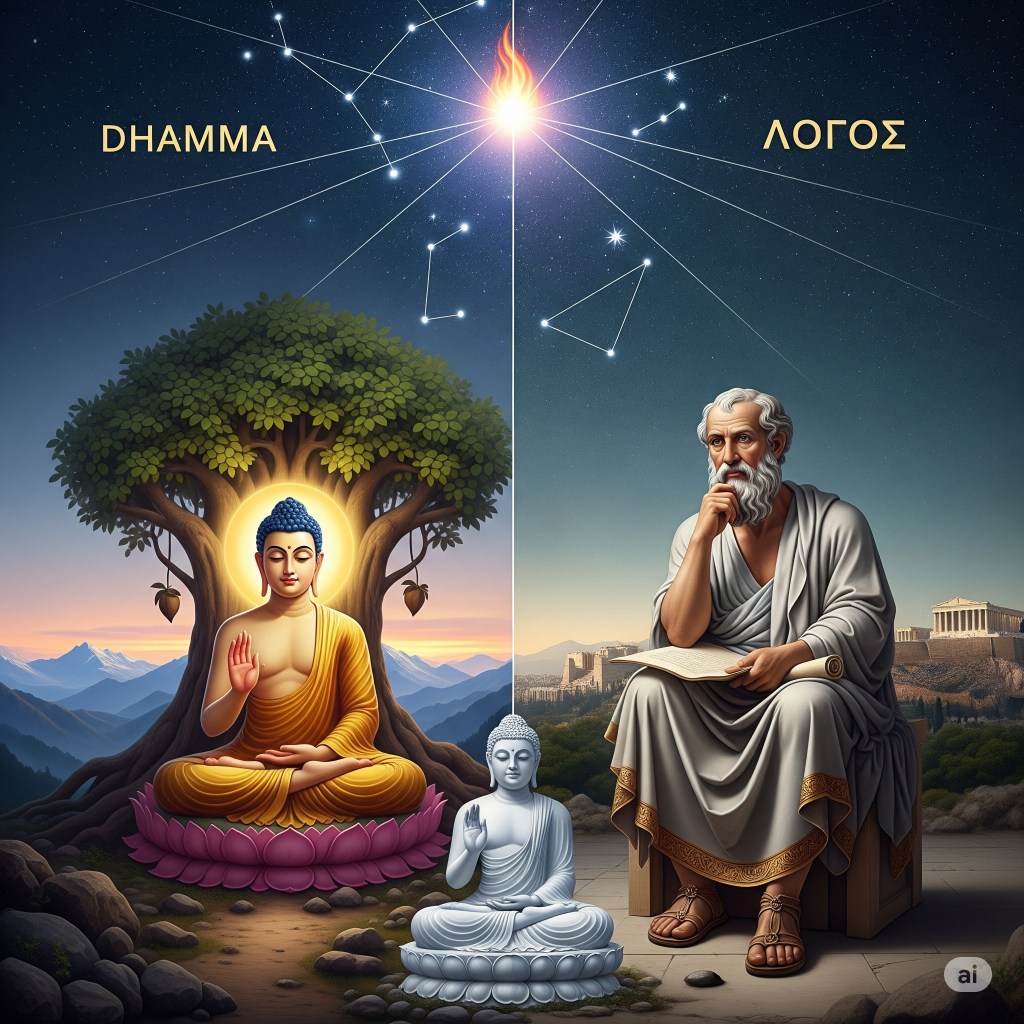
The Buddha and the Philosopher under one sky: two seekers of liberation, united by Gandhāra as the bridge of cultures.
This image symbolizes the encounter of Buddhism and Hellenism — not as rivals, but as parallel quests for truth. On one side, the Buddha under the Bodhi tree embodies samādhi and the unconditioned; on the other, the Greek philosopher represents logos and reasoned search for immortality. At the center stands a Gandhāran Buddha, clothed in Greek drapery — the artistic bridge between East and West. Above them both stretches a single starry sky, inscribed with Dhamma and Logos, converging on the same cosmic flame. Together they remind us that beneath cultural differences lies a shared horizon of liberation, the timeless human longing to transcend death.
Introduction: A Meeting of East and West
When Alexander the Great’s armies reached the frontiers of India in the 4th century BCE, two great civilizations first touched: the Hellenic world of Greece and the Śramaṇa–Brahmanic world of India. What followed was not only trade and political exchange but a profound meeting of minds.
Greek philosophy and Indian Buddhism both sought answers to the deepest human questions: What is the self? What happens after death? How can one transcend suffering? The dialogue between these traditions — sometimes explicit, sometimes hidden — produced one of the most remarkable cultural fusions in history: Greco-Buddhism.
This essay explores that encounter. We will examine:
- Hellenistic philosophy’s parallels with Buddhism.
- Gandhāran art as visual evidence of cross-fertilization.
- Plato’s Phaedo and Buddhist thought on liberation.
- Shared metaphysical horizons of East and West.
- How Buddhism absorbed, resisted, and transformed Hellenistic ideas.
Greek Philosophy Before the Encounter
Plato and the Immortality of the Soul
In Plato’s dialogues, especially the Phaedo, Socrates speaks of philosophy as learning how to die. He describes the body as a prison, the soul as eternal, and liberation as release into pure truth. These themes resonate with Buddhist thought: impermanence of the body, detachment from sense pleasures, and the possibility of transcendence.
Stoicism and Detachment
The Stoics emphasized virtue, self-mastery, and indifference to external fortune — a discipline close to Buddhist equanimity (upekkhā). Their vision of a rational cosmic order parallels the Buddhist law of dependent origination, both stressing alignment with the way things truly are.
Skepticism and Emptiness
Greek skeptics questioned the possibility of certain knowledge, urging suspension of judgment for peace of mind. While Buddhism does not end in skepticism, its doctrine of emptiness (suññatā) resonates with the skeptical dismantling of dogma.
Buddhism on the Western Frontier
Gandhāra and Greco-Buddhism
In the centuries after Alexander, the region of Gandhāra (modern Pakistan and Afghanistan) became a melting pot of Greek and Buddhist cultures. Here, Buddhist art adopted Hellenistic forms:
- The Buddha was first depicted in human form (before this, only symbols like footprints or wheels were used).
- Sculptures show Greek drapery, realistic anatomy, and serene expressions — blending Greek aesthetics with Buddhist spirituality.
This artistic fusion reflected deeper intellectual exchange, as monks and philosophers met along the Silk Road.
Aśoka’s Missions and Greek Edicts
The edicts of Emperor Aśoka (3rd century BCE) mention missions to the Hellenistic world, including areas under Greek kings. Some inscriptions even appear in Greek and Aramaic, showing Buddhism directly addressing Greek-speaking audiences.
Plato’s Phaedo and Buddhist Liberation
Learning to Die
In the Phaedo, Socrates teaches that philosophy is practice for death — freeing the soul from bodily distractions. The Buddha likewise described meditation as training to let go of clinging to the body, leading to release from rebirth.
The Soul and Anattā
A key difference remains: Plato affirms an immortal soul, while the Buddha taught anattā (non-self). Yet the Buddha’s teaching is subtler than a denial — it is a dismantling of false identification. Both traditions aim at liberation beyond the body, though they describe the “who” that is liberated in different terms.
Transcendence and Truth
For Plato, liberation meant ascending to the Forms, eternal and unchanging. For the Buddha, liberation meant realizing the unconditioned (asaṅkhata), the deathless element (nibbāna). Both are beyond time, beyond decay, and beyond language.
Shared Metaphysical Horizons
Despite differences, both Buddhism and Hellenism shared a transcendental orientation:
- Body as impermanent → both saw the body as not ultimate.
- Discipline of mind → both valued training, virtue, and meditation (Greek askēsis, Buddhist bhāvanā).
- Liberation beyond death → both promised freedom from the prison of mortality.
- Cosmic order → Greek logos and Buddhist dhamma function as universal principles of reality.
Points of Divergence
Yet the encounter was not simple harmony.
- Buddhism rejected eternal soul doctrines, preferring analysis of processes and conditions.
- Greek philosophy prized rational speculation, while Buddhism emphasized meditative insight and direct experience.
- Ethics differed: Stoicism emphasized duty within worldly life; Buddhism prioritized renunciation from worldly entanglement.
These divergences reveal not conflict, but complementarity: two paths toward transcendence, each highlighting what the other risked neglecting.
Transformation Through Encounter
The Greco-Buddhist encounter left lasting legacies:
- In Art: The image of the Buddha as a serene philosopher-king owes much to Greek aesthetics.
- In Thought: Early Mahāyāna philosophy shows traces of dialogue with Hellenistic logic and cosmology.
- In the West: Later Neoplatonism and Gnosticism may have absorbed Buddhist ideas through Alexandria and Gandhāra.
The Silk Road was not just trade in silk and spices — it was a trade in metaphysics and liberation.
Conclusion: East and West, One Quest
Buddhism and Hellenism, far from being isolated traditions, were branches of the same human quest: to break free from mortality, to train the mind, to find the eternal beyond change.
In Gandhāra, this quest took visible form in statues of the Buddha that looked like Greek philosophers. In Plato’s dialogues, it found voice in the call to prepare for death. In Buddhist monasteries, it took shape as Vinaya, samādhi, and paññā.
The encounter did not erase their differences — but it revealed their shared horizon. Both East and West sought liberation, and in their meeting, they affirmed the universality of the human longing to transcend.
 Gautama Dhamma
Leave a comment