
By Bhante Mudita Thera
🌍✨ Abraham = A–Brahmana?
What if the patriarch Abraham — revered as the father of Judaism, Christianity, and Islam — was not separate from India’s ancient Brahmana seers, but part of the same bloodline and spiritual current?
His very name may reveal the link:
- “A/Ab” = “respected one” or “lord”
- “Brahman” = the seer lineage of India
Together: A–Brahmana — the Respected Brahmana.
If true, then Buddhism and Christianity are not rivals but siblings, restoring the same primordial flame of gnosis in different lands. 🔥🌿✝️
👉 Read the full essay here:
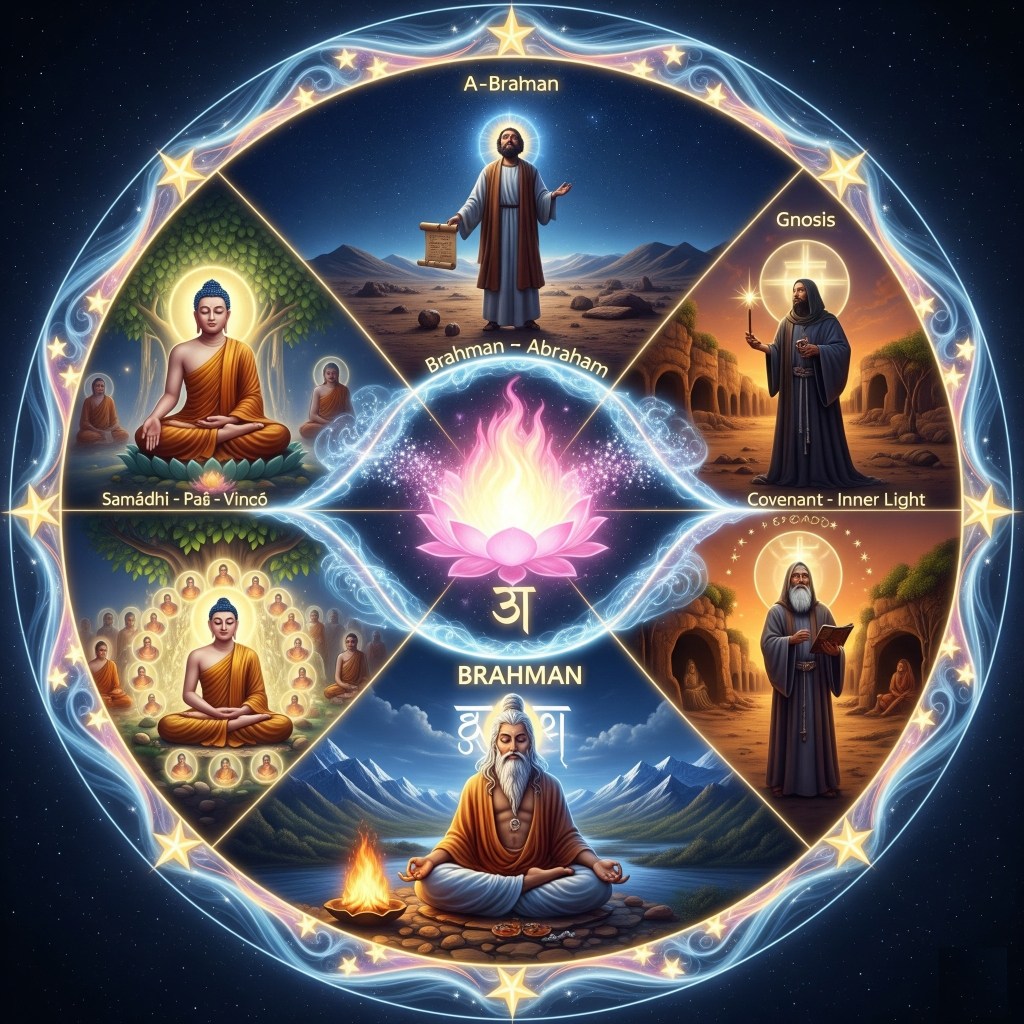
Mandala of One Source, Many Streams: Abraham (A–Brahman) and the Brahmanas as twin reflections of the same lineage, from which Buddhism and Gnostic Christianity arise as siblings.
This mandala portrays Abraham and the Brahmana seers not as unrelated figures, but as two faces of the same ancestral archetype. Linguistically, Abraham may be understood as A–Brahmana — “Respected Brahmana” — linking him directly to the Brahmana lineage of Northern India. Both carried the same bloodline and spiritual consciousness: Abraham through covenant and prophecy, the Brahmanas through wisdom and fire sacrifice. From these twin roots arose the Buddha, who synthesized Śramaṇa and Brahmanic streams with Vinaya, and the Gnostic Christians, who sought inner gnosis of the divine. At the center of the mandala is the primordial flame, symbolizing the one source from which many traditions flow.
Introduction: Beyond Parallel Traditions
At first glance, Buddhism and Christianity seem worlds apart — the one born in the Ganges plain under the Bodhi tree, the other in Judaea under the shadow of Rome. Yet beneath their differences lies a profound resonance: both traditions cherish renunciation, cultivate inner transformation, and point toward liberation beyond death.
Usually these similarities are explained away as coincidence or universal archetypes. But what if the connection is far deeper? What if the patriarch Abraham, regarded as the father of Judaism, Christianity, and Islam, was himself a Brahmana — linked by bloodline, belief, and spiritual inheritance to the ancient seers of India?
Even his name hints at this connection. In Semitic languages, the prefix “A” or “Ab” means “father,” “lord,” or “respected one.” In this sense, it is a title of reverence — a marker of exaltation. The second element, “Braham”, echoes unmistakably with Brahma or Brahmana. Thus, “Abraham” can be read as A–Brahmana, meaning Respected Brahmana, or Exalted Seer.
If so, then Buddhism and Christianity are not simply parallel streams, but siblings of the same ancient river, flowing from a primordial source of gnosis, memory, and higher-dimensional influence.
Abraham and the Brahmana: A Linguistic and Lineage Connection
The Name as Title and Lineage
The Hebrew Avraham is usually translated “father of many nations.” Yet linguistically it can be reframed:
- “A/Ab” → a respectful title, meaning father, lord, or divine-respected one.
- “Braham” → cognate with Brahma and Brahmana.
Together: A-Brahmana → “Respected Brahmana.”
This reading situates Abraham not as an isolated patriarch but as a western bearer of the Brahmana archetype, carrying forward the seer lineage outside India.
Shared Bloodline Memory
Traditions across the Near East and South Asia speak of migrations and dispersals after cataclysmic events — “the flood” being one of them. It is not implausible that a Brahmana lineage traveled westward, establishing patriarchal figures who carried the same archetypal consciousness that the Buddha later restored in India.
Archetypal Role
The Brahmana and Abraham are each depicted as:
- Seers who hear divine truth.
- Renouncers willing to leave worldly attachments.
- Covenant-holders: the Brahmana bound by sacred fire and mantra, Abraham bound by covenant with God.
Both function as guardians of the link between humanity and the eternal.
In this light, Abraham may not be merely a Near Eastern patriarch, but a carrier of the same priestly-seer bloodline as the Brahmanas of India.
Common Archetypes: The Seer, the Renouncer, the Covenant
The Seer (Ṛṣi / Prophet)
Both Brahmanas and the Abrahamic prophets are depicted as intermediaries between worlds — ones who hear the Word, the eternal Law, or the divine command. The ṛṣi “hears” the Veda; Abraham “hears” the voice of God.
Renunciation and Sacrifice
The Brahmana ideal is not about wealth but sacrifice and renunciation. Abraham too embodies this archetype — willing to give up his homeland, his son, even his future, to obey a higher call. In both traditions, renunciation is the price of gnosis.
Covenant and Vinaya
Abraham’s covenant — a binding code that separates his lineage from the world — parallels the Buddha’s Vinaya, which creates a community of renunciants bound by discipline. Both operate as covenantal frameworks: one theological, the other practical, but both designed to pull the mind away from worldly entanglement and toward higher reality.
Shared Subconscious Space
Universal Memory
If Brahmanas and Abraham are linked by bloodline, they are also linked by a shared subconscious space — an inherited memory of transcendence. This would explain why Abraham’s descendants cultivated prophets and mystics who spoke of visions, ascensions, and heavenly worlds — experiences familiar to yogis and seers of India.
Higher-Dimensional Influence
In both traditions, seers speak of guidance from beyond: angels or devas, visions of heavenly realms, revelations of cosmic law. These are not mere metaphors but reflect encounters with higher-dimensional consciousness. The resonance between Abrahamic prophets and Brahmanic seers suggests they were tuned to the same field of influence.
Buddhism and Gnostic Christianity: Restorations of the Same Current
Buddhism as Restoration in India
The Buddha arose within the Brahmana lineage itself. He identified as Brahmana by conduct, rejected decayed ritualism, purified Śramaṇa practices, and restored the quest for the deathless.
Gnostic Christianity as Restoration in the West
Early Gnostic Christians, influenced by Jewish mysticism and possibly Buddhist missions (via the Therapeutae), spoke of gnosis — direct knowledge of divine truth beyond the material world. Their emphasis on inner light, transcendence, and liberation from worldly bondage mirrors Buddhist soteriology.
Shared Source
If Abraham was Brahmana, then Buddhism and Gnostic Christianity are not coincidences but restorations of the same primordial current:
- In India → restoration through the Buddha, uniting samādhi, paññā, and Vinaya.
- In the West → restoration through Christ and the Gnostic mystics, reinterpreting covenant as inner gnosis.
Toward a Unified View of Ancient Religion
The conflict narrative — Buddhism versus Brahmanism, Christianity versus Judaism — obscures the deeper truth: all are branches of one ancient tree.
- Brahmana / Abrahamic Lineage → priestly-seer bloodline, archetype of covenant and sacrifice.
- Śramaṇa Traditions → yogic disciplines, radical renunciation.
- Buddha → synthesis of samādhi, paññā, and Vinaya.
- Christ and Gnostics → synthesis of covenant, gnosis, and inner transformation.
In this view, the question is not “East versus West” but how different lineages carried the same subconscious memory of transcendence, shaped by culture but sourced from a higher-dimensional influence that sought to free humanity from bondage.
Conclusion: One Source, Many Streams
Abraham and the Brahmanas may be two names for the same bloodline, the same archetype, the same current of gnosis.
Seen this way, Buddhism and Christianity are not rivals but siblings, both born from the same ancient quest to escape death, transcend the world, and unite with the eternal. Their similarities are not accidents of history, but echoes of a shared lineage — carried in blood, in myth, in memory, and in the higher dimensions that guide humanity.
If Abraham was indeed a Brahmana, then the story of world religions is not about conflict, but about continuity transformed. And in that continuity, Buddhism and Christianity emerge as twin restorations of the primordial religion of the seers.
 Gautama Dhamma
Leave a comment