
Introduction: Why Rethink Śramaṇas?
In most histories of Indian religion, the Śramaṇas are described as a group of wandering ascetics who emerged in northern India around the 6th century BCE, contemporaries of the Buddha. They are often portrayed as a counter-movement to Vedic ritualism, rejecting the authority of the Brahmins and the sacrificial system in favor of meditation, austerity, and philosophical inquiry. From this stream came Jainism, Buddhism, Ājīvika fatalism, and other less-remembered paths.
This description, while accurate within the scope of Indian history, is incomplete. It treats the Śramaṇas as a phenomenon bounded by India and by a narrow time frame. But if we step back, a larger pattern emerges. The Śramaṇas were not an isolated development. They were part of a primordial current of human spirituality, older than Vedic ritualism, older than organized religion itself.
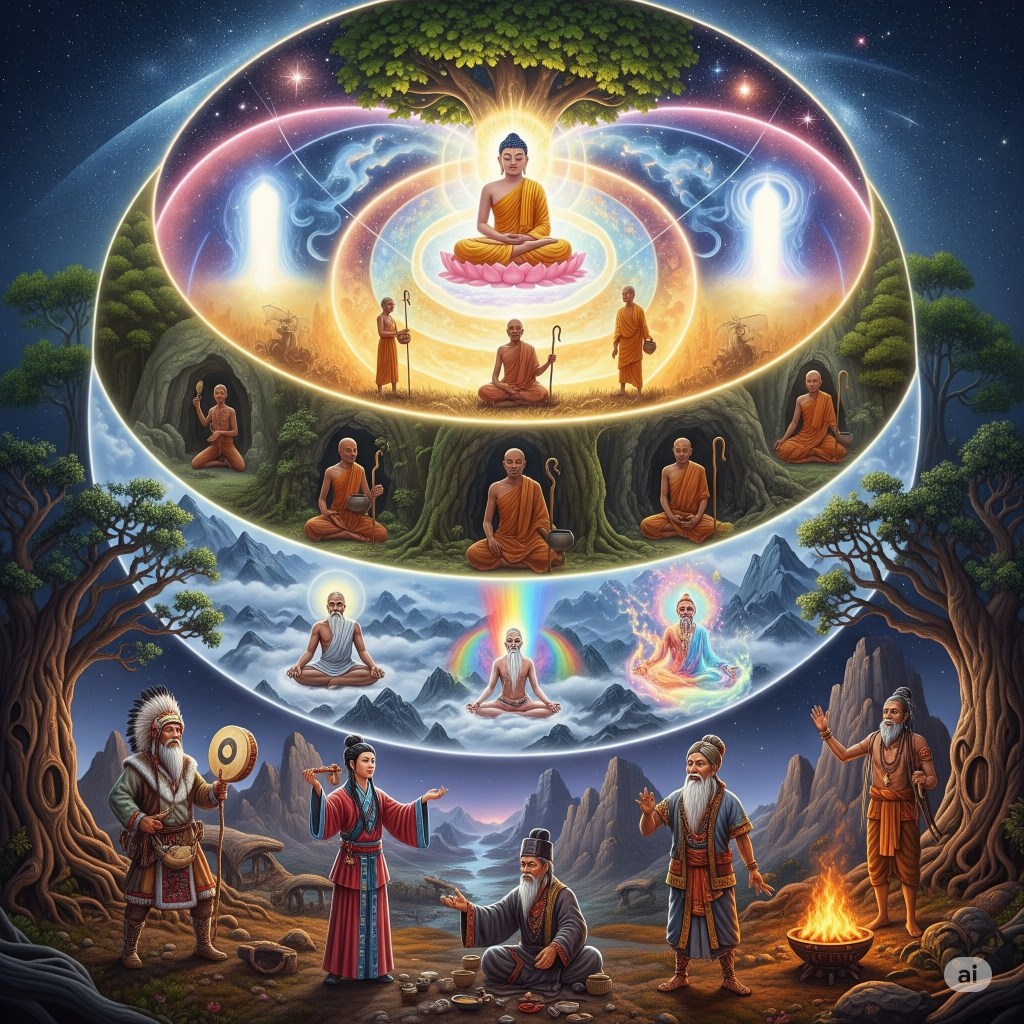
This current is what we might call, in modern comparative terms, the Shamanic Tradition. Across the world — from Siberia to Africa, from the Americas to Europe, from Daoist China to Vedic India — we find strikingly similar practices, visions, and aspirations. Long before temples and priesthoods, long before dogmas and scriptures, human beings sought to break through the veil of ordinary existence, to commune with spirits and gods, to transcend mortality, and even to transform themselves into immortal, luminous beings.
If we understand the Śramaṇas within this wider human horizon, we can see them as the Indian expression of humanity’s most ancient spiritual quest. And in this context, the Buddha himself appears as both heir to this shamanic current and its radical transformer, pointing to a liberation beyond even the immortality and higher realms sought by shamans and yogis alike.
The Primordial Shamanic Current
The word “shaman” originates from Siberia, but the phenomenon it names is universal. All over the world, the earliest human societies produced figures who could enter altered states of consciousness, communicate with spirits, heal, guide, and cross between worlds. What we now call “shamanism” is not a single religion but a pattern of human spirituality that seems as old as humanity itself.
Common Features
Despite vast geographical distances, shamanic traditions share certain features:
- Altered states of consciousness: induced by drumming, chanting, fasting, dance, breath control, or natural substances.
- Journeying between worlds: ascent to celestial realms, descent to underworlds, exploration of parallel dimensions.
- Communion with beings beyond the human: spirits, ancestors, gods, devas, or elemental forces.
- Transformation of the self: acquiring animal powers, becoming radiant or immortal, dissolving the ordinary body.
- The quest for transcendence: moving beyond the limitations of ordinary human life, especially death.
Global Expressions
- Wuism (China): the ancient Chinese wu (巫) were ecstatic mediums who ascended to the heavens, mediated between humans and spirits, and guided souls.
- Northern European seers (Seiðr, runes): chanting, ecstatic states, communication with divine beings, journeys to other worlds.
- Voodoo and Afro-Caribbean traditions: possession by divine beings, healing, and ancestral communion.
- Daoist immortals: practitioners of inner alchemy, breath, and meditation who sought to refine the body into an immortal, luminous state.
- Indian Ṛṣis and Yogis: seers who “saw” the Vedic hymns, practiced austerities and meditation, and sought liberation (mokṣa).
- Tibetan Dzogchen: the rainbow body tradition, where advanced practitioners dissolve their bodies into light at death.
Across these traditions, the central aspiration is the same: to break free of human limitation, to transcend mortality, and to attain a higher, divine, or immortal state of being.
Śramaṇas in Ancient India: Part of the Same Stream
In the fertile Ganges Valley around the 6th century BCE, Indian society was undergoing dramatic change. The Vedic ritual system, with its Brahmin priests and sacrifices to the gods, was dominant — but it was not unchallenged. A new class of seekers arose: the Śramaṇas (“strivers,” “renunciants”).
These were men and women who renounced society, wandering homeless, begging for food, and dedicating their lives to meditation, austerities, and the search for liberation. They rejected the authority of the Vedas and the Brahmins, denied the salvific power of sacrifice, and sought direct experience of truth.
Śramaṇa Practices
Much like shamans elsewhere, the Śramaṇas cultivated practices of transformation:
- Ascetic austerities: fasting, nudity, exposure to heat or cold, standing for long periods — all aimed at transcending bodily limitations.
- Meditation and altered states: training the mind to enter profound absorptions (samādhi) that lifted the practitioner out of ordinary reality.
- Cosmic journeys: some traditions described ascents to higher realms of existence or communion with gods through meditation.
- Pursuit of superhuman powers (iddhi): walking on water, flying through the air, recalling past lives, seeing future events.
Śramaṇa Goals
Their goals mirrored the wider shamanic tradition:
- To become Ṛṣis (seers) with direct vision of higher truths.
- To attain immortality, release from rebirth, or entry into celestial worlds.
- To develop superhuman abilities, transcending ordinary human limitations.
Thus, the Śramaṇas of India can be seen as the Indian branch of the global shamanic stream — heirs of a primordial tradition of transcendence, adapted to their cultural setting.
Shamanic Aspirations: The Quest for Immortality
At the heart of this current is the quest to overcome death.
- In India, the Ṛṣis were seers who gained divine vision, often through austerities and meditation. They were said to access realms of the gods and to acquire supernatural powers.
- In China, the Daoist Immortals practiced alchemy and meditation to refine their bodies into pure light, transcending aging and death.
- In Tibet, Dzogchen masters aimed for the rainbow body, where the physical body dissolves into light at death, leaving only hair and nails.
- In Siberia and the Americas, shamans journeyed to the spirit world, died and were reborn, and returned with new powers.
The common conviction: the human being is not limited to this fragile body. With the right practices, one could cross into higher dimensions, become divine, or even escape death.
The Śramaṇas fully embodied this aspiration. Their renunciations and meditations were part of this global human quest: the dream of becoming immortal, luminous, free of death.
The Buddha: Fulfillment and Transcendence
Siddhattha Gotama was born into this world of competing visions. As a young man, he encountered the “four sights”: old age, sickness, death, and a wandering ascetic. Struck by the inevitability of decay and death, he renounced his princely life to seek liberation.
He first studied with Śramaṇa teachers such as Āḷāra Kālāma and Uddaka Rāmaputta, who taught him meditative absorptions leading to exalted realms of existence. He mastered these states, but found them unsatisfactory. He then practiced extreme austerities, nearly starving himself to death — but realized that self-torment was no path to liberation.
Finally, seated under the Bodhi tree, he discovered the Middle Way: not indulgence, not torment, but a direct penetration into the nature of existence.
His awakening was a radical redefinition of the spiritual quest. Where other Śramaṇas and shamans sought to become immortal, divine, or superhuman, the Buddha realized that even gods, immortals, and subtle realms are impermanent, conditioned, subject to arising and passing away.
Nibbāna, the unconditioned, is beyond all of these. It is not immortality within the cycle, but liberation from the cycle itself.
Thus, the Buddha both fulfilled the shamanic aspiration — attaining superhuman powers, transcending ordinary reality — and transcended it, pointing beyond even divinity to the unconditioned Nibbāna-dhātu, the deathless beyond death.
The Legacy of the Shamanic Current in Buddhism
Buddhism retains many marks of its shamanic heritage:
- The Buddha himself was described as possessing psychic powers (iddhi).
- Meditation practices open gateways to altered states, visions, and cosmic journeys.
- The Saṅgha preserved renunciation and wandering asceticism.
But Buddhism transformed the current:
- From immortality to liberation.
- From becoming more (a god, immortal, light-body) to becoming free (ending the delusion of self).
- From striving for eternal existence to peace in the cessation of all conditions.
In this sense, Buddhism is the culmination of the shamanic current — carrying humanity’s most ancient quest beyond immortality into the ultimate freedom.
Conclusion: Śramaṇa and Shamanism as Humanity’s Primordial Quest
When we view the Śramaṇas not only as a historical Indian movement but as part of a primordial global stream, we see Buddhism in a new light. The Śramaṇas were the Indian expression of humanity’s oldest spiritual impulse: to transcend mortality, to become luminous, immortal, free.
The Buddha entered this current, mastered its practices, and then revealed a truth beyond even its highest aspirations: the unconditioned realm of Nibbāna, the end of birth and death.
To see Śramaṇas as Shamans is to recognize that Buddhism did not arise in isolation. It was the flowering of humanity’s most ancient spiritual quest, brought to fulfillment and transcendence by the Buddha.
In this way, Buddhism is not just one religion among many. It is the final horizon of the shamanic current itself — the doorway not merely to higher dimensions, but to the end of all dimensions, to the deathless, the unconditioned, the ultimate peace.
 Gautama Dhamma
Leave a comment