
Order Theory, Aging and Death, and Gautama Buddha’s Solution
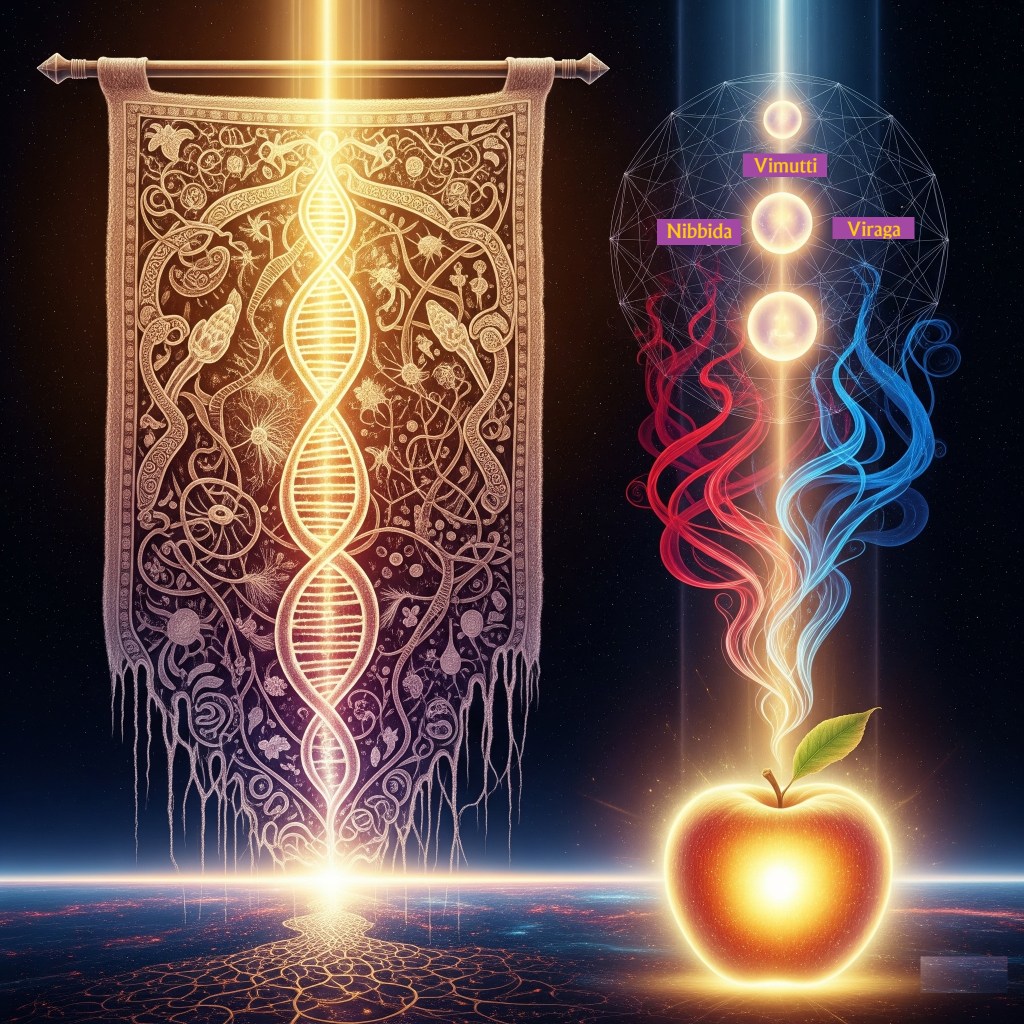
This essay advances a unifying lens: life is order—the ongoing creation and maintenance of structured patterns of matter, energy, and information against entropy. Aging is the gradual erosion of that order; death is its collapse. As Newton explained a falling apple by discovering a law (gravity), the Buddha explained the universal fall of beings into aging and death by discerning a lawlike regularity in the conditioned world and a counter-method for escape. His response is radical: withdrawal from the world’s flux via nibbidā (disenchantment), virāga (dispassion), and vimutti (liberation), culminating in entry into the deathless Nibbāna-dhātu—the deathless realm of Nibbāna. We then show how aligning our motive with the Buddha’s motive and our method with his method inclines the practitioner toward gotrabhu-ñāṇa, the “change of lineage” into the Gautama lineage. Key scientific references include Schrödinger’s negentropy and the modern “hallmarks of aging”; canonical references include the Nagara Sutta (SN 12.65) and Itivuttaka 44 on the two Nibbāna states.
1. The Apple and the Corpse: Two Minds Confront a Universal Fall
Refusing mere description is the common courage of Newton and the Gautama Buddha as a Bodhisatta. Apples don’t “just fall”; they fall lawfully, and once the law is known, we can work with it—even achieve flight. Likewise, in SN 12.65 (Nagara Sutta), the Gautama Buddha as a Bodhisatta, contemplating age, sickness, and death, refuses fatalism: “Oh, when will an escape be found from this suffering, from old age and death?” This is a demand for knowledge of escape, not stoic resignation.
Key analogy
- Newton: Falling bodies obey gravity; flight requires engineering that works with gravity (lift, thrust, drag, mass).
- Buddha: Worldly conditioned life tends toward aging-and-death; liberation requires training that works with conditionality, to uncondition the conditioned — thus not by beautifying the world, but by withdrawing the fuel that binds us to the world.
2. Order Theory: A Clear Lens for Life, Aging, and Death
2.1 Life as Order (Negentropy)
Life, in its most essential nature, is the triumph of order over chaos. Against the universal tide of entropy—the tendency of energy to disperse and structures to dissolve—living beings hold together improbable patterns, maintain delicate balances, and even generate higher levels of coherence. From the double helix of DNA to the symphonies of ecosystems, life is the ceaseless weaving of complexity, a luminous tapestry continually renewed against the backdrop of disorder.
The Principle of Negentropy
Erwin Schrödinger, in his 1944 classic What is Life?, observed that organisms survive by “feeding on negative entropy”—that is, by importing energy and exporting disorder. Later thermodynamics clarified this as the continuous inflow of free energy: sunlight for plants, food for animals, nutrients for cells. Without this energy, the exquisitely ordered structures of life would rapidly collapse back into randomness. Life is thus not a static thing but a dynamic process of resisting decay, maintaining improbable order moment by moment.
Every breath we take, every heartbeat, every neural pulse is a small act of negentropy. A cell’s molecular machinery tirelessly repairs DNA, pumps ions, assembles proteins, and removes waste—each process a thread reinforcing the pattern of life. To live is to be a pattern of order continuously sustained against entropy’s pull.
Life Maintains Order
At the cellular level, this order is astonishing. Proteins fold into precise shapes, enzymes catalyze with breathtaking specificity, membranes regulate flows with exquisite selectivity. Such order is fragile yet tenacious, preserved by continuous energy throughput. At the organismal level, organs synchronize their rhythms, homeostasis stabilizes temperature and chemistry, and immune systems defend against invasion—all expressions of order maintenance.
Buddhist thought parallels this insight in the doctrine of idappaccayatā (specific conditionality): phenomena arise and persist only when the right conditions sustain them. Life’s order is not arbitrary but conditioned, a fragile balance of causes that must be continuously tended. Anicca (impermanence) reminds us that this order is never permanent; it must be renewed moment by moment.
Life Creates More Order
Life does not merely preserve itself; it generates new forms of order. From single cells emerged multicellular organisms; from organisms, societies; from societies, cultures and knowledge systems. Evolution, in this sense, is the universe’s way of exploring more stable and more elaborate configurations of order. Where matter alone tends toward entropy, life creates islands of increasing complexity, and through consciousness, even self-reflective awareness of order itself.
From the Buddhist perspective, this creative tendency can be seen as dhamma-niyāma—the lawfulness of phenomena unfolding toward greater refinement, culminating in the possibility of liberation. The arising of wisdom (paññā) is not merely another layer of biological order, but a transcendence of the conditioned world itself. If life as order is the resistance of chaos, wisdom is the step beyond all order and disorder—into the unconditioned (asaṅkhata).
Life Evolves the Universe from Chaos to Order
Cosmologically, the universe began in near-perfect chaos: a homogeneous plasma, undifferentiated and turbulent. Over billions of years, order emerged—atoms, stars, planets, ecosystems, minds. Life is the apex of this ordering tendency, a mirror in which the cosmos reflects upon itself. Every organism is thus a local node of universal evolution, a small agent through which the universe experiments in creating more order.
Metaphorically, life is a luminous tapestry stretched across the void. Each thread is a metabolic process, each knot a genetic code, each motif an ecological niche. Together they form resilient patterns that hold back the encroaching tide of entropy. The darkness of disorder presses constantly against the fabric, but the living weave persists, shimmering with improbable coherence.
Toward Transcendence
Yet, Buddhism teaches that even this magnificent order remains within saṃsāra, bound by impermanence. Life’s order, no matter how intricate, eventually succumbs to entropy—cells age, organisms die, civilizations collapse, even stars burn out. The deepest liberation does not lie in clinging to order, but in realizing the unconditioned beyond both order and chaos. Still, to recognize life as order is to honor its profound role: it is the bridge by which the universe ascends from chaos toward coherence, and the stepping stone by which consciousness may transcend into Nibbāna-dhātu, where even the duality of order and disorder falls away.
2.2 Aging as Loss of Order
Modern biogerontology enumerates systemic degradations—genomic instability, telomere attrition, epigenetic drift, loss of proteostasis, nutrient-sensing dysregulation, mitochondrial dysfunction, cellular senescence, stem-cell exhaustion, altered intercellular communication—each a way the tapestry’s weave thins and frays.
2.3 Death as Collapse of Order
Death is when structure can no longer be sustained; energy-information cycles fail, patterns disintegrate into noise, and constituents return to less ordered states. In this lens, aging and death are lawful dissolutions of order, not mysteries.
3. Aging-and-Death as a Solvable Problem
Newton did not abolish gravity; he out-engineered it. The Buddha did not abolish conditionality; he out-understood it. The practical move is removing conditions, not conjuring “anti-suffering.”
Fire metaphor: A blaze ceases when fuel, oxygen, and heat are withdrawn; likewise, suffering ceases when its conditions are not supplied—culminating in virāga and vimutti. (For readers who want canonical framing of the “deathless element,” see Itivuttaka 44 on the two Nibbāna elements.)
Life maintains order locally, and yet every being is drawn inexorably back into the flux of saṃsāra. Why? The Buddha identified three fundamental forces that anchor consciousness to the conditioned world: rāga, dosa, and moha—craving, aversion, and delusion.
- Rāga (Attachment): This is the gravitational pull of the world. Through the five senses, the mind encounters sights, sounds, smells, tastes, and tactile sensations. Attachment arises naturally: pleasure is pursued, comfort sought, beauty clung to. Life as negentropy works within the system, but rāga biases the energy of consciousness toward accumulation and consumption rather than transcendence. It is the law of liking, keeping the mind tethered to the objects of the world.
- Dosa (Aversion / Negative Emotions): Dosa is the turbulence that unravels mental order. Trauma, anger, fear, jealousy, and resentment inject chaotic energy into the system. Emotion, untrained, acts like uncontrolled atmospheric currents, eroding the stability of life’s tapestry. While life builds and maintains order physically, dosa destabilizes consciousness, pulling it back into cycles of reactivity, which in turn perpetuate saṃsāra.
- Moha (Delusion / Ignorance): Moha is the structural blindness that prevents the mind from seeing the ultimate lawfulness of reality. At the deepest level, moha is not knowing Gautama Buddha’s liberation path: the existence of Nibbāna-dhātu, the deathless realm outside the world and universe. Even if order is maintained locally, moha ensures that the mind remains invested in temporal, conditioned phenomena, unaware that a total escape is possible.
Metaphor: Imagine a spacecraft orbiting a planet. Rāga is the gravity holding it near the surface, dosa is turbulence in the atmosphere, and moha is the pilot’s blindness to the trajectory beyond the stratosphere. Without counter-forces, escape is impossible.
As recorded in the Nagara Sutta (SN 12.65), the Bodhisatta recognized this entanglement:
“Alas, this world surely is unsatisfactory, in it everything is born, ages, and dies, yet there is no knowledge to escape from this unsatisfactoriness of aging-and-death. Surely there must exist the knowledge to escape…”
Here the Buddha identifies the problem precisely: beings are bound to the flux by the three poisons. Recognizing the lawfulness of this entrapment is the first step toward liberation.
3.1 Three Counter-Forces: Nibbidā, Virāga, Vimutti
Newton did more than explain falling—he made trajectory engineerable. Likewise, the Buddha did more than explain suffering—he made freedom practicable. In Nagara Sutta, the search is explicit: a knowable escape from aging-and-death. The Buddha’s answer is not “more refined order” within the flux, but withdrawal from the flux through nibbidā → virāga → vimutti, culminating in the Nibbāna-dhātu.
If rāga, dosa, and moha are the forces pulling the mind into the world, the Buddha presents three counter-forces that allow withdrawal from saṃsāra: nibbidā, virāga, and vimutti.
- Nibbidā (Disenchantment): The recognition that attachment and aversion cannot satisfy leads to disenchantment. One sees clearly that sensory experiences, material accumulation, and even emotional highs are temporary and unsatisfactory. Nibbidā weakens rāga by dissolving desire for the world’s pleasures.
- Virāga (Fading of Passion / Dispassion): Disenchantment is refined into virāga, the cooling of craving and aversion. Like reducing fuel in a fire, the mind gradually ceases to feed the flames of attachment and emotional turbulence. Virāga counteracts dosa, stabilizing mental order and clearing the way for higher realization.
- Vimutti (Liberation / Freedom of Mind): The culmination of the practice is vimutti, liberation of consciousness from all conditioned entanglements. Moha is removed—the mind knows the Nibbāna-dhātu, the deathless realm, and is no longer constrained by the structural pull of ignorance. Vimutti is the successful execution of the escape trajectory: consciousness transcends the gravitational field of saṃsāra entirely.
Metaphor: Returning to our spacecraft, nibbidā is recognizing the pull of gravity and disengaging from planetary attractions, virāga is throttling engines and shedding residual mass, and vimutti is the moment the spacecraft crosses the Kármán line—no longer bound to the planet, free to travel in unconditioned space.
Thus, the Buddha’s insight is not merely theoretical: he provides an engineerable method for escape from the universal “law” of aging-and-death. The three counter-forces operate in practice through the Eightfold Path, with each element—virtue, mindfulness, concentration, and wisdom—directly supporting the weakening of rāga, dosa, and moha.
Sutta Reference: In MN 36 (Mahāsatipaṭṭhāna Sutta), the Buddha illustrates that through mindful observation (sati) of body, feelings, mind, and phenomena, one progressively sees the arising and passing of all conditioned states, cultivating nibbidā, virāga, and eventually attaining vimutti.
3.2 Engineering the Escape: The Eightfold Path as Counter-Gravity
Just as Newtonian physics allows engineers to work with gravity to achieve flight, the Buddha presents a practical, systematic method to work with the laws of mental entanglement—rāga, dosa, and moha—so that liberation becomes achievable. The Eightfold Path functions as the launch vehicle for consciousness: each element strengthens the mind’s capacity to withdraw from the world, resist chaos, and transcend into Nibbāna-dhātu.
1). Sīla (Virtue / Ethical Conduct)
- Counter-force target: Rāga and Dosa
- Mechanism: Ethical restraint stabilizes the mind, reducing turbulence from attachment and aversion. Precepts act as boundary conditions, limiting behaviors that reinforce craving or resentment.
- Order analogy: Sīla forms the structural framework of the launch vehicle—the airframe. Without it, the craft is unstable and cannot withstand gravitational forces.
2). Sammā-sati (Right Mindfulness), emphasizing Kāyagatāsati
- Counter-force target: Rāga, Dosa, Moha
- Mechanism: Mindfulness anchors attention at the interface of mind and world, body and mind, conscious and subconscious. By observing sensations, thoughts, and emotions non-reactively, the practitioner sees clearly how attachment and aversion arise, and how ignorance obscures reality.
- Order analogy: Mindfulness acts as guidance and navigation systems—tracking the craft’s position relative to gravitational pull, detecting turbulence, and charting the escape trajectory.
3). Samādhi (Concentration / Mental Cohesion)
- Counter-force target: Dosa and Moha
- Mechanism: Unified attention organizes the mind’s energy into coherent patterns. Emotional turbulence is stabilized; insight into impermanence and unsatisfactoriness deepens. Samādhi amplifies mental negentropy, increasing the mind’s resilience against entangling forces.
- Order analogy: Samādhi provides thrust—the engine that drives the spacecraft upward. Energy is harnessed efficiently, enabling lift-off from the planetary pull of saṃsāra.
4). Paññā (Wisdom / Insight)
- Counter-force target: Moha
- Mechanism: Insight perceives the lawfulness of conditioned phenomena and the possibility of cessation. The practitioner sees that aging-and-death, suffering, and rebirth are lawful, knowable, and thus avoidable with proper understanding.
- Order analogy: Paññā serves as the trajectory computer—calculating the optimal path to escape, ensuring that energy is directed not wasted on futile attachment.
Integration: The Path as Dynamic Negentropy
Together, these elements transmute chaotic forces into structured energy:
- Emotional turbulence (dosa) is redirected via metta, karuṇā, and equanimity.
- Craving (rāga) is cooled through nibbidā and virāga cultivated by ethical restraint and mindfulness.
- Ignorance and delusion (moha) is illuminated by insight, allowing consciousness to rise above the limitations of conditioned perception.
Metaphorically: If rāga, dosa, and moha are the gravitational pull of the world, then the Eightfold Path is the engineered launch system. Sīla is the airframe, mindfulness the guidance and stabilization system, samādhi the thrust, and paññā the calculated escape trajectory. Applied correctly, these counter-forces bring consciousness to vimutti—the free, unconditioned realm of Nibbāna-dhātu, where the mind is no longer constrained by the “gravity” of craving, aversion, and delusion.
Sutta Correlation
- MN 36 (Mahāsatipaṭṭhāna Sutta): Mindfulness and insight systematically weaken attachment, aversion, and delusion.
- DN 22 (Mahāsatipaṭṭhāna Sutta): Ethical conduct and mindfulness maintain order in the practitioner’s mind-body system.
- SN 12.65 (Nagara Sutta): The Buddha articulates the knowable, practicable escape from aging-and-death.
In this framework, the practitioner literally engineers liberation. The law of raga, dosa, moha is real—like gravity—but the path is scientifically precise: work with the law, don’t fight it blindly, and escape is achievable.
3.3 The Sequential Emergence: Nibbidā → Virāga → Vimutti
Through systematic engagement with the Buddha’s path—ethical conduct, mindfulness, concentration, and insight—the three stages of liberation unfold, each addressing the entangling forces of raga, dosa, and moha in a functional, cumulative way.
Stage 1: Nibbidā (Disenchantment) – Stopping New Entanglement
- Mechanism: Nibbidā functions primarily to prevent new raga, dosa, and moha from arising. By cultivating ethical conduct (sīla) and mindfulness (sati), the practitioner interrupts the flow of fresh attachments and aversions generated by sensory contact in daily life. Awareness sees craving, aversion, and delusion at their inception, halting them before they take hold.
- Order perspective: Nibbidā stabilizes the mind’s negentropy by stopping entropy from entering via the five senses. The system no longer imports new disorder.
- Metaphor: Imagine a water filter that blocks pollutants before they enter a reservoir; nibbidā prevents fresh contamination of the mind’s order-tapestry.
Stage 2: Virāga (Dispassion) – Purging Accumulated Entanglement
- Mechanism: Virāga addresses existing raga, dosa, and moha—the residual karmic imprints accumulated from past conditioning. Through meditation, reflection, and insight, these ingrained patterns gradually dissolve. Emotional turbulence calms; cravings fade; aversions release.
- Order perspective: Virāga restores integrity to the mind’s internal system by purging historical chaos, reorganizing energy into coherent patterns that maintain stability.
- Metaphor: Like cleaning a cluttered library, virāga removes old disordered volumes, allowing the mind’s archives to function efficiently, free from outdated reactivity.
Stage 3: Vimutti (Liberation) – Transcending the World
- Mechanism: With both new and accumulated raga, dosa, moha curtailed, the mind becomes capable of transcending conditioned existence. Samādhi consolidates attention and elevates consciousness to higher dimensions, creating the experiential leverage to exit the confines of the three-dimensional world and enter Nibbāna-dhātu.
- Order perspective: Vimutti is the full negentropic ascent: the mind’s energy is now coherent and self-sustaining, lifted beyond local entropy. The system no longer interacts destructively with the world’s flux; it escapes the universal law of aging-and-death.
- Metaphor: Imagine a spacecraft ascending beyond planetary gravity: fuel is managed, thrust is directed, guidance is precise. Samādhi functions as the engine that elevates consciousness, enabling the exit from the gravitational pull of the world.
Integration with Gotrabhu-Ñāṇa
This sequence marks the threshold of lineage transformation: gotrabhu-ñāṇa. At this juncture, the mind irreversibly shifts from the puthujjana consciousness lineage to the Gautama (ariya) consciousness lineage.
- Metaphor: Just as a spacecraft that clears the atmosphere is no longer bound by terrestrial physics, the practitioner’s mind, having stopped new entanglement (nibbidā), purged old karmic residues (virāga), and elevated through samādhi (vimutti), is liberated from the gravitational pull of craving, aversion, and delusion.
Sutta Correlation
- SN 12.65 (Nagara Sutta): Recognizes the knowable escape from aging-and-death.
- MN 36 (Mahāsatipaṭṭhāna Sutta): Mindfulness weakens the three poisons, leading sequentially to nibbidā and virāga.
- DN 16 (Mahāparinibbāna Sutta): Liberation (vimutti) culminates in exit from saṃsāra, fully accessing Nibbāna-dhātu.
Metaphorically, the practitioner’s path is a carefully engineered ascent:
- Nibbidā = stop fresh “pollutants” from entering the system.
- Virāga = cleanse accumulated chaos.
- Vimutti = elevate the system beyond worldly constraints to the deathless, unconditioned realm.
4. Practice Architecture: Turning Theory into Trajectory
- Right Understanding of the Buddha’s Solution
Adopt a scientific attitude: if aging-and-death are lawful, escape—if real—must also be a lawful orientation and with the goal to uproot rāga, dosa, moha to reach Nibbāna-dhātu.) - Stabilize the Vehicle (Sīla + Sense Restraint)
Ethical precepts and restraint reduce turbulence that would scatter attention. - Mindfulness Directed to the Body (Kāyagatāsati)
Anchor in breath, posture, pressure, heartbeat—the contact interfaces where reactivity begins; progressively refine from outer senses to subtler consciousness as Theravada tradition teaches. - Samādhi (Unification of Mind)
Build coherent power (the mind’s lift capacity). - Vipassanā (Diagnostic Seeing)
Identify and disengage the conversion of feeling → craving; cool the system toward virāga. - Wisdom Themes
Sustain the view: the aim is not better fabric within samsāra, but withdrawal into the deathless realm of Nibbana. - Fruition
Withdrawal, escape from the world’s cycle, change of lineage (Gotrabhu) into the Gautama line, and participation in the Nibbāna-dhātu. (See Itivuttaka 44 for canonical language on the deathless element.)
If life is understood as negentropy—a continuous effort to maintain and build structured patterns of matter, energy, and consciousness—then the Buddha’s path provides a practical methodology for preserving internal order and ultimately transcending the universe’s entropic pull. Through ethical, mindful, and contemplative cultivation, the practitioner reinforces mental and physical coherence, purges chaos, and elevates consciousness.
4.1 Sīla (Virtue / Ethical Conduct) – Stabilizing Foundations
- Function: Sīla provides the structural integrity of the mind-body system. By adhering to ethical precepts, practitioners prevent unnecessary turbulence from unwholesome actions and karmic consequences.
- Order perspective: Ethical conduct acts like the scaffolding in a building: it maintains the shape of the system, prevents collapse, and allows higher structures (mindfulness, concentration, insight) to be safely developed.
- Example: Restraining from harmful speech, acts, and consumption prevents disturbances to one’s relationships, emotions, and internal energy—analogous to maintaining pressure gradients in a stable ecosystem.
- Metaphor: The airframe of a spacecraft must be rigid and properly aligned before launch; sīla is that airframe for consciousness.
4.2 Kāyagatāsati (Mindfulness Directed to the Body) – Anchoring the System
- Function: Mindfulness stabilizes attention at the interface between internal and external phenomena, detecting the onset of raga, dosa, and moha. By observing sensations, postures, breathing, and heartbeat, the practitioner intercepts chaotic impulses before they destabilize mental order.
- Order perspective: Mindfulness functions like a guidance system, constantly calibrating the mind’s trajectory, ensuring stability, and preventing disorder from accumulating.
- Example: Observing a rising anger at work, one notices tension in the shoulders and chest, allowing awareness to redirect energy before eruption.
- Metaphor: Mindfulness is the gyroscope and guidance computer on a spacecraft, detecting drift and correcting orientation in real time.
4.3 Samādhi (Concentration / Mental Cohesion) – Cohering Energy
- Function: Samādhi organizes scattered energy, producing coherent, sustained attention. Emotional turbulence (dosa) and scattered desire (raga) are integrated into stable, directed mental power.
- Order perspective: Samādhi converts chaotic, high-energy phenomena into structured, usable energy—akin to electrical power being regulated and routed through circuits rather than dissipating as heat.
- Example: A concentrated mind can remain steady in meditation despite external distractions, maintaining clarity and energy flow.
- Metaphor: Samādhi is the engine providing thrust: energy is focused, coherent, and directed toward escape velocity.
4.4 Paññā (Wisdom / Insight) – Navigating Conditionality
- Function: Insight discerns the patterns and laws of causality, seeing the arising of raga, dosa, and moha, and understanding the possibility of their cessation. Paññā identifies how the universe’s entropic tendencies affect mind and body, and how liberation operates as a lawful, achievable outcome.
- Order perspective: Paññā functions as the trajectory computer, calculating the optimal path to escape the gravitational pull of craving, aversion, and delusion. It ensures that energy is efficiently used, avoiding wasteful oscillations.
- Example: Insight into impermanence allows one to release attachment to wealth or status, stabilizing internal energy and reducing psychic turbulence.
- Metaphor: Paññā is the navigation system that reads cosmic law and adjusts the spacecraft’s trajectory for successful exit.
4.5 Dynamic Integration: Life, Mind, and Liberation
The fourfold practice operates synergistically:
- Sīla stabilizes the structure.
- Kāyagatāsati monitors and calibrates ongoing processes.
- Samādhi concentrates energy and maintains coherence.
- Paññā discerns lawful patterns and guides direction.
Together, they maintain existing order, create additional order, and prepare consciousness for the ultimate exit, paralleling your theory that life itself contributes to evolving the universe from chaos toward order.
- Metaphor: The mind is a spacecraft: sīla builds the frame, mindfulness is guidance, samādhi is thrust, and paññā calculates escape velocity. By operating in concert, the system achieves lift-off, leaving the gravitational pull of aging, death, and samsāra.
4.6 Sutta Correlations
- MN 36 (Mahāsatipaṭṭhāna Sutta): Mindfulness as the stabilizer of mental processes.
- AN 4.194: Purity of body and mind reinforce clarity of perception.
- SN 12.65 (Nagara Sutta): Knowing the lawful escape from aging-and-death validates the system’s operational coherence.
5. Emotion and Intelligence: Harnessing Energy, Guarding Order
Emotion is high-energy, low-structure—like weather moving through the psyche. Left untamed, it accelerates the cycle of reactivity → craving → clinging, eroding stability. Yet, when trained, it becomes fuel for courage, compassion, and steadfastness.
Intelligence, or the faculty of reasoned discernment (paññā-viveka), is the ordering principle. It maps causes and constraints, enabling non-reactive navigation through the storm of conditions. But without energy, intelligence remains inert—like a rudder in still water.
Buddhist integration proceeds step by step:
- Sīla (ethical restraint) stabilizes the valence of emotion, transforming destructive impulses into harmlessness and contentment.
- Mettā and karuṇā transmute raw affect into radiant, expansive energy—compassion without entanglement, love without possession.
- Sati–samādhi (mindfulness and concentration) create the still platform where intelligence functions with precision, undistorted by turbulence.
- Vipassanā (insight) pinpoints the exact conversion point where feeling (vedanā) mutates into craving (taṇhā), halting the cascade before it solidifies into clinging.
The result is not suppression of emotion, nor cold domination by intellect, but the right channelling of energy into order, where both faculties work in harmony to stabilize the system. From that stability, the practitioner can then surpass order itself, stepping beyond all conditioned systems into Nibbāna-dhātu.
Metaphor: Emotion is the wind; intelligence is the rudder and keel. With both in balance, the craft travels not merely through the weather, but beyond the weather altogether.
6. Gotrabhu-Ñāṇa: Changing Lineage into the Gautama Line
In Theravāda analysis, gotrabhu-ñāṇa—“change-of-lineage knowledge”—marks the precise threshold where the mind ceases to be bound by the worldling stream (puthujjana-gotta) and enters the lineage of the Noble Ones (ariya-gotta). It is not yet the supramundane breakthrough, but the decisive turn toward it: the moment when ordinary inheritance bends into the current of the Dhamma.
The Itivuttaka (4.100, Brāhmaṇa Dhamma Yāga Sutta) gives luminous voice to this transformation:
“Bhikkhus, I am a brāhmaṇa, committed to charity, always open-handed, bearing my final body, a healer, a surgeon. You are my rightful children, born of my mouth, born of my Dhamma, created by my Dhamma, heirs in my Dhamma, not in material things.”
(Ahamasmi, bhikkhave, brāhmaṇo yācayogo sadā payatapāṇi antimadehadharo anuttaro bhisakko sallakatto. Tassa me tumhe puttā orasā mukhato jātā dhammajā dhammanimmitā dhammadāyādā, no āmisadāyādā.)
Here the Buddha identifies himself as the supreme physician (bhisakko sallakatto), who removes the dart of craving lodged deep in the heart. His disciples are not heirs of property, but dhammadāyādā—heirs of the Dhamma. To be “born of the mouth” (mukhato jātā) is not a biological birth but a rebirth through his teachings, through resonance with truth, through direct transformation of consciousness.
Bloodline as Consciousness-Lineage
In this light, gotrabhu is not about physical genealogy but about conscious belonging. Bloodline in the physical realm is only the outer expression of a deeper current: the continuity of consciousness. To change bloodline, in the Dhamma sense, is to undergo a radical reorientation of consciousness—from the cycle of conditioned becoming in this world to the stream that flows toward the unconditioned and deathless realm of Nibbana.
Thus, “joining the Gautama lineage” means entering not a family of flesh, but a higher-dimensional consciousness-group. It is to resonate with the Buddha’s motive (the conviction that aging-and-death can be solved) and his method (the gradual path of withdrawal from the world), thereby becoming a true son or daughter of the Tathāgata—not by birth, but by awakening.
The Metaphor of Lineage
Think of gotrabhu-ñāṇa as the craft crossing the Kármán line—the invisible threshold where Earth’s atmosphere gives way to outer space. Below the line, gravity dominates: fuel burns quickly, resistance is constant. Above the line, gravity still exists, but no longer binds in the same way. Movement becomes freer, trajectory sustainable.
So too in the Dhamma: the worldling is bound by the pull of rāga, dosa, moha—craving, aversion, delusion. At the moment of gotrabhu-ñāṇa, the mind rises above this atmosphere. Karmic momentum is still present, but its dominion has been pierced. The being is now oriented toward the infinite, no longer confined to the cyclic.
Resonance as Adoption
To “resonate” with the Buddha’s teaching (dhamma) is to be adopted into his lineage. By aligning one’s heart with the Buddha’s original question—“Surely there must be an escape from this unsatisfactoriness of aging-and-death?” (SN 12.65, Nagara Sutta)—one steps into the same quest, the same solution, the same family.
Thus, gotrabhu-ñāṇa is both a cognitive and existential crossing: the inner declaration, “I am no longer of the worldling line. My bloodline of consciousness now flows with the Buddha. My inheritance is the Dhamma. My kinship is with the unconditioned and deathless realm of Nibbana.”
7. Objections and Clarifications
1). “Isn’t ‘life = order’ just physics?”
Life as order is more than mechanical physics; it is a lens that clarifies aging and death as lawful phenomena. Just as Newton’s laws explain why apples fall, the life-as-order framework explains why the living weave patterns of matter, energy, and information—and why those patterns unravel over time.
Metaphor: Imagine life as a luminous tapestry. Each thread (cell, thought, action) contributes to stable motifs (functions, meaning, coherence). Aging frays threads, death unravels the fabric. Understanding this allows us to see that the Buddha’s solution is not weaving a stronger tapestry, but stepping out of the weaving loom itself—entering the unconditioned realm where threads and loom no longer constrain the mind.
2). “Is this escapism?”
Withdrawal from the world is often misread as avoidance. Yet liberation is law-aligned freedom, not evasion.
Metaphor: Consider orbiting a planet. To escape the pull of gravity is not defiance but precise alignment with physical law. Similarly, liberation is alignment with the ultimate laws of conditionality: the mind moves beyond the pull of craving, aversion, and delusion. It is a conscious exit from the gravity well of samsāra.
3). “Should emotion be suppressed?”
Emotion is chaotic energy, powerful but potentially destabilizing. Suppression is neither necessary nor beneficial. The Buddha’s Path transmutes emotion into a stabilizing and constructive force.
Metaphor: Emotion is wind; intelligence is the rudder and keel. Untamed wind drives the vessel into storms (reactivity, craving, clinging). Guided by mindfulness (sati) and concentration (samādhi), and refined by metta, karuṇā, and upekkhā, emotion becomes a propulsive wind for liberation, steering the craft beyond turbulence rather than letting it capsize.
- Mettā converts attachment into benevolent force.
- Karuṇā converts aversion into empathetic power.
- Upekkhā provides the stable platform for navigation.
- Sati–samādhi coordinates observation and control, allowing intelligence to apply direction effectively.
4). Integration:
Viewed through these lenses, the Buddha’s solution is neither mechanical nor escapist. It is a dynamic harmonization of energy (emotion), structure (order), and awareness (intelligence), enabling the mind to rise above the entropic processes of samsāra. Aging and death are intelligible as dissolutions of order; liberation is law-aligned freedom achieved through skillful resonance with the causal patterns of reality.
Summary Metaphors for Readers’ Intuition:
- The Tapestry: Life maintains order; aging frays threads; death unravels the fabric. Liberation steps off the loom entirely.
- The Fire: Suffering ceases not by fighting it directly, but by withdrawing fuel, heat, and oxygen—conditions that perpetuate the blaze. The Triangle: Remove fuel, oxygen, heat ⇢ fire ends; remove craving, aversion, delusion ⇢ dukkha cools.
- The Launch Vehicle: Sīla = airframe, Sati = guidance, Samādhi = thrust, Paññā = trajectory ⇢ escape velocity from jarāmaraṇa.
- The Wind and Vessel: Emotion is raw wind; intelligence and mindfulness are the rudder and keel, guiding energy safely beyond storms.
- The Lineage Transfer: Gotrabhu = crossing the boundary where gravity no longer binds. Gotrabhu-ñāṇa is crossing the Kármán line—gravity still exists, but its pull no longer constrains; freedom is law-aligned.
8. Conclusion: From Wonder to Method
Newton’s gift was to see law in the fall and to engineer with it.
The Buddha’s gift was to see law in aging-and-death and to engineer freedom from it.
Order Theory clarifies why aging and death are predictable outcomes in conditioned systems. The Buddha clarifies how training—Right View, Right Conduct, Right Meditation, Right Wisdom—opens the path out of conditioned becoming. To understand his motive is to feel his urgency; to adopt his method is to change lineage—the living sense of gotrabhu-ñāṇa, entering the Gautama lineage oriented to Nibbāna-dhātu, the deathless realm.
References & Further Reading (selection)
- Canonical / Classical
- SN 12.65 (Nagara Sutta)—Bodhisatta’s search for escape from aging-and-death.
- Itivuttaka 44—Two Nibbāna elements (with/without residue).
- Nibbidā–Virāga–Vimutti sequence in expository works: Bhikkhu Bodhi, Transcendental Dependent Arising (Upanisa Sutta); analytical treatment with sections on nibbidā, virāga, vimutti.
- Vimutti (encyclopedic overview): Bhikkhu Anālayo.
- Hadaya-vatthu (heart-base) in Theravāda scholasticism.
- Exposition of motive and aim: Gautama Dhamma—Our Practice.
- Science / Philosophy of Life and Aging
- Schrödinger, What is Life?—negentropy/free energy as the sustenance of living order.
- “The Hallmarks of Aging” (Cell, 2013)—nine interlocking degradations that erode biological order.
- Complexity & nonequilibrium life (popular synthesis): how information use and energy dissipation sustain life’s order.
 Gautama Dhamma
Leave a comment