
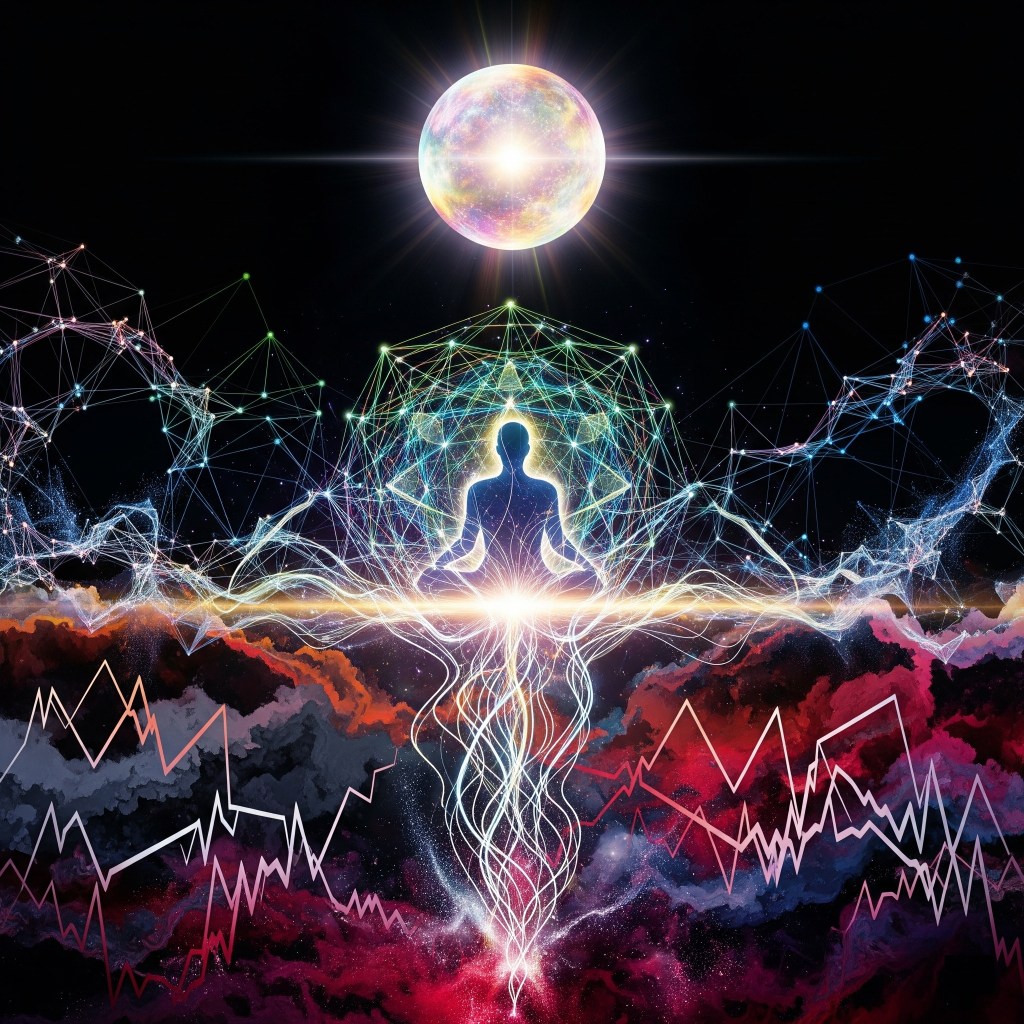
The universe is a dynamic interplay between chaos and order. Life emerges as organized systems resisting entropy, while aging and death mark the inevitable loss of order. Evolution reflects the progressive emergence of complexity from chaos. Emotions are high-energy, chaotic forces, while intelligence and reason impose order. This article critically examines these principles, drawing from biology, philosophy, and Buddhist thought, and highlights how Gautama Buddha’s path offers a means to transcend the limitations imposed by universal entropy, achieving liberation in the unconditioned Nibbāna-dhātu.
1. Introduction
Life is fundamentally order manifesting within chaos. At every scale—from molecules to consciousness—living systems create and sustain patterns that resist entropy. Yet, aging and death demonstrate the fragility of order, while evolution reveals the universe’s capacity to generate ever more complex organized structures. Emotions, intelligence, and consciousness are key forces in this dynamic.
This essay explores how chaos and order shape life, cognition, and spiritual liberation, integrating scientific examples, metaphoric illustrations, and Buddhist philosophy to present a holistic view of existence.
2. Life as Order
2.1 Biological Order
- Living systems maintain structural and functional coherence. DNA sequences precisely encode protein structures; cellular processes regulate energy flows and molecular repair.
- Schrödinger (1944) described life as “feeding on negative entropy,” importing energy to maintain organization.
- Example: The coordinated beating of the heart, regulated by pacemaker cells and nervous input, exemplifies life sustaining order against entropy.
Metaphor: Life is like a network of glowing threads, each strand a cell or organ maintaining harmony against the surrounding darkness of entropy.
2.2 Cognitive and Spiritual Order
- Consciousness integrates brain and heart, combining rational thought with intuitive awareness.
- Mind organizes perceptions, emotions, and concepts into coherent experience, a form of informational and spiritual order.
- In Buddhist thought, a well-ordered mind reflects balance, clarity, and alignment with universal principles.
3. Emotion as Chaos
- Emotions are dynamic, high-energy forces arising from internal states and environmental stimuli.
- They are inherently less structured than cognition, often disrupting internal or external order.
- Example: Fear or anger can trigger physiological responses (elevated heart rate, hormonal surges) that momentarily override the body’s regulatory systems.
Metaphor: Emotion is a storm within the ordered network of life, capable of both destruction and renewal, driving adaptation and evolution.
4. Intelligence and Logic as Order
- Reason, planning, and problem-solving impose structure on chaos.
- Intelligent life maintains internal order, channels emotion, and creates external systems (societies, technology, art).
- Example: Human engineering and medicine stabilize physical and social systems, counteracting entropy locally.
Metaphor: Intelligence is the weaver of threads, organizing the storm of emotion into coherent patterns that sustain and extend life.
5. Evolution: Order Emerging from Chaos
- Evolution illustrates the progressive stabilization of complexity from random variation.
- Mutations introduce chaos; natural selection organizes it into functional systems, producing increasingly complex life forms (López-Otín et al., 2013).
- Example: Single-celled organisms evolved into multicellular life, then into conscious, reflective beings capable of creating and sustaining ordered structures far beyond their original environment.
Metaphor: Evolution is the cosmic sculptor, chiseling order out of the raw material of chaos, generating patterns that persist through time.
6. Aging and Death: Loss of Order
- Aging is the gradual erosion of organized systems: DNA damage accumulates, organ function declines, and cognitive coherence diminishes.
- Death represents complete dissolution, as matter, energy, and information disperse into entropy.
- Buddhist insight frames this as anicca (impermanence): all conditioned phenomena inevitably dissolve (Bhikkhu Bodhi, 2005).
Metaphor: Aging and death are like a sandcastle eroding under the tide, the structures of life gradually washed back into the chaos from which they arose.
7. Liberation: Transcending Order and Chaos
- Gautama Buddha taught that while all conditioned life is subject to entropy, liberation transcends these limitations.
- Through mindfulness (sammā-sati), concentration (samādhi), and wisdom (paññā), consciousness detaches from the conditional systems of body, mind(brain), and ego.
- Liberation (Nibbāna-dhātu): a realm beyond aging, death, and decay, where consciousness exists in unconditioned order.
Metaphor: Liberation is rising above the sandcastle and storm, observing the ebb and flow of chaos and order without being swept away.
8. Integrated Framework
- Chaos → Life: Random energy organizes into stable, living systems.
- Life → Order: Self-sustaining structures maintain coherence against entropy.
- Emotion → Chaos: Dynamic, unpredictable forces driving adaptation and growth.
- Intelligence → Order: Rational faculties channel chaos, maintain internal and external stability.
- Evolution → Progressive Order: Complex systems emerge through selective stabilization of variation.
- Aging/Death → Return to Chaos: Even highly ordered systems ultimately succumb to entropy.
- Liberation → Transcendence: Consciousness exits the cycle, entering unconditioned, eternal order.
9. Conclusion
The universe is a dance between chaos and order. Life, intelligence, and evolution manifest pockets of order, while emotion, aging, and death reveal the pervasive force of entropy. Understanding these dynamics clarifies both scientific and philosophical perspectives and illuminates the spiritual path: Gautama Buddha’s teachings show that freedom from conditioned order and disorder is possible, offering liberation in the timeless Nibbāna-dhātu.
References
- Schrödinger, E. (1944). What is Life? Cambridge University Press.
- López-Otín, C., Blasco, M. A., Partridge, L., Serrano, M., & Kroemer, G. (2013). The hallmarks of aging. Cell, 153(6), 1194–1217.
- Odum, E. P. (2004). Fundamentals of Ecology. Cengage Learning.
- Bhikkhu Bodhi. (2005). In the Buddha’s Words: An Anthology of Discourses from the Pali Canon. Wisdom Publications.
 Gautama Dhamma
Leave a comment