
Exploring the Multidimensional Path of Awakening & Transforming the Subconscious
探索多维存在与潜意识转化的正念之道
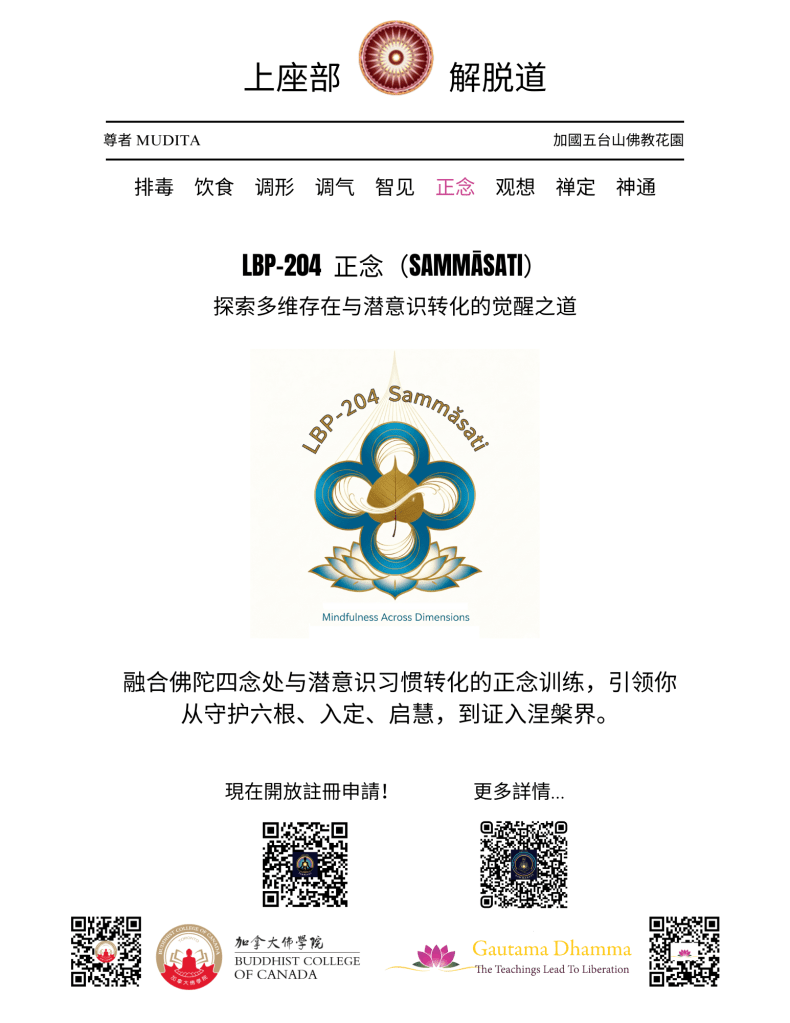
This course dives deeply into the Four Foundations of Mindfulness (Satipaṭṭhāna) as the Buddha’s path to liberation, with special emphasis on Kāyagatāsati — Mindfulness Directed to the Body as the entry point into multidimensional reality and as the key method for transforming habitual thought patterns at the subconscious level.
本课程深入探讨佛陀所开示的解脱之道——四念处(Satipaṭṭhāna),并特别强调身至念(Kāyagatāsati,正念安住于身内)作为进入多维现实的起点,以及作为转化潜意识层面习惯性思维模式的关键方法。
Students will learn to:
- Dwell in body within body, feelings within feelings, mind within mind, and dhammas within dhammas.
- Perceive existence across physical, mental, subconscious, universal consciousness, and transcendent dimensions.
- Recognize and change unwholesome subconscious habits into wholesome ones.
- Progress through the path from sensory restraint → samādhi → insight → Nibbāna-dhātu.
学员将学习:
- 在身中观身、受中观受、心中观心、法中观法。
- 观照存在于物质、心理、潜意识、宇宙意识、超越等不同维度的现实,并从中解脱。
- 识别并转化潜意识中不善的习惯,令其成为善法习惯。
- 依循“守护六根 → 禅定(samādhi)→ 内观智慧 → 涅槃界(Nibbāna-dhātu)”的次第,稳步走向解脱。
By the end of this course, students will:
- Understand the doctrinal depth of Sammāsati in the Noble Eightfold Path.
- Apply Kāyagatāsati to experience the layered structure of existence.
- See the arising and passing away of body, feeling, mind, and dhamma in multiple dimensions.
- Identify habitual subconscious patterns (anusaya, latent tendencies) and intentionally transform them.
- Use mindfulness to dissolve craving (rāga), ill will (dosa), and delusion (moha).
- Make virtue (sīla) and wholesome mind states an automatic subconscious habit.
通过本课程,学员将能够:
- 了解正念(Sammāsati)在八正道中的深刻法义。
- 运用身至念(Kāyagatāsati)直接体证存在的层级结构。
- 在多维度中观照身、受、心、法的生起与灭去。
- 识别潜意识中的习惯性模式(anusaya,潜在倾向)并有意识地加以转化。
- 以正念熄灭贪(rāga)、嗔(dosa)、痴(moha)。
- 令戒德(sīla)与善心所成为潜意识的自动习惯。
Module 1 — The Mindfulness Gateway to Liberation
- Sammāsati in the Noble Eightfold Path.
- Mindfulness as the bridge from moral discipline (sīla) to wisdom (paññā).
- Overview of the multidimensional model of existence: physical, mental, subconscious, universal, transcendent.
模块 1 — 正念通向解脱之门
- 八正道中的正念。
- 正念作为戒(sīla)与慧(paññā)之间的桥梁。
- 多维存在模型概述:物质、心理、潜意识、宇宙、超越。
Module 2 — The Subconscious Mind and Habitual Patterns
- 90% of mental activity is subconscious.
- How habits, emotional imprints, and past-life kamma shape personality.
- Why liberation requires working directly with subconscious tendencies (anusaya).
模块 2 — 潜意识与习惯模式
- 90% 的心理活动属于潜意识运作。
- 习惯、情绪印记与过去世业力如何塑造人格。
- 为什么解脱必须直接处理潜在倾向(anusaya)。
Module 3 — Kāyagatāsati: Entering the Body
- Mindfulness of breathing, postures, and actions.
- Awareness of physical body, energy body, and universal body.
- Using body mindfulness as an anchor to recondition the subconscious.
模块 3 — 身至念:入身之道
- 呼吸、姿势、动作的正念。
- 物质身、能量身与宇宙身的觉察。
- 以身正念作为重新塑造潜意识的锚点。
Module 4 — Habit Awareness in the Body
- How bodily gestures, posture, and reactions express subconscious habits.
- Detecting tension patterns linked to emotional memory.
- Practice: Body scan with habit-awareness journaling.
模块 4 — 身体中的习惯觉察
- 姿态、动作、反应如何反映潜意识习惯。
- 侦测与情绪记忆相关的紧张模式。
- 练习:全身扫描与习惯觉察日记。
Module 5 — Vedanānupassanā: Feeling Awareness
- Observing pleasant, unpleasant, and neutral feelings without reactivity.
- Feelings as the language of the subconscious.
- Practice: Labelling sensations by origin (physical, mental, karmic).
模块 5 — 受随观:感受的觉知
- 观照乐受、苦受、舍受而不生执取。
- 感受是潜意识的语言。
- 练习:按来源标注感受(物理、心理、业力)。
Module 6 — Emotional Habit Transformation
- Identifying habitual emotional loops (fear, anger, craving).
- Substituting wholesome emotional responses.
- Mindfulness-based emotional release techniques.
模块 6 — 情绪习惯的转化
- 识别情绪循环(恐惧、嗔恨、贪欲)。
- 用善法情绪取代不善情绪。
- 基于正念的情绪释放技巧。
Module 7 — Cittānupassanā: Mind in the Mind
- Observing mental states without merging into them.
- Layers of mind: surface thoughts → subconscious impressions → universal consciousness.
- Practice: Watching the watcher (metacognitive mindfulness).
模块 7 — 心随观:观心中的心
- 观照心的状态而不与之融合。
- 心的层次:表层思绪 → 潜意识印痕 → 宇宙意识。
- 练习:观照观察者(元认知正念)。
Module 8 — Thought Pattern Reprogramming
- Recognizing automatic thought loops.
- The Four Right Efforts for thought transformation.
- Turning virtues into subconscious habits.
模块 8 — 思维模式重塑
- 识别自动化思维循环。
- 以“四正勤”转化念头。
- 将德行转化为潜意识习惯。
Module 9 — Dhammānupassanā: Phenomena in Phenomena
- Observing dhammas arising from the mind.
- Conditioned vs. unconditioned dhammas.
- Using awakening factors to displace hindrances.
模块 9 — 法随观:观法中的法
- 观照由心所生的诸法。
- 有为法与无为法的辨识。
- 以觉悟支取代五盖。
Module 10 — Dissolving the False Self Across Dimensions
- Anattā as dismantling the ego-interface.
- How mindfulness severs identification with all dimensions.
- Practice: “Not me, not mine, not I am” meditation.
模块 10 — 跨维度的无我体证
- 五蕴非我(Anattā)即拆解“自我界面”。
- 正念如何切断对一切维度的认同。
- 练习:“非我、非我所、非我存在”的禅修。
Module 11 — From Mindfulness to Samādhi & Psychic Power
- How sensory restraint deepens mindfulness into samādhi.
- Samādhi as a transformative, psychic force beyond the material.
- Practice: Sustained mindfulness leading to measureless mind (appamāṇa citta).
模块 11 — 从正念到禅定与神通力
- 守护六根如何令正念深化为禅定。
- 禅定作为超越物质的心灵力量。
- 练习:持续正念直至无量心(appamāṇa citta)。
Module 12 — Mindfulness as the Gateway to Nibbāna-dhātu
- The progression: nibbidā → virāga → vimutti.
- Abiding in pure awareness without clinging to any dimension.
- Culminating one-hour practice integrating all four foundations and habit transformation.
模块 12 — 正念通向涅槃界
- 次第:出离(nibbidā)→ 离欲(virāga)→ 解脱(vimutti)。
- 安住于不执着任何维度的纯净觉知。
- 终修:一小时整合四念处与习惯转化的禅修。
Practice Components
- Daily Kāyagatāsati Practice — formal sitting, walking, and mindful daily actions.
- Mindful Substitution Drills — replacing unwholesome thoughts with wholesome ones.
- Dimension Mapping Journaling — recording insights at physical, mental, subconscious, universal levels.
- Group Recitation — chanting key sutta passages in Pāli & English.
修学要点
- 每日身至念:坐、行、日常生活中的正念实践。
- 正念替代训练:将不善念替换为善念。
- 多维记录日记:在物质、心理、潜意识、宇宙层面记录洞见。
- 团体诵念:巴利语与英文经典诵读。

 Gautama Dhamma
Leave a comment