
In a previous article, I explored the origins of English words like therapeutic, therapy, and therapist, all stemming from the Greek word therapeutae. This word is linked to a Jewish-Buddhist sect that received teachings from Gautama Buddha in Alexandria, Egypt, courtesy of a Buddhist emissary from India.
I recently came across an article penned by a respected Buddhist monk, which delves into Gautama Buddha’s original teachings as a form of Psychotherapy – a therapy aimed at healing the mind. I have included some excerpts from this article below.
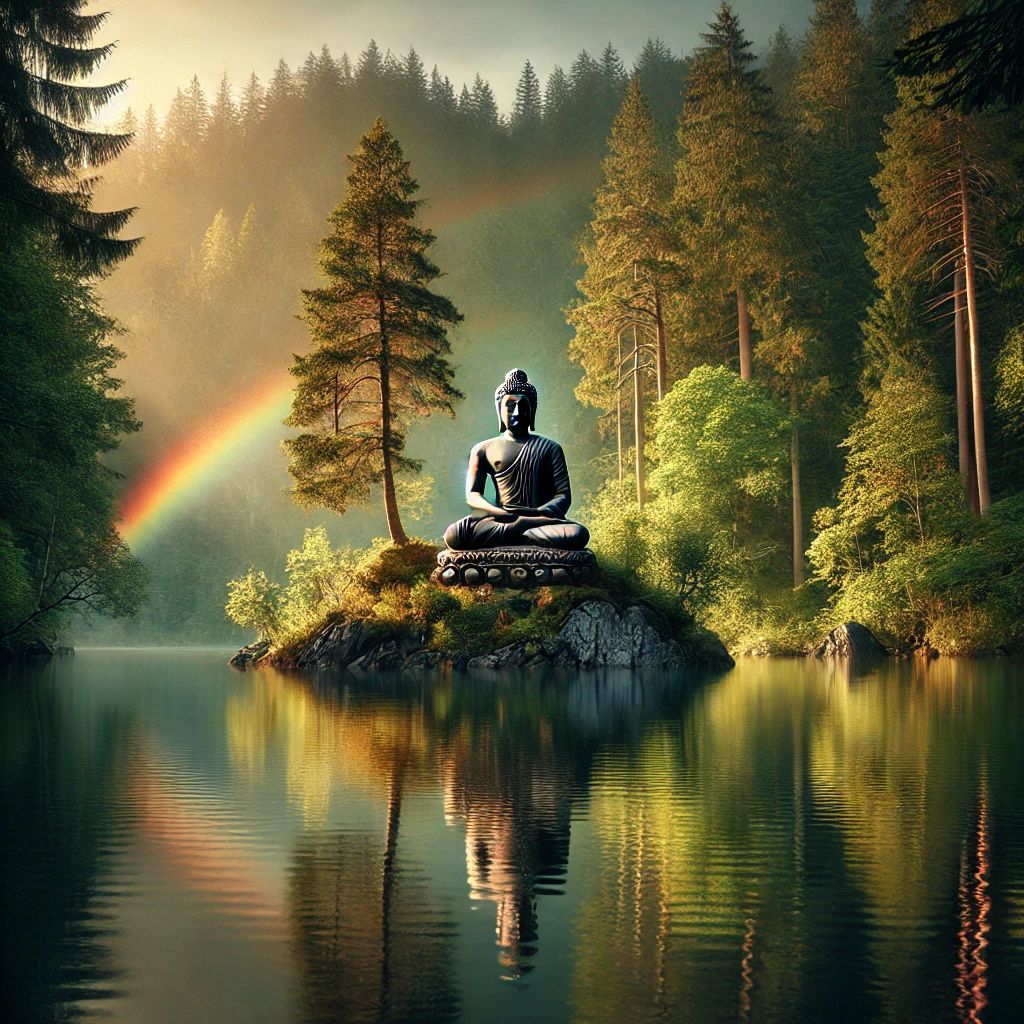
Excerpts from Buddhism as a Psychotherapy
By Late Ven. Dr. Punnaji Mahathera
West End Buddhist Center, Mississauga, Ontario
It is popularly thought today that Buddhism is a religion containing numerous myths, traditions and mystical practices. If we examine the original Buddhism as taught by Gautama the Buddha, we will discover that it is indeed different from this popular view.
In order to clarify this point, let me draw the reader’s attention to the distinction between original Buddhism and modern Buddhist practices and belief. It is important not to confuse modern Buddhism as it is practiced in different cultures and societies with what was taught and practiced by either Theravada or Mahayana, are mainly rituals and ceremonies associated with emotionally held traditional dogmas or world-views and objects of veneration. This type of Buddhism is not different from any other religion with different dogmas, rituals and symbols of worship, which serve mankind only in temporarily reducing the anxieties and worries of life, about the here and hereafter.
Quite distinct from this modern Buddhism is Original Buddhism which was a practical solution to the basic problem of existence which is the anxiety that underlies all our daily concerns, troubles and tribulations. Without understanding this distinction, it is not possible to examine this psychotherapeutic aspect of Buddhism. Therefore, I wish to emphasize at this point that whenever I use the word “Buddhism”, I refer to that original Buddhism and not to any form of modern Buddhism that is practiced by any culture today.
In speaking of the psychotherapeutic aspect of Buddhism, I have presented my position too mildly. I would prefer to say that Buddhism is entirely a psychotherapy. My hesitation in doing so, is because it would be too much of a shock to the devout ethnocentric Buddhist. Yet, I would like to remind those familiar with Buddhism that the Buddha says, in the Anguttara Nikāya, that it may be possible for a person to claim to have been free from physical disease even for a hundred years, but it is not possible for a person to claim to have been free from mental disease even for one day, except for an Arahant or a perfected disciple or a Buddha. It is recognized by all Buddhist scholars that the ultimate aim of the Buddha, according to the Pāḷi Nikāyas, is to produce Arahants. Arahantship was the culmination of the Original Buddhist Practice. If the Arahant is the only person with perfect mental health, the aim of the Buddha was to produce mentally healthy personalities. This means that Buddhism is a psychotherapy or rather the ultimate psychotherapy.
In the Pāḷi Nikāyas, the Buddha was called the “Unsurpassable physician and surgeon” (anuttaro bhiSakko sallakatto) and also the “Unsurpassable trainer of persons” (anuttaro purissa dhamma sarati). Expressed in modern language, these terms may be rendered as “the super psychiatrist” and “the super personality trainer”.
…
The Buddhist psychotherapist, it must be pointed out, does not play the role of a doctor in his therapeutic practice. His role is that of the teacher. His technique of therapy is a process of education. We might even go so far as to say that Buddhism is a form of Ego therapy or cognitive therapy.
Through education, the patient’s sense of reality is improved. The conflict between the Id and the Super Ego as well as that between the Id and reality is resolved through education of the Ego. This education is done first through verbal communication by the use of reason and secondly through the practice of meditation where the patient, or more correctly, the student, is helped to become aware of his experience within, which is observed as physical movements and tensions, feelings and emotions, and as mental images and concepts.
…
In discussing the harmonious practice we come to another aspect of Buddhist therapy which is in line with a different kind of psychological technique from what we have just discussed. The modern psychological technique that falls in line with this practice comes under what is called the Behaviour Therapies. This practice could be described by using terms like desensitization, operant conditioning, and also the learning theory. Buddha regards even mental processes as habits of thought which have been learned and which could be unlearned by consciously stopping their repetition, and constantly practicing wholesome thoughts. What are regarded as wholesome thoughts are those thoughts that are calming. Those that excite the mind and produce tension are regarded as unwholesome.
Buddhism also recognizes that affective mental processes or emotional excitements are rooted in cognitive mental processes, such as the formation of concepts or interpretation of experiences. According to how you interpret the situation, you become emotionally excited or become calm and relaxed. These interpretations that produce excitement are always associated with a “self-concept” or “self-image”. If we carry bad self-images habitually, we become habitually unhappy individuals. By practicing good thoughts we begin to eliminate these bad self-images and cultivate images of calm. The calm mind is able to observe the subjective experience objectively and this brings us to the next step which is the harmonious awareness. In the harmonious awareness, one becomes aware of the subjective experience objectively and by the constant practice of this awareness, one begins to depersonalize the subjective experience. This way the personality perspective (sakkaya ditti) is gradually removed followed by further gradual removal of all thoughts of “I” and “mine”. This gradual depersonalizing process calms the mind further and leads to the experiencing of progressively deeper levels of tranquillity and happiness, leading to the perfection of mental health with the complete eradication of the experience of self within and the rooting out of thirst, and the disappearance of all anxiety for good. This ultimate state of mental health is rarely attained in modern Buddhist practice, but this is the final goal of the Buddhist as taught 2500 years ago.
These principles of Buddhist psychology could be used in the modern world and could be constructively used by modern psychotherapists. Space limitation does not allow me to discuss in detail, in the present essay, the various cases where the Buddha has used these principles in his time. For the same reason, I am unable to discuss here some of the cases in my own experience where I have used these principles. The most important of all is the use of these principles on oneself. I would like to state, in passing, that I have tested in my own experience the validity of these principles.
In discussing the First Sermon of the Buddha called the Revolution of the Wheel of Experience in this way, as the process of transformation of an individual’s personality from an unhealthy one to one of health, I might appear to have strayed away from the Orthodox Theravada, Mahayana or any other Buddhist tradition. But as I pointed out earlier, I am not discussing any form of modern Buddhist standpoint or practice. I am discussing the Original Teaching and Practice of the Buddha as found in the earliest sources recognized by all scholars which do not belong to any modern school of thought. I hope this effort will kindle your interest in exploring further the early teachings of the Buddha. I believe that if modern psychologists make a serious study of these early teachings of the Buddha, it would become a significant turning point and breakthrough in modern psychotherapeutic thought and practice.
Full Article of Buddhism as a Psychotherapy
 Gautama Dhamma
Leave a comment