
The origins of Gnostic Christianity can be traced back to the Therapeutae, a group of Jewish mystics who migrated from Babylon around 300 BC to Alexandria, after the founding of the city by Alexander the Great in 332 B.C. Alexandria then became the cultural capital of the known world. Scholars from all over the world flocked to its university and unique Library. The Jews in Alexandria, a significant portion of the population, utilized Greek as their language due to the city’s status as a hub of trade and culture.
Around 250 BC, this group of Jewish mystics encountered Buddhist missionaries known as Therapeutae, who had arrived from India. These missionaries were were sent by the Third Buddhist Council convened by Emperor Asoka in 250 BCE to spread the teachings of Gautama Buddha which were compiled into what would be known as Theravada,”teachings of the Elders”. Those Buddhist missionaries in Alexandria called themselves Thera-Putta, meaning Sons of the Elders.
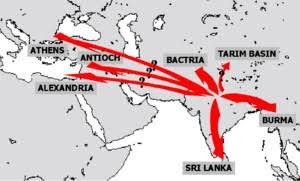
The Jewish mystics learned from the Therapeutae and eventually formed a Jewish-Buddhist sect, which they named Therapeutae, a Hellenized version of Theraputta. This fusion of Jewish and Buddhist teachings became The Essenes’ movement, which laid the groundwork for the development of Gnostic Christianity.
Subsequently, the Essenes returned to Jerusalem and Palestine, eventually evolving into the predecessors of the Gnostics. This shift made Alexandria a focal point for the advancement of Gnosticism. Additionally, the Therapeutae played a pivotal role in shaping the Christian monastic tradition. As evidenced by the modern English terms therapeutic, therapy, therapist, and so forth, their legacy emphasizes healing and spiritual wellness, embodying the concept of being skilled healers for the soul.
In pali sutta, we know Gautama Buddha claimed himself as a healer, a surgeon: “I am a brāhmana, committed to charity, always open-handed, bearing my final body, a healer, a surgeon”. (Itivuttaka 4.100 Brāhmaṇa dhamma yāga sutta)
Upon their return to Palestine, the Essenes, known as a religious sect or brotherhood of Therapeutae, exerted a significant influence on the Essenes residing near the Dead Sea. These individuals eventually became the authors of the Dead Sea Scrolls, which focused on themes of human transformation and ascension into celestial realms. Notably, John the Baptist, who was trained within the Essene community, played a pivotal role in passing on their teachings to Jesus, thus forming an important lineage for the Gnostic Christianity.
The Dead Sea Scrolls were penned between the 3rd century BCE and the 1st century CE, with a core focus on Gnostic beliefs. Similarly, the Nag Hammadi Codices, written around the 4th century, also delve into Gnostic teachings. These texts highlight a pursuit of secret knowledge (gnosis) concerning the divine realm and a longing to withdraw from the material world.
The Gnostics held the belief that every individual possesses a divine spark within them, which inhabits a physical human body in order to navigate this realm. However, they also believed that this divine spark becomes entrapped in this earthly existence. The key to breaking free from this cycle of life on earth is to attain knowledge, enlightenment, or gnosis. Gnosticism centers around the idea of self-realization and the enlightenment of the divine spark within each person. The goal is to liberate oneself from the involuntary reincarnation process, characterized by suffering and amnesia, which is perpetuated by hostile forces.
The Gnostic writings, such as the Dead Sea Scrolls and Nag Hammadi Codices, serve as historical artifacts that offer insights into the original teachings of Gautama Buddha. Amidst the evolution of his teachings in India, Gautama himself foretold that his authentic message would endure for only five centuries. More than that, these texts may shed light on why his initial deep hesitations to share the path to liberation after his enlightenment and how a brahma god intervened to encourage him to teach. In a way, this ancient lineage of wisdom regarding breaking free from the cycle of reincarnation can be traced back to the intervention and intention of the brahma gods.
Reference:
1. Deep Space S2E10 – Alien Origins of Gnosticism
2. The UnXplained S02E07 – Mysteries of the Bible

 Gautama Dhamma
Leave a comment